It’s the fourth and last entry for our “What pours out of a Fawcett” theme week, and begins with a question from me: was the Loch Ness monster ever called the Loch Ness dragon? That’s how it’s referred to in this story from Ibis the Invincible #5 (1946). I don’t remember ever hearing it called that.

The story has Ibis involved in a contest between two men who are fighting over a woman, which he intends to see is conducted fair and square. Yet earlier Ibis didn’t feel a bit bad about abruptly ending an afternoon of fishing with his squeeze, Princess Taia, by using his magical powers to have a fish bite on Taia’s hook. I guess fair play in macho doings is one thing, boredom in the middle of a lake with your girlfriend is another.


The art on the story is credited to Gus Ricca. It’s the first story I’ve ever shown by Ricca, who had some famous covers, including the one above, which was used for Craig Yoe’s great book, Comics About Cartoonists. As far as I know it’s still available, and you don’t need Ibis’ famous Ibistick to get it. Just wiggle your fingers over your keyboard and type in www.yoebooks.com, which will magically take you to a wonderful place where you get it the old-fashioned way, by buying it.


**********

It’s been fun since Number One!


Today is the seventh anniversary of Pappy's Golden Age Comics Blogzine. I usually don’t make anything of this anniversary because every year I usually forget.

You can find old Number One, the first posting from this date in 2006 by clicking on the picture of the stairway corpse above.

I began this blog with the notion that if I could find enough of interest to scan and write about I might do 300 postings. As you can see I’ve done more than 1400, and #1500 will be January 2, 2014, unless, of course, I’m hit by a meteor or otherwise incapacitated.

I want to say how much I’ve appreciated the readers who have stuck with this blog over the years, who have even used it for inspiration to do their own blogs. This is more than a hobby to me. Since 2009 I have had the luxury of retirement from the daily toil of 45 years at various jobs. Now I consider Pappy’s to be my job...and it’s a lot more fun than I’ve had on any other job.

Will I make it another seven years? We’ll take it one post at a time, and hopefully I’ll see you next July 26 on the eighth anniversary.


Writer Tony Bedard follows up his good New 52 Blue Beetle debut with an enjoyable sequel, Blue Beetle Vol. 2: Blue Diamond. The massive eleven-issue trade starts slowly, but picks up steam as it goes along, and if nothing else whet my appetite for the short-lived Threshold series that follows this, Blue Beetle's last collection.

[Review contains spoilers]

The first two chapters of Blue Diamond are the weakest, though they represent well why the book gets stronger from there. In these, Blue Beetle Jaime Reyes has run away to New York so as to keep his scarab powers from further harming his family. There, he encounters a shelter for runaways where new villain Stopwatch uses the runaways to commit crimes. Stopwatch is a rather silly, one-note villain, and despite that the story reflected Jaime's time in New York, it didn't have much to do with him as a character; any number of heroes could have easily fit the same role.

Fortunately, Blue Beetle improves consistently after that. Bedard spends the next couple issues on team-ups, bringing Jaime more fully into the new DC Universe. He meets Green Lantern Kyle Rayner and some of the New Guardians (a team that brings a smile to my face despite myself), runs afoul of Director Bones and the DEO, and then has a dust-up with Booster Gold, which is a nice twist on the old Blue and Gold friendship. These stories each consist of more than just hero versus villain, and also reintroduce Jaime's friends and family to the story.

Having Brenda, Paco, and the rest appear for a couple issues is important, because for the last five issues, Bedard takes Jaime off Earth completely. The transition would be confusing -- Jaime's actual departure takes place in the pages of Justice League International Vol. 2: Breakdown, and there's a bit that ties into Green Lantern: New Guardians, too -- but Bedard makes good use of the Zero Month issue as a primer on the series in general, filling in the gaps from other titles. (An issue of New Guardians was supposed to be collected here, but ultimately was not, probably due to Blue Beetle's cancellation and the number of issues they had to fit into this trade.)

Whereas the first two issues of this collection didn't tie much to Jaime himself, the space adventure is all about Jaime and his scarab; two of his main antagonists, Lady Styx and Sky Witness, are both former hosts of Jaime's scarab. Jaime also re-encounters Khaji-Ka, another scarab who'd been hunting him, now turned ally. The space trip itself is a lot of fun; Bedard puts a bunch of sci-fi cliches to good use with a hijacked space ship and an alien cantina. Though Ig Guara and Marcio Takara handle most of the art duties, Scott McDaniel contributes an issue to the space story; after a disappointing run on Static Shock, McDaniel's art is nicely clear and energetic here.

I appreciated Bedard's Beetle-centric origin for Lady Styx, who in the old DC Universe was just a stock, origin-less space baddie. Throughout the story, Bedard stays true to the core of Jaime Reyes, a well-intentioned teenager thrust into a situation outside his control; I appreciated, for instance, that even though Sky Witness tries to kill him, Jaime still takes pity on Sky Witness and tries to recruit him as an ally later on. Bedard also ends Blue Beetle on just the right note, with a heartfelt message sent across the stars by Jaime to his family; Jaime's family, the core of the series, comes back around at the end.

At first the premise of Threshold, Keith Giffen's new series about a cosmic reality series where Lady Styx hunts the contestants, sounded hokey to me. Between Bedard's Lady Styx origin and his depiction of the show's sensationalism (a nice parallel to the Superfail website that hounds Jaime in the early chapters), I'm a bit more convinced. Blue Diamond ends on a good cliffhanger, and since Giffen and John Rogers wrote the original (and still best) adventures of Blue Beetle, the sole Threshold trade just got bumped a little higher on my list.

Blue Beetle Vol. 2: Blue Diamond is a pretty basic superhero story, nothing to stretch your brain but still plenty entertaining. I give DC points for shoving eleven issues in here without the paper feeling thin nor the covers curling as is sometimes a problem (though there's a lot of text that's difficult to read so close to the spine inside). For, let's say, a long airplane ride or a car trip, Blue Diamond's not a bad book to take along.

[Includes original covers]

Next week, a little Aquaman, a little Star Wars. See you then!
[Continuing Doug Glassman's "Indie-Pendence Month"; Doug also Tumblrs at Hell Yeah '80s Marvel!]

As I mentioned in my review of The Wretch: Everyday Doomsday, Slave Labor Graphics was one of the first small publishers I ever encountered. They tend to put out some of the quirkiest books on the comics market with authors such as Evan Dorkin, Jhonen Vasquez, and Roman Dirge. At points, Jim Rugg and Brian Maruca’s Street Angel Vol. 1: The Princess of Poverty feels out of place amongst the oddities put out by its publishers; it feels like it should have been published by Fantagraphics or another distributor of “serious graphic novels."

Then you get to Evan Dorkin’s introduction and the drawing of the title character fighting a giant squid, and any concept of “serious graphic novel” being applied to Street Angel goes out the window. I wouldn’t call this unevenness of tone a weakness, however. Rugg and Maruca use the five issues of Street Angel to tell an impressive array of stories. We are introduced to Jesse Sanchez, an orphaned homeless pre-teen skateboarding martial-artist vigilante on the mean streets of Wilkesborough, which happen to be her home. She takes on the fearsome geologist Dr. Pangea and his army of cowardly ninjas who seem to have come straight out of the pages of The Tick: The Naked City.

One of the goals of Street Angel is to examine and parody crime-fighting tropes, starting with Jesse’s homeless background. There have been other homeless superheroes, most notably Spawn from Image and Demolition Man from Marvel, but the former is a supernatural creature and the latter is just insane. Jesse is a girl that the rest of the world has forgotten: she has no permanent source of running water and usually skips school to fight crime and scavenge for food. Her school progress report, printed on the interior covers of the book, show both her struggles and how the few adults in her life seem to overlook them.

For the initial stories, the book uses Jesse’s homelessness as a throwaway piece of background information to establish who she is. It’s used to contrast her horrible life with her fights against Incan death cults, time-displaced Spanish pirates, and a dangerously sacrilegious priest. She’s aided by Bald Eagle, her one-armed, no-legged sidekick; Cosmick, an Irish astronaut with an Australian accent; and Jesus himself, who turns out to be a bit of a letdown as an ally. The last of the original stories, “Hero Time!” introduces Afrodisiac, a pastiche of Blaxploitation characters like Luke Cage and Shaft, as he relives some of his old glories alongside Jesse.

But the heart of the book -- literally and figuratively -- is “Down in the Dumpster Blues," which changes the tone of the series entirely. “Blues” strips away any facet of fantasy from the book. The driving action isn’t a supervillain attack: instead, Jesse tries to avoid seeing a classmate while she forages for food in a dumpster and converses with old homeless men. It almost makes you feel guilty for indulging in the more adventuresome, early stories, when you know that such dumpster-diving is how she scrapes by. Her being an orphan isn’t just a backstory -- it’s a key part of why she is where she is. “Hero Time!” and the stories published for the first time in the trade were written with “Blues” in mind, especially when it comes to the character of Afrodisiac, who is similarly despondent.

Jim Rugg is the rare artist whose work is better in black and white than it is in color. This has a lot to do with his shading and inking techniques; much like Wasteland, proper shading can convey more color by having the reader’s mind color the work. His artwork is incredibly intricate, with one perfect example being in “Dr. Pangea’s Continental Conundrum," where he uses small panels to track Jesse as she breaks into the villain’s lair. Right in the middle of the action, it cuts to a sketch of Pangea’s hideout which looks as if it’s done on graph paper and shows parts of the hideout not even featured in the rest of the book. In “Hero Time," crucial parts of Afrodisiac’s backstory are told through the covers of his comic book, complete with Power Man and Iron Fist shout-outs.

The Street Angel trade, despite being printed in digest-size, is filled with extras, such as Official Handbook of the Marvel Universe-style profile pages for various characters complete with fake original appearances and power bar rankings for things like “Smarts” and “Basketball Skills." Unlike the original version of this trade, the full Street Angel Vol.1: The Princess of Poverty trade keeps the drawings of Jesse fighting the giant squid, a running gag which is never explained. Four bonus stories are added, which feature hilarious takes on the Hostess fruit pie ads and time travel paradoxes. The last sixth or so of the trade serves as a cover gallery and sketchbook, with covers spoofing Danger Girl, Johnny the Homicidal Maniac, and Grand Theft Auto amongst others. Rugg’s sketches include character design concepts and unused cover ideas.

If you’ve never heard of Street Angel, it’s because the back issues and trade are very hard to find. Slave Labor Graphics is usually pretty good about keeping their books in circulation, and with the announcement of a new Afrodisiac series, there’s a strong possibility of a re-release. I can tell that Rugg and Maruca had huge plans for Street Angel, and five issues wasn’t nearly enough for a title so bold. Cast Kiernan Shipka as Jesse in a film version and I think the book could become an overnight sensation.

This is the third entry of our “What pours out of a Fawcett” theme week, featuring comics from that publisher.

Nickel Comics was short-lived. It was the idea of the publisher to beat the competition by putting out a cheaper product (it was half the page-length of the usual 64-page comics costing 10¢), and it came out every two weeks, which meant it was the equivalent of a monthly comic with a normal page count. But according to lore the magazine distributors didn't like it because they had to find rack space for it just like the dime books, and yet they got less of a return. If someone in that era had opined, “What this country needs is a good 5¢ comic book,” at least the idea was given a chance.

This Bulletman story, credited to writer Bill Parker and artist Jon Small by the Grand Comics Database, is the second Bulletman story published, and is fairly typical superhero fare for 1940. It is burdened by Parker’s use of captions, describing action we have already seen in the panel. Parker is credited with writing the original Captain Marvel stories, also. The captions stop the action cold. I suggest you do as I do; don’t read them.

I understand that Small was from the UK and worked in the American comics industry from the mid-thirties to the mid-fifties. He was the first artist to do Bulletman.


**********

In 2010 I showed this elegantly illustrated story by Small for Fairy Tale Parade. Click on the picture to read it.


Given the glut of Batman books on the market, it's sometimes comforting (if not completely accurate) to consider what role each of them fills: Batman is the flagship or most superheroic of the books, Detective is the mystery stories, Dark Knight focuses on the villains, and so on.

At one time, Grant Morrison's Batman, Inc. was the book that spotlighted Batman's international adventures or his allies from other countries. With the penultimate volume of Morrison's Batman saga, Batman, Inc. Vol. 1: Demon Star, however, I think we have to concede that Batman, Inc., now, is simply about Grant Morrison writing Batman. The international team is still here, but they're hardly the focus; rather Morrison's plot is all over the place, from Batman's past to the far future, with a rollicking story that more evokes Morrison's chaotic Batman and Robin than it does his philosophical Time and the Batman.

Demon Star ends on a swift cliffhanger that doesn't make this first volume necessarily feel complete on its own, and what the reader learns in this volume isn't really new or different than what was established in the previous (pre-New 52) Batman, Inc. volume. In the push for a final "year" of Batman, Inc., Demon Star feels like filler, if still an entertaining read nonetheless.

[Review contains spoilers]

The seven-issue Batman, Inc: Demon Star begins with three relatively self-contained chapters. The first was the title's Zero Month issue, which for me -- as a fan of Batman, Inc.'s more international territory (and with art by Frazer Irving) -- might have actually been the best of the lot. The second chapter (issue #1) generally introduces the cast and the Leviathan threat (but even the significance of "Demon Star" is something already established in the last volume); the third chapter (issue #2) is a twenty-page profile of Talia al Ghul, which weaves liberally in and out of established Batman lore. Nothing wrong with Grant Morrison writing a Talia spotlight necessarily, but at this point we're three issues in and for the most part in exactly the same place as we were at the end of the last volume.

The four-part main story begins with Morrison reintroducing Batman's alter-ego Matches Malone, enjoyable itself, but a series of events quickly leads to Leviathan kidnapping Batman (all part of Batman's plan, as is Morrison's wont) and Batman and the Incorporated crew having to fight their way out of Leviathan's "kill box." The story is essentially a four-part action sequence -- but actually, make that three issues, because Morrison uses one of them to visit the future Damian again. This is perhaps supposed to be the "big reveal," the apocalyptic situation Batman is trying to prevent, but I found it a little bit of a let-down -- more tragic apocalyptic scenarios I think we've seen.

Now the reader is left with just three main, present story issues, which again are mainly an action sequence. There's nothing wrong with action per se (and those who complain Morrison's stories might be "too cerebral" shouldn't have much to fault here) but this kind of pitched battle seems better suited for the actual conclusion, after more build-up. More significantly, Batman, Inc. is only fighting Leviathan's minions here, not Leviathan; the fight feels like a fight for fight's sake, again like filler, rather than something that's really moving the plot forward.

My discontent is exacerbated by the fact that many of the dangling threads from the previous Batman, Inc. volume aren't addressed here. At one point Batman shows an image of Leviathan's "web" that includes the Spyral organization and former Batwoman Kathy Kane, among others, but the story delves not at all into any of that (nor does current Batwoman Kate Kane ever appear here). Morrison does reveal the identity of Inc. member Wingman, though even this too is a tad muddled, in that the characters seem to be referencing events of Morrison's Batman and Robin series while ignoring some of the character's more recent New 52 appearances.

What largely helps this book is first, the strength of Morrison's writing -- there's all sorts of cute and irreverent bits here, and indeed Morrison choreographs some great action and demonstrates well the threat that Leviathan poses (the part where the hulking Batman throws the boulder down the stairs was horrifying!).

Second is that artist Chris Burnham really makes Demon Star his own, perhaps even more than the previous volume, with frenetic images that are just this side of cartoony, while also populating Demon Star with buckets and buckets of blood. Demon Star emerges as a strange amalgam of Batman and Mortal Kombat -- heads snapping back and blood flying from wounds -- that turns Batman, Inc. into something else, something odder and more nightmarish than Morrison's stories so far, though with shades of Batman and Robin. In parallel, Morrison and Burnham are at times hilarious, punctuating a joke simply with the look on Batman and Robin Damian Wayne's faces.

In all, Burnham gives the book a jukebox, circus feel that endeared me to the book even as the plot puzzled me. That goes a long way toward keeping the book from being "forgettable" even I tend to think the real story won't start until the final volume.

I have adored certain volumes of Grant Morrison's long Batman run, but here at the end, unfortunately, Batman, Inc. Vol. 1: Demon Star isn't one of them. It's all over but the waiting, now, and maybe the upcoming second volume will redeem the first.

[Includes original and variant covers]

Later this week, our review of the final Blue Beetle collection. Don't miss it!
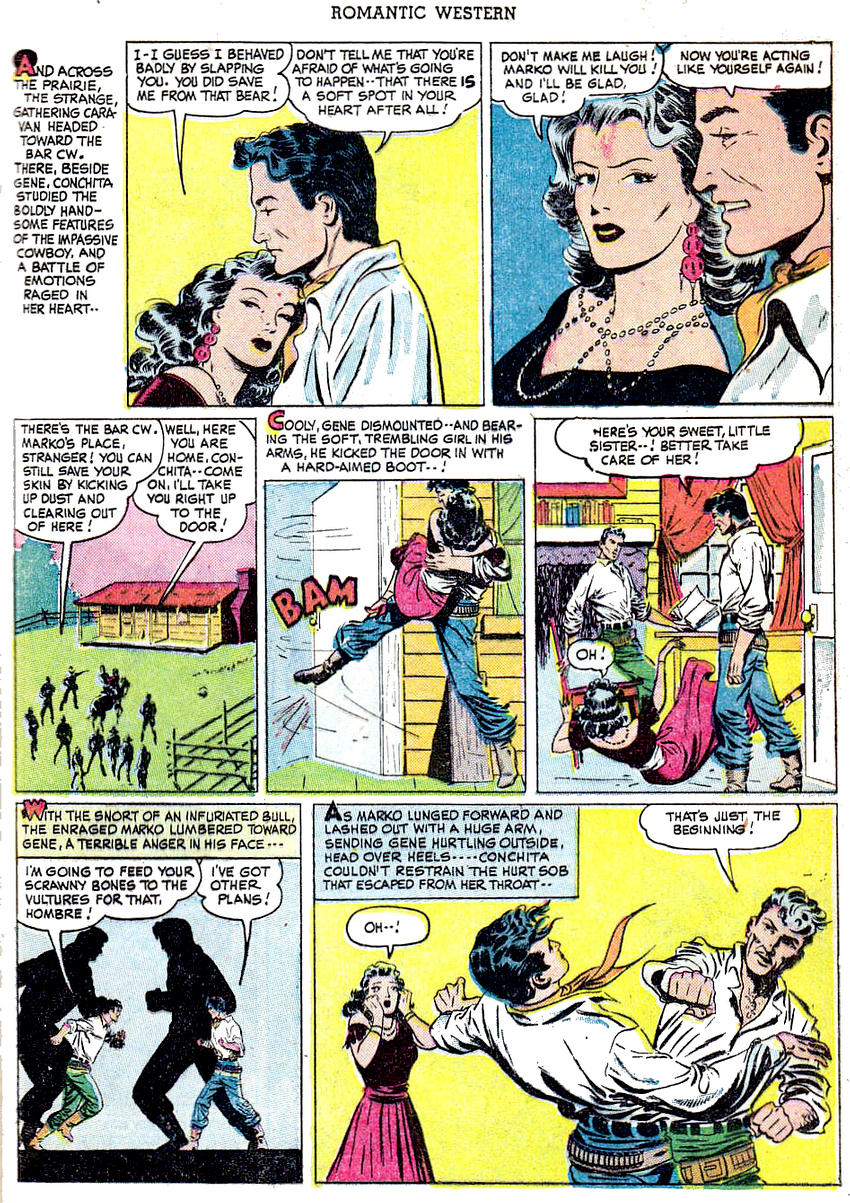
This is day two of our “What pours out of a Fawcett” theme week. I have a love story from Fawcett’s Romantic Western #2 (1950), drawn by Al Williamson and friends.

The story is pretty simple. Gene Lasseter, the hero, has a hankering for a pretty gal with a brother, Marko, who has a problem with guys liking his sister. He beats them up. Señorita Conchita, dark-eyed Latin beauty, seems to approve of that method of weeding out boyfriends. Love triumphs in the end because Lasseter gets the upper hand on Marko. But I’m not sure Lasseter wouldn’t have to fight Marko again at some point in the future. Guys like that who can dish it out don’t take kindly to taking a beating.


I haven’t had a theme week in a while, so I’ve gotten together some Fawcett comics for a “What pours out of a Fawcett” week.

First up, the Marvel Family #84 issue from the UK in 1952. It reprints part of the US issue, #76. I’ve mentioned in the past that I like these black line reprints. I also have the original color issue, and those colors cover up a lot of the sharp cartooning from the C.C. Beck studio. With this I can see each crisp line.

The Marvel Family comics, particular favorites of mine, look to me as if scripter Otto Binder had fun with the writing, and Beck and his assistants had fun with the artwork. The pro-nuke stuff is fairly typical fifties puff that atomic energy would change our lives with such things as “atomic trucks.” Imagine an atomic truck hurtling down the freeway, right on your back bumper.