Hiển thị các bài đăng có nhãn Kieron Gillen. Hiển thị tất cả bài đăng

14. A Digression (Part 1)

It's 1983 and it's something of love at first quip. Martin has adopted me as his sidekick, because I'm young enough to be of no threat while precocious enough to be entertaining. It makes him laugh that I won't back down in an argument, and that I'm as sarcastic and, regrettably, cruel as he is, and, most importantly, because I'm the only bloke he knows that's as obsessive about music as he is that isn't also too embarrassingly odd to be seen out with. He's four years older than me, a text-book alpha male, loud, biting, funny, solidly built and vigorous too, more than fond of the booze and the weed and the powder, attractive to women and shockingly able to sleep with them too, and his eyes, when you can catch a glimpse of them under that overgrown mullet of a haircut, are constantly flickering around in the hope of catching sight of something more interesting.


It's 1985 and Martin's a record plugger at a very big record label indeed, convincing the nation's favourite daytime DJs at Radio One and Capital Radio that they really ought to be playing this week's plastic-product from the sonic-pap workshops of the decade's nadir, and we can't believe that it's all happening for him. We're so pleased we're not even resentful. It's exactly the job that Martin ought to be doing. For I can fake sociability, but he really is incredibly gregarious, he really is, when he isn't overcome by contempt for whoever he's talking to. Martin's one of humanity's born snake-oil salesmen. (His body language is so effusive that his simple presence can make an excited Italian feel as if his personal space is being invaded.) And now here he is, in the stockrooms and staff canteens of Babylon, all hype and, he promises us, cocaine payola, raiding stockrooms stacked with Talking Heads sweatshirts and Duran Duran wristbands in order to win air-time from household names at the BBC. The gossip is as glamorously tawdry as we want it to be, the handouts as precious as we pretend they're contemptible, and, for awhile, Martin's more alive than he's ever been seen to be when he wasn't out of his head and unbelievably pulling women while speed-lauding obscure Philly B-sides.


It's 1986 and we don't see Martin so much anymore. Oh, well. Occasionally he throws us tickets to Talk Talk at the Hammersmith Apollo, or posts out the press release kits for the likes of Duran Duran's "Notorious" to us. But he seems to have forgotten, and this really is hard to come to terms with, that Duran Duran press kits just aren't the presents to be handing out to folks who can't stand Duran Duran, regardless of Nile Rodger's presence as producer, or that Talk Talk in concert at this stage really are a somewhat dull 90 minutes of standing still and Fairlight-sourced animal sounds. There are brief pity dates in pubs in Charing Cross and the Tottenham Court Road between us, so kindly squeezed in between his afternoons at the office and his evening caning it with the rest of the plugging fraternity. It's nothing more than the insulting largesse of the nouveau riche. I turn up once, can't bear to lift the swag he's so graciously dropped on the table before us, as if it's Maundy Money and he were the Kinge, and I disappear, never to return.


The talk, which always becoms his tittle-tattle, is all taxi-rides with David Kid Jensen, drinking between radio interviews with Fish, and what really killed Ricky Wilson. Most of all, he regales with the japes of the folks who market and pimp records, and there's absolutely no doubt that we are expected to laugh, and to be fascinated, and to be very impressed by Martin.

The public are proles, we're his subjects, and even "his" artists couldn't find their way to a career saving meeting with Anglia TV if he wasn't there to hold their hands and deliver something with an inspiring fizz into their mineral water while he does so.


But I've always been impressed by Martin, and I'm still incredibly pleased for him. Yet when I talk to him about Microdisney, he cuts me off and declares that Rough Trade just don't have the distribution. And when I mention "Sign O'The Times", he's off on an epic about how he'd blagged tickets for Prince in Utrecht, but was too wasted to travel, and what does it matter, because Prince's always touring.


15.

It certainly makes sense that there's apparently no music playing during Dave Kohl's visit to the Memory Kingdom of Britpop, beyond that suggested by a single panel showing a Retromancer cack-handedly picking out a chord on a child's guitar. (*1) For everything's decayed in that region of the collective unconscious, and the Retromancers certainly can't understand anything of the spirit which originally animated the music associated with the era. But when is it that the Phonomancers and their opposite numbers in "Rue Britannia" actually enjoy music? They talk about it, or at least they banter about the cultural chit-chat related to it, but when do they listen to music for the music's sake? In all six chapters of the book, we only ever see two situations in which music is more important than the power it can bring. (*1) And even one of those scenes, of David Kohl delaying sleeping with his girlfriend so that can he listen again to a Kenicke single, has the ring of a falsehood, of a tale told to aid the seduction of yet another young woman. Elsewhere, music is held in contempt or its value denied, as in Dave's visit to The Fleeces, or used as means to enter the memory kingdom of Britpop, or shown being manipulated by a Luthor-esque Retromancer who's acting as a "nostalgia parasite".


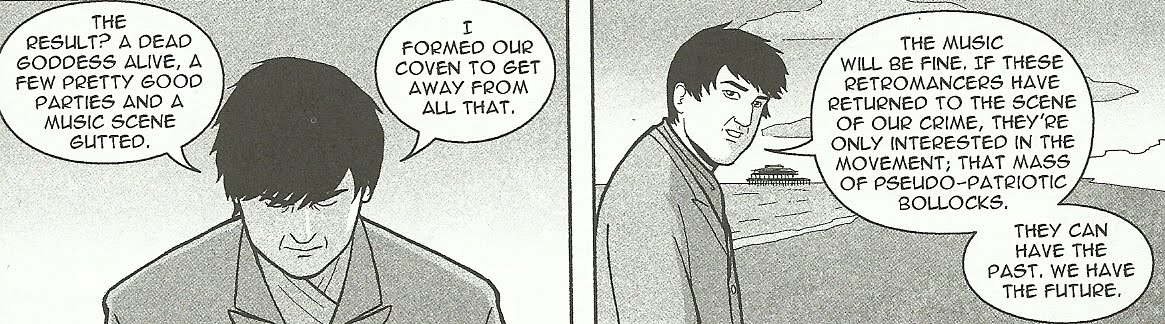
Although it's easy at first to believe that Dave Kohl is a music obsessive, he really is all talk and no needletime. For all that he's forever trying to debate the cannon of Britpop, he doesn't seem to ever listen to it, or anything else for that matter. (Anyone who can travel that far in a van while humming Shed Seven songs, for example, can't have been listening to anything else at the same time, which means that that was a long, long journey without music.) Emily can discuss the mix of ideologies which informed the Manic's first incarnation, but she talks about the ephemera of music rather than the music itself. And The Myth doesn't even seem to be able to associate music with anything other than power; "The music will be fine." he tells Dave Kohl. Not exciting or invigorating, wonderful or moving, upsetting or transcendental, but simply "fine", as if he were describing the weather for a placid May morning.


And if often seems as if the only difference between Phonomancers and Retromancers, as we've mentioned briefly before, is the difference in the scale of how they abuse others using the music that they draw their enchantments from. Neither breed seem to treasure music for its own sake. The Retromancers, who Dave Kohl obviously regards as a lesser, crueler breed, aren't doing anything that the various members of the Coven aren't, although they are manipulating folks on a greater scale. (Perhaps what Kohl most hates so about the Retromancers is how accurately they mirror his own corruption.) Both groups use the magic they can access through music to influence others against their will, and yet neither group seems to get any pleasure from the very thing that's made them what they are. The Retromancers are joyless and controlling, and the Phonomancers seem hardly more alive at all, concerned as they are for no-one but their individual selves.

(*1) - I'm grateful to Colin Smith - yes. another Colin Smith, but a clearer thinking one - for several corrections to this paragraph. His perceptive comments can be found below. (17/8/2/11)

16.

It's not that the world of "Phonogram", or even its bars and clubs, would immediately become an Arcadia if only those damnable magicians would stop screwing about with the music and with the perceptions of the people who're moved by it. In a pleasing display of a lack of sentimentality, the nameless mass who exist beyond the tiny circle of the Coven and its rival players are often shown to be just as self-regarding and elitist as those who prey on them. There's nothing as trite as "the people" shuffling around in the background of "Rue Britannia", just waiting to be treated kindly and to be set an appropriate example before heaven can be declared upon Earth. Whether it's the clubbers who regard Dave Kohl's appearance as a Manic's fan a dozen years out of time with a mixture of outrage and disdain, or the women in The Fleeces who note his appearance with no little suspicion, everyone is policing their own territory and defining who's acceptable and who's not on first appearances. (That the women at the Ladyfest are right to nail David Kohl as a dangerous predator is irrelevant to the fact that they're defining him by his appearance rather than his behaviour, though I readily concede that their wariness is a sensible measure.) For it's not that the Coven are an intrinsically corrupt minority of human beings by their very nature. The seeds of the elitism, for good reasons as well as ill, can be found elsewhere in "Rue Britannia". The difference between them and most of everyone else, we're left to presume, is simply that they've accessed power, and power really does, as Acton forever reminds us, corrupt, and corrupt absolutely.


But if the music magicians aren't fundamentally different to everyone else in this first book of "Phonogram", they undoubtedly do have a pernicious habit of quite effectively denying other people the right to make their own decisions. And beyond the range of their influence, there's a far better chance of folks being kinder to each other. We can see this in the backgrounds of Mr McKelvie's work in "Rue Britannia" where spontaneous moments of good humour and gentleness constantly occur where Dave Kohl either can't or won't notice them. The little boy excited to find himself before the bear cage in London Zoo. The couple chatting in the club as Dave waits for the Kid to, shall we say, fill out Kohl's painkilling prescription, whose presence he notes only so far as there's a drink beside them for him to steal. The women relaxed and largely free from the likes of Dave Kohl in The Fleeces for Ladyfest. Out there, where personalities aren't fixed by magic and will, something other than selfishness is possible, even if goodness is hardly ubiquitous.


One of the most impressive technical achievements of Mr Gillen and Mr McKelvie's work here is how subtly they represent the degree to which Dave Kohl is disconnected from, and largely oblivious of, the world around him. For we're rarely shown characters from beyond Kohl's immediate circle except for those he's intensely focused upon at any one moment. For most of the story, no-one but young men and women can be seen in the backgrounds of Mr McKelvie's art, purposefully undistracting and largely emotionless characters who flicker at the edge of Dave Kohl's awareness. Anyone else whose appearance makes them unsuitable for being cast and re-dressed for the movie that runs in Dave Kohl's head of his Britpop memories are simply absent from his perceptions. He just doesn't see them. And so, the women at Ladyfest are shown in some specific detail because Kohl's scanning them to see if they're both attractive to him and susceptible to magic, but elsewhere, the world that we're shown is often as deserted as a provincial town on a Sunday afternoon before the shop-opening laws were relaxed. Even the roads and motorways are largely empty of traffic, and there's what might be a lovely joke in "Faster", where the van carrying the Kid and Kohl is shown driving along the middle of a dual-lane highway which is empty of all other traffic even as they're being held up by a moped. Well, of course David Kohl would notice a moped, even if he couldn't register anything else around him.


And it's only during the long, long afternoon before his visit to Primrose Hill during "Kissing With Dry Lips" that any sign of diversity starts to flicker into Dave Kohl's perceptions, a sign that his self-obsession is just starting to waver to that significant degree. The range of people he's starting to perceive, if not pay any real attention to, is still a narrow one, but it's notably far broader than before. As his opinions begin to develop beyond that prescribed by the elitism of the coven, something of the wider world gradually flickers into view, and the process which finishes in the untitled story in "The Singles Club"# 6, where P J Holden so evocatively shows Kohl sitting in a bar in the company of all measure of folks and accepting a "boogie" with a woman of mature years, is finally properly underway.


19. A Conclusion And A Digression Too (Part 2)

In the end, I'm not sure that "Rue Britannia" is about music at all, except in the fact that music can be reduced to a commodity which enriches those who control its production and distribution, its criticism and consumption . Because "Rue Britannia" is really about power and its temptations. It's concerned with how human beings are so compulsively good at forming in-groups and out-groups, and of convincing themselves that those folks on the outside are different, and inferior, and deserving of being exploited. It's a profoundly anti-elitist book, and where it shows us the pleasures to be found in pop music, it does so by presenting us with a cast of characters who mostly seem to take no real pleasure in pop music at all.


I'd not thought of my once and no-longer friend Martin in almost a decade until I started writing about "Rue Britannia". Either the whole business simply didn't matter to me anymore, or it mattered so much that I felt compelled to hide it all away where I shouldn't have to stumble across it anymore. Whatever. But I am suddenly immensely thankful that it was him and not me that had that opportunity, that rose up that particular greasy pole. Because wherever Martin went, I'd've gone too. At the age of 23, and a particularly stupid 23 at that, well, I'd not have made a good fist of that degree of temptation. And I have enough guilt about others and regrets for myself as it is.

Perhaps he found himself his equivalent of a Libertines fan on Primrose Hill, a tumbling-off-of-the donkey moment that turned him around, or perhaps he really didn't need turning around at all. As the culture-ghost of Luke Haines demands of Dave Kohl in the Memory Kingdom of Brit-Pop, " Who are you to begrudge their happiness?" Perhaps Martin was just having a real good time.


But it is true that Martin used to adore the music rather than the hype it can come wrapped up in, and I think that he used to like us as well.

By which I mean, "me". I think that he used to like me as well.

But I wasn't very useful anymore, and neither were those inconvenient, those so tiresomely irrelevant, melodies and lyrics, productions and associations.


The very last memory I have of Martin is from 1989. It's a fiercely hot, cloudless Sunday lunchtime in July. Martin's having a barbecue as a housewarming, and for some reason I no longer recall, I've been invited. Over here are the folks from the label, and over there are a few last survivors of the old crew and a sprinkling of his family. The twain do not meet, and we're laughing a lot less, and alot less loudly, than they are. All around us is a building site, grand half-built fake-Tudor mansions standing either side of long, winding sandy lanes. It's as if someone has decided to build an almost-executive estate on the last day of the world, and with the exception of Martin's guests, the whole bombshell landscape seems empty, and silent.

Martin's standing over by the sliding door to his living room, safe in the shadows with his colleagues, with a few beers, and a few lines, and a great deal of industry chatter, when an old friend asks, in an effort to spark a ghost of intimacy, what music he should put on.


That old friend may have been me.

"Anything you like." is what he replies, before returning to his preoccupations, and those three words have always stuck in my memory, or at least they did, until I apparently chose without choosing to try to delete them.

They could have meant that he was too busy to be specific, or that he was happy with whatever anyone else wanted to hear, or that music was no longer as important as the company of his good friends and family, as indeed it shouldn't ever be.

But I think that he meant that he simply didn't care about music anymore.


Well, that's a first look at "Rue Britannia" been and caught the last train home, and there's still thousands of words on myth, on the superhero in Phonogram, on gender and social representations, and a great deal more sitting around unused. Oh, well. Perhaps they'll come in useful when we chat about "The Singles Club" later on this year. Next time, a complete pallet-cleansing change of pace, to say the least, with a visit back to the early Nineties, and Valiant Comic's "Unity" crossover. No, really.

.
11.

For all that it's a book that's so obviously in love with pop culture, and so obviously entranced by the sturm und drang of trying and inevitably failing to make sense of it, there's a very real sense of sadness at the heart of "Phonogram: Rue Britannia". It's a comic about inadequate men and women who've done their best to fulfil their wills and ended up neither kinder nor truly wiser than they were when they began the process. Oh, they may know something more about magic, but the hidden world of Phonomancers and Retromancers produces not a single individual who we'd consider both responsible and compassionate, for all of their grand dreams and their sorcerous capacities. They're all relics of their own ossified ambitions, all morally desiccated almost-human beings who at best might make entertaining if contemptible dinner companions. At their worst, they're quite cancerous, as individuals and as a breed, either bent on enslaving the tastes of their fellow human beings as a mass or quite happy to turn their backs on such exploitation in the name of a quiet life. And even Dave Kohl, who alone of them all actually takes a few baby steps in the direction of doing the right thing, has to be shamed, cursed, threatened and effectively tortured by a goddess while having his very identity threatened by his opposite numbers before he'll even begin to behave in a semi-decent fashion.


If it's remarkable that "Rue Britannia" is, for most of its pages, a book without a heroic, or even a conventionally moral, figure anywhere in its text, it's also amazing that it's a comic that's nominally about music starring characters who rarely seem to be enjoying music at all. Phonomancers and Retromancers alike use music as a source of their power, debate its meaning and sneer at the tastes of anyone who doesn't grasp the ultimate value of their superior aesthetics, but they're never shown simply enjoying it. Music to them has become a commodity, a means to an ends, but in their stunted and cruel lives, it never seems to be very much fun, never moves them or changes them in unexpected ways.


It's this separation of music from the enjoyment of it that fuels every evil, great or passing, in "Rue Britannia". Every page of the comic seems informed by an equal measure of despair and distaste, a sadness on the part of Mr Gillen and Mr McKelvie that folks can turn even music - especially music - into a weapon of snobbery and power. There's a weary-minded amazement here that human beings can take even the most precious and rarefied of resources and twist it until it's a mark of them and us, superiority and inadequacy, power and subjugation.

And that's surely a great deal of why the book's final page has music relegated to the background of matters at hand, informing but not controlling Beth's pre-existing feelings of great fondness for her boyfriend. Their sharing of a gentle, unforced, undramatic morning embrace is worlds away from the heightened states of existence, or at the very least the knowing rapture, that so much of musical myth expects its listeners to adopt. The inane breakfast DJ prattling over "Motorcyle Emptiness" is something which the purist/elitist would surely be appalled by, music separated from its supposed artistic context and pumped out as a background for the nation's yawns and teeth-brushing. Yet in "Rue Britannia", we're being shown that, for all its transcendental qualities, music is ultimately far less important than the lives it can be used to enhance, and that music is there to inform the everyday rather than to transform the everyday into a heaven on earth.


12.

In this way, "Phonogram: Rue Britannia" serves as a determined satire on the elitism that constantly, and no doubt inevitably, characterises pop culture. It presents us with sharply and deliberately dressed, stiflingly-mannered individuals who consistently screw up their own lives even as they ruin those of their numberless and largely faceless victims. These are very but self-satisfied and yet so often joyless obsessives and elitists, characterised by their contempt for the masses, by their belief that anyone who doesn't dress and dream and live as their principles demand is a lesser form of life, to be at best exploited as individuals and at worst en masse. There's Emily, who's decided that "all revolutions are revolutions of one", and then managed to make the philosophical leap from that egoistic principle to the Randian-esque conclusion that she's responsible for no-one but herself. Emily, who's capable of sharing a drink with Dave Kohl as he rather pathetically begs, while trying not to seem to, for her help, and responding with;

" ... a little etiquette pointer. If a boy is impolite to invite a girl to a suicidal endeavour, the girl is justified in an equally impolite refusal."


And there's the Coven leader himself, the Myth, shown pointedly striding across an empty Brighton Beach, as if it were a private estate carved out by the Bank Holiday riots in the Sixties, denuded of the qualities of flux and conflict and uncertainty that gave those punch-ups their cultural frisson in the first place. A man so self-contained and selfish that you'd suspect he resents breathing for fear the great unwashed might benefit from his exhalations, a man with "sad eyes" and a love for passing on grand statements about "dignity and integrity" while quite missing out on the fact that's he's content for others to have their freedom curtailed as long as he's OK. The world, according to his argument, is divided up between them and us, and "anything" the Retromancers might "influence doesn't matter".

But Dave's personality matters to him, although The Myth so arrogantly and yet so passionately tells him it shouldn't, and, we can't help but suspect, so do the personalities and experiences of those the Retromancers will affect.

"Recentre" yourself, advises Emily, "Move it and move on.", pronounces The Myth, with an old Mod's inability to avoid paraphrasing the great Curtis. To the leaders of the Coven, to the elite of this society that's no society at all, even our personality, let alone the music we love, is a commodity to be traded for self-interest. Even the concept of a individual personality has been counter-intuitively redrafted by them until it means "whatever it is that I have to be in order to be what I want".


But if a central tenet of Rue Britannia is that music isn't more important than people or the lives they choose to lead, another is that music is still an incredibly life-enchancing good. The great and sweatless of the coven have chosen to see music as a means to a end, and even view their own personalities not as works in progress so much as works of art to be defined, purchased and sealed off from change, but that's because they've turned a precious common resource into a private commodity. In doing so, they've squeezed the magic out of music by using it to work their wills, and they've purposefully drained the humanity out of themselves because they see no advantage to it. In truth, they're horrible creatures, rooted in their own abstractions of the past which they believe will allow them to live without compromise, change or suffering. And for all that we might enjoy their company on occasion, for all that we can recognise value in some aspects of their personalities, they're horrible creatures and vile bodies, and they do nobody any fundamental good at all, including themselves.


13.

"Phonogram: Rue Britannia" is a text without role models, and that may well be a large part of why it's been received in some quarters with such a qualified and often quite unfairly dismissive response. Indeed, it's clear that Mr Gillen and Mr McKelvie expect the reader to be the moral arbiter of the tale, rather than the audience having their hand held as they're walked through thesis, antithesis and onwards through the dialectic. The world we see is filtered largely, though in no way entirely, through Dave Kohl's perceptions, his point of view, and nothing that he sees and thinks can be taken for granted; he's in no way any measure of an objective observer, and we're not supposed to regard him as being so. Just because he retains a fondness for Emily, and her surface similarities to Britannia herself, doesn't mean that we're compelled to take his tolerance for her as our response. She's willing to abandon him to the prospect of either dying or having his personality entirely rewritten in a fashion beyond his control without caring to lift a finger to help. Whether being considered as an individual or a symbol, she's surely beyond the pale, regardless of what Dave himself might sentimentally feel.


"Rue Britannia" is a book which trusts us to keep our wits about us, and which encourages us not to sleepwalk into accepting without thinking what we're being shown, no matter how good-humoured and entertaining the scenes are that we're being presented with. It's a text that trusts us not to be elitist, not to revel in sexism or to bend the knee to the pop-Stalinism practised by so much of the old British music press. The reader is constantly being asked to empathise with the characters in this first book of "Phonogram", but we're also being asked to decide whether these people really are what they want us to think of them or not. Dave Kohl is, as the goddess herself says, a man carrying "buried guilt", and so he's obviously deserving of some measure of sympathy, but she's also quite right in the definitive judgement that he's a "complete bastard". Emily may wistfully regret Dave's decision to make a stand on Primrose Hill, but she lets him go alone. And The Myth talks of "a few sacrifices I don't like to think about", but he's quite unwilling to consider helping Dave deal with the folks who want to raise a zombie Britannia. "Screw them", says The Myth about the Retromancer's project, "Anything it'll influence doesn't matter." Yet of course, that word "it" refers in this case not to things, but to people, including Dave Kohl himself, and The Myth is willing to let them all suffer since he has, as he declares, "the future".


This willingness to trust the reader not to believe that the cast of "Rue Britannia" are adorable hipsters, and to consider the fact that they might mostly be elitist monsters, can best be seen in the text's portrayal of "Kid-With-Knife", who is, according to Dave Kohl's own narration, "a lovely guy" and "a friend". Yet if we go by the evidence of "Rue Britannia", the Kid, for all his affable loyalty to Kohl, is anything but an endearing mirror serving as a friendly little track-suited scamp for the tale of Dave Kohl, comic book protagonist. Time and time again, this comic book places its characters in narrative roles which we associate with certain virtues and certain outcomes, and this skillfully results in there being a clear distance between what we think we see at first and what's actually there on the page. Despite what often seems to be occurring in "Rue Britannia", a touch of reflection consistently reveals heroes who aren't often behaving so heroically, friends who are fundamentally unfriendly, leaders lacking leadership, and antagonists who aren't so very different from their nominal opponents at all. And where the Kid is concerned, this tension between how he appears and how he acts is especially difficult to resolve. For it really is especially difficult not to adore him, not to cast him in the role of selfless sidekick. He's unquestioningly loyal, helpful, trusting and supportive. He doesn't pry, he rarely tries to, or cares to, understand. He's everyone's ideal second for that moment when everything hits the fan, and, of course, he looks adorable.


But it does need to be asked why Dave Kohl's only "friend" just happens to be a charmer, a not-too-self-aware younger man who defers to the Phonomancer in everything, who never challenges Kohl, or demands anything of him, and who does everything that's asked of him. Dig under the surface of "Rue Britannia" and David Kohl's attitude to the Kid is not unlike that of an owner to a pet crossed with that an employer to a handyman. Kohl tells us that The Kid "lacks irony", and he certainly does. But he lacks irony because, for all that he's fiercely smart in certain situations, he's not particularly morally informed or engaged. The Kid is, as so many lovers of Phonogram have either missed or didn't care to recognise, and I include myself in their number, a man who doesn't understand that " ... not every problem can be solved by breaking off a lager bottle in someone's face". We may love him because he isn't burdened by angst even as he's devoted, because he wouldn't make demands upon us even as we can make the same of him, and because he offers what we might call a highly effective range of social and physical skill sets for situations that lie outside of the conventionally challenging, but he's something of a social monster as well as a great deal of a best mate too.


Kid-With-Knife certainly cares not a whit for the law, which all seems rather romantically endearing and liberating and all very Dean Moriarity, until the reader considers what the world would be like if it were even more full of Kids-With-Knives, or, indeed, if we were living next door to just a few of them. And even if we put the matter of violence to one side and push the issue of purely recreational drug-taking away, there's a great deal of the anti-social individual about The Kid. Parking where he likes and then sawing off the wheel clamp that results from it really does seem like a case of sticking it to the man, man, and no doubt having the Kid around with the tools and the will to help you break into any locked property you want to access is a convenient business. Or, at least it is until you imagine what happens to society if everyone does what they want to, at which point The Kid merges into the cohort made up of all the other primary characters in "Rue Britannia", the folks who do as they will and feel on one level or the other that they're doing it because love is the law and they know exactly what the broader points of that are. Indeed, the Kid is surely the flip side of Dave Kohl's art-Mod take on Brit-pop, representing the myth of the lawless but lovable tyke, the Oasis tendency who somehow manage to stand for liberation through not caring for anyone else outside the gang. Yin and Yang, the parka and the not-so-casual casual wear, a strange marriage of convenience with a measure of affection between apparently disparate types both set on personal success without the inconvenience of compromise.


And yet, in terms of the harm that the Kid and Dave Kohl might each cause as a result of their own personal selfishnesses, it's not hard to see who's the more anti-social of the two. The Kid's utterly disconnected from any of the covens, which means that the worst that he can do is limited to the purely individual level, though that'd be of no comfort to any individuals that he might in one fashion or another harm. That very lack of an ability to handle "irony" safely innoculates him against the will to power and the utter lack of responsibility which the ideology of the Phonomancers brings them. There's certainly not the slightest evidence that the Kid has been systematically abusing women as Dave Kohl has been. But just because he doesn't belong to the ranks of what might elsewhere be identified as the "super-villains", those parasites who use their extraordinary powers to prey on others, doesn't mean that he's a good bloke to anyone beyond his own. For the characters in "Rue Britannia" are a litmus test for our own prejudices. And regardless of the fact that he's been slotted into the role of "mirror", of everyone's cutest best friend, Kid-With-Knife is nothing close to an unqualified success as a human being, as anyone who's been introduced to a broken lager bottle by him would surely testify. Should the reader really be so beguiled by what appears to be innocence when the evidence is that it's something that at least in part is far less appealing? After all, isn't "Rue Britannia" concerned with the difference between the appearance of things and their true nature, between claims made and goods received?


I've known and loved several blokes like the Kid, though I'd never have told them that, and loved them as much for their success in being true to themselves, no matter how despicable that could be, as for the fun they threw in my direction. And I'll happily, if somewhat shamefacedly, own up to the fact that it's taken me weeks to grasp that The Kid isn't objectively the nicest bloke in comic pop fiction, and that he is, in fact, something of an anti-social liability. I saw the smiles and the support and thought what a good thing it would be to have a friend like that, and how lucky it is for Dave Kohl that he's still a good enough person that he can attract and retain such friendship. Yet, that's nothing but sentimentality, and its the same rush of sentimentality that pop music at its best and simultaneous worst can so enchantingly deliver, convincing us that we're, for example, listening to the voice of a generation rather than a Slade for the Nineties singing about "cannonballs" and "halls". But put aside the sentiment, and ignoring where their relationship will later be shown to have taken the two of them, and it's obvious that it may well not be any essential goodness in Kohl that draws the Kid to him, and vice-versa. These are two immature men who are largely different enough from each other to not tread on each other's toes, while both being largely concerned only with their own somewhat dubious interests. From that point of view, their friendship isn't exclusively a wholesome and entirely heartwarming business, just as it's undoubtedly characterised by affection and trust too.


I'm glad that the characters in "Rue Britannia" aren't moral paragons, because I've met damn few of those in almost half a century - half a century! - lurching from one disaster to another. I'm glad that there's ethical ambiguity deliberately placed in the text, and that as a reader I'm forced to admit as I re-read that I've quite missed the point of things, because that means I'm being both respected and challenged by the work. (Indeed, I've no doubt that I'll take "Rue Britannia" out in a year's time and realise that what I'm writing here is piffle, and be pleased for it too.) And I very much want to read more about Kid-With-Knife and that Dave Kohl as I push onwards into "The Singles Club", and I'll not be doing it with any lack of affection for their characters or lack of concern for their fates. I'm not in any way complaining that the text is unethical or the creators are wrong-headed. I'm just pointing out to myself, so that I might not forget, that charm isn't the same as virtue.

There are folks who've managed to read, or perhaps just hear of, "Phonogram; Rue Britannia", and taken it for a text in favour of elitism. I was feeling both irritated and somewhat uncharitably contemptuous of that. But then I realised how I'd missed a very great deal of the whole point about Kid-With-Knife, and so I really don't feel in any way so clever or judgemental anymore.


To be concluded, and in the remarkably near future too;


.
10.

Once, when I was an idiot boy of 15, I fell in love before I'd even had the time to know that it had happened. I remember everything about the moment, though nothing of the details of the irrelevancies of what went before, nor much of what occurred later that evening. Similarly, I can recall with flashbulb precision the events of perhaps another two dozen moments in my life when something utterly unexpected and fundamentally moving rose up out of the everyday, froze the events which framed it, summed up what I'd been before and predestined what I was going to be afterwards, and then blinked right back into the fabric of the typical, into the standard-issue ordinary, and time rolled on. A car crash, a desperately needed and quite unforeseen kindness, the last paragraph of Gatsby, the "Ah!" at the beginning of "Born Under Punches"; all brief moments of the remarkable between which my haphazard life now appears to have been strung.


Pressed to name Jamie McKelvie's leading quality as an artist, I'd say that it lies in his ability to precisely identify and movingly depict these life-defining, time-freezing moments. (Such events are, after all, far more frequently encountered in pop fiction, because that's what pop fiction is often largely about.) In the pages of "Phonogram: Rue Britannia", Mr McKelvie not only effectively ensures the plot's progression, but also defines in his untypically precise and touching fashion why the reader should care about the sequence of events they're witnessing. There's a constant sense in his work of his character's lives being marked by intense flashes of emotion sweeping often unexpectedly out of apparently unremarkable events and entirely commonplace settings. In other words, his art functions as a shorthand summary of the business of the experience of real life, and of all those one damn things after another broken up by seconds of emotional intensity. To achieve these effects without derailing the reader's engagement with the storyline, to accentuate the inner lives of his characters while never abandoning his intent to do so subtly and without careless recourse to cliche, marks out Mr McKelvie as a highly effective storyteller, even at this relatively early stage of his career. Drawing on the traditions of Manga and indy-autobiography, he so effectively presents us with an everyday world that we can clearly recognise, depicting comic-realistic backgrounds against which his cartoon-vulnerable characters can act out their recognisably prosaic existences. In such settings, the contrast between the remarkable, when it occurs, and the humdrum seems all the more startling and involving.


It's a world so objective and yet so distant from the emotions of the folks of Phonogram that it almost demands that something of the sacred flashes into existence across its face, for those lonesome canals and bridges, those empty motorways and deserted beaches, seem saturated with a sad promise that nothing wonderful will ever happen until it's all too late to matter. (It's the world of The Smiths and Suede, of The Auteurs and post-shoegazing Blur, of Pulp and the Manics, but it's certainly not that of Oasis and the guitar-anthem tendency which proclaims that everything'll be far more than alright if we're just loud enough, bloody-minded enough and, of course, constantly hammered.) Mr McKelvie's landscapes are just somewhere melancholic where their characters are passing through in their restlessness and sadness in order to get to somewhere else, which'll no doubt be more of the same, since even Indy Dave's shack in the countryside is little but mud and rain and, of course, isolation. Such settings are the perfect background to carry the meaning that all the tightly-curated, anally-dictated pop culture in the world won't make these Bristols and Londons meaningful. Being compassionate to others, Dave Kohl, is the only thing that can achieve that.


We can see a great deal of this process, this business of the unexpectedly intense, for good or ill, counterpointed with the mundane in the panel above, wherein Dave Kohl recalls the first time he saw Britannia. The goddess is shown perfectly balanced in that exact moment when her carefree progress forwards is distracted by her future acolyte's presence to her right. She's so fiercely alive, so full of energy, so luminous, that every limb is purposefully describing her forward motion; even her handbag is being swung before her, as if this were a woman who's not only got somewhere transcendentally splendid to go to, but who possesses the ability to be absolutely invigorated even while travelling there. And that sense of kineticism and purpose is accentuated by the still and colourless street-scene that she's been placed within, while her fundamental other-worldliness is signalled by her lizard-dark eyes and her noticeably absent shadow. This is a human being who isn't a human being at all, and she's not of the world so much as dancing through it. It's a scene of the first moment of a future love-affair as viewed from the wrong end of time's telescope.


That there's a naivety to the composition of the panel is undeniable, but then, what we're perceiving through the lens of Dave Kohl's memories is a moment of beguiled naivety. What matters is whether the panel works, and it works wonderfully well. It describes that moment when the world as David Kohl knew it and the life he wanted to own seemed to suddenly and glamorously separate one from the other, and it achieves that so effectively that I can understand exactly why Dave has done all that he has, and why he's so resisted the not-incidental responsibilities of growing up these past ten years or so in favour of a narcotising nostalgia.


There's a similar attention to the detail of body-language and the emotional meaning of the script in even the smallest of Mr McKelvie's panels. The scene of Dave Kohl assuming the identity of a pre-Britpop Manics fan for a second time in "Rue Britannia" - above - takes up but an eighth of a page, and yet it's designed in such a way that it carries a mass of visual information which would otherwise weigh down the frame with story-deadening text. Quite unlike his previous appearance in the height of 1993/4's anti-fashion, Dave Kohl's here presented as a man unashamed of what he's wearing and who he is. He's deliberately adopted the pose that he would have cut 12 years before, and by doing so, he's presented himself to Beth's ghost as a citizen of the same lost culture to which she's bound because that's what she most needs. With his head tilted confidently to the right while his body leans to the left, with his leather jacket thrown casually over one


shoulder and that ever-smouldering cigarette, with the apparent arrogance of a man who believes the world won't listen and doesn't deserve to hear, the reader is immediately being informed that Kohl is using style as a means to help Beth rather than as a weapon to bolster his own ego. We know that he isn't this man anymore, either in form or content, and so we're immediately being told by Mr McKelvie that this is now both an act and a mission of some mercy on his part. The soulless, ashamed, almost Frankenstein-like awkwardness of his first appearance as a "harmless freak", as a glum/glam Manics fan, is so marked in contrast to this purposeful, new/old Dave Kohl that the reader can't help but grasp that what we're seeing isn't a rebel without a shred of decency, despite all surface appearances, but a human being with a kindly purpose. And it's something well worth noting to remark how that key information is subtly and unpretentiously carried within that single small panel, as Mr McKelvie, working with Mr Gillen's sparse and yet similarly informative dialogue, creates the maximum effect from a minimum degree of detail.


To be concluded ...

.
In which the blogger finds himself taking an unexpected detour from his own plans to wonder why "Phonogram: Rue Britannia", a book playfully and yet profoundly concerned with ethical issues, succeeds in never appearing to be lecturing its audience. Why not?


8.

It'd be ridiculous to suggest that "Rue Britannia" is a book whose meaning can be reduced to that of a feminist primer. Thankfully, the truth of the matter is far more complicated and nuanced than that. For it's the fact that this comic seems to come to some pretty definite ethical conclusions, while also providing some rather qualified and even contradictory supporting evidence for them, which helps give the book its sense of being alive. And "Rue Britannia" does succeed in lending the reader the sense that they're listening in on a great mass of opinions, and through that experiencing a whole series of ways in which its story might develop, even as the narrative works purposefully towards suggesting one particular solution to the problems at hand. To succeed in making a text seem so apparently open-ended when it's in fact driving towards a deliberately preordained and traditionally-minded solution is no little achievement, and it's one which is, I'd suggest, well worth paying attention to.


One of Mr Gillen and Mr McKelvie's techniques in creating this sense of possibility and plurality in a book which is in truth heading towards a definitive moral conclusion is to make sure that their characters are more than just two-dimensional symbols of the values they're representing. And so, the fact that the end of "Rue Britannia" gives the sense that Dave Kohl has become something of a new man is, to a degree, tempered by the realisation that he's never shown actually fulfilling such a role. We leave him before he can be shown entering into a relationship of equals with a woman, his previous associations with the not-so-opposite sex having always been previously marked by exploitation or a calculated advantage. And, as we've already discussed, the insensitivity of his rant against Richey Manic near the book's close shows that he's still quite some way from the kind of total moral, empathetic transformation that marks, for example, Phil Connors at the end of "Groundhog Day". In such a fashion do Gillen and McKelvie ensure that their characters have a life that's separate to and partially distinct from the moral purpose that their thoughts and actions are used to illustrate. Their existences help to illustrate the principled themes of "Rue Britannia", but they're not simply thin and unengaging representations of right and wrong thinking. In short, Dave Kohl's experience helps to accentuate why feminism is a damn good thing without turning Dave Kohl into an unconvincing paragon of feminist virtue.


It's this process of creating great broad ethical brushstrokes across the narrative as a whole while providing more subtle and less morally specific character development within the story which prevents the first book of "Phonogram" from feeling like a moral admonition from a humanist lectern. (Instead, it most often feels not unlike a great mass of competing conversations and lectures, a comic-book Speaker's Corner, where the declaimers are at the very least as interesting as the points they're offering up to their audience.) Nothing would have killed the energy and argumentative goodwill that characterises "Rue Britannia" so much as such a closing example of two-dimensional worthiness, especially considering how formal and traditional the comic's structure was designed to be, drawing as it does on the form of the monomyth. Such a recognisably conventional form can lead to a simplistic, stilted dialectical brew in which good is presented here, evil here, and the outcome never in doubt and never counting for much either. Without the appropriate care, there was every chance that the first book of Phonogram could have ending up as a rigid, self-righteous harangue.


And so, rather than ending with an utterly reconstructed Dave Kohl, it could rather be argued that "Rue Britannia" ends not with his adapting a feminist point of view at all, but rather a regressively chivalrous one, in which he sees it as his responsibility as being to save women from both their own weaknesses and their male oppressors. For he's not collaborating with women at the end of "Rue Britannia" so much as he's rescuing them, freeing both the undead goddess and Beth's shade from the expectations of patriarchal order. From that point of view, Dave Kohl's transformed himself not into a new man, but into a paternalistic knight errant, and if that's at all so, then he's certainly not crossed the floor from the party of blokedom to the community of gentle and respectful kind citizens.


It's a form of deliberate symbolic restraint which keeps Dave Kohl feeling like a individual rather than a type, and which prevents Rue Britannia from setting in the shape of a diatribe. In short, the struggles which the arc of the character's development represent stand relatively separate from the nature of the characters themselves. Dave Kohl shows us something of why we really ought to be gentle and kind, but he's never shown coalescing into a two-dimensional representation of a totally reconstructed new man.

Or, if we were at this point to try to reduce the script of Rue Britannia as we've discussed it so far to a formulae, which is of course exactly what Rue Britannia cautions us against, it might read: M( Monomyth) + H (humanism) + IC (characters which exist in part separate from their thematic purpose) = PRB


9.

But then, part of the purpose, and indeed the fun, of "Rue Britannia" is that it isn't concerned to debate a single ethical point, though it finally resolves itself on one, but rather a vast mass of them. Just like the greatly lamented cacophony once howled up each Wednesday by the towers of Babble that were the four British music papers, the first book of Phonogram seeks to present us with a vision of the world in which every seven inch single and every pair of shoes is incredibly important and fantastically meaningful far, way beyond any question of mere functionality. More importantly, perhaps, Mr Gillen and Mr McKelvie present us with a world in which moral debate is engaged in with a similar fervour to that practised by the gatekeepers of popular culture, as if the supposedly weighty and the apparently insubstantial, ethics and pop life, are all part of the same piece, as of course they are. In that, these characters are constantly shown engaged in the kind of meaningful debate about the macro and the micro dimensions of their lives which are, shall we say, not entirely typical of the great mass of everyday existence. (Debate is to "Rue Britannia" as fisty-cuffs and energy-blasts are to superhero comics. It's a mark of character and identity, virtue and moral purpose, plot, theme and closure.) And to fulfil this purpose of presenting an everyday world of ideas, even if they're being used to close off questions rather than open them, "Rue Britannia" is designed to be as dense a reading experience as possible, while never allowing that to slow down the forward momentum of its (anti) hero's journey. It's a difficult balancing act, to drive an adventure right through a great conflagration of concepts and arguments, movements and ideologies, but Rue Britannia achieves it.


As a result, the reader is constantly being pushed to ask questions of what they're being shown, and there's always space left purposefully in the text for the creation of alternate readings of what's going on. We'll discuss the detail of this process next time out, but perhaps we might at this point note how the narrative of "Rue Britannia" simultaneously carries a whole string of themes, several of which overlap and can be used to make sense of the events on the page. For example, we've already discussed something of how the book carries a specifically feminist meaning, just as the details of that theme become all the more hazy and less resolved the closer the text is examined. Yet it's interesting to note that Dave Kohl's tipping point, his tumbling-off-a-donkey moment, is actually a specifically humanist one, and an apparently damn odd one too. For the roots of his final transformation lie not in his relationship with women, but from his encounter with a far younger and considerably less ideologically exacting version of himself. In choosing to fight for the right of a Libertines fan to know nothing of the ideology of Britpop, Kohl finally manages to create a statement of principle to act according to, and yet he does so after a fashion that's filtered through his own experience and in the light of his own tastes. He doesn't adopt humanism, and he's no convert to a deeply caring liberalism. Instead, he creates his own version of them from his own history. He's inspired by experience, not theory, which is, after all, a rather British way of conceiving of a political stance.


And so, rather than seeming to parrot truisms that he was obviously created to ultimately represent, Dave throws us back a familiar principle in an involvingly unfamiliar guise. Everyone, he decides, everyone has got ".. a right to be stupid ... Their own stupid, unblemished by any of mine". As a political call to arms, it's framed in opposition to a great optimistic mass of democratic theory, but it makes perfect sense in terms of what Dave Kohl's been and all that he's perceived. For he can see now that the greatest danger is posed by those who would impose their own narrow ideological constructions of the world upon others, as we'll soon discuss. The right to be stupid is Dave's way of framing the concept of the right to the freedom of thought and expression and conscience, and it makes perfect sense that he'd fasten onto such a way of expressing that principle. For he's learned that the business of fixing the meaning of myth and imposing such upon anyone else isn't a magical, life-enhancing tool for engaging with and defining reality, but a totalitarian weapon of subjugation, whether delivered up by the inkies, big business, "blokes", magicians or whomever.


Again, it's another way in which the themes of the book and the thoughts and actions of the characters dove-tail together without working in an oppressively mechanistic fashion. Dave Kohl may end up representing some rather straight-forward and well-established ethical principles, but Dave Kohl himself is anything but traditional and obvious.


To be continued with, now that I'm finally in a position to do so having finished the above, a discussion of some aspects of Mr McKelvie's artwork in PRB.


.