Hiển thị các bài đăng có nhãn Birds of Prey. Hiển thị tất cả bài đăng
I very much enjoyed Duane Swierczynski's first New 52 Birds of Prey collection. After so many years of Gail Simone writing the series (and then some less-than-stellar fill-ins), I wasn't sure about yet another writer taking over the group; Swierczynski's story, however, deftly mixed humor and espionage, and his new character Starling seemed like someone Simone might have created herself.

But Swierczynski's second volume, Birds of Prey Vol. 2: Your Kiss Might Kill, didn't thrill me quite as much. Swierczynski writes a respectable Birds of Prey, with no embarrassing out-of-character moments; still, the book feels rushed, is perhaps too vague on one of the story's most important elements, and treads too long on a lesser storyline that isn't as interesting.

As well, most of this volume trades artists Jesus Saiz and Javier Pina for Animal Man's Travel Foreman and a host of fill-in artists; I like Foreman's work a lot on Animal Man, but he's a mis-fit for this superhero title, and the multitude of guest artists contribute to the book's hurried, slapdash feel.

[Review contains spoilers]

The first chapter starts "three days ago," in which a spy agent finds one of his group murdered, with evidence pointing to Black Canary. "Now," Canary and the Birds have been lured to the hotel where the man was killed, and then attacked by the group's super-powered "Infiltrators." The victim, we learn as Starling investigates separately, was Canary's husband Kurt Lance; in the end Canary admits to the Birds that she did indeed kill Kurt ... three years ago.

The most likely explanation is that this is simply a gaffe, and the issue is supposed to begin "three years ago." But I can't be sure -- the agent who finds the body refers to Canary striking "again" and that they need to "burn her" (the present attack involves fire), such to suggest a more immediate cause and effect. If Kurt isn't the victim, then Canary has killed someone else, and while there's (a little) more about Kurt later in the book, there's no mention of Canary's possible second victim at all.

All of this simply starts off the book on the wrong note; it's hard to get into a story when the basic tenets of who did what aren't clear.

The next chapter is Birds of Prey's "Night of the Owls" crossover issue. While there's a nice callback in this issue to the series's first issue, Travel Foreman takes over art here, and his grotesque figures, which work in Animal Man, seem baseless in Birds; see Canary on the fourth page, bent nearly in half, animal-like, while simply walking. Again, no major flaws in the writing, but it's not a remarkable issue (as many of the "Night of the Owls" tie-in issues weren't) and it distracts from the more-interesting story about Canary and her late husband.

Swierczynski never quite returns to any of that in force, because the penultimate three chapters involve the Birds taking Poison Ivy to the Amazon for healing, and Ivy subsequently blackmailing the Birds into a bit of eco-terrorism. This is interesting, and I rather like Swierczynski's portrayal of the Birds as heroes on the wrong side of the law. They disagree with Ivy's methods but perhaps see some justice in what she does; there's also an undercurrent of danger (a la Simone's Secret Six) where the reader feels at any time one of the Birds might slip and kill in cold blood.

But again, the story suffers from a variety of mismatched art teams, some of whom draw the Birds in gratuitous cheesecake fashion (when Saiz and Pina never had such problems). There's also more story confusion -- one accomplice of Ivy's refers to talking to the Birds before, though I can't at all find him elsewhere in the book. And the story suddenly jumps in the final part from the Birds doing Ivy's bidding to standing around while Ivy rests, able to finally free themselves; it's a sudden shift that I suspect emerges from the book losing an issue to "Night of the Owls" or something else.

Your Kiss (a title never really explained) ends with the book's Zero Month issue, and it might be the best of the bunch. It reminded me of some of Chuck Dixon's original Birds of Prey specials; here, Canary infiltrates the Penguin's organization to stop a weapons sale, meets Starling, one of Penguin's enforcers, and runs afoul of Batgirl. When Batgirl and Black Canary met in the "old universe" is a story slightly muddled, so it's nice to see a real concrete "origin" for the characters; Swierczynski also teases some ties to the Suicide Squad title, which I liked. Artist Romano Molenaar's style is closer to what I expect from Birds of Prey (though over-inked), but a silly unnecessary shot of Canary in her underwear late in the issue knocks my opinion of his art down a peg.

Ultimately Duane Swierczynski's Birds of Prey Vol. 2: Your Kiss Might Kill isn't bad Birds of Prey, but neither is it good Birds of Prey, either. Swierczynski abandons too quickly the most exciting part of the book, the circumstances around which Canary killed her husband, for a Poison Ivy story that's interesting but doesn't have the verve of the first volume's mind control intrigue. Swierczynski still has one more collection of Birds of Prey to go; hopefull the third mimics the first more than it does the second.

[Includes original covers, sketches by Travel Foreman and Stanley "Artgerm" Lau]

Up next, Green Lantern Corps Vol. 2: Alpha War. Don't be late!
Toward the end of the "old" DC Universe, the Birds of Prey title had become somewhat dour and directionless, despite the return of long-time Birds scribe Gail Simone. Still, when DC Comics announced their New 52 initiative, it was alarming that someone other than Simone would be writing the book -- crime writer Duane Swierczynski. Simone was only one of two writers, with Chuck Dixon, that had successfully written the title in its over fifteen-year history, so fans met a new writer with some apprehension.

Fortunately, Swierczynski's Birds of Prey: Trouble in Mind is near flawless. Swierczynski proves right away he understands the Birds concept and what makes it work. Not only does Swierczynski write a great Black Canary, he also makes new character Starling a favorite in seconds, and the book barely falters from there. Like Teen Titans, Birds of Prey was a book that needed a kick in the seat, and Swierczynski delivers with perhaps one of the most enjoyable relaunches of the DC New 52 so far.

[Review contains spoilers]

There's plenty to like in Swierczynski's first chapter of Trouble in Mind, with a high-action caper sequence reminiscent of Chuck Dixon's early Birds stories or, perhaps, a James Bond movie. Things don't really calm down until about eight pages into the second chapter, just after Starling crashes her second vehicle of the book. "Is this going to be a thing with you from now on?" Black Canary asks, Starling replies, "Sue me. I like breaking stuff," and the book is off to the races. Black Canary is still Black Canary, tough but idealistic. Starling could herself be a Gail Simone creation, a combination of the "old" DC Universes's Birds Huntress and Lady Blackhawk, with even some of Simone's Secret Six's Scandal and Jeannette mixed in. It's a crime story, it's a spy novel, and it's fresher than Birds of Prey has felt in a while.

As befits a story about Black Canary getting a new team together, Swierczynski pits the characters against a villain that can secretly control minds, such that the Birds can't trust one another even as they're just beginning to mesh. The scenes of Katana and Poison Ivy joining are fine, as are the Birds's initial fights against mind-controlled citizens, but Trouble gets truly, deliciously paranoid once the Birds find they've been compromised themselves. Swierczynski uses some narrative tricks slightly more complicated than one might find in the average DC comic, sometimes moving the Birds inexplicably between times and locations such to present the mental blocks caused by the villain Choke. The final scene in which the teammates attack each other one moment and deny doing so the next is wonderfully chilling.

Despite Poison Ivy's presence, the new Birds of Prey title is Birds and not a New 52 rendition of the Gotham City Sirens title -- the former a superhero-espionage title, and the latter a Gotham villains sitcom with considerable cheesecake undertones. The new Birds shares on facet with Sirens, however, that differentiates it from the old Birds, that the Birds this time around are criminals, or at least wanted by the law. This adds a Marvel-esque layer to their adventures -- no matter how much good they do, the public will never accept them. It also begs the question how the larger superhero community will accept, or not, Black Canary's Birds team; Swierczynski includes the obligatory Batgirl appearance here, a nod to former Birds leader Oracle, and Barbara is generally accepting of Canary's activities, but one wonders if a Batman-type might not be so gracious.

The art throughout most of the book is by Jesus Saiz, late of Greg Rucka's Checkmate, a series with plenty of tonal similarity to Swierczynski's Birds; that his back-up artist is Javier Pina, artist also on Marc Andreyko's Manhunter, is fitting, too. In a book where all the protagonists are women, Saiz's characters are sexy without being oversexed or gratuitous; Starling's costume may be low cut, but Saiz never has Canary's zipper, zipped to her chin, just-so-happen slip down as many artists would. The distinction is starkest when compared to David Finch's covers, in which the doe-eyed women are strangely contorted to accentuate both bosoms and bottoms; these don't reflect the contents of the chapters near as well as Saiz's covers do.

Birds often has the cadence of a television drama in dialogue-based story recaps and emphasis on the characters calling one another by name. This gives the book, in collected form, a slight drag it might not have had in the single issues -- Trouble is fast-paced enough to be read in one sitting, but in doing so the reader will encounter some repetitious exposition. The characters' dialogue becomes slightly melodramatic at the end, especially when Canary faces Choke directly, but these are small matters in a book that's otherwise a striking debut collection.

There are certainly flaws to be found in DC's New 52 initiative, but between Animal Man and Batman, Batwoman and Flash, Superboy, Teen Titans and others, there's a lot to like. Duane Swierczynski's Birds of Prey: Trouble in Mind is another one of those -- one that took the core concept and relaunched it, and the concept is better for him having done so. This book ends on a cliffhanger, and volume two can't come soon enough.

[Includes original covers and uncolored covers, sketchbook by Jesus Saiz, Jim Lee, and Cully Hamner]

Next week, the Collected Editions review of Ron Marz's New 52 Voodoo: What Lies Beneath, and some special Thanksgiving guest reviews.
Birds of Prey: The Death of Oracle marks the beginning of the end of the DC Universe as we know it. If memory isn't failing me, this is the first book reviewed here that presents the final issues of a title before the Flashpoint/DC New 52 relaunch (a variety of cancellations notwithstanding). There's still a ways to go before we reach the New 52, with the final collections of certain pre-Flashpoint titles arriving even as late as May of next year, but this Birds of Prey trade marks the beginning of the old DC Universe putting the chairs up on the table and turning out the lights.

In terms of story, Death of Oracle does not necessarily provide the closure one might expect from the series's last book. Rather, Death of Oracle is about new beginnings, more like the first book instead of the last, and maybe that's fitting. There's also a heavy dose of wish-fulfillment here, with a couple of unexpected mash-ups of Birds writer Gail Simone's various titles, and even guest-writer Marc Andreyko penning the Manhunter character again. In this way, what defines the final volume of Birds of Prey is what also defines much of the series -- it's just plain fun -- and that's not a bad note to go out on after all.

[Contains spoilers]

Birds of Prey, as a title, ran beautifully for a long time but recently hit a rough patch. After issue #100 (Birds of Prey: Blood and Circuits), Black Canary left the team, and the revolving door of team members never quite carried the book like core members Canary, Huntress, and Oracle. Long-time writer Simone left after Birds of Prey: Dead of Winter, and neither the writers that followed nor a spate of uneven artists carried the book as well as Simone, until the first iteration's cancellation. Simone returned for Birds of Prey's second iteration with End Run, which was a marked improvement over what we'd seen of late, but was also a twisting story that never quite stopped to establish the Birds' new status quo.

The two-part story "Hostile Takeover," mid-way through Death of Oracle, is an entirely more familiar kind of Birds of Prey story. Oracle sends most of the team on an undercover mission; one team member, in this case Huntress, handles a parallel job that ends up tying in to the main plot. Simone gives each one of the Birds a role and a purpose here; with the first part of "Takeover" featuring art by Jesus Saiz -- a dynamic bright spot as compared to a number of the book's fill-in artists -- this final Birds story by Simone feels like a fresh new beginning. The story ends with Oracle presenting the Birds a new mission and a new status quo, and the reader gets a great sense that this book is finally on the right track, even if the Birds will now be having their adventures in limbo.

What gets the Birds to this point is the four-part "Death of Oracle," whose cover images tease the demise of Barbara Gordon even though that's never part of the plot. "Death," like End Run, is not the kind of Birds story I personally favor -- Oracle is at a loss in both stories, rather than leading her team -- but I entirely agree with the sentiment, that Oracle believes she's become so well-known she's no longer effective and uses the villain Calculator to fake her own death.

The story runs long, as the Birds fight some D-list villains and there's a subplot involving Black Canary's subconscious that never amounts to much. It ends, however, with Oracle newly back in the shadows, as she was in the very beginning of Birds of Prey, and that's an auspicious turn of events. The last couple of pages are, yes, a lot of fun, both as Simone gets to cameo the few members of the Bat-family who know Oracle is still living, and also as Catwoman calls Canary and Huntress's bluff about Oracle's death. It bespeaks fascinating stories to come (if only in our heads) where the Birds have to account for their information while preserving Oracle's anonymity -- all of this, a step in the right direction for the title.

After "Death," the single issue "Which Reason Knows Not Of" and the aforementioned "Hostile Takeover" share in common appearances by Simone's Secret Six characters. With both Birds and Six cancelled with the DC Relaunch, and only Birds getting a new #1, the final Six appearances are to be treasured, and so they're welcome here. The Huntress/Catman "date" is perfectly in character for the two and follows well from recent events in Secret Six: Cats in the Cradle; I also liked (in End Run and here) Simone giving the Huntress more standing as both a fighter and a detective.

"Takeover" pits the Birds against ghoulish Six baddie Junior; while I've been rooting for the Six to face Junior again, the villain almost seems too dark for Birds, and it's an effectively chilling tale. "Takeover" also brings the Question Renee Montoya into the fold; Simone picks up exactly the patter between Question and Huntress as in earlier team-ups by Greg Rucka, and it's great to get another shot of their ... bromance? womance? It's this -- Huntress and Catman! The Birds vs. Junior! Question teams with Huntress! -- that I mean by "wish-fulfillment"; in the final pages of Birds, Simone plays a kind of greatest hits series of the things fans (this fan, at least) have been waiting to see.

Death of Oracle ends with a two-part story by Marc Andreyko, writer of the fan-favorite Manhunter series. Manhunter Kate Spencer herself gets precious little to do in the story (though former Phantom Lady Sandra Knight's quip, "Did I ever tell you, Manhunter, that you are amazing?!" must come with a well-deserved wink and nod from Andreyko). Instead, Andreyko explores the fact that with Phantom Lady and sometime-Bird Manhunter in the mix, the Birds of Prey becomes something of a legacy team, with a Blackhawk and a Black Canary teaming both in the 1950s and today.

The two-part "War and Remebrance" is fairly standard superhero fare, but the characters are all having fun throughout and clearly so is Andreyko. The present Black Canary's toast to the female heroes who came before her is especially poignant here at the end of Birds of Prey, and there's a certain joy that comes from seeing these heroes out on a "regular" adventure one last time. That Andreyko has a chance to write Manhunter one last time, even if only a bit, is icing on the cake, and a perfect use of the final issues of Birds of Prey

[Includes original covers]

It feels as though the Flashpoint restart catches the Birds of Prey title somewhat off-guard, something we may find with a number of the concluding titles going forward. Even so, Gail Simone's Birds of Prey ends on a high note, and that's as much as we could have hoped for. Hail and farewell, Birds of Prey -- see you again post-Flashpoint.
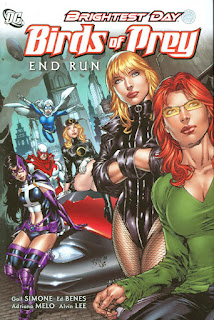
It is a delight to have the band back together again in Birds of Prey: End Run, both characters and creators, though the book feels more like a two-hour reunion movie than the start of an ongoing series. In contrast to Birds of Prey launches previous, the focus is less on the Birds saving others than saving themselves, which gives the story a one-off, personal feel. I'm glad the Birds are back together, though in the end their new mission isn't quite clear to me.

[Contains spoilers]

DC's been rather mum on the exact date and time the idea for the new relaunch came about; if I had to guess based on what I can intuit from interviews and such, I'd bet writer Gail Simone did not know about Oracle's return to Batgirl at the start of the new Birds of Prey series. And yet, with Simone's new Batgirl on the horizon, her portrayal of Oracle here makes it not such an outlandish concept.

Oracle gets her own story in End Run involving sometime-allies Savant and Creote while Black Canary and Huntress are off battling the mysterious White Canary, so it's not as though Oracle is idle in the book. Until Savant and Creote kidnap her, however, Oracle mostly worries about her teammates through their audio receivers; after the titular "End Run" story, she's mostly absent through the two-part concluding "Two Nights in Bankok." When Savant dangles Oracle's wheelchair off the end of a dam, Oracle thinks about how she would previously run along the edge "in heels" as Batgirl; though she's strong enough to catch Savant when he jumps off the bridge himself, she still needs Creote to help pull Savant up.

There's nothing wrong with Oracle considering her past life nor having to ask for help, but there's a certain wistfulness here in Simone's portrayal of Oracle, not to mention the character's general impotence in the story. Even if I didn't know that a change was on its way, chances are I'd still be advocating for Oracle to be in the field more -- questioning suspects, sneaking around, getting into fights -- something that's hopefully on its way in the next volume's ominously titled Death of Oracle.

End Run rests heavily on three other of writer Simone's Birds of Prey stories -- Of Like Minds, The Battle Within, and Perfect Pitch -- with so much detail in fact that I had to pull the three to remind myself about some of the characters interactions. Less notable, I thought, than the conflict with White Canary was the aforementioned return of Savant and Creote, and how their kidnapping of Oracle evokes their kidnapping of Black Canary in Of Like Minds, Simone's first Birds book, reinforcing the feeling of new beginnings giving deference to the old.

In an excellent twist, Savant and Creote seem the villains of the piece, though they don't actually end up as such. Instead, Savant's mental breakdown reminds Oracle of her tendency toward arrogant self-reliance, and her habit of taking her associates for granted that she thought she'd curtailed. That End Run recasts several stories relating to Savant and Creote is good -- showing what Oracle thought was rehabilitation to instead be considerable harm -- because it sets volume two apart as a clean break distinct from what came before.

Ultimately, though the beginning and middle of End Run pertain mostly to Oracle and Black Canary, "Two Nights in Bangkok" largely the Huntress's. In fact, if I had to characterize End Run succinctly, I'd say this is Huntress's Battle Within and Perfect Pitch, compressed. The White Canary means to pit super-martial artist Lady Shiva against Black Canary, but Huntress steps in instead, and manages to hold her own against Shiva, if not exactly cleanly.

Defeating Shiva has been a rite of passage for Bat-characters. For Simone to pit Huntress against Shiva is to continue Birds's process of giving Huntress the recognition she deserves, just the same as this title did for Black Canary. That Huntress does it "her way" is perfect, splattering blood in Shiva's face rather than developing some outrageous fighting skills and becoming essentially a second Canary; I also appreciated Simone's reminder more than once that Huntress is willing to kill while Black Canary isn't, further defining the two characters as individuals.

End Run is enjoyably action-packed, with a number of successful surprises, and again it's great to have Simone and artist Ed Benes back together with these characters. I did worry whether familiarity breeds a certain amount of ennui, however; when the Birds reunite, the ordinarily stoic Huntress bursts into tears, and there's more than one scene given to the Birds telling each other how much they feel for one another. Sure, it might be nice if Superman and Batman were so open for a change, but the echoes in End Run of earlier Birds stories reminds me things were not always so rosy between the Birds -- and maybe it was better that way. That the Birds know each other so well and care about each other so much borders on the melodramatic, and there's little drama when Canary abandons the Birds for a stint, for instance, because we know she'll be back and because we've seen a lot of this before, even if we enjoyed it both times.

Indeed, as End Run comes to a rather sudden conclusion, there is no talk here of how the Birds will continue as a team, nor as to whether or why the heroes Hawk and Dove will be joining the group (the duo do a lot of just standing around throughout). There's some implication in the book that the Birds will now be outlaws in Gotham City (unless that's cleared up by White Canary's defeat), but it's not specifically addressed in the end. I don't object to a super-team that fights crime together just because they like one another, but End Run lacks Of Like Minds's sunrise-set forward-looking ending. Likely much of this will be addressed in Death of Oracle, but the end of End Run leaves the story feeling not quite concluded.

End Run's story, at least, lends itself fairly well to the collected format, in that even despite there being two titled stories here, they're essentially of a piece. Ed Benes leads a number of fill-in artists whose style is sufficiently close to his own, and End Run's first issue especially is quite beautiful, with Benes's definitive take on the Birds and some advanced coloring highlighting the tones in the characters' hair and costumes. But unfortunately Benes gets a couple of inkers who aren't quite the right fit, and from the second issue on really nice pages sit side-by-side with ones that look dark and rushed (see page two and three of the second chapter, where the characters seem especially frozen in position); in the third issue, an artist draws a conversation between Canary, Huntress, and Lady Blackhawk in which they're all in the same room but Blackhawk is entirely off panel, and there's a shot of White Canary pummeling Black Canary toward the end of that issue in which Black Canary's leg seems to begin halfway up her body. Someone also saw fit to give the character's descriptive boxes explaining their powers at the start of every single issue; this might've been useful for the monthly comic, but it's repetitive and distracting and the trade, and should have been taken out.

Given End Run's loose ties to Brightest Day, DC included a Hawk-and-Dove-centric Brightest Day excerpt at the end of this book. This is a great touch, as was the Green Arrow preview at the end of Justice League: Rise and Fall. Not only does it offer a few more story pages for the purchase price, but it acknowledges that trade readers are just as much a part of the DC Universe as monthly buyers, and want to be pitched to and teased about new storylines as well. Two thumbs up and here's hoping for more of the same.

[Contains original and variant covers, Brightest Day Hawk and Dove preview]

The DC Relaunch announcement is just two weeks past, and already we're in this kind of awkward position where there's one if not two more collections of this Birds of Prey series still to come, and yet we already know the book is cancelled and the characters on the cusp of being radically changed. I'd have bought Birds of Prey: End Run anyway, I'm pretty sure, if only to see the classic Simone/Benes team back together again, but it's hard not to intuit shades of things to come in what I'm reading now, even if those connections might just be coincidental.

That said ... coming up next is our review of the New York Times bestselling Batgirl: The Flood -- don't miss it!
If I wrote this review a few weeks ago, before DC Comics announced Gail Simone's return to a new Birds of Prey series, this would have been a much different review. Oracle: The Cure collects the final issues of the the original Birds of Prey series, closing it out in a manner far removed from what Birds of Prey deserved; the Oracle miniseries that's also included has its high points and low points and just plain weird points, but fails in my opinion to offer anything conclusive about Oracle Barbara Gordon in the end. If that were it for Oracle and the Birds of Prey, I'd lament that a series that began with such promise ended like this; since I know there are better things to come, I can consider this just an unfortunate bump in the road.

[Contains spoilers]

It's hard to say here whether Birds of Prey writer Tony Bedard would have broken up the Birds team in the last issue -- if the series had ended at all -- if not for Batman events taking place in any of a number of other titles. The difficulty is that Oracle disbanding the team makes no sense in light of plenty of other earlier vows that she'd always keep the team together; as I discussed in my review of Birds of Prey: Platinum Flats, Bedard has seemed to ignore Oracle's earlier growth in exchange for creating drama in his run.

It's easier to accept Oracle's explanation that she's breaking up the team because she feels she's lost her edge because, frankly, it does seem that way, but again that seems due more to poor writerly choices (some botched Metropolis operations in Sean McKeever's Metropolis or Dust, the rather boring move to Platinum Flats) than a natural outgrowth of Oracle's character. So, though Manhunter quite naturally steals the show in the last issue, Birds of Prey ends overall with a whimper instead of a bang.

The Oracle miniseries that follows by Kevin VanHook's begins strongly. Barbara Gordon is back in gritty Gotham instead of sunny Platinum Flats, which makes an immediate difference; VanHook's Oracle is still technology-minded, but also angry and fallible (that genius Gordon loses track of time and is late for a dinner with her father is a gigantic understated moment), and this makes her more interesting than she's been in a while.

VanHook and the art team (not sure if it's Fernando Pasarin, Julian Lopez, or another here) go out of their way to "sex up" Oracle in the first pages; the shower scene (seriously) may be gratuitous, but perhaps counterintuitively I appreciated the team treating Oracle with the same cheesecake they might treat any other comic book character and not holding back because Oracle's a techno-geek or because she's disabled. There was a freshness to this first issue that the last Birds of Prey issues lacked, and this drew me in right away.

Unfortunately, The Cure doesn't progress much from that strong start. The Internet-based murder that Oracle's nemesis Calculator commits in the first issue is surprising; it loses its suspense when he tries it again in the second and third issue. As well, given that the reader knows that Calculator is to blame, Oracle's hunt for Calculator and the pseudo-science she employs just seems to slow down the action. And while I recognize that it's tough to write an action sequence about two characters at their computers, I just hate watching Oracle take on a virtual avatar to fight the Calculator superhero-style in cyberspace; for a character whose greatest asset is her brains, putting her in a typical action sequence seems something of a waste.

As well, it seems throughout The Cure that VanHook very strongly wants to say something about the Joker crippling Gordon in The Killing Joke, but his meaning is never quite clear. Throughout the story, Oracle talks about the phantom pain in her paralyzed legs, the night the Joker shot her, and even that the Joker took naked pictures of her after he shot her -- something many other writers gloss over. But, a story called "The Cure" never faces the question of whether Oracle wants to use the Calculator's Anti-Life Equation to restore her legs -- where, by denying this, she might be shown, in territory that other writers have mined before, her acceptance of her condition. Nor does VanHook hearken back to the Joker's recent appearance in Birds of Prey or anything else to explain why, after all this time and supposed healing, the Joker is back on Oracle's mind.

There's one nice moment where VanHook has Oracle assisted by a stranger who turns out to have been a child that Oracle introduced to computers when she was a librarian; it's a sign of Oracle's journey from past to present and an indicator that Oracle was the person Gordon was always becoming, not Batgirl. At the same time, the story ends, literally, with Calculator's daughter Wendy emerging from a coma to find herself paralyzed; on the same page, she's screaming that she can't feel her legs while Oracle berates a semi-conscious Calculator for his murders. Granted, murder equals bad, but the reader knows Calculator worked on behalf of his daughter, and the fact that Oracle shows no emotion about Wendy's plight beyond a brief "I will help you" was startling to say the least.


The final scene of Oracle: The Cure needed a moment more. As it is, its a rather horrifying end that makes Oracle's own paralysis seem torturous rather than putting any focus on the way in which Oracle subsequently empowered herself (Oracle is talking to Calculator about his murder, but still says in dialogue parallel to Wendy's screams, "I like the idea of an eye for an eye.") I'd like to believe the sudden end came because of editorial changes in the ongoing Batman Reborn storyline, but it's hard to say for sure; certainly, I couldn't have been happier than on this last page that Birds of Prey will continue in Gail Simone's hands, where it belongs.

[Contains full covers, "Origins and Omens" pages]

More "Batman Reborn" reviews coming up. See you then!
It goes without saying that Birds of Prey: Platinum Flats is not the kind of ending Birds of Prey deserved. For a book that not only spawned a short-lived television series, but also had the unique providence of a second writer, Gail Simone, taking over from series creator Chuck Dixon and making the book's second half even better than its first, this melodramatic, flat end leaves much to be desired. Writer Tony Bedard tries hard, and the previous volume Club Kids had some interesting moments, but it's clear now that DC ought have ended this series when Simone went to Wonder Woman.

Bedard's difficulty here, in my opinion, is trying to create drama where there's just none to be found. In Simone's last story especially we also saw Oracle leave Batman's shadow and learn to trust her operatives as friends; good for Oracle, but bad for conflict in the story. Thus we see in Platinum Flats Oracle regressing -- she's spying on former partner Black Canary, she's bringing new operatives to the team while keeping established operatives in the dark, and she's secretly teaming with backstabbing villains. It's incongruous and repetitive, and ends the story on a sour note -- for most of the book Oracle isn't someone the reader especially likes, rather than the hero we've come to respect.

The second problem (and I'm surprised I can't find more about this online) is Bedard's face-off between Oracle and the Joker, who previously shot and paralyzed her. Dixon's Oracle/Joker meeting danced around the issue of how they knew each other; here, Bedard directly addresses their conflict, and the result is appropriately frightening. However, at the end of the series, even as Oracle vows to the Joker, "You took nothing from me," the Joker ultimately beats Oracle quite severely, and then escapes. If there were a clear lesson Bedard meant us to take from this as part of an ongoing arc, this might strike me differently, but on the page Oracle comes off as the loser of the episode at the tail end of the book's other troubles.

I did appreciate that Bedard uses continuity to good effect. He did well tying up a loose end from his excellent Black Canary miniseries in a conversation between Oracle and Black Canary, and I very much enjoyed the use of a mystery villain here from Judd Winick's Outsiders run. I found myself wishing Bedard might've stopped there; the humdrum villains he creates to populate Platinum Flats -- and indeed the city itself, which lacks the texture of Gotham or Coast City -- are far less interesting than the villain Bedard brings back from the dead.

The final two issues of Birds of Prey aren't collected here. The book ends on an uncertain note as Oracle and Black Canary, together again, set off to do battle; if that's really it, it's at least a mildly upwards note, if unfinished. My hope is that we'll see Birds of Prey #125-127 at the beginning of the Oracle: The Cure so at least we see the storyline completed, but my guess is I'll feel the same as now -- no offense to Bedard, but DC ought have quit while they were ahead.

[Contains full covers]

A guest review of Alice in Sunderland next, and then more Batman-related goodness with Whatever Happened to the Dark Knight?.
As Birds of Prey comes to an end, writer Tony Bedard offers a string of done-in-one stories in Club Kids. None of these are earth-shattering, but neither do they discrace the work of Gail Simone that came before (versus, say, after Simone left All-New Atom). Many of these stories are in service of Final Crisis, but in a way the tie between the action/adventure Birds of Prey and the cosmic Final Crisis is so interesting that the unlikeliness can almost be excused.

The book's title story, "Club Kids," doesn't come until the last chapter, and it occupies strange ground between Countdown to Final Crisis and Final Crisis itself. Fans of Grant Morrison's Seven Soldiers of Victory will enjoy cameos by the faux-urbanized New Gods found in that story; how the explosive death of Granny Goodness in Club Kids meshes with her differing fate in Death of the New Gods is something I haven't quite worked out yet.

However, what we do have here is a story of Birds of Prey Misfit and Black Alice, which starts in medias res like some of the best Chuck Dixon Birds of Prey stories. Misfit and Alice, the Dysfunctional Duo, have quickly outshined the more stodgey Oracle and Huntress as the most interesting Birds of Prey characters, and their bickering, bloody team up is an angsty joy to read. I have a hard time believing Bedard's final revelation about the connection between the two characters, but I trust Bedard at this point to do something good with it.

Much of this book, as a matter of fact, deals with the fallout of Death of the New Gods, and it's a strange mix for a book that began as a Batman-family espionauge title. What makes it work is that Simone included late in Birds of Prey fan-favorites like Knockout and Big Barda, and Bedard's stories deal with the fallout of what happens to these characters in that other series. Bedard's Lady Blackhawk/Big Barda story is perhaps a bit too much like Sean McKeever's Lady Blackhawk story in Birds of Prey: Metropolis or Dust, and his Knockout story is as much about the New Gods as Black Canary and Green Arrow's upcoming nuptuals, but I appreciated the general continuity between different areas of the DC Universe.

The remaining two stories spotlight Huntres and Oracle respectively; essentially, every main Birds of Prey character gets their own issue in this book. The Huntress story is a fun "what if" tale that considers how other heroes might handle Huntress's case; nothing really happens, but there's great cameos throughout. The Oracle story pits Barbara Gordon against her arch-enemy the Calculator; the idea of Oracle's online worm chomping on Calculator's virus is vaguely ridiculous, but the story has a nice surprise ending. This is indicative of most of the stories in this volume; Bedard doesn't write the most exciting or moving Birds of Prey you've ever read, but these are fine stories if you consider this volume more of a "Tales of the Birds of Prey."

Tony Bedard's been making the rounds at DC Comics lately (now regular writer on R.E.B.E.L.S., and I've been impressed with his work on Supergirl and the Legion of Super-Heroes and the Black Canary miniseries. Birds of Prey is coming to an end, that's a fact, and maybe you might've preferred to stop reading with Gail Simone's last volume; but if you're following continuity from Final Crisis or Death of the New Gods, Birds of Prey: Club Kids is an entertaining side-trip along the way.

[Contains full covers, character biographies]

More reviews coming soon -- stay tuned!
Sean McKeever accomplishes a near-perfect changeover from previous Birds of Prey writer Gail Simone in Birds of Prey: Metropolis or Dust. I haven't found much to like in McKeever's recent work on Teen Titans, taking over from Geoff Johns, but whereas I felt McKeever's Titans dipped in story and characterization, McKeever preserves the humor and atmosphere of Simone's Birds of Prey.

Much of Metropolis or Dust sees the new Birds (now consolidated to Huntress, Lady Blackhawk, Misfit, and Oracle) split on separate, unrelated-but-thematically-tied missions, which start and conclude together. This, to begin with, evokes such Simone Birds of Prey stories as Between Dark and Dawn and Perfect Pitch, where at least one storyline emphasizes more a Bird finding herself than punching bad guys (though there's that, too).

McKeever makes the interesting choice to de-emphasize the star players Huntress and the Lady Blackhawk Zinda over Misfit, sending the former to investigate a bit of Zinda's Golden Age history. There's little lasting that comes out of this story, but it's fun to see McKeever explore more of Zinda's character, and also to deepen the friendship between Huntress and Lady Blackhawk in the absence of former-Bird Black Canary. I did feel that Huntress deferred perhaps a bit too much to Zinda, even given the Blackhawk's Golden Age battles, but McKeever certainly gets things right in the relationship between the two characters.

In the other story, McKeever offers the long-awaited team-up and fight between the unstable young Bird Misfit (is that Junior Birdwoman?) and the equally unstable teen goth magician Black Alice. I have, at times, not terribly liked either of these characters, but in combining them (and in the story of Misfit's guilt over having possibly killed a villain) McKeever presents such wonderfully disturbed individuals that one can't help both smile and sympathize.

We also find Oracle Barbaraa Gordon in the role of reluctant den mother to the two teens. It's not the first time Barbara's done this, having taken the second Batgirl Cassandra Cain under her proverbial wing. But whereas strategy and fighting were second-nature to Batgirl, and it was only literacy that former-librarian Barbara had to teach her, teaching even manners to Misfit fills Oracle with frustration. There aren't many more issues to Birds of Prey, we know, but were the series to go on I'd have been curious to see how this relationship evolved (akin, now that I think of it, to the Oracle/Black Canary relationship in the Birds of Prey television show).

Of course, as much as I liked McKeever's stories here, he's only the writer for this one volume, giving way to two more volumes by Tony Bedard before the series end. Keep reading; we'll let you know how those hold up before too long.

[Contains full covers, profile paragraphs]

We'll continue in the Bat-verse now with Nightwing, Robin, and more from there!