Batwoman: Hydrology, the first Batwoman collection of the DC New 52, will be a source of joy to Batwoman fans and a source of confusion to new readers. Hydrology is enjoyable, painstakingly drawn by writer/artist J. H. Williams (with co-writer W. Haden Blackman), but its roots in the "old" DC Universe -- subsequently delayed so as to emerge in the New 52 premiere -- are well on display here. The Batwoman saga was a continuity puzzle before and now it's even more so, but that does not negate the pleasure of the Batwoman series in general.

[Review contains spoilers]

There is nothing wrong necessarily with Williams and Blackman's story here, but the star of the show is Williams's art. Though a little something went away with the departure of former Batwoman writer Greg Rucka (Williams's panels tend to be very straight, like architecture, whereas under Rucka they twisted and curved across the page), Williams still makes Batwoman infinitely more visually detailed than, say, the entirety of Static Shock.

This is not just in Williams's paneling, but in how he (and the effects team) make Batwoman Kate Kane more dimensional and the other characters flatter, and how Williams imitates himself across a number of different styles. When Williams depicts Batwoman hallucinating an image of her own younger self, it is not just young Kate -- it is Williams imitating his depiction of young Kate from the "Go" storyline in Batwoman: Elegy, which was itself Williams doing his best David Mazzucchelli impression in a homage to Batman: Year One.

Williams's art isn't all of a piece, but rather it's different styles all with layers of meaning, sometimes interweaved on the same page. If this were the norm and not the exception, the comics landscape would be a different place.

Hydrology deals with Batwoman tracking a seeming water banshee that's been kidnapping children; she's also pursuing a new romance with Gotham detective Maggie Sawyer, training her cousin -- former Flamebird Bette Kane -- and feuding with her father over family secrets revealed in Batwoman: Elegy. Kate's interpersonal drama is more interesting and occupies more of the book than her conflict with the villain, which is not necessarily a bad thing; La Lorona is rightly weird in the style of Batwoman's last foe, the Lewis Carroll-quoting Alice, though there's less closure when Batwoman's supernatural foe dissipates than if she'd been able to send a "normal" rogue off to Arkham.

Scott Cederlund at the Wednesday's Haul blog recently praised Greg Rucka's writing for Rucka's willingness to let his characters make mistakes in their personal lives, and then to see those mistakes through. Williams carries this forward even without Rucka: Kate, spurred on by anger at her father, promises grieving parents that she'll bring back their children alive, a mission doomed to fail. Kate agrees to train Flamebird, making up for her father's absence, but finds she's doomed both her father and Flamebird by attracting the attention of Cameron Chase and the Department of Extranormal Operations.

In brilliantly choreographed pages, Williams and Blackman have Kate go to bed with Maggie even as a newly-fired Flamebird pursues a violent gang on her own. The juxtaposition of Kate's passion and Flamebird's bloody defeat is stunning, head and shoulders above what's happening in other comics.

It's always great to see Williams, one of Chase's creators, work with the character, though the DC New 52 Chase takes some getting used to. At the close of the 1990s Chase series, the character had closed in on Batman's secret identity but chose not to reveal it, signaling some softening of Chase's hard-line approach against "vigilantes"; Chase's subsequent friendly role in Marc Andreyko's Manhunter series was further evidence of this change. In Batwoman, Williams returns Chase to her roots, essentially the Bat-family's enemy, and this is surprising though Williams's prerogative with the relaunch.

The difference in Cameron Chase's character is only the start of the continuity issues that Hydrology unpacks, however. The story makes direct reference to Kate Kane's relationship with former Gotham detective Renee Montoya, also the second Question; it hasn't been specifically established in the DC New 52 that the Question doesn't exist, but given that the first question Vic Sage now has newly-mystic origins related to the Pandora character, Renee's time as the Question will be hard to explain.

Bette Kane herself is also a mystery, having been a long-time romantic interest and annoyance to Robin Dick Grayson as part of the Teen Titans, who now no longer existed prior to their New 52 iteration. This, as opposed to the Question, is easy to explain -- Bette could have been an amateur crimefighter and acquaintance of Dick Grayson without being part of the Titans -- but these explanations aren't found in the volume, suggesting that, at some point, the writers were under the impression that the reader would already know Flamebird's origins per the "old" DC Universe.

In essence, Hydrology puts to lie this idea that the New 52 is a complete reboot of the DC Universe rather than just a fresh starting point like "One Year Later." Hydrology is so steeped in "old" DC Universe continuity and plotlines that it's a surety that any new fan, starting with the New 52, will end up going back to read Batwoman's "old" DC Universe adventures before long. This comes as no surprise and should actually be some comfort to fans of the "old" DC Universe, but it also demonstrates how New 52 continuity, here at the beginning, varies from series to series and writer to writer.

None of that should give fans news or experience any pause in picking up Batwoman: Hydrology. The volume emerges just a step below Greg Rucka's Batwoman: Elegy -- Williams and Blackman's story is about Kate Kane, but the conflict is not so central to Kate as is her fight with Alice in Elegy -- but Williams's art remains top-notch. It's tough to figure where Hydrology fits in the New 52 tapestry, but it hardly matters; the book is so beautiful that the readers' confusion will be gone before they know it.

[Includes J. H. William's sketchbook and examples of script pages versus pencils]

Next week, more New 52 with the Collected Editions reviews of Frankenstein and Red Lanterns. The fun doesn't stop and neither should you!
[Guest review by Doug Glassman]

Carnage: USA takes place shortly after Family Feud, with Carnage on the run from the authorities and taking refuge in a remote meatpacking town. Spider-Man and the Avengers go after him, and the rescue mission goes horribly wrong, as Cletus Kasady has physically taken over the town of Doverton.

Carnage has usually been able to take over other creatures on a limited basis, but the crazy devil actually came up with a good strategy, gaining more mass by lying low and eating thousands of cows. As a result, he’s able to simultaneously take over the bodies of everyone in the town, along with Captain America, Wolverine, Hawkeye and the Thing. In a neat touch, they’re literally his puppets -- there’s always a tendril connecting his victims to him, turning them into a part of him instead of spawning new symbiotes (a process which never ends well).

This leaves Spider-Man and the town’s few survivors to find a way to fight back. They’re soon aided by the government and most of the other symbiotes on the planet. Toxin and Anti-Venom sit it out, which is a shame, but then the complexities of the Eddie Brock/Cletus Kasady relationship deserve their own story. Tanis Nieves, the doctor from Family Feud, has been turned into Scorn, a techno-organic variant. Venom, as a government agent, shows up near the end and becomes key to the conclusion.

The most unusual symbiote appearance, however, is Hybrid -- or rather, his components. Back in the Separation Anxiety event, Venom split off five new offspring. They first inhabited five humans, and then four inhabited the body of Scott Washington. These four have been brought under the heel of the government and turned into living, controllable weapons ... with “controllable” being an optimistic term. Unfortunately, the fifth symbiote, Scream, is also absent. It would be nice to get an update, as Scream is the most notable; she’s the symbiote seen on the “Amazing Adventures of Spider-Man” ride at Islands of Adventure in Orlando.

At the center of this story is Kasady’s quest for power. He has only reached this point through rage and power; the symbiote is the one with the brains, and even then, it’s more of an instinctual intelligence. Here, he has taken over the town by physically and mentally dominating its residents. Doppelganger, the multi-armed, feral Spider-Man clone, is still at his side, but Shriek, his wife, is still in custody. He tries to take over a local family, physically controlling the children and turning both them and the wife into parts of him. At one point, Spider-Man is attacked by a pregnant woman, a seven-year-old and an infant, all clad as Carnage, and yet the threat still feels authentic.

Kasady also has an inferiority complex about his artificial lower body, which was created after the Sentry ripped him in half. His legs prove to be his undoing in the climax. This is another one of those moments that I can’t bear to spoil, but let’s just say that Flash Thompson, the current Venom, is also a double leg amputee. They temporarily lose their symbiotes, and it becomes what could be the most ridiculously brilliant battle since Thor became a frog. While this goes on, their symbiotes do something I never thought I’d see. Again, I just can’t spoil it; let’s just say that it involves zoo animals.

Zeb Wells’ humor remains strong, especially at the start with the scenes of the Avengers assembling. Through Hawkeye, he points out how clichéd Ben Grimm’s dialogue has become; he even answers the phone as “the ever-lovin’ blue-eyed Thing.” While the Avengers are possessed for most of the story, it does make me want to check out Wells’ Avenging Spider-Man to see more of this interplay. Wells imbues Carnage with a sick sense of humor, taking out his sadistic pleasures on a town fully under his control. For instance, he’s disappointed that “adopted son” doesn’t take to Doppelganger; after all, what’s wrong with a Spider-Dog?

As with its predecessor, Clayton Crain’s art is key, and it’s still as beautiful as ever. Marvel made the right decision in publishing it as an oversized hardcover, because there are times when you need to peer close to get the flow of the story. The one downside to Carnage’s many tendrils is that you sometimes have to trace them back to their source to figure out the action. This is why I didn’t realize the Avengers and townsfolk were being physically manipulated until I took a second look at the art. There are also some character design oddities; his Thing looks like the Michael Chiklis version, missing the brow ridge I’m used to.

Speaking of character designs, however, I do need to mention how much I love Carnage’s redesign. Gone are the long tongue, drool and black splotches, instead replaced with a wine-dark, wiry body consistency. I was trying to place what he looked like, until I re-read League of Extraordinary Gentlemen Volume 2. The tendrils, eye spots, fleshy throat and beak-like mouth remind me of the Martians from that incarnation of War of the Worlds. It’s such an alien look grafted on to a human body. Crain’s covers are also great, especially the darkly humorous image of Carnage as George Washington crossing a Delaware River filled with blood and corpses.

If you liked Carnage: Family Feud and enjoy villain-driven comics in general, Carnage USA is certainly worth a look. Carnage can’t really support an ongoing, but if we get a five-issue story of pure chaos every year like Family Feud and USA, I think he can stay in the limelight without overstaying his welcome.

I wrote this review after the recent events in Aurora, Colorado; in fact, I felt compelled to move the review up in my queue. The "remote meatpacking town" in the story is in Colorado and so maybe Carnage USA ought be set aside for a while. The way I see it, however, a normal person can read this comic and realize that it’s not inciting the reader to commit violence. We can’t let the acts of a one person get so far under our skin that we can’t enjoy fiction, and so I've written this review in defiance of the terror we're meant to have felt.

[Thanks Doug. Remember, to show your support of the victims in Colorado, you can always donate blood with your local Red Cross.]

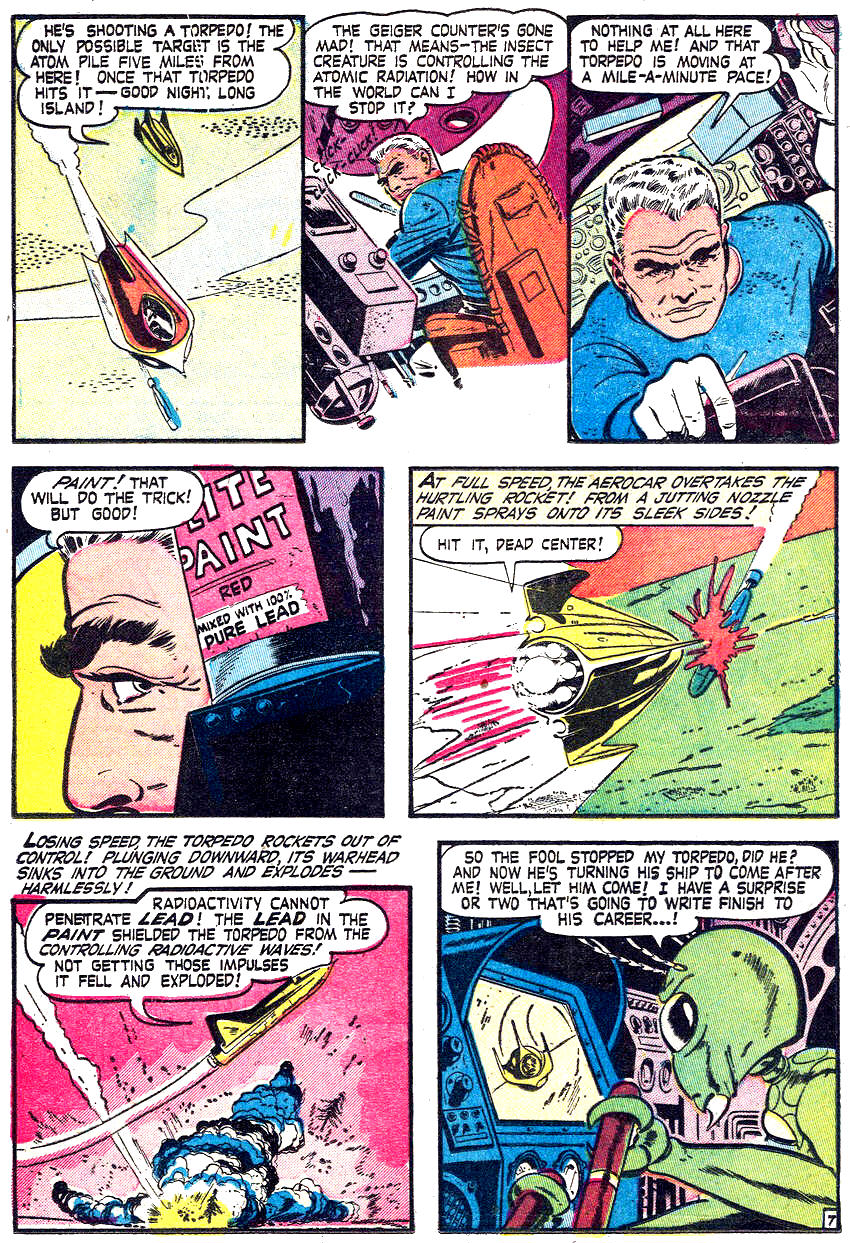
We learn in the third and final Jet Powers story from Jet #1 (1950) that Jet is an environmental disaster. He not only uses the potent insecticide DDT but he carries around in his aerocar — a combination plane and space vehicle — a can of lead-based paint. Well, paint me red with lead and spray me with DDT...then call the Environmental Protection Agency.

But, of course, in 1950 both of these products were common and legal. DDT was taken off the market decades ago because it got into the food chain and killed more than the insects it was designed to kill, and we know that lead is bad stuff. But they didn't know that in 1950, and thank goodness for that, otherwise how would Jet Powers have figured to kill the big insect that is the advance bug for an alien invasion?

This is a re-scan of a story I showed years ago, drawn by Bob Powell. Other stories from Jet #1 were shown in Pappy's #1127 and Pappy's #1141.


A new entry in our "Uncollected Editions" series, where we look at single issues that might've made a collection, but never came to be.

There's nothing terribly significant about the "Cutter" storyline from Detective Comics #861-863, except that it stars the Kate Kane Batwoman and it was written by her creator and author of Batwoman: Elegy, Greg Rucka. "Cutter" holds some mystique because it was not included in Elegy even though the issues followed right after those that were collected, and because it completes Rucka's Batwoman work with DC Comics.

When I read Elegy, I was vocally disappointed that "Cutter" wasn't included; having just read "Cutter" alongside Elegy, however, the reasons are fairly clear. Artist Jock does nice work on "Cutter," a preview as it were of his unforgettable chapters of Batman: The Black Mirror, but his thin lines and minimalist style are starkly different than J. H. Williams's lush spreads in Elegy. Also, while "Cutter" is interesting, the "Go" storyline that completes Elegy is Rucka's real Batwoman triumph.

In essence, I probably would have found "Cutter" to be a discordant note had it been included in Elegy, and maybe it's better that "Cutter" was set aside, especially for bookstore buyers who wouldn't ever miss "Cutter" if they didn't know it wasn't there.

"Cutter" is a story told, masterfully but somewhat confusingly at the outset, at two periods of time -- one, when Batman Bruce Wayne searched for a missing heiress, and the second as Batwoman stalks a serial killer (Rucka's Batwoman stories, you'll recall, came while Bruce Wayne was "dead" after Final Crisis). This makes it, kind of, the first team-up between Bruce Wayne and Kate Kane, though that "really" happens in the first volume of Batman, Incorporated (or in Batwoman: Hydrology. With Flashpoint, some of this is a little confused).

Through a number of split pages and panels, Rucka parallels Batman's work with Jim Gordon and Batwoman's work with Maggie Sawyer, and how each vigilante underestimates their prey and gets in over their heads. (With no offense to Jock, I imagine Williams would have done wonders on these split panels, as he did with the final Batwoman/Alice fight in Elegy.) The juxtaposition of "new" and "old" Bat-hero is interesting, though maybe a little less so since Bruce Wayne is both alive and New-52ed, and also I'm not sure Rucka makes any statements here that really crackle. Rucka's parallel in Elegy of how Batwoman does not sneak up on a friendly doctor whereas Batman would (as detailed in Elegy's text pages) says more about the differences in personality between the two heroes than does anything in "Cutter."

What will be of most value to Batwoman fans is that "Cutter" takes place directly after Elegy and so contains the fallout from various lies and revelations there, though not in any significant fashion. Moreover "Cutter" guest-stars Kate's cousin Bette and addresses Bette's former life as Flamebird, so Flamebird fans or those curious about Kate's familial connections will want to take a peek.

"Cutter" does not get into how Kate's stepmother, Cathy or Kathy, appears to have been the former Batwoman Kathy Kane even though the stepmother is only a Kane by marriage -- this is covered somewhat, again, in Batman, Incorporated, though even there it's fairly vague. I have not yet read the first DC New 52 Batwoman collection, Hydrology, but I wouldn't be surprised if the Bette Kane material and maybe much of "Cutter" is ignored entirely -- in DC New 52 continuity, Flamebird Bette Kane or at least her significant connection to Dick Grayson and the Teen Titans must certainly no longer exist. [UPDATE: Bette Kane is in Hydrology as Flamebird, she just wasn't apparently a Titan.]

Therefore, inasmuch as there's joy simply in sitting down to read a story starring Batwoman and written by Greg Rucka, probably only purists need to apply. Uncollected, "Cutter" slips from the canon and it's unlikely it deserved a place in the canon anyway; if you find these in the back-issue bin, enjoy, but imagine them like apocrypha and nothing more.

More Batwoman on Thursday with the Collected Editions review of Batwoman: Hydrology. Doug Glassman's got a new Marvel review tomorrow -- see you then!
Tony Daniel is the kind of writer/artist that the reader wants to root for. Having made a name for himself at DC Comics drawing Teen Titans and Batman RIP, Daniel went on to become the writer/artist of Batman: Battle for the Cowl -- attractive, without a doubt, but melodramatic and with poor characterization. Daniel followed this, however, with the absolutely stellar Batman: Life After Death; here, Daniel would seem to be growing as a writer, and he also make good use of continuity as to suggest true Batman fandom.

Daniel's follow-up to Life After Death, however, Eye of the Beholder, wasn't quite on the same level. It was clear Daniel could offer exemplary work, but the results were hit and miss. Daniel's next project would be relaunching Detective Comics, veritable DC Comics's flagship title, for the New 52 -- which Tony Daniel would show up?

The answer, in a twist Two-Face would love, is "both of them." Readers are advised to read the first four chapters of Batman -- Detective Comics: Faces of Death and then wait a day before reading the final three chapters, such to effectively split this book in two. Daniel's first half of Faces of Death is brilliant, shoulder-to-shoulder with the work Scott Snyder is doing on Batman; the latter half of the book is weird and convoluted, and hopefully not a sign of things to come.

[Review contains spoilers]

Daniel succeeds, especially in Faces's first chapter, in relaunching Detective Comics for DC's new era. In contrast to Snyder's Batman: The Court of Owls, which included Batman's cadre of Robins and their various continuity eccentricies, Daniel's Detective might be considered "Batman classic," the book you could give to any reader (or, perhaps, fans of The Dark Knight Rises) and they could understand it easily -- Batman, Commissioner Gordon, Alfred, and the Joker are the main actors here.

Daniel's first issue is New 52 by way of Batman: Year One: Batman, in his New 52 suit of armor, fights toe-to-toe with the Joker over the Gotham rooftops while the Gotham police take shots -- at Batman. Daniel's Batman is a more public and ostentatious Batman than we're used to, and also one far more criminalized by the Gotham police than he has been in years under the "old" DC Universe. This is a little off-putting because it's harder to jibe with the "old" DCU (sure, the police hated Batman when he first emerged, but still, five years later?), but at the same time it keeps Daniel's Detective generally in line with Geoff Johns's portrayal of things in Justice League: Origins, which will be comforting to new readers.

Where Daniel takes a step farther is in that not only the police, but also the citizens of Gotham (as influenced by corrupt Mayor Hardy) also dislike the Batman. A crowd, which must be meant to be reminiscent of the "Occupy" movements, gathers in a Gotham park to protest Batman having seemingly killed the Joker; in Joker masks, they decry Batman as a vigilante and the Joker as a symbol of the "common man." This is a different challenge for Batman -- not just protecting the citizens of Gotham, but protecting the citizens who actively reject his help -- and it will be interesting to see it play out. With Daniel leaving Detective after the next book, however and no similar such plotline in Snyder's work, it's hard to know if Gotham's attitude toward Batman will remain consistent or change with the next writer.

Gore is no substitute for a good storytelling, but Daniel manages to combine both -- Faces of Death is gory, earning it some derision at the start of the DC New 52, but Daniel's gore builds suspense, it is not gore for gore's sake. The Dollmaker cutting off the Joker's face not only underlines the danger of the Dollmaker character, but casts a pall over the story in general -- among a couple of masked characters, the reader is never sure if the Joker might be hiding underneath. Daniel's comparison between the Joker's torn-off face and the Shroud of Turin also opens possibilities that overshadow the gore of the image -- concepts such as that the Joker's face itself might contain evil, or that it becomes a totem for his followers, are so engaging as to justify the gore needed to get to that point.

After four issues, however, the main Faces storyline gives way first to an unrelated short story, and then to a lackluster Penguin story. A series of gangsters are ripped off, leading up to an attack on the Penguin, though it turns out to have been a plan by the Penguin to bump off his competition. Penguin's assassins are Snakeskin (so close in powers to Clayface that this ought have been Clayface) and a woman named "Jill" (given with differing last names in the story, which might be a mistake).

Jill, Daniel first reveals, is the sister of Charlotte Rivers, a nosy reporter and Bruce Wayne's current main squeeze (Catwoman, the story acknowledges, notwithstanding); then, in an overwrought scene with Batman, that Jill is also the illegitimate daughter of Mayor Hardy. Given that Bruce has dated Charlotte for nearly seven issues now with no foreshadowing of Charlotte's relationship to Hardy, the revelation of Charlotte's parentage, by proxy, is too sudden to be shocking. Hardy himself is a character much discussed but never seen, such that it's hard for the reader to react on any emotional level to this news about him.

At this point Daniel's story is far afield from anything having to do with Batman and his allies; Batman's pitched battle with the Dollmaker's goons while Commissioner Gordon lies bleeding is considerably more riveting than Batman shouting "Don't move!" and "Too late!" at the Penguin and Jill.

Further it seems a new inker comes on for the last half of the book, making Daniel's art less crisp and more distorted than the earlier pages. In the early pages, Daniel's art looks how many wish Guillem March's would -- thin, artful lines benefited by coloring that resembles watercolors, but without the gratuitous sexuality inherent in March's work. Daniel's may be perhaps the definitive artist of Batman's new costume, depicting the lines and seams of the armor more distinctly than Greg Capullo on Batman (though Capullo is no slouch either).

Batman -- Detective Comics: Faces of Death begins better than it ends. The beginning -- the DC New 52's new Detective Comics #1 -- may be what matters most, and if that's the case, Tony Daniel has done his job. The end slips, but with such a good beginning, one has to keep their fingers crossed that in the second volume, the Daniel from the first part of this book comes around again.

[Includes original cover, Tony Daniel's sketches and penciled pages]

Later this week, more from the DC New 52 Batman universe with the Collected Editions review of Batwoman: Hydrology. See you then!

I'm showing this five-pager from DC's Unexpected #176 (1976), because of the artwork of Jess Jodloman. Jodloman was one of the artists who were part of the Filipino invasion of the early '70s. Because they were already fully formed as artists when their work appeared in the States they stepped right in as total comics professionals. I visited a table at an early '80s San Diego Comicon with stacks of art by Filipino artists, all for the bargain price of $15 a page! I chose some of the best I could find, and page two of "What Haunted Herbert" was one of them.


Jodloman's busy brush inking style wasn't especially well served by DC's printing in the '70s. I saw a lower quality of printing at the time, where fine lines got broken up and details got muddy. I wish I could have afforded to buy more of the fantastic original Filipino artwork by Jodloman and the others I thought were also excellent artists. In retrospect, even at the time $15.00 wasn't much to pay for pages like this, but I was on a budget. Ah, to be rich, a one-percenter loose at a comic convention!


Zzed was a villain who fought Airboy more than once. This story is Zzed's first appearance.Zzed is an immortal who has been around a couple of thousand years. He cannot die until the world ends, an event he's trying to bring about. That's pretty heavy stuff!

Ernie Schroeder drew the stories Zzed appeared in. I've shown a two-part story featuring this character, which appeared a few months after this issue. In the bass-ackwards way things work in this blog, they are in Pappy's #1120 and Pappy's #1121.

From Airboy Comics Volume 6 Number 12, 1950: