If you're spending a little time in front of the computer this holiday, or if holidaying isn't your thing, we've got a Collected Editions open thread for your chatting enjoyment.

Suggested topic? Tell us about all the loot you got today, or this past week, or heck, any time you got a gift -- or talk about anything at all. It's a Sunday Talkback post -- go at it!

Number 1076


A Dan Dare Christmas


"I saw three spaceships come sailing in,
On Christmas Day, on Christmas Day;
I saw three spaceships come sailing in,
On Christmas Day in the morning..."


Merry Christmas to all you Pappy readers. We're sailing across the pond to the United Kingdom via our online "spaceship" to celebrate the holiday, with a strip from the 1955 Eagle Annual, featuring Frank Hampson's Dan Dare.

Dan Dare was published weekly in Eagle in the UK. I like the strip very much, and especially the beautiful painted work of artist Frank Hampson. I'll refer you to some websites: Frank Hampson.co.uk and the Wikipedia entry on the Eagle comic paper, where Dan Dare appeared.

What ties this strip to Pappy's is that the Eagle was created as a more wholesome response to the American horror comic books introduced to that country by American GI's stationed in England, and British sailors bringing back comics they picked up in U.S. ports. American comics weren't the only things imported that caused alarm. As I recall, a couple of years later there was this little thing called rock 'n' roll...

Happy Christmas to all!


Here's a vintage Pathé newsreel story about Hampson. Just click on the picture:

DAN DARE


**********
Creig Flessel, one of the earliest of the comic book journeymen, left comic books and after a stint as an assistant to comic strip artist John H. Streibel on "Dixie Dugan" went to the advertising agency, Johnstone and Cushing. In the heyday of comic art many ads were drawn comic art style by top comic artists (Lou Fine, Milton Caniff, Noel Sickles among others). The real money was in advertising, where pages were drawn for hundreds of dollars rather than a paltry few dollars at the comic book companies.

Beginning in the early 1950s Johnstone and Cushing provided the 8-page comic supplement to Boys' Life magazine. Flessel did this two-page adaptation of Dickens' A Christmas Carol for the December, 1952 issue. It boils the story down to 23 panels, but the tale is so familiar we just fill in the details in our own heads. Flessel's artwork is outstanding. Flessel worked for many more years in various fields of comic art and advertising. He died at age 96 in 2008.


Number 1075


The Great Tubbo


In this John Stanley story from Tubby #9, 1954, Tubby invites Gloria to go with him to see a stage hypnotist. He gets to the ticket office before he realizes he has no money. A normally smart boy, his enthusiasm for a date with Gloria has temporarily rendered him stupid.

Well, girls have been known to do that to guys. I've mentioned before that Tubby lives in much the same fantasy-state my head was in when I was that age. Such was John Stanley's genius I found reading Tubby's exploits to be more like channeling my own life. Maybe other kids felt the same. A big difference between Tubby and me is I didn't have those little men from Mars to help me out of a jam.


[Guest reviewer Zach King blogs about movies as The Cinema King]

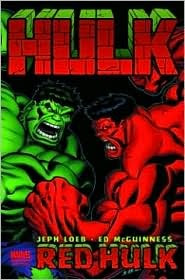
In the midst of a universe-wide reboot over at the Distinguished Competition, I wanted to check in with Marvel and see if I ought to jump on board any of their titles, too (as if I'm not not already spending too much on comics every week). I won't deny that the advent of the Marvel Cinematic Universe has led me to dive into Marvel comics, and the appearance of a few creators I recognize from my life with DC made Red Hulk seem as good a place as any to begin.

There are only two things you need to know about the first volume of Jeph Loeb's collaboration with Ed McGuinness on Hulk: there's a new Red Hulk in town, and he's about to fight with as many Marvel characters as he can in the six issues collected in Red Hulk. After Abomination is murdered, apparently by a gun-toting Incredible Hulk, General Thunderbolt Ross and Leonard "Doc" Samson discover that Bruce Banner hasn't escaped captivity since his rampage in World War Hulk.

Enter the Red Hulk, Abomination's true murderer and the Marvel Universe's "Most Wanted" for a six-issue slugfest with Iron Man, Thor, The Thing, and even Uatu the Watcher -- before Bruce Banner "hulks out" and takes on his new nemesis.

I came to this title with Jeph Loeb as a favorite writer but the Hulk as one of my least favorite Marvel characters (blame two lackluster feature films in the last decade). In fairness, I've never read a Hulk comic book beyond the six Loeb volumes and Loeb's collaboration with Tim Sale on Hulk: Grey, not even the original Stan Lee/Jack Kirby issues. The good news about Red Hulk is that I didn't need to. Loeb starts a new storyline with a new status quo (and a new #1 -- there's a bit of that going around on my comics reading list) and doesn't get bogged down in story-stopping continuity.

There's no question Red Hulk takes place in a larger universe, with an unfamiliar Avengers team and allusions to past storylines like Civil War, but Loeb smartly boils this Hulk story down to what every Hulk story has at its core -- large creatures brawling for pages at a time with stilted grammar.

To this end, Loeb is helped greatly by Ed McGuinness, whose exaggerated muscleman style is a natural fit for a Hulk story -- especially one with two Hulks. While his DC work (Superman/Batman, JLA Classified) was fun and cartoony, McGuinness is perfectly suited for drawing the Hulk, and now his unique style feels complementary rather than just entertaining. Not to slight colorist Jason Keith, but McGuinness does a solid job differentiating between Hulk and Red Hulk.

McGuinness's work with the other Marvel characters here isn't bad, either; his Iron Man and Thing have personality even behind their well-established looks, his Uatu channels Kirby without plagiarizing, and his Thor is as regal as he is intimidating. McGuinness is given plenty of double-page spreads to let his titanic juggernauts duke it out, and not a one of them disappoints.

Unfortunately, Red Hulk is filled with double-page spreads and wordless clobbering to the point that, despite being six issues long, the main story feels a little light. By the end, Red Hulk has smacked around everyone in sight, but even Hulk leaves the unconscious Red Hulk unattended -- a serious problem considering the whole story was about catching a murderer. The whole excursion feels like a popcorn movie, which isn't actually a bad thing. Red Hulk is a fun and entertaining read, but it's not (pardon the pun) terribly hard-hitting. This is quite clearly an opening salvo in a much larger story, and at this point the story is firing on all cylinders for excitement but remains a little light on content.

Taking a backseat to the action of Red Hulk is the ongoing mystery of the Red Hulk's true identity. At no point can the reader forget that Jeph Loeb is also the author of DC mystery mainstays The Long Halloween and Dark Victory, with red herrings and significant clues sprinkled throughout Red Hulk. Unfortunately, I had the identity of the Red Hulk spoiled for me long before I even bought this book (a spoiler I won't disclose until the sixth and final volume's review), but that made the reading experience a little more fun.

Knowing the who and not the how, I got a little more bang out of the red herrings Loeb throws in, trying to puzzle through them rather than simply scratching names off a list of potential suspects. To any reader, the identity of the Red Hulk should be fairly obvious, but when Loeb puts Red Hulk and the prime suspect in a room together, you have to wonder on what level you're being tricked. This act of "puzzling through" made Red Hulk more than just a mindless slugfest for me -- not that a mindless slugfest drawn by Ed McGuinness wouldn't be fun in and of itself.

The collection is padded out with two features of note. First, a Wolverine/Hulk story by Loeb and McGuinness that retells the infamous first meeting between the jolly green giant and Canada's own mutant. This story has no connection to Red Hulk at large and adds little to the relationship between these two characters; it's just one more opportunity to McGuinness to draw big men beating each other up, but it's done well with a curious allusion to the Ultimate Marvel Universe thrown in for good measure. The other feature is more entertaining, a few Tiny Titans-style "Mini Marvels" shorts written by Loeb's daughter Audrey, with three young Hulks (Red, Blue, and Green) in absurd but delightful comic scenarios involving zoos, finger paints, and swimming pools.

All told, Red Hulk was a good "first" experience for me, an easing into the Marvel waters with familiar creators and a new original storyline which has me hooked for the next volume.

To paraphrase our gamma-irradiated friend, "Zach satisfied!" Up next, Hulk goes to Vegas in search of the Wendigo while Red Hulk has his crimson keister handed to him by Marvel's loveliest ladies.

Number 1074


Man of Steel


Monday we had a story set in MLJ Comics' transition period from superheroes to Archie Comics, and today we reach back to MLJ's beginnings.

In his early days Superman was known as the "Man of Tomorrow" and MLJ's Steel Sterling was the Man of Steel. Sterling debuted a couple of years after Superman, in Zip Comics #1. Superman later became the Man of Steel.

Steel Sterling, as you'll see in his origin story from said Zip Comics #1, 1940, had a reason for being the Man of Steel. He jumped into a vat of molten steel and came out a superhero. I do not recommend you try this, but in comic books I guess it's as likely an origin as Superman arriving on earth as a baby from Krypton, or Eel O'Brien falling into a vat of chemicals and becoming Plastic Man.

The story is credited by the Grand Comics Database to Abner Sundell, and the artwork to Charles Biro, who later rose to fame (and infamy) by creating Crime Does Not Pay.*


*There is a text story in Zip Comics #1 with art by a young Mort Meskin, author uncredited. It's about the notorious kidnapper/murderer William Edward Hickman, executed in 1928 for a horrible mutilation killing of a child. It reads like something Biro would have used later in Crime Does Not Pay. When reading several online articles about Hickman I saw his victim was twelve years old, not eight as this two-pager says. Nowhere else but in this article did I read anything about Hickman taking a really long time to die on the gallows, while witnesses stood around watching him fight the noose by using his neck muscles. Did that actually happen, or is this some fever dream by a comic book writer?


In its last two volumes before the DC New 52 relaunch, Justice Society of America gets a new writer, Marc Guggenheim, and a new direction -- the signs of a series popular enough that fans have clamored for its inclusion in DC's new line, but not so steady as to have warranted a number of recent creative changes. Justice Society: Supertown is still a little rough around the edges, not exactly at the level where one might hope this book would be, but the finale is quite interesting and definitely left me eager for the next volume.

[Contains spoilers]

Just as Bill Willingham's Justice Society: Axis of Evil was largely a Mr. Terrific story guest-starring the Justice Society, Guggenheim's is really a Golden Age Flash story (Guggenheim also wrote, to much acclaim, the best issues of the otherwise abysmal Flash: The Fastest Man Alive), the story finds Flash Jay Garrick announcing his retirement (fitting, on the eve of the New DC Universe); by the end, however, he gains new purpose as the savior and incoming mayor of new DC locale Monument Point. Jay's journey from irrelevancy to ultimately setting an example of "responsible heroism," plus the upcoming political drama that the ending portends, are all quite engaging and speak good things for the book.

I also appreciated that the master villain in Supertown is one of the senators who forced the Justice Society to retire rather than reveal their identities in the 1950s. Though that story is often referenced, I've never seen it addressed as a plot point even though it's conceivable the government players might still be alive. Supertown also turns on a World War II fight between the Flash and the Golden Age Green Lantern over whether to murder a super-powered Nazi baby, a conflict that has consequences in the present day. Both of these elements make Supertown a story about the Justice Society, rather than just an adventure the Society goes on, and the story is better for it.

Unfortunately, Guggenheim lost me early on with a key element, and it shadows the book just a bit. The Society arrives in Monument Point because of "terrorist" threats made by the villain Scythe (though we never hear these threats nor does Scythe even speak all that much). Teen hero Lightning asks "Terrorists? Like, real terrorists? Like Al Qaeda-type terrorists?" Wildcat retorts, "Are there any other kind?" and Mr. Terrific says, "Actually, yes. But that's not what's important right now."

Fair enough -- the kid is ignorant, Wildcat is characteristically uncouth, and Mr. Terrific corrects them.  But then a page later, Green Lantern makes reference to Scythe's "politics" (quotes Guggenheim's) and adds "and I'm being extremely generous there, I know" -- and mind you, Scythe hasn't said a word yet. After Scythe disables Green Lantern, leaving Wildcat and Lightning to the fight, Wildcat says, "We'll take care of Bin Laden."

Now, it's comics. And I grant that Wildcat is supposed to say insensitive things as part of his "came up before political correctness" ethos. But without the villain of the scene saying a word, Guggenheim implies through jokes and innuendo (and the fact that Scythe, off-screen, apparently makes a statement on Al Jazeera television, though how he does so from Monument Point is tough to say) that Scythe is a Muslim extremest -- in fact, other parts of the story would suggest he's a Nazi, if anything -- when neither has much to do with his goals or character and Scythe might otherwise just be an angry behemoth. It's sloppy writing of the worst kind, in my opinion, because it uses stereotypes instead of characterization, and makes the Justice Society seem old and out of touch at the book's outset.

Guggenheim sets a nice ticking clock in the middle of the story when the Justice Society races (and fails) to prevent Monument Point's mayor's murder, but the villain here, too, is rather ill-defined. Guggenheim makes Dr. Chaos plenty scary, but also somewhat ludicrous. This old man fights the heaviest hitters of the Justice Society -- Hourman and Citizen Steel, for instance -- to a standstill, and Guggenheim never offers a reason why. I appreciate that Guggenheim creates new foes for the Society (I don't need to see the Society fight Icicle or Johnny Sorrow again), but I appreciate the villains making sense (even comic book sense); else it just seems Guggenheim arbitrarily twists the story for the needs of the moment.

Artists Scott Kolins and Mike Norton are each perfectly suited for the Justice Society title, their art more on the sedate side of the spectrum than an Ed Benes or Jim Lee. (Though Kolins offers a butt-shot of Manhunter that I thought there must have been another way to present). Like in the recent Superman/Batman: Worship, both Kolins and Norton's pencils are colored un-inked, giving the book a painted quality that again seems just right for the Golden Age Justice Society. I was glad, however, that Supertown is the penultimate Justice Society book when I saw Kolins's new Green Lantern costume -- it is meant as a shell for the paraplegic Lantern, but he comes off looking more like a Lantern baseball mascot than a superhero.

All of this contributes to Supertown's less than stellar rating; it is good, but I would not call it great. Guggenheim's implied criticism in the book that superheroes never clean up their messes (as the Society prepares, initially, to abandon a decimated Monument Point) is an old chestnut addressed before (and if anyone wouldn't be guilty of it, I'd think it would be the Golden Age heroes), but I like the action it spurs the Flash to, if not the impetus itself.

My hope for the next volume, Monument Point, is an Ex Machina-type political story; to see the Justice Society set themselves up as a real society, with a town of their own, sounds like a fitting closing arc to me.

[Contains original covers. Printed on glossy paper]

Later this week, guest poster Zach King Hulks out with a new review. Don't miss it!

Number 1073


IN the swim with Betty and Veronica

Were you startled by the new look Betty and Veronica?

Check out a 1947 interpretation of our pulchritudinous pair from an artist who signs the splash page I.N., and is in fact Irving Novick. Irv did Black Hood strips for MLJ. He later did extraordinary work at DC.

At the time Harry Shorten was the editor, and there's an in-joke about "Shorten's Beach." The writing was on the wall at MLJ as they made the transition to the Archie teenage comics they're still living on. Maybe Irv wasn't getting enough work after the postwar demise of the superheroes, and Shorten gave him the assignment.

It's a fascinating strip, if only for Novick's artistic interpretation. Did he do any more of these?

From Archie #27, 1947:


Betty got herself into a similar situation ten years later, in Archie Annual #9, 1957-58.