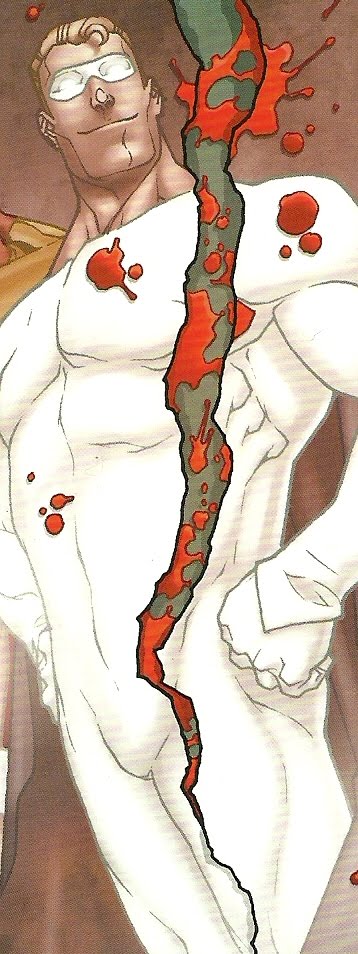
concluding last Monday's piece, and with the warning that spoilers lurk below;
 11.
11.I need to take a moment to pause and digress here, because I'm just about to discuss what I suspect may be some intensely political aspects of Ms Simone's script for "Welcome To Tranquility", and it really is important that I explain what I'm trying to do first. Anything else and I may run the risk of appearing to argue a point that it's certainly not my intention to.
It will seem even more of a digression if I start by discussing Elliot S!
Maggin, but I assure you I'm staying true to my point. For Mr
Maggin was once generous enough to leave a comment on this blog following a piece in which I argued that it was probable his prose work on his first Superman novel has been a considerable influence on Alan Moore. It remains an essay I'm pleased with in content, if not style, because the similarities between some aspects of Mr Moore's scripts during his years working for DC Comics and that of Mr
Maggin's writing in "Last Son Of Krypton" really are remarkable, and to my knowledge unmentioned elsewhere. Yet for all that I was sure there was a high probability of some kind of influence, I knew I couldn't prove it. I'm a social scientist by training, and a quarter century of degree work and teaching has left me constitutionally unable to say "I know" unless I've got the incontrovertible evidence before me. And in the case of the relationship between those two fine writer's work, I didn't have that evidence, and so I qualified what I wrote.

Mr
Maggin's response was as forthright as it was thrilling to receive. Of course the influence was there, he said, and he advised me to be braver with my writing, to argue my case with more conviction. It was, he said, what he told his writing students.
Now, I can absolutely see the virtue of Mr
Maggin's advice, but I don't believe that it's always appropriate to avoid tempering an opinion with a measure of doubt. For one thing, I've never been a blogger who was motivated by the desire to declare how right I am so much as one who's quite desperate to avoid being wrong, and one of the worst thing that an amateur can do, I believe, is to claim that they know what a creator was and is thinking and feeling simply through a supposed close reading of their work. Social scientists receive a great deal of flack these days, but the most effective of them never claim that they know anything, because they're aware that they surely don't.

Why am I saying all this? Well, I'm just about to discuss one particular reading of "Welcome To Tranquility", and I want to make it clear that I so very well know that it's just my opinion of Ms Simone's work that I'm stating, rather than any truth about Ms Simone's politics at all. I've not felt uncomfortable so far discussing the theme or the social content of
WTT, because I think that any discussion of such fairly general issues merely emphasises the text's fundamental decency. But now that I'm going to touch upon what I suspect may be a specific political target of
WTT, I think it's a good time to throw my hands in the air and declare
mea culpe. Not to avoid criticism, because I really do think that the following has some small measure of validity, but rather because I can't possibly know whether what I've surmised is even one or two per cent vaguely correct.
And I don't think that any blogger has the right to say "this
is what a writer believes
and what a writer intended" on something as personal as a specific issue of politics without also writing "but I'm probably wrong and I know that and I'm sorry if that's so".

We do live in impolite and intemperate times, and an admission of a lack of surety is sometimes mistaken for timidity rather than common respect and good manners. But the following is merely intended as a "what if?", as the opinion of a baffled blogger still relishing coming to terms with a tremendously enjoyable comic book, and as, perhaps, a conversation starter rather than a debate closer.
Mr
Maggin was almost 100% right. The influence of his work on Mr Moore's was so apparently clear that it'd be far more remarkable for it not to be so, and I ought to have been a touch more determined there. But here, I'd rather opt not so much for the self-preserving benefits of caution, but for the respect for others that caution can express.
If nothing else, it's an appropriate enough stance to take when discussing "Welcome To Tranquility".
 12.
12.I know that there's nothing that I've said so far which might justify my initial comments about "Welcome To Tranquility" carrying a political meaning which might irritate and annoy the gatekeepers of moral correctness on the far right. Yes, "Welcome To Tranquility" is undoubtedly a deliberately moral text, in that the virtue of
forgiveness and of its little sibling
tolerance are constantly recognised and reinforced, but such values are taken for granted today even as they're so often ignored. Indeed, forgiveness is so associated with the content if not always the practise of the fundamentalist religious mentality that few at the margins would care that Ms Simone was actually agreeing with the New rather than the Old Testament where the business of an eye for an eye is concerned. That's not where I'm suggesting the point of possible difference might lie.

Of course, "Welcome To Tranquility" is a social critique too, and yet the comic book contains almost as much social comment that might sit well with a conservative as with a radical agenda. It's plainly on the side of a woman's right to choose where abortion is concerned, but it also establishes a powerful argument for respecting the elderly and the traditions they've served. It's clearly respectful of law and order, just as it's distrusting of those who'd accept the holy relics and legends of patriotic legend without questioning their validity. And if it's clearly against homophobia, it's also obviously proud of the Republic and its citizens. Picking a fight with such a fair-minded work in these conditions would be more trouble than it was worth to all but the most pig-headed of opponents. For though "
WTT" is an allegory of a society which has lost something of its way, and which has done so in part because of a corruption throughout its social structure, it's also a narrative that's always designed to stress the fundamental decency of the Republic's citizens and of the shared core of their common values too.
But what turns "Welcome To Tranquility" from a general social comment to a specific political concern first becomes obvious in chapter 4, when Sheriff
Lindo discovers that the murdered gutter journalist Bug had stolen a copy of Ayn Rand's "The Fountainhead" from Mr
Articulate's home. From that point onwards, Ms Simone not only steams forward in carefully revealing the twists of her murder mystery, but she also names the guilty men, or rather, the guilty ideology, which has so debased the values which Tranquility has supposedly been founded upon, and which has so betrayed the citizens of the
"town of peaceful woods". And in doing so, of course, she suggests that that ideology is a similarly corrosive one in our world, in that world without Maxis and their kin.
 13.
13.As we've talked about before, "Welcome To Tranquility" is written in such a way as to be censorious of anti-social thinking, but it's never dismissive of the moral potential possessed by those who believe in such dangerously selfish ideas. And the knowledge that the kind and decent Mr Articulate may well be an Objectivist is used, I suspect, to empathise this very point. For although "Welcome To Tranquility" is a text which ultimately damns the ideology of Ayn Rand, and those ideologies bolstered by association with her thinking too, Ms Simone is extremely careful not to leap to the conclusion that Randians and their various fellow travellers can't as individuals be excellent members of the community, can't be decent citizens in themselves. So it is with Mr Articulate, as we've chatted of previously, though his attitude towards his own private wealth and advantage can be seen in the beautifully crafted inscription he left in each of his books;
"Please remember that loaned books are a joy to be treasured only BRIEFLY. Please return where found or stolen!" Mr Articulate has the good heart to share, but that doesn't mean that he's just going to give away his own property. (It's a stance which, where the matter of my own books are concerned, I can't help but agree with. My opinions on the excesses of wealth owned by those who control the commanding heights of the economy may well be a different matter.)
 14.
14.This copy of "The Fountainhead" most visibly functions as a vital clue in the mystery of who it is that's killing the citizens of and visitors to Tranquility, as well as hinting strongly at why the murders have been
occurring. For Mr Articulate has annotated its title page in such a way as reveals something of how the town has been built upon the Fountain Of Youth, and of how that source of inconceivably precious advantage has been seized by a small cabal of
Tranquility's leading citizens.

But, exquisitely, there's a wonderful further layer of meaning in the appearance of "The Fountainhead" in "Welcome To Tranquility". It lies in the relation of Rand's beliefs, and the many adaptations and popular mutations of it, to the scenes we see of the Liberty Squad's discovery of the Fountain far beneath the most beautiful and fecund of land, land which you might expect would be enough for anybodies ambitions to create a better world out of in itself. And it's a relationship between Rand and
Cragg and Fury that can first be seen when the reader is shown how the Fountain Of Youth is no fountain at all, but nothing more than a few drips of water on a subterranean wall;
"It was the fountain ... just a trickle, a few drops a day."And we're presented then with a room full of men - and they are
all men - who are so powerful and influential in their own right, for good or ill reasons, that you might expect that they already had well enough uncommon advantage for this life. And up until this point in their existence, these Maxi-Men have been, with the exception of poor mad
Cragg since his torture during the war, examples of self-sacrificing heroism which most any political
ideology might be proud to claim for its own. They've been generous and socially-minded citizens who despite their considerable might have chosen to serve the community to at least the same degree that they serve themselves. Whether radical or traditional in one's point of view, these Maxis might be claimed to represent any belief that's optimistic about how human beings might deal with power.

Importantly, there's no sense that "Welcome To Tranquility" is any way a text that suggests that typical human beings shouldn't possess considerable privileges denied to their fellows.
WTT is no leveller text, arguing that no-one should be allowed to amass uncommon amounts of personal advantage. As long as her
superfolks are serving the common interests of the community as a whole, and as best as they can, Ms Simone is absolutely happy to present them as admirable individuals who deserve the boons they've been granted by fate. And by extension of such a point, we might choose to believe that Ms Simone's work expresses not the slightest problem with individuals acquiring wealth and status and power through hard work and good citizenship.
But what
WTT seems to be concerned with is the difference between the rewards of hard work which has helped the community, and the accumulation of excesses of riches which deny the community that which it'd so clearly and substantially benefit from.
 15.
15.There are, argues Mayor Fury, some temptations which few men can resist;
"I'd never been tempted. I'd been offered the wealth of kingdoms to look the other way while some maxi-villain ran. But this was different. It meant living maybe dozens of years past my expiration date.."And so the super-folks who stumble upon Henry
Hate's discovery of the Fountain of Youth are faced with an extreme of temptation which can supposedly corrupt a fine heart. And the gravitational pull of corruption, just as with repentance, is of course a constant lure to the characters in "Welcome To Tranquility". As Deputy
Duray explains;
"You know anyone can break their beaks on a bad day."
For it's not that being tempted is sign of a degraded soul in
WTT, and even succumbing to temptation isn't a sign of moral damnation, as we've discussed, because this is a book about the possibilities for redemption that are inspired by the community's willingness to forgive. Those who've fallen are constantly proving themselves capable of turning their fates around. Dr Hate himself eventually repents of allowing Fury and
Cragg to retain their power and returns Maxi-Man's magic word. Mad Dog is welcomed into the opposition to
Cragg and Mayor Fury. And even Cosmos has been allowed to live in Tranquility despite his supposed responsibility for Astral Man's death, miserable on the periphery of society, but not constantly tarred and feathered for his presumed sins.
But what
WTT is deeply, fundamentally, opposed to is the shameless practise of hypocritically wrapping selfishness in the corruption of a moral myth. For Mayor Fury to take Astral Man's incorruptible and profoundly American values and use them to create a cult which disguises Fury's own considerable sins is something which seems to disgust Ms Simone. As she has Maxi-Man tell Fury before the book's climatic battle;
" ... you have disgraced yourself and this entire town."
Tranquility may in many ways be nothing more than window dressing disguising Fury and
Cragg's crimes, a kind of social housing
equivalent of false accounting, but its inhabitants largely believe in the values represented by the legend of Astral Man, despite the Mayor's cynical
appropriation of his example. For just as a liar's punishment is that they cannot ever believe that anyone else is telling the truth, so a cynical politician will mostly never grasp that the ideals she or he pays lip service to will inspire others to sincerely defend such principles. And Mayor Fury does seem bemused and baffled that everyone else can't understand that he had to do what he did. He knows that he was wrong to horde the Fountain's waters and deny others their use, and to effectively condone
Cragg's various murders too, but he also appears to really believe that no-one else beyond the saintly Astral Man would really have done any different. (Astral Man is thought of as "the best of us", rather than just one decent human being in a population of other like him.) It's an utter failure of empathy, to see most everyone else in the world as being both exactly like himself and yet also of far less worth than he is. Even his wife
Suze is discussed in terms of being an object to please him rather than a partner to cherish as an individual, as he shows when he describes how he'd considered the ways in which the Fountain of Youth might help the both of them;
"It meant never seeing my beautiful wife fading into senility and ill-health."It's notable that he doesn't care think of what his wife might want where this temptation is concerned. Her feelings and thoughts on the matter are irrelevant to him. He thinks instead of avoiding his own suffering, of an oppurtunity, tellingly, to side-step the agony of watching his lovely wife lose her beauty, of grasping at a chance not to have to care for her when the trials of their later years arrive. For all that he's fond of his wife, she's almost a pet, thought of in the terms of her effect upon him and
his desires for
her. Such unsympathetic and self-obsessed egotism inevitably results in everything and everyone being less important to him than Mayor Fury's own long-life and health, and so it's no surprise that ends his days of freedom beating his wife into unconsciousness and setting out to murder Colette Pearson.
Anyone that's that rich, and that corrupt, and that hypocritical, and that independent of democratic oversight, Ms Simone seems to be saying, will eventually if not sooner end up doing some quite terrible things to maintain their advantage.
 16.
16.The key to Ms Simone's
specific criticisms of modern America can be found, I believe, in the nature of the Fountain itself, in the words that she uses to describe it, and the scene she provides with Mr
Googe of the Liberty Squad debating how to put its few waters to use. It's such a cleverly-executed business that it at first went quite over my head, as indeed it should, because any political banners which can be obviously noted tend to throw the reader out of the story while reducing it to to a lecture. Yet, it surely can't be an accident that the Fountain's waters are described as
"a trickle", making the scene of the Maxi's discovery of the life-enhancing fluid as succinct an assault on
Randian economics as I can imagine in such a medium and such a genre. For the phrase "trickle down" is one that's
of course associated with Objectivist and other brands of right-wing economic dogma, with those strange beliefs that individual selfishness inevitably leads to general social advantage. Let the rich become richer, as a brief summary of the argument might go, and their example will inspire everyone else to become rich too. At worst, these virtuous and hard-working wealthy individuals of Randian legend will as a class of discrete individuals re-invest their riches in the economy, nobly sharing their surplus capital through the process of "trickle down".

It's a ridiculous argument, of course, and one which has constantly failed to work in practise just as its advocates have constantly refused to accept its invalidity. And it's this kind of uncaring and yet supposedly compassionate selfishness that perfectly describes how Fury and
Cragg justify their appropriation of the fountain. They're already incredibly
privileged and powerful before they stumble upon Henry
Hate's secret. They don't
need anything more in their life. Yet of the members of the Liberty Squad present at the Fountain's discovery, only Astral Man is willing to retain his former convictions and contend that what they're faced with needn't and shouldn't be a matter of private advantage.
The extremely familiar excuses that Fury and
Cragg provide for taking the Fountain for their own are perfect cartoon summaries of the broad justifications for "trickle down" as given in practise. Fury recalls, for example, how
"... there wasn't enough" of the trickling water for everyone, and from that logical observation seems to have immediately jumped to the illogical conclusion that if everyone can't
greatly benefit from such wonders, then just a few should have it all. It's not a logical or reasonable argument, but it is one which can ease the burden of a conscience. Neither Fury nor Cragg could claim to need the excess of years and

health, unless we define life as a process by which the individual seeks to get the
absolute maximum of advantage for themselves and damn everyone else, which is surely the opposite of the common, non-"Objectivist" version of the word "hero" . Certainly, the
conspirators never seem to have considered saving up the waters so that they might be used if some terrible disaster afflicted humankind, or using the Fountains trickles to study how the life-extending properties therein might be synthesised. (This is, after all, the
Wildstorm Universe, full of super-intellects and magical adepts. It's hard to believe that the Mayor and Cragg couldn't envisage such a possibility if they'd cared to.) And yet more social-minded solutions abound. Why not identify those individuals which humanity could least afford to do without? Perhaps another few years of Martin Luther King might have been a fine idea for everyone, for a start. Or, as a last or first resort depending on where one stands, perhaps the drops might be allowed to enter the world's water table, giving everyone and everything just a moment or two's better health. Anyone who's ever been laid low by pain will recognise how being saved from such suffering is arguably the greatest gift that can be offered, even for just a moment or two.
Or: the observation that everyone can't have a super-yacht isn't a justification for a few people having very big super-yachts indeed.
 17.
17.Cragg and the Mayor's response to the moral dilemna of the Fountain is to create a "compromise", and it's as hilarious and unethical as any extreme right wing economic thinking is;
"Each of us would get a drop a day forever. And one drop for the person we cared about most in the world, though they would never know. And the last few drops would go into the city's water supply at Six Mile Lake ... it would add years, not decades, to their lives."It's a fine example of "trickle down" indeed, and quite literally so too. For supposedly "free-market" ideologies, which claim to want to liberate all individuals to compete against each other without unfair competition, immediately creates cartels and monopolies, classes and interests, individuals passing on their advantage unearned to those they hold in the greatest favour. It's remarkable how that "trickle" of Ms Simone's fountain so precisely summarises the real-world effects of Randian thinking. Cragg and Fury's closest lovers and friends come first to them, of course. And then there's a class of the privilaged around them, the folks of Tranquility, who are allowed a tiny fraction of the cabal's wealth. And then, well, everyone else can just go hang, despite the fact that the fountain itself was discovered by chance, and stolen from its original discoverer, and used to shore up a town characterised by deceit, and murder, and hypocrisy. Virtue has nothing to do with the whole process of unenlightened selfishness, except to justfy the practise of it.

"Welcome To Tranquility" seems to me to be in part a critique, and a very elegant and witty comic book critique too, of the radical right wing ecomomic and political ideologies which associate themselves with traditional ethical and national values in order to facilitate their greed, in order to make their rapacious intentions more appealling for the less enlightened. For of course there's never enough of the most precious riches to go around, to make everyone a zillionaire. As Fury says of the Fountain's waters:
"How could there ever be enough?" But those rare riches could be used in ways that gradually help everyone, rather than in a fashion which brings the already powerful even more power, until the world becomes entirely theirs, and nobody elses.
 18.
18."Trickle down" in the world of Tranquility is the pernicious myth and practise that it is in ours. And just as in our world, the ineffectiveness of such policies for the mass of people is masked with a public ideology of worthiness. Cragg argues, for example, that stealing the fountain's waters will allow he and Fury to do
"good", but his definition of
good excludes everyone that Cragg doesn't approve of. And though Fury seems more consistently aware of what he's really doing, of his own corruption, he's still especially fond of the myth of his shining city on its hill. Tranquility is
"peaceful". and
"gentle". Why, look what a lovely world he's created! And as Cragg says, the cabal can
"stay their protectors forever", which is no doubt a wonderful salve for whatever ethical nature either of them has left. Of course, staying the protectors of their loved ones, who they made sure will get to live longest, and of the citizens of Tranquility, who get to live somewhat longer than they otherwise would, brings with it the fact that everyone else on the globe gains nothing from the whole matter at all.

This fundamental selfishness of Mayor Fury is something which Ms Simone quite fairly presents to the reader right at the beginning of "Welcome To Tranquility", when he explains his reasons for not locking up Miss Minerva,
"America's greatest aviator", despite the fact that she's been repeatedly crashing her jets onto the town;
"Minxy's designs won the war for us, Tommy, She's got friends in the White House and the Pentagon. And a personal net worth twenty times the value of this town."At first, this seems to be a socially-conscious, comic-book way of expressioning solidairy with the elderly. For on a sentimental level, it's touching to think that, yes, old folks who've served the community should be allowed to accidentally fly their jets into the town's streets and parks. And that unconditional concern for the elderly is part of the expectations of the concept of "Welcome To Tranquility" that was presented to the book's readers before its publication, because the comic was sold on the high concept of "a retirement community for superheroes", which technically it is. But WTT is more acurately a comic which uses the metaphor of such a town to discuss far broader social concerns as well. Yet the reader is expecting a tale about the rights of the elderly, and so quite naturally presumes that the superheroic leader of Tranquility must be expressing some morally decent values in granting Minerva such license. As a consequence, Mayor Fury's flim-flam gets swallowed by the reader as an example of civic-mided compassion for the elderly when it's his obvious skull-duggery which should register.

For it's patently ludicrous that Miss Minerva should be allowed to continue her unimaginably dangerous hobby, regardless of how noble a past and how beautiful a heart she possesses. And the reader is actually being shown not that Fury is a decent leader of this community, but that the law in Tranquility is whatever he says it is. Indeed, what matters to the Mayor, despite his fine words, is his access to political and economic power, and his own rather stomach-turning sense of his own warm-heartedness. Nothing else beyond that hierachy of self-interest counts.

What's more, the Mayor in that scene does what so many of the worst do, cloaking his self-interest in the scoundrel's flag of patriotism, evoking "America", World War Two, and "the White House", and he accentuates his old-world, folksy man-of-the-people image with his suggestion that Lindo joins him for
"sunday supper". In fact, he just can't stop representing himself as a fine human being deserving of everyone's faith. He's a peacemaker, having united the Maxi-heroes and the Astray, who, he declares, are "united" in their "fellowship" under his leadership of Tranquility.
But it's all snakeoil salesmen hookum, and far worse. And that's what Ms Simone is suggesting, I believe, about those whose behaviour exemplifies the ideology contained in the likes of "The Fountainhead". Selfishness doesn't promote social wellbeing, she seems to be telling us, with an equal measure of conciliation and exasperation, it simply enables even greater selfishness. For that book isn't just used in "Welcome To Tranquility" to throw a light on the conspiracy in the text, but also to suggest a parallel between Objectivist practise in reality and Fury's shoddy little deception in Tranquility.
And anyway, don't we already live in a world where the exceptionally rich live far longer lives in far healthier states than so many of their less affluent fellows? And aren't we so often told that they deserve that incredible reward for all they've done for the rest of us?
 17.
17.It seems to me that a great deal of "Welcome To Tranquility" constitutes a misdirection on Ms Simone's part, to keep us from noticing what's actually going on in the text until the "doh!" moment arrives, until the point where the story's mystery is resolved and the reader grasps that they need to read backwards in order to realise all that they've missed. That is, of course, what good writers are supposed to do, just as good magicians must, namely, hide the truth in plain sight while convincing the audience that something else of greater importance is before their eyes.
Perhaps the final irony of misdirection is the town's name of "Tranquility" itself. It was, said Mayor Fury to Collette Pearson,
"a peaceful, gentle town" with
"no secrets to keep", a quote I keep returning to for both its utility and its astonishing hypocrisy. But Ms Simone seems convinced that the myth of the semi-urban idyll, of the perfect America, is one of a whole number of myths not to be trusted. Certainly, "tranquility" isn't the be all and end all of what the
"Maxis and their families" living
"out their golden years" require. The aged citizens of Tranquility are as vital and vigorous and able as are those of our world. They've got far more to give than simply acting as nostalgic window-dressing to disguise the purpose of Fury's cabal, and they show that in their involvement in the common resistance to Fury and Cragg at WTT's end.

In truth, the town of "Tranquility" becomes a far better place to live the less tranquil it becomes. It's not that murder and mayhem and a war against tyranny are vital invigorating components of a healthy society, of course. Rather, WTT suggests to us that when things aren't being kept so deliberately quiet, and when the citizenry as a whole allow themselves to wake up and note the world around them, and to take action too in each other's interests, then Tranquility becomes that most inspiring of utopias, one based on constant hard work, debate, compromise, sharing, a lack of doctrine, and, yes, forgiveness.
A city which is set on a hill, after all, cannot be hidden. As the sermon on the mount says, it is the light of the world.
All of which might, if "Welcome To Tranquility" were held in the wrong hands and processed by the wrong mind, seem entirely unAmerican.
But then, that's where these pieces began .....
 And I still didn't get to talk about the ants! Oh, well. Splendid wishes at the moment of writing were bring transmitted to all who'd even glance at this piece. And I continue to hope that others stick together with you as you do with them. Next time, we'll be chatting about a rather different proposition indeed, and you'd be very welcome to pop in, should you at any time care to.
.