Number 191


Arrrr! Hangman talks like a pirate today


September 19 is Talk Like A Pirate Day. Here at Pappy's we like pirates and like to arrrrrrgghhh along with Robert Newton in Treasure Island.

This Hangman story is from Hangman #8, Winter 1942-43. But the pirates are from 1498. You'll just have to read the story, because I can't explain it. All I can say is, it's vintage Golden Age comics. It's drawn by Bob Fujitani, signing himself Bob Fuje. He's drawing in his early style. Within a few years he'd adopt a more realistic, illustrative style. As you can see from some of the panels, a lot of his influence for the drawing in this story came from Will Eisner.

After you've read the story, mateys, swing your cutlasses, shake your pirate booty and holler arrrrrgghhh in honor of Talk Like A Pirate Day.


Thanks to 1506NixNix for the scans.


Number 190


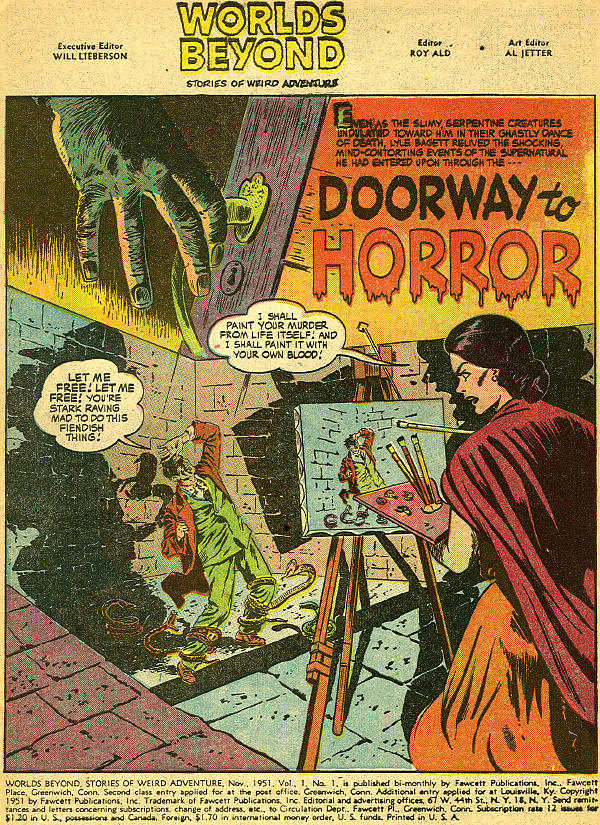
Sheldon Moldoff takes us through the Doorway to Horror!


When I first encountered organized comics fandom in its early phase, 1961, there was a focus on the DC superhero comics of the early '40s, specifically All Star Comics, and Max Gaines' All-American line of DC's superheroes. Sheldon "Shelly" Moldoff, who was born in 1920, was one of the earliest of the stars of DC Comics, drawing lots of covers but best known in 1961 for the work he had done 20 years prior on Hawkman. He was revered for Hawkman. He used a lot of swipes from Alex Raymond's Flash Gordon, but to be fair, everybody swiped. At the same time he was being revered for that earlier work, he was being reviled for his then-current work, as Bob Kane's ghost on Batman. The fans who loved his stuff didn't know he was the same guy they hated.


If you read Moldoff's version of things, he was an idea man as well as an artist. He came up with the idea for horror comics, pitching the idea to Bill Gaines, who--according to Shelly--took the idea and ran with it, leaving Moldoff drinking from his cup of bitter gall.* Oh well…you win a few, you lose a lot. Moldoff took his ideas to Fawcett, and after EC's horror comics took off, Fawcett published his horror stories.

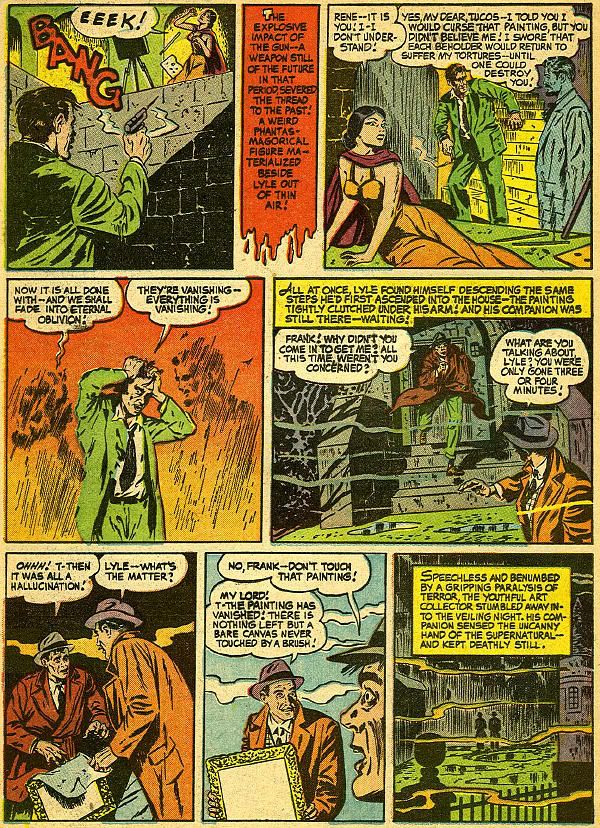
This story, "Doorway to Horror," from Fawcett's Worlds Beyond #1, dated November, 1951, is a fairly typical story, but it's a good solid entry in the horror comics annals.

Shelly also drew the cover. Click on it to see it full size. It illustrates a story done by Bob Powell and posted in Pappy's #110.

Sheldon Moldoff was one of the cartoonists who made the Golden Age what it was. He and his peers worked hard for little money, they made their deadlines, they weren't flashy, but they were professional and dependable. In my opinion, "Doorway to Horror" is one of Shelly's better jobs. I think he enjoyed the horror work, the deep shadows, the whole noir atmosphere. It may have been in an artistic sense what would have attracted him to Batman.


*Tales Of Terror!/The EC Companion By Fred von Bernewitz and Grant Geissman, Fantagraphics Books, 2000.

Number 189


How I went Mad in the 1950s


As a kid I never kicked and fussed when Mom took me to the grocery store, because it gave me a chance to stand near the magazine rack and paperback book spinner, ogling the sexy covers. On one occasion in 1955 or thereabouts I spotted a book I'd never seen before, The Mad Reader.

I opened it up to the first panel of Wally Wood's "Superduperman" story, and the rest, as they say, is history.

The problem is, as much as I wanted this book, and I wanted it really, really bad, Mom wouldn't buy it for me. Mom was aware of the talk about evil comic books turning children into juvenile delinquents, and while she let me read comic books she approved of (Uncle Scrooge, Little Lulu, etc.), she wasn't about to let me go over the line to something like Mad.

I went home disappointed, then my obsessive-compulsive disorder kicked in. When I wanted something as bad as I wanted this book I usually kept up a whining, obnoxious pleading until my parents caved in. Since Mom had said no, I went to my dad. Dad was usually more easygoing when it came to things like this. Listening to me bellow, snivel and whine for about an hour was all it took. He went to the store to find the book for me.

It's said that Mad, in its original comic book incarnation, was a flop saleswise until issue #4, which had the Wood "Superduperman" story. From that time on Mad became a cult favorite. Even my future brother-in-law, who was in in high school in the early '50s, bought Mad, as did his buddies. Mad was real gone! It was hep! I didn't know any of that, though. I just knew that I recognized who Superman was, I knew who the Lone Ranger was, I knew the comic book character, Archie, and I loved the grotesque, funny artwork of Wally Wood, Bill Elder and Jack Davis. They took all of those familiar characters and turned them inside out and upside down. They turned them into jokes. From that book I went on to the other Mad paperbacks, like Mad Strikes Back, Inside Mad, and Utterly Mad. From the time I first held these books I was hooked, a junkie to the drug of Mad-ness.

Mom's problem with Mad was the effect the drawings had on her, which was the exact opposite of the effect they had on me. She claimed they "made her head spin." They did that to me, too, just in a good way.

Take "Starchie, "Bill Elder's version of Archie. The art is very close to the original. The people who produce the Archie comics like to tout their comics as being wholesome, but there was no doubt that the whole subtext of their comic books was some sort of triangular sexual thing going on between Archie, Betty and Veronica. The author and editor of Mad, Harvey Kurtzman, always went for the most obvious satirical elements of what he was lampooning, and that is the crux of this story, behind its more obvious elements of Starchie and gang as juvenile delinquents.

The Lone Ranger was a guy who traveled around with a Native American companion and wore a mask. As in this Mad version called "The Lone Stranger," he steered clear of womenfolk. One might ask why? And did he and Tonto share body heat around the campfire? Anyway, when I saw this Jack Davis panel of the Lone Stranger being chased by the ugly "girl," I laughed my guts out. Yes, the lady chasing the Lone Stranger is actually a man in drag.

I was a big fan of Mad in the 1950s, but the two entities, the Mad paperback books and the regular Mad, magazines being published every couple of months, were entirely different things. I wondered why, but didn't know why they were different until later when I found out about the two editors, first Kurtzman, then Al Feldstein, about the Comics Code, about the color comic book after 23 issues becoming a 25¢ black and white periodical. Much to my mom's displeasure, despite a lot of yelling, burning my magazine collection, and even her outright theft of mail-ordered copies of early Mad comic books, I didn't give up on Mad.

What happened to me with The Mad Reader, I'm sure happened with a lot of people in my generation: aspiring cartoonists, comedians, actors, whoever. Who knew that such brilliance could exist in parody and satire? Looking back on that book today I still see the sort of genius I saw many years ago the first time I pulled it off the paperback rack.


*The copy of The Mad Reader at the top of this page is not my original Mad Reader, which was destroyed by my mother at some point in the late 1950s. This is a copy of a first printing I picked up in California 20 years ago.


Number 188

The Not-Quite-Kelly


Howie Post is one of those comic artists who worked in the business for so many years his work is everywhere. This particular strip, from DC's Animal Antics* #9, July-August 1947, was drawn when Post was only 21 years old, based on his birth year of 1926. He started in comics when he was still in his teens, not as young as Joe Kubert or Frank Frazetta, but still a prodigy, as far as I'm concerned.

In his later career Post did a daily syndicated comic strip called The Dropouts, and Harvey Comics are filled with his pages, mostly in Hot Stuff. The Little Devil and Spooky, The Tuff Little Ghost. He has a very appealing style, full of action and humor, as this page from a 1976 issue of Hot Stuff shows.

Post's early art was inspired by Walt Kelly. According to Post he met with Kelly and comic book packager Oscar Lebeck about doing work for them. His method of inking and penciling was inspired by Kelly, but different enough that it is wholly Post. "Presto Pete" is a funny animal magician strip. I think it's quite good. I don't know if Post wrote his own material, but it's well done. Rather than being a clone of Walt Kelly, Howie Post went on to develop his own style, instantly recognizable. That is until he invented Anthro for DC Comics in 1968, where he went from funny devils, funny ghosts and funny animals to funny cavemen.


*Post mistakenly calls Animal Antics a book he packaged for Timely (Marvel), rather than DC in his TwoMorrows interview from Comic Book Artist #5. This is the danger of interviews with artists who have fallible memories stretching back five or six decades, or even more.


Number 187


The Waterboys


Here's something you don't see anymore: a monster story combined with Cold War jitters. "The Merman Menace" is from Forbidden Worlds #5, published by the American Comics Group, dated March-April, 1952. The writer is unknown, but according to the Grand Comics Database, the artist is Lin Streeter, about whom I know little. About all I could learn about Streeter is that he was active in comics from the early '40s until at least the 1950s.

You've gotta love having a monster pumped full of adrenalin and benzedrine to get him back up to speed, so he can get revenge on the Reds. It's in the story, folks. I don't make this stuff up.


Just as this giant merman is a survivor of an underwater city, so is Aquaman a citizen of Atlantis. He was born of an Atlantean mom and an American dad. He can stay out of water for an hour but then he has to be submerged again. His adventures had to be short because of that hour time limit, no doubt.

I was given the DC phonebook-sized Showcase Presents Aquaman, and have enjoyed reading a story or two a night. I read Aquaman stories in Adventure Comics in the 1950s and enjoyed them then, too. Of course, at that time I didn't really discern how gimmicky the plots are. I should have, because that was DC Comics in a nutshell: all gimmicks, all the time. Something I appreciate even more than I did 50 years ago is the artwork of Ramona Fradon. Ms Fradon had an excellent semi-cartoony style, perfectly suited to the somewhat zany plots.* Her panels are full of action and her sea creatures are great. In the 1960s I liked her work on Metamorpho and in the 1970s on Super-Friends.

My favorite story (so far) in the book is "The Undersea Hospital," reprinted from Adventure Comics #262, cover-dated July 1959. In this outrageous tale Aquaman opens a "hospital" for his finny friends, splinting a broken tentacle (!) for his octopus friend, helping a dogfish who chased a catfish and got in trouble. You get the idea. At the end an outrageous story goes right off the outrageousness charts when Aquaman is shot by some bad guys. The sea creatures help him: swordfish-surgeons cut into him, and sucker fish suck out the bullets!


After a tryout in Showcase (the comic book) Aquaman got his own book and the stories went totally bonkers, as all DC Comics did, with science fiction monsters and menaces. The Aquaman artwork went from Fradon to another great artist, Nick Cardy.

The current Showcase series of volumes is bringing back all of the old DC characters, the gimmick plots, the ridiculous and stilted dialogue, just as we saw them in the 1950s and '60s. At an affordable price, too. I hope you're joining in the fun and nostalgia of these great black and white reprints.

*The editor was Mort Weisinger, who showed in Action Comics, Superman, Superboy, Jimmy Olsen, Lois Lane, etc., etc., how much mileage a comic book editor can get out of a few gimmicks. The writer on most of the Aquaman stories in Adventure Comics was Robert Bernstein, probably best known amongst Golden Age fans as writer of Psychoanalysis for EC Comics' New Direction. Apparently Bernstein had psychological problems, had psychoanalysis, and elements of it pop up even in the Aquaman stories.

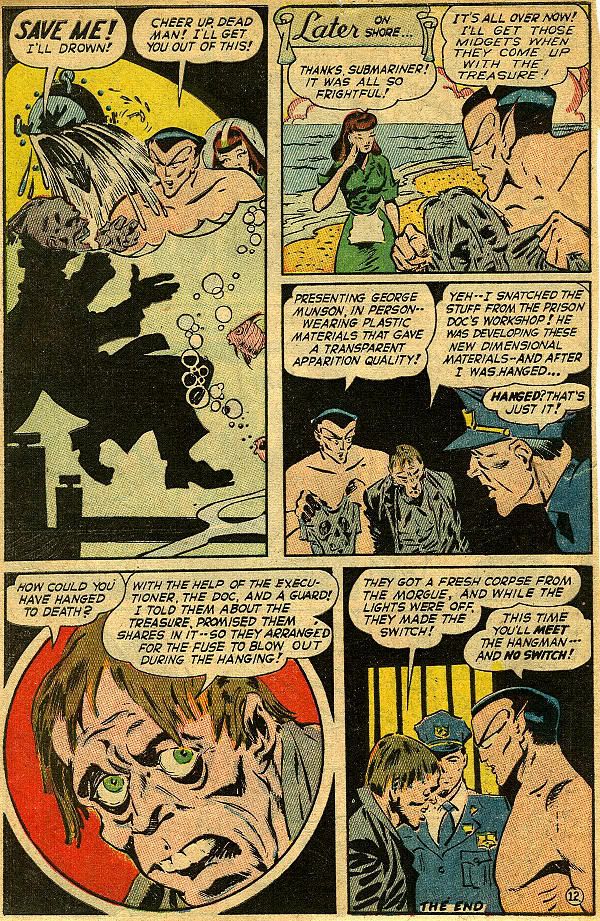
It's a bonus! If you've read this far then you deserve a treat. I'm enclosing an extra story about another famous half-fish, half-human hero. The story is from the late 1940s, and was part of the box full of comic book tear sheets I received years ago. I went through and assembled the complete stories, of which this is one. Comic title unknown, by a writer and artist unknown. (See note by reader Darci below.)