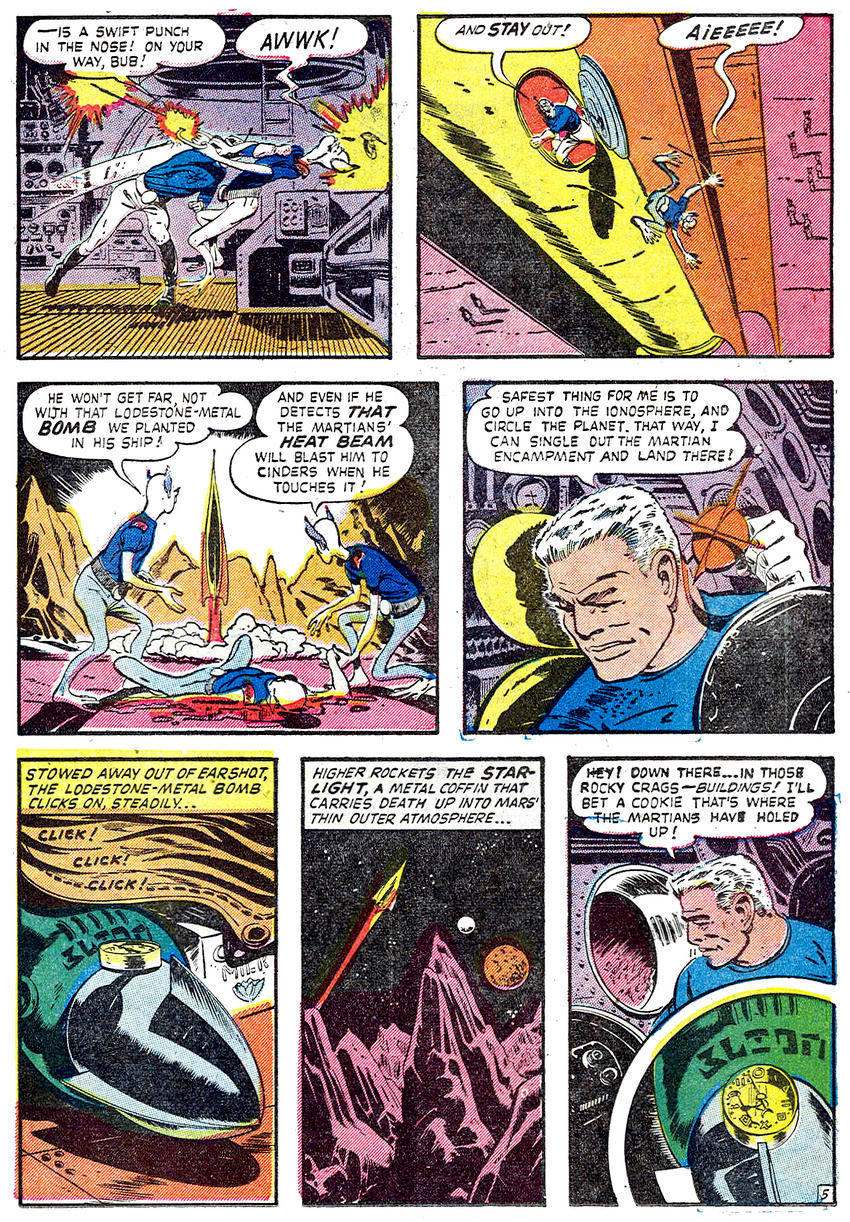
The story, “Savage World!”, although drawn by Al Williamson years earlier, was rewritten by Wallace Wood and used in the first issue of Wood’s prozine, Witzend, in 1966. Apparently readers were confused about the genesis of the story, about Al Williamson’s friends (like Roy Krenkel, Angelo Torres, Frank Frazetta), who would chip in to help on a job. Wood included this paragraph in Witzend #2:
The “long since defunct” comic book Wood refers to is Buster Crabbe.

I couldn’t find my copy of Witzend #1 (someday I’ve just got to get organized) so I scanned it from its appearance in Marvel’s black and white magazine, Unknown Worlds of Science Fiction #1 in 1974.


What we understand at the end of Green Lantern: New Guardians Vol. 2: Beyond Hope, which concludes Tony Bedard's first year on the title, is that probably most of the ongoing story could have been resolved in the first trade, if not for a couple of tangents on which Bedard sent the characters. This was true for Red Lanterns, too (though Bedard's story is better); one imagines an edict that each Green Lantern title simply needed to fill twelve issues and get the characters to a certain point so that the first New 52 Green Lantern crossover could take place. Certainly that's what this collection feels like, looking at it in total.

At the same time, despite its circuitous plot, New Guardians remains a perversely enjoyable series. As I mentioned in my review of the first New Guardians collection, Bedard offers a compelling team of fan favorite characters who are fun to see interact and begin to coalesce as a team, even despite how goofy Bedard writes, especially, Green Lantern Kyle Rayner. New Guardians is a book like cotton candy -- brightly colored and momentarily satisfying; even if it doesn't stay with you for long, there's something about it that's strangely addicting.

[Review contains spoilers]

The first volume of New Guardians took the characters from Earth to Oa, to Larfleeze's home planet Okaara, and then to the orrery of the alien archangel Invictus; in this book, the characters move from the orrery to Earth, to the Blue Lanterns' planet Odym, and then back to Okaara. We learn that, despite blame having been placed variably on Invictus and Larfleeze for stealing the Lantern rings that were delivered to Rayner, they actually came from the rogue Guardian Sayd, hoping that Rayner could help free her companion Ganthet from the other Guardians. This effectively means that the characters arrived at the solution to their mystery on their third stop in the first book, and much of what else was found in New Guardians -- including their fights both with Invictus and with Larfleeze -- were mere distraction, threads that marked time but didn't truly move the story forward (near as I can tell, Invictus has yet to be even seen since this story).

That's to New Guardians's detriment, though keen plotting was never the book's strong suit to begin with -- Bedard's Rayner continues to call a vast selection of aliens "dude" and is surprised when Glomulus, whom we all know is meant to be an extension of Larfleeze, reveals to Larfleeze Rayner's secret plans.

Instead, the strongest points of Beyond Hope are Bedard's use of two of the perhaps-strongest characters going in, Sinestro Corpsman Arkillo and Blue Lantern Saint Walker. Bedard gives Arkillo something of a profile issue here, as he discovers himself to be the last member of the newly-eradicated Sinestro Corps. Bedard also gets points for using the Weaponer, who appeared last in Bedard's so-so Green Lantern Corps: Weaponer storyline, but who is stronger and more interesting here with his keen weapon-generating powers.

As with a number of other New 52 Vol. 2 books, New Guardians features a crossover, theirs with Bedard's Blue Beetle title. Rayner's encounter with Blue Beetle Jaime Reyes affects that title more than this one (hence why the Blue Beetle issue is collected here, but no New Guardians issues are collected in Blue Beetle), but it leads into a separate storyline in which the beetle scarab's creators, the Reach, attack the Blue Lanterns and Odym.

Though this is, again, a tangent that ultimately comes to nothing, it allows Bedard to spotlight the Blue Lanterns and Saint Walker, and especially to put the hope-powered Blue Lanterns in a situation we haven't seen before -- one where it seems hopeless for them. Like Green Lanterns and fear, hopelessness threatens to decimate the Blue Lanterns, and Saint Walker clinging to false hope only makes it worse. The Blue Lanterns prevail through Rayner's help, but what emerges is an angrier Saint Walker, slipping some of his Blue Lantern cool, and this is an engaging turn for the character.

Arkillo and Saint Walker continue to gain each other's characteristics -- this was more apparent with Arkillo in the first volume, and more apparent with Saint Walker here. I'd be eager to see Bedard continue to explore these characters together (a Saint Walker/Arkillo special, anyone? The Blue and the Gold?), though I wonder if the constraints of the upcoming Green Lantern crossovers will allow it.

It's a tad difficult to know who's doing what to whom in the Green Lantern universe without a scorecard. Generally everything bad that's happening in Green Lantern, Corps, New Guardians, and etc. can be laid at the feet of the Guardians, trying to eliminate their Lanterns before the rise of their new Third Army, though I do wish New Guardians would give us a better sense of all of this. Stealing the rings, we know, was Sayd, but we're never quite sure who brought Invictus into the Lantern's universe, though "the Guardians" is a pretty good guess. Ditto who might've lead the Reach to Odym; Saint Walker blames Larfleeze (for no specifically good reason), but we never learn the truth.

It's still, however, bunches of fun to see Green Lantern Kyle Rayner interact with Star Sapphire Fatality, Red Lantern Bleez, and especially with Saint Walker and Arkillo. Even despite that Bedard writes an exceptionally annoying Rayner, one can't help but be taken in by Rayner's so-cheesy-it's-compelling avowals that the various Lanterns are stronger together than they are alone; when Rayner questions Weaponer because he's not "one of them," we get the sense Rayner sees a family in these other Lantern misfits that he can't find elsewhere. What Green Lantern: New Guardians Vol. 2: Beyond Hope offers is an old comics trope in multi-hued packaging; this is far from the strongest Green Lantern title, but it does have a certain charm.

[Includes original covers]

Coming up it's Green Lantern: Rise of the Third Army, plus the next volume of Brian Azzarello's Wonder Woman.
[Review by Doug Glassman, who Tumblrs at Hell Yeah '80s Marvel!]

One of my favorite shows, Castle, is returning to the airwaves in a few weeks, so I thought it would be apt to review one of its tie-in graphic novels. Comic book tie-ins to prime-time shows are increasingly popular, with Heroes being one of the largest efforts (and one of the rare cases where the comics often ended up being better than the show). Since Castle revolves around a writer, it was a natural fit to turn some of Richard Castle’s books into comics. In an unusual move, the comics, such as Castle: Richard Castle’s Deadly Storm, actually “adapt” the novels Castle wrote before he met Kate Beckett at the start of the series, when he was still writing the character “Derrick Storm."

There are two reasons for this. Firstly, the “Nikki Heat” books he’s currently writing in the series are being turned into real-world mystery novels. Both Richard Castle’s Deadly Storm and those novels, such as Heat Wave, do an excellent job of representing themselves as artifacts from the television series. Only a few Castle television series and ABC network logos spoil the effect; when the graphic novel appeared as a prop on the series, they were replaced seamlessly with Marvel branding. A foreword by Castle credits writers Brian Michael Bendis and Kelly Sue DeConnick as the “adapters." The prose novels actually go further; the real-world ghost writer not only isn’t credited, but no one knows who he or she is!

The other reason why the Derrick Storm novels are adapted as comics is because they are more action oriented. Because the “Nikki Heat” books are based on a detective’s adventures, they make better mystery novels. Also, because the characters in those books are based on the actors on Castle, it would be distracting to essentially read an episode of the show while watching the wrong people act it out. Storm is drawn to look like Nathan Fillion, while female lead Clara Strike, who in the show is based on CIA agent Sophia Turner, looks like actress Jennifer Beals, who portrayed Turner. I’m not sure if the latter is a happy accident or if Beals had already been cast in the role while the graphic novel was being drawn.

Derrick Storm is a private investigator turned inadvertent CIA operative, aided by his handler Strike. It sounds hokey, but that’s actually the point. Unlike many “quirky civilian and straight cop” shows which present the oddball as a genius in their field, Castle is repeatedly referred to as writing pulp novels and “beach reads." It’s a distinction highlighted on the series when Castle plays poker with real-world mystery writers like Stephen Cannell and James Patterson, who often spoof their own writing techniques in their discussions with him. The tone, which tends to bounce between jokey and overly-serious, reminds me a lot of Clive Cussler’s Dirk Pitt novels, which my father was an avid reader of and which I read a lot of back in middle and high school.

Storm gets sucked into the world of the CIA when his private eye work investigating a cheating husband takes a strange turn. He ends up pulled into a plot involving rogue agents, stolen gold, and Central America. Clara keeps sneaking around in various disguises, while Storm’s father provides wisdom and comic relief. That Storm has a father as a character and a dead mother is a meaningful reversal from the show, where Castle never met his father but his mother is an ever-present live-in character. It also has a reveal predicated around Sophia Turner’s appearances in season 4 and events in season 5. For a dramedy series about a writer, Castle has a fairly strong sense of continuity, which extends to its tie-ins.

This is a rare book where the best part isn’t the story itself, but the extras, which help turn the book into a true prop from the show. Aside from the foreword, there’s an “about the author” page in which Castle regales us with the books he wrote as a child. A script-to-page section shows how Bendis and DeConnick’s words were interpreted by Lan Medina ... and how they were supposedly adapted from the novel. Medina is a good artist, but the breakdowns show that the inks could have benefitted from a lighter hand. Chris Eliopoulos uses a blocky font to denote that the “narrator” is pulling lines right from the adapted material. I swear, I don’t seek out books that are done by Eliopoulos; he just keeps showing up in a lot of the really good Marvel works in the last few years.

The absolute best extra, though, is the catalog of other books by Richard Castle. First is a listing of the rest of the Derrick Storm books, and it seems like in each of them, Clara dies, only to come back in the next book. For some reason, I find this hilarious, especially since she dies at the end of Deadly Storm. I don’t mind spoiling this because it’s not a huge surprise; Strike is on the cover of the next book, Storm Season. I’m also impressed that Bendis and DeConnick were able to come up with a dozen workable pulp novel titles featuring puns on the word “storm”; I probably would’ve given up after eight. From there are the rest of Castle’s novels, including the old ones he wrote under a pseudonym and which were name-dropped in the first episode of Castle. All of these feature suitably pulpy mystery cover images, including the first four “Nikki Heat” novels.

While there isn’t a lot here for someone who isn’t a Castle fan, for those who are in on the joke, Richard Castle’s Deadly Storm is a fun tie-in. (If you’re behind on the show, TNT airs re-runs in the afternoons on most weekdays.) Both Marvel and the show’s production team clearly put a lot of work into creating it.
In my next lifetime make me a Frenchman, so I may be “born to love.” As Andre LeBlanc says on the cover of ACG’s Lovelorn #2 (1949), “It’s in our hearts — in our blood — part of our life!” Andre is being dramatic; love is not under patent by the French. (Love aside, the other reason I could be a Frenchman is I own a beret.)


Laura Matthews, an acting student on scholarship to the Sorbonne in Paris, meets Andre after he insults her while she is singing in a café. He says she has a “stupid American crow’s voice.”  This is a love comic, so besides the stereotypes, complications abound, including Laura’s hometown boyfriend showing up unexpectedly after Laura becomes engaged to amorous Andre.

Sharp-eyed comics fans will notice Andre LeBlanc, the mustached cad of “Lure of Latin Love,” is also the name of a longtime comic artist. LeBlanc was a journeyman in the American comic book industry for many years, working with Eisner, Dan Barry, among others, and even working solo on projects like The Picture Bible. Could using his name be some sort of inside joke on the part of the writer? Our story is signed by artist John Belfi.


It's hard to say much that's specific about Matt Kindt's Mind MGMT Vol. 1: The Manager without spoiling the whole thing. It is in the conspiracy theory genre, owing its roots to shows like The X-Files (and certainly earlier than that) though perhaps stylistically having more in common with Lost (beyond simply Damon Lindelof's introduction). It has an element of meta-fiction to it, a la David Foster Wallace's Infinite Jest. Mind MGMT, for another comparison, might be what Cameron Stewart's Sin Titulo (which I'll be reviewing soon) would have been if it were an ongoing series, or vice versa if Mind MGMT were a webcomic.

Mind MGMT requires more from the reader than I originally expected. A keen eye, for one, but mostly patience. The core of the book is a mystery, and that mystery does not unfold quickly. I understand Kindt conceptualized Mind MGMT as a book readers would want to read in monthly installments so as to be able to pore over and discuss the book's puzzles; for me, this would have been tough. While reading, I considered I might have dropped the series around the third issue; having finished, however, I'm keen to pick up the soon-to-be-released second volume. The message is, if you're going to read The Manager, commit to reading the whole thing before passing judgment.

Though the story is difficult, it's hard to beat a creator-owned book written and also drawn by that creator (ditto for Sin Titulo), and Kindt's sketched-out style is nicely different than anything else you'll find on the stands today.

[Review contains spoilers]

Many, though not all, of the concerns I had about Mind MGMT were solved by the book's conclusion. What exactly has Meru been doing with her life since her first bestseller? If she wasn't on Amnesia Flight 815, why does she seem so out of it? Why does she take for granted the existence of talking dolphins, or that Bill is a CIA agent working for her best interests? I'm still a little fuzzy on the Bill part, but the rest we get -- it's because Meru has done all of this before and so she's operating with a certain amount of deja vu, which the audience, at least at the outset, doesn't have the advantage of.

The payoff is sufficient for the reader's struggle, but reading the book is not without said struggle. Meru isn't a well-defined character -- we don't know her likes, dislikes, friends, etc. -- and at some point as she runs hither and yon across rooftops with Bill, trying to escape the Immortals, it's hard to care about Meru as a character beyond watching a good action scene. Additionally, of the six issues, almost a full two are given over to the origin of Mind Management agent Henry Lyme, such that Meru is less the protagonist than simply the vessel through which Kindt delivers the reader Lyme's story. Much of this, again, is cleared up by the end, but the overall effect causes Mind MGMT to lack the depth of Saga or Sin Titulo, though that's plenty good company to be in.

I even wonder, with no foreknowledge of what's coming up, whether Meru will remain this book's protagonist, or if Kindt will focus on another character in the next book. Having read some of Kindt's two-page profiles of other Mind Management agents, I can see there's plenty other stories to tell in this world (as Brian Vaughan sometimes turned the focus to characters other than Yorick and company in Y: The Last Man), and it would not surprise me if Kindt set Meru aside for a storyline or two, though I'd be equally glad to have her in the next book for the audience to learn more about her now that we have a clearer picture what's going on.

What makes Mind MGMT remarkable is what also makes books like Watchmen remarkable -- the sheer volumes of extraneous artifacts the author creates for telling the story. In the case of The Manager, this is mainly the Mind Management Field Guide rules that Kindt prints along the side of nearly every page, almost 120 of them in all. This certainly required a considerable amount of planning and plotting, as each rule ties tangentially to the action on the page. Though this is one of the things that "sold" me on Mind MGMT, I'm ready for Kindt to try a new "trick" in the next volume -- it was entertaining but at the same time sometimes distracting to have to read the side of the page every page, making ongoing scenes seem stilted.

The book is at its most effective, however, when the rules on the side of the page begin to morph into secret messages that speak directly to the reader. The reader becomes a character, as it were, holding this "found object" of the guide pages. It seems relatively clear in the book that when Meru writes about what she learned from Lyme and mails it to herself, she actually writes it, but art factors strongly in the book (the animal that everyone is drawing), so perhaps The Manager is meant to be Meru's ultimately-lost pages, or even perhaps her writing is being "translated" to images for the reader via some Mind Management technique. The idea of The Manager-as-hastily-scribbled-notes goes to explain the particular "sketched" look of Mind MGMT, too.

Perhaps, between Mind MGMT and Sin Titulo, this kind of paranoia-laced secret government agency tale is reaching market saturation; at the same time, I can't help but be sucked in. In its middle, Mind MGMT Vol. 1: The Manager doesn't offer as much detail as I'd like, but its final question -- how will Meru surmount the tricks of her own mind? -- is very enticing. I'll stick with this one for the next round.

Green Lantern reviews coming up later in the week. Don't miss it!

Henry Kujawa of the Professor H’s Wayback Machine blog did me a big favor by coloring a black line strip scheduled for today. “Sally the Sleuth ‘Winning Her Stripes’” was scanned from a reprint in Malibu Comics’ Spicy Tales, but was originally published in the pulp magazine, Spicy Detective, in 1942. Henry did a great job enhancing the strip. He didn’t have the greatest copy to work with...the blobby black line is because the strip came from a pulp magazine, where drawings were reproduced on paper a step below what most of us find in our bathrooms. During printing the ink hit the porous pulp paper and spread into the fibers, making fine lines next to impossible.

Thanks to Henry. You can see more of Henry’s handiwork in his blog, where he does restorations of comic book covers, and even the “Tales of the Great Book” feature from Boy’s Life.

The artwork is credited to Adolphe Barreaux, art editor of the Spicy titles. Those titles were published by some of the same folks who gave us DC Comics, and were more than a shade on the seedy side. They upset postal inspectors and bluenoses of that era. The titles were soon changed from Spicy to Speed, and in my opinion lost about 90% of their desirability. But, that was then. Cheesecake, even slightly kinky cheesecake involving spies with whips and sexy girls who are out of their clothes more than they are in, seems a lot tamer now than it did 70 years ago.

To go along with Sally, we have Dan Turner, the Hollywood detective. It’s also signed by Barreaux and by writer Robert Leslie Bellem, who had a gift for slang-filled dialogue like, “Butched! He’s defunct!” which will probably make more sense when you see it in context.

Sally is from Spicy Tales #2, and Dan Turner is from Spicy Tales #4, both from 1988:


***********
More Sally and Dan! Click the picture:


In June I showed a continued story from ME’s Jet # 3 and #4 (1951).* I mentioned at the time there was another continued story started in #3 and finished in #4. It was the first time I’d seen that. In the first two issues of Jet the continuations were within the issue.

“Interplanetary War” has Jet interceding in a war on Mars. Jet, being a very resourceful guy and way ahead of other Earth people, has his own rocket ship. It allows him to travel to the red planet...in two days!

“Interplanetary War” and “The Fleets of Fear” are written by Gardner Fox and drawn by Bob Powell and his staff.


 **********

*Click on the pic to see the story.