I showed the first story from Avon’s Wild Bill Hickok #1 (1949), drawn by Jimmy Thompson, in December, 2012. You’ll find a link to it below the scans for the second story, “Cheyenne Campaign,” also drawn by Thompson.

In this story Wild Bill meets up with Buffalo Bill and even George Armstrong Custer for a fight with some Indians on the warpath. You read dialogue like “. . .those red fiends will...get our scalps...” and “Every shot must be a dead or wounded Cheyenne!” and realize this is one of those stories with casual racism common when Westerns were at the height of their popularity. My apologies to those who may be offended. It was fairly standard fare for its era, but made vivid by Thompson’s excellent and action-packed drawings.


**********

Read more about artist Jimmy Thompson. Click on the picture to go to another rip-roarin' story:


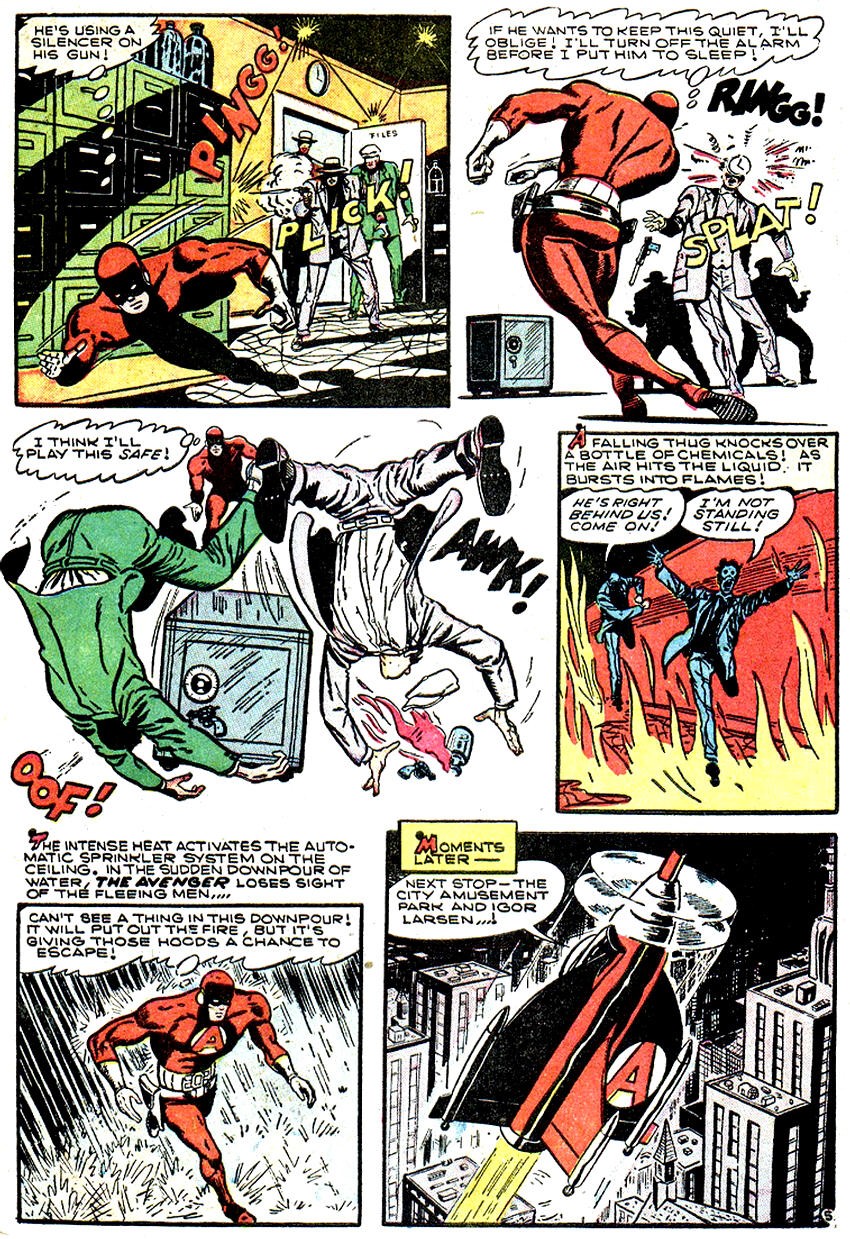
The Avenger was really “millionaire scientist” Roger Wright, who apparently had nothing better to do than run around in a bright red skintight costume with hood and mask, fighting commies. That’s the premise of both of these stories, taken from The Avenger #1 (1955), published by ME Comics in the wake of the Comics Code. ME (Magazine Enterprises) had been publishing Ghost Rider, drawn by Dick Ayers, but GR didn’t fit into the new Code-world, so they tried a couple of superhero comics. The Avenger (four issues) was one, and Strongman (also four issues) the other. The Avenger #1 was drawn by former Ghost Rider artist Dick Ayers for issue #1, and Bob Powell for subsequent issues. In an unusual twist, the origin story of The Avenger is held until the last story of the issue, after we've already seen what the guy can do in action. Another unusual twist is that The Avenger is inspired partially by a Ghost Rider mask (!!) Roger bought for his nephew. Those masks were sold in ads from ME. So it’s an early example of product placement.

The Grand Comics Database gives veteran comic book scripter Paul S. Newman credit for the writing.


[SPOILER ALERT] Comics Code influence shows significantly in the origin story, where Roger’s brother and sister-in-law have been killed by the commies in East Berlin. Yet even though Roger has the guy responsible for the deaths, he leaves without doing any avenging. Before the Code I believe he would have taken him up in his autogyro and dropped him out, or some such vengeful act, but after the Code, nuh-uh, nope. If anything happened to the bad guy, it isn’t shown, and we have to use our imagination. [END OF SPOILER]
We have reached the last of our Funky Funnies theme week, with entries from Basil Wolverton, Bill Holman, Gill Fox and now from the team of Richard E. Hughes and Ogden Whitney, who created one of the greatest 1960s comic characters, Herbie Popnecker. Herbie has a perfect camouflage for his extraordinary powers: a corpulent body, a blank look through his goggle-eyed lenses, an obsessive-compulsive need for lollipops. No one should mistake his appearance for who he really is. Herbie is much more than what meets the eye. Among things like the power of levitation and ability to talk to animals, Herbie knows famous people. In this story he encounters Ava Gardner and Gregory Peck. He even demonstrates to Gregory how to properly kiss a woman. It's just all in a day's doings for our “fat little nothing,” (as his cruel and verbally abusive father, Pincus Popnecker, calls him). Herbie is very attractive to the opposite sex, as we see here and as we have seen in the past when he's had dalliances with none other than Elizabeth Taylor and Jackie Kennedy. In “A Caveman Named Herbie” he not only makes a starlet swoon, but he catches the eye of a prehistoric dreamgirl, Ticklepuss. Oh, that I should have Herbie’s charms! No woman would be safe!

It's all from Herbie #6 (1964):


**********

A couple more Herbie stories. Just click the pictures:


Stieg Larsson's Girl with the Dragon Tattoo Vol. 2 graphic novelThe second volume of Denise Mina's adaptation of Stieg Larsson's The Girl with the Dragon Tattoo is better than the first, both in plot and characterization. The second volume benefits from the principle characters actually meeting and working together, plus considerably more of the mystery unfolds. As well, Mina, with artists Leonardo Manco and Andrea Mutti, captures more of the characters' subtleties this time, especially in their dialogue, making for a volume that needed less careful parsing and offered more enjoyment.

[Review contains spoilers]

Though the first volume of this two-book series offered an interesting character study -- more so of Lisbeth Salander than Mikael Blomkvist -- it didn't ultimately feel like a satisfying read. Salander has an arc, in that she's raped by and then later takes revenge on her state guardian Nils Bjurman, but Blomkvist makes little headway in solving the disappearance of Harriet Vanger, and Salander and Blomkvist don't meet before the end of the book. The book felt less like Girl with the Dragon Tattoo and more like Before Girl with the Dragon Tattoo.

The second volume makes up for this, however, and indeed to read the two books together is to get a much better reading experience (I wish Vertigo had released these as one truly novel-sized book, or that they eventually will). Within the first fifty pages, Blomkvist's daughter helps him find his first real lead in the case, and soon after Blomkvist hires Salander to assist him; they're getting shot at (and in bed together) before page 100.

I haven't read Larsson's books in print nor seen any of the movies, so I can't say whether the same is true to the originals, but in the second part of this tale considerably much more happens, and faster, than in the previous volume. That Blomkvist and Salander solve their case helps in no small part for the second book to feel more complete than the first; it probably doesn't hurt that the second volume has twenty more pages to tell its story than the first, too.

That Blomkvist makes no progress in the case in the first volume makes his storyline feel less necessary, contributing to the first volume's unevenness; the mystery, as it were, does not drive the story in the first volume. Perhaps it's Salander's personal storyline that gets short shrift in the second volume, but she's involved so much one would hardly notice, and indeed the psychological effects of Bjurman's attack permeate this book even if he physically appears in only one scene.

Indeed, in the second book Mina puts the comic book form to greater use to drive the book and show the states of the characters than in the first book; this second book feels positively more like a translation than an adaptation. This is most prominent in the phantom voices that taunt Salander about her assault -- Mina and artist Leonardo Manco depict these in floating instant message windows, on the backs of cell phones and the sides of purses, really giving the reader a sense of how inescapable Salander's trauma is. I also noted and appreciated that the only two-page spread in the book is where Blomkvist and his daughter talk and Blomkvist makes his first progress in the case. Blomkvist's break is highlighted by the spread, and the specialness of the paneling underlines the importance of the scene.

Mina has an unenviable task in trying to bring forth two characters voices on the page, both of whom are somewhat unemotional or disengaged from their surroundings. In the first book, some awkward paneling made it difficult to discern Salandar's social difficulties, requiring the audience to read a page over and over to "get it"; the extent to which Blomkvist is meant to be taken un-seriously, as something of a cad, was completely lost. In the second volume, sequences like Salander talking to her boss or Blomkvist bedding the emotionally-unstable Cecila are more direct, without being unsubtle; in comparison to Cecila's lovesick weeping, Blomkvist's disinterest becomes all the more clear.

Here again, the words and images are working together better than before; there's fewer panels that don't move the story forward, and a greater amount of the characters acting on the page in addition to the dialogue.

Again, the twenty extra pages here benefit the story immensely. Blomkvist and Salander have dispatched the bad guy, if not solved the mystery, a little after page 100, and that gives Mina fifty or sixty pages to really let the denouement unfold. This includes a couple of travels overseas that tease out the mystery's solution to the end, but I found even more interesting Salander's paranoia over her role in dispatching the villain. What is a victory for Blomkvist at the end of the book is not a victory for Salander, as Mina shows in the last pages as Blomkvist celebrates while Salander disappears to the streets.

When I'd only read the first book I wondered about the wisdom of Vertigo adapting Girl with the Dragon Tattoo, as the first volume didn't seem to do enough to entice the non-comics reader to follow this series over two or three years. I still believe that; however, it equally seems to me that if a reader did return for the second book, they'll probably be enticed to get the third. Hopefully Vertigo plans a long game for these collections, released as individual volumes and then as larger collections or omnibuses (a collection of volumes one and two would be wise just before the third single volume comes out) -- the better reading experience is certainly in reading the two books together, getting the build-up and the resolution all together.

UPDATE: DC/Vertigo has changed their plans and the next book, Girl Who Played with Fire, will be released in May 2014 as one volume, not two. I think that makes a collected version of Girl with the Dragon Tattoo Vol. 1 and 2 even more likely.
Iron Man/War Machine: Hands of the Mandarin[Review by Doug Glassman, who Tumblrs at Hell Yeah '80s Marvel!]

The early 1990s era of Iron Man is something I enjoy despite its flaws, mostly because it was such a big part of my comic book collecting origins. The Modular Armor was brought to television as the base design of Iron Man: The Animated Series, which was one of the most influential shows in my childhood. When I was twelve, the very first back issue I ever bought was a copy of Iron Man #300 -- the Modular Armor’s debut. The issues from Iron Man, War Machine, and Force Works that form the newly collected Iron Man/War Machine: Hands of the Mandarin crossover show the Iron Man franchise right before its utter collapse.

At its core, Hands of the Mandarin consists of two stories: the Mandarin taking over China with the aid of an extraterrestrial weapon, and Iron Man and War Machine reconciling after a long period of mistrust and anger. The rift between Tony Stark and Jim Rhodes has a deep history, demonstrated by flashbacks to everything from Rhodey’s first appearance and his first tenure as Iron Man to the Armor Wars and the events of the War Machine trade. At the end of that book, Rhodey cut ties with Tony for not being in the loop about his faking his death. Now roaming the world as the violent vigilante War Machine, Rhodey needs Tony’s help to fix his armor -- by force, if necessary.

Meanwhile, the Mandarin lost badly to Iron Man in John Byrne’s classic Dragon Seed Saga (featuring Fin Fang Foom as one of the titular dragons). He’s now found a device called the Heart of Darkness, which rebuilt the hands he lost in the previous story with dragon-like claws and has increased his power immensely. Additionally, he’s gained a new philosophy on life, choosing magic over technology; his plan is to rid the world of technology entirely and rule over a new Dark Ages. It’s a bit of a departure from his old methods, but the Mandarin has always been a character in need to a purpose since the fall of Communism.

If the story had just been about Iron Man, War Machine and the Mandarin, then Hands of the Mandarin would have been a great success. Unfortunately, there was a third title in the Iron Man franchise which caused problems. Under the leadership of Iron Man and the Scarlet Witch, the West Coast Avengers decided to become a “proactive team” called Force Works. If the name and concept bring the infamous Extreme Justice to mind, it’s worth noting that the two titles were contemporaries. The Force Works parts of the crossover suffer from traditional '90s team book problems, such as uninspiring roster choices, combative members, and a lack of strong leadership.

The Scarlet Witch leads the team ... unless Iron Man is present, or unless U.S. Agent decides to go off and do his own thing. Supposedly, Wanda is more powerful than before, but her characterization is next to nonexistent. Julia Carpenter, the second Spider-Woman, also brings little to Force Works; it was disheartening to learn this since Julia was one of my favorite characters on the Iron Man cartoon. Even more depressing is U.S. Agent’s decline from a misguided anti-hero into a juiced-up goon.

Rounding out the team is Century, a spindly alien who has an odd verbal quirk of speaking in synonyms when trying to sound out concepts in English. Century has an interesting subplot in Hands of the Mandarin involving the theft of his staff, which makes him relive the memories of other people. This plot point is unfortunately not answered within the pages of this trade. Incidentally, his staff is called Parallax, proving that that word was the bane of comics in the '90s.

Most of the Force Works material consists of the team engaging in what '90s grim and gritty teams did best -- attacking a fortified base, in this case the Mandarin’s castle. It gets extremely spread out because extra pieces of the crossover were published in the Marvel Comics Presents anthology series. These short stories are told from the point of view of Force Works’s members but do little except pad out the story. Worse still, they take room away from what could have been important linking sequences, such as the rather abrupt ending. In a silly move, Marvel had an editorial policy banning curse words to make them feel more “mature” than upstart companies like Image and Dark Horse. As a result, people are told to “go to Hades” numerous times.

The biggest problem in Hands of the Mandarin is the art. The War Machine issues won the artist lottery with Gabriel Gecko (an alias of Hulk artist Gabriel Hardman) and Geoff Senior (known for his work on Transformers). Their art is a little above the '90s standard with far more consistent proportions and clearer action. Tom Morgan’s Iron Man work is full-on early Image, but still somewhat readable through the heavy lines.

Once again, Force Works is where it really falls apart, with numerous errors in proportions and even botched coloring, such as Scarlet Witch’s hair being colored purple many times. However, the absolute worst comes in the Marvel Comics Presents short stories. There’s a thin line between “art you dislike” and “bad art” The artwork in these short stories is so incredibly sloppy and poorly done that I think they should not have been published without heavy editing. There are points where Century’s face tattoos jut off from his face like horns, and others where U.S. Agent has a full-blown case of Liefeld’s Disease.

It may sound like I hated Iron Man/War Machine: Hands of the Mandarin but I’m really accepting of its flaws. There’s a great story buried under a veneer of bad artwork, and the Mandarin, Tony, Rhodey and even Century get some good character development. If you’re willing to accept exposure to early '90s artwork ranging from acceptable to utterly horrifying, you’ll find something to like here.
This is the third in our Funky Funnies week, featuring one of the most famous screwball comic characters of all time.

Smokey Stover was a long-running comic strip, around long enough to create a sort of cult readership who understood terms like “1506 nix nix” or “Notary Sojac.” Unfortunately, they came later in the strip, and aren't in any of the pun-filled silliness of the panels in these 1941 and 1942 Sunday strip reprints, found in Dell Four Color #64 (1945). We do have “foo,” which according to popular lore, led to the term “foo fighters,”coined by U.S. airmen during World War II when encountering UFOs in the sky during night raids. In turn that led to the name of a popular rock band, much removed in time and culture from those events of decades ago, including the Smokey Stover strips that were the ultimate inspiration. (That is, if you ignore the speculation that “foo” from Smokey Stover came from the French word “feu,” meaning fire.)

Whatever! It doesn’t matter except to an addled comic book blogger who likes things, including screwball comic strips, kept in context. But what is really important is that Bill Holman was a funny guy who kept the funny stuff coming, panel after panel, page after page, year after year.


More Smokey here. Just click on the pics.


Batwing Vol. 2: In the Shadow of AncientsFans of Azrael Jean Paul Valley or Batgirl Cassandra Cain who haven't taken a look at Judd Winick's Batwing, should. In the second collection, Batwing: In the Shadow of Ancients, Winick continues to present a Batwing David Zavimbe who fights for justice not as Batman does, out of a sense of personal injury, but rather out of a sense of atonement. Zavimbe has blood on his hands, as Azrael and Batgirl did before him, and his struggle against evil is also a struggle for his own redemption.

Winick's stories here range from an issue that was so good it made me want to stand up and cheer, to some that are less notable, but the book is carried throughout by Winick's strong depiction of Zavimbe himself. More's the pity Winick only wrote two Batwing issues after this one; I'd have been curious to see what Winick would do fifty issues into Batwing and beyond.

[Review contains spoilers]

Ancients begins with a two-part story, illustrated by Streets of Gotham's Dustin Nguyen, which concludes the "Massacre" storyline from the first Batwing book, The Lost Kingdom. I read that volume over six months ago and all that time I thought, as the Batwing character did, that I knew the villain Massacre's identity -- boy, was I wrong. I'm happy to say Winick fooled me both with Massacre's identity and with the identity of the mastermind behind him; what had seemed like a too-obvious solution previously was actually a red herring. Real surprises in comics are rare these days, especially for trade-waiters, and Winick lands a good one.

What is especially fantastic about the revelation scene in the second chapter (Batwing #8) is that Winick bucks any number of super-villain cliches for some crushing emotional honesty. For as bloodthirsty as Massacre was in Kingdom, once Batwing reveals Massacre's identity and moreover when he speaks Massacre's real name, the villain becomes completely distraught. Winick could have chosen defiance, but instead he gives Massacre a childlike panic that fully embodied the trauma that Massacre has gone through. These are gripping pages, begging for a later followup that unfortunately, without Winick, probably won't ever come.

The seven-issue collection also includes two single-issue stories. The first is Batwing's Night of the Owls tie-in issue, which at the beginning builds up a disgraced Talon assassin for Batwing to fight, but ultimately the Talon's history doesn't affect the story. As with most Night of the Owls tie-ins, the story is basically an elongated fight scene, and of them all it's Batwing's least remarkable issue.

The other single-issue story, however, is the book's Zero Month issue. So far in other titles these issues have worked best when they offer some "secret origin" aspect -- not just the character's origin but some detail that reshapes the character's present. Winick's story doesn't necessarily do that, but it does reveal how Zavimbe's assistant Matu Ba lost his eye, something I'd thought had happened well before Zavimbe met Ba and I was surprised to learn it was more recent. I think Winick also works to smooth a bit of pre-/post-New 52 continuity vis a vis Batwing and Grant Morrison's first Batman Incorporated book, too. Winick calls out to Frank Miller's Batman: Year One in showing Zavimbe's early crimefighting, as is only appropriate, and this is entertaining especially since the issue comes as a coda at the end of the book.

The larger three-part story that finishes out this book is interesting but rough, suggesting perhaps that Winick's strongest Batwing idea might have been in the initial Massacre pitch. Batwing and Nightwing solve a mystery involving a kidnapped nuclear scientist, at the same time that Matu Ba's estranged family is killed in Africa. These are each cogent threads separately, but then sends Ba to his family's funeral in a mystical, isolated African nation ruled by a warlord called Lord Battle, and as Batwing continues to solve his mystery, it turns out not coincidentally that Lord Battle is involved in the nuclear warhead story.

I say "not coincidentally" because the difficulty here is that in the three issues, all the pieces ultimately fit, and too neatly. Ba's family had barely been mentioned before now and indeed he's estranged from them all, so the slaughter of an entire family comes mainly for plot purposes; it does not seem to resonate in a larger, more "real" way for Ba or Zavimbe. Also, Lord Battle, with his on-the-nose name and giant hammer, comes off as a silly villain (especially after the legitimately-frightening skull-faced Massacre), not to mention his immediately-forgettable henchmen, the "Blood Storm," who are there mainly for the Justice League International to fight. The story starts off compelling, but the end is basically just an exercise in superheroes versus super-villains.

No doubt writing about the Batman of Africa, and making Batwing's stories seem realistic and germane to an African setting may be one of the toughest tasks of the DC New 52. Winick makes the book both moving and believable when he's dealing with child soldiers and even the African Kingdom superhero team that stands between the government, the warlords, and the people's revolution. The Batwing title seems to depict Africa more stereotypically, however, with Lord Battle in his fur cloak, and here the African setting seems more of a detriment. I tend to like my Batman (or at least Bat-family) stories more realistic than fantastical, and the end of Ancients veers too close to the fantastical for my tastes.

The Bat-family's presence is strong throughout this book. Batman, Robin, Batgirl, and Nightwing all appear in the first story (it's a joy to see Nguyen draw Damian Wayne again), and Nightwing remains for the second story as well as Batwing's Justice League International colleagues showing up. All of this perhaps makes Batwing feel a little less like Zavimbe's book, but it's nice to see how quickly Zavimbe has been accepted into the superhero community, and the JLI's presence in the last chapter ups the fun even if it lessens the seriousness (doesn't hurt to see Winick write some of the Generation Lost characters again, too).

With the Massacre story completed, Batwing seems to be evolving into a more superhero-y book; not necessarily where I'd like to see it go, but not a terrible direction, either -- and I imagine things will change after Judd Winick departs anyway. Again, Batwing: In the Shadow of the Ancients has some remarkably good moments and some that aren't so good, but Winick's David Zavimbe remains a riveting character throughout, and whatever legacy Zavimbe may have will be largely due to Winick's efforts.

[Includes original covers]

Later this week, the Collected Editions review of the second volume of Denise Mina's adaptation of Stieg Larsson's Girl with the Dragon Tattoo.