Ace Horror is a blog in English which comes from Germany. It spotlights pre-Code horror comics from Ace. Ace is the comic book company from publisher A. A. Wyn who simultaneously published the fantastic and collectible Ace paperback books (including Ace Doubles, a special love of mine). Ace's comic books have grown on me over the years as I've seen more of them. The Ace Horror website is an invaluable resource for anyone studying Ace comics, or just interested in 1950s horror comics.

I’ve shown both of these stories before, and the Ace Horror website links to both of my original postings. If you check them out you can see the differences in my scans, then and now.

Both are from Web of Mystery #13 (1952). First up, a werewolf tale illustrated by Lou Cameron, from a time in his career when he was still finding his way artistically, and before he began signing his work. Next, Lin Streeter drew one of my favorite Ace horror tales, “Syr-Darya’s Death Song,” which is well illustrated, and contains one of my favorite single comic book panels. You can see it at the top of this page. As someone pointed out to me years ago when I created a privately printed postcard of the panel, "It's kinky without being real kinky, y'know? There’s a chick whipping a guy, calling him 'Dog' but they both have all their clothes on.” Ohhhh-kay. Sounds about right to me.


That writer Mike Costa's credits include IDW's G.I. Joe and Cobra is no coincidence; the New 52 Blackhawks: The Great Leap Forward is essentially G.I. Joe set in the DC Universe. And it's awesome. DC's inaugural New 52 "Edge" line did not fare well, with over half of the first wave of titles cancelled including Costa's Blackhawks; in a line that included the equally ill-fated Men of War and G.I. Combat, Blackhawks may have seemed just another war title. Instead, Great Leap Forward reads like a snappy, smart, action-packed spy thriller, an echo of Checkmate without the politics.

It's definitely a shame Blackhawks ended when it did, but Great Leap Forward emerges as an enjoyable, self-contained collection.

[Review contains spoilers]

There are no direct G.I. Joe analogues, which might've been fun, but Blackhawks has all the trappings -- an elite UN paramilitary spy force, handling missions beyond the normal. The team is composed of colorful characters, and Costa has a little fun here with the legacy of the Blackhawks. Earlier versions of the Blackhawks team were composed of characters of different nationalities with stereotypical appearances and word choice to match; these Blackhawks have names like "Irishman" and "Canada," but they're all meant ironically (Irishman is a red-haired Ukranian and Canada got his name from a dalliance with a Canadian woman). Each team member brings unique skills to the story, a la G.I. Joe -- Canada is the pilot, Wildman the computer expert, and so on.

Though Andrew Lincoln leads the team and is ostensibly the main character, most of Great Leap Forward turns on two aspects of operative Nikki "Kunoichi" Nemzer -- first, that she's infected by one of their enemies with super-powered nanocites, and second, that she's photographed on a mission and becomes the public face of the covert Blackhawks. Great Leap Forward therefore presents a time of change for the Blackhawks -- they're under public scrutiny for the first time, and a team built to fight technological threats has to adapt to an extra-normal being within their own ranks. This makes for a lot of fun tension; Great Leap Forward isn't just about the Blackhawks completing missions, but about the Blackhawks having to complete missions with new challenges they hadn't experienced before.

Costa handles the sizable cast of seven well, often splitting them into groups; Kunoichi, Lady Blackhawk, Attilla, and Irishman usually battle on the ground, while Canada and Wildman often get a B-plot where they learn more about the enemy du jour (this becomes a running joke that whereas Canada and Wildman aren't supposed to be involved with actual dangerous work, they always are). Wildman seemingly dies before the end of the book, which is unfortunate because his interplay with Canada also often provides the moral backbone of the book (whether, for instance, killing a technology-based species is genocide); Costa strongly suggests a way in which Wildman might live on, and among the unfortunate aspects of Blackhawks's cancellation is that the reader doesn't get to see this play out. Costa also gives a brief spotlight to Irishman and Attila that demonstrates them as deeper characters worthy of further study.

The show-stealer, however, is Costa's UN delegate Schmidt, sent to monitor the Blackhawks after Kunoichi reveals their presence to the world. Costa's stories are wonderfully outlandish -- the characters jump from a plane crash-landing from space in one story, blow up their base with a nuclear bomb the next -- and Schmidt represents the reader, equally appalled and enthused by the Blackhawks' dangerous situations. When, in the third issue, Schmidt asks to be reassigned to the Blackhawk's full-time, the smile on his face is the same as the reader's; to have been able to watch the Blackhawks get in trouble month after month would have been a great thing.

The only problem with Great Leap Forward, which might have contributed to its cancellation, is that DC uses a baffling rotating cadre of artists on the series. Comics legend Graham Nolan provides layouts for the first four issues, but each issue has a "finisher" with a different style, a move likely to confuse prospective readers; of these, Trevor McCarthy is the best, giving his issue an angular, nostalgic look that bridged new Blackhawks with old-style noir. After issue five, CAFU comes on, and he gives the book a clear, defined look (as he did on early issues of Grifter) that makes it all the more tragic that the book is cancelled.

Men of War struggled to combine war stories with the DC Universe, and it was a shaky title that earned its cancellation. Blackhawks: The Great Leap Forward likely faltered by association, but the two titles couldn't be more different. Mike Costa relaunched this classic DC Comics team with great energy and it's a shame this title didn't last. Readers will do themselves a favor checking this one out, and hopefully it's not the last time the Blackhawks will fly over the New 52.

[Includes original covers, sketches by Ken Lashley and Graham Nolan]

Later in the week, it's back to the volume twos with Batgirl Vol. 2: Knightfall Descends. See you then!
It's been only a short time since I showed you the most infamous headlights cover of Phantom Lady #17, and here I am again, to blind you with headlights set on high beam.

This Stuart Taylor tale from Jumbo Comics #41 (1942) is sexually suggestive, especially in its depiction of Cleopatra. Yet beyond its fictional framing, it’s essentially the story told in history books: Cleopatra's seduction of Julius Caesar, and after Caesar's death, Marc Antony. But told Fiction House-style makes history so much more entertaining.

Lee J. Ames is credited with penciling and inking. It’s been a while since I showed anything by Ames. He was a journeyman comic book artist who went into book illustration, and then into instruction books with titles like Draw 50 Animals, Draw 50 Famous Faces, etc., which taught many kids they could draw by taking the steps Ames showed them. The last thing I showed by Ames in this blog is the 1951 Avon adaptation of King Solomon’s Mines in Pappy's #919.


I don't think I can adequately describe this incredible, crazy tale from the obscure Great Comics #3 (1942). The best I can do is say it's beautifully illustrated, but it’s like a fever-dream. An invisible man from the future, Futuro, guides his fellow invisibles to Bavaria to kidnap Hitler, then take him to “Hades.”

“I can eat toads and Japs, but...UGH!! Not that rotten dictator!” proclaims a winged demon. Everyone involved with this story certainly made their feelings about Hitler known. The artist is unidentified.


I've wanted to read Alan Moore's seminal run on Saga of the Swamp Thing for a while, especially in light of Scott Snyder's new DC New 52 Swamp Thing series. Given that Snyder's work itself is influenced by the work of Swamp Thing's creator Len Wein, Moore, and others on Swamp Thing, I'd find it more interesting not to go into Snyder's book blind, but rather with some sense of the works that contributed to this current incarnation. (This series of reviews was written prior to my review of Snyder's Swamp Thing: Raise Them Bones.)

I don't imagine there's much that can be written about Moore's work on Saga of the Swamp Thing that hasn't already been written. At the same time, to keep with my own imperative to write about what I read, I hope the reader will permit me what will be a series of loose and relatively uncoordinated thoughts on DC Comics/Vertigo's Saga of the Swamp Thing collections, which I've been eyeing at my local library. These reflections will run on Fridays for the next few weeks and I encourage anyone who'd like to join me to read along.

Saga of the Swamp Thing Vol. 1 begins with issue #20, which Moore wrote to close out the preceding run by Martin Pasko. This in medias res beginning is not too difficult for the reader to understand, especially with the introduction by Wein and writer Ramsey Campbell. Beginning not quite at the beginning, however, creates some distance between Swamp Thing and the reader, even despite that Moore begins to recreate Swamp Thing completely with issue #21.

It is the central contradiction of Swamp Thing which I, as a reader, haven't quite been able to assimilate yet -- that Swamp Thing is, indeed, a hulking green swamp monster, and yet he's gentle toward innocents and most everyone seems to like him. The sudden beginning drops the reader into a scenario where characters Dennis Barclay, Liz Tremayne, and especially Abby Arcane-Cable already fight for Swamp Thing and confide in him; they have overcome Swamp Things's contradictions, and so there's little time spent helping the reader to do the same via the characters. Who could look into Swamp Thing's kindly visage and not want to hug him -- and yet, after the first volume, I don't feel I know Swamp Thing quite yet.

This may also be because in the first eight issues, which encompass two story arcs, Swamp Thing is not very often the book's main actor. Swamp Thing (I have an urge to call him "Swampy," but I'm not sure if that's kosher) arrives both times to thump the bad guy in the end, but largely the stories are about the horror that Jason Woodrue, the Floronic Man, and later the demonic Monkey King, inflict on the larger population. In this way, Moore's first volume of Swamp Thing stories remind me of aspects of Neil Gaiman's Sandman stories (though Moore's Swamp Thing, I know, predates Sandman by a few years) or the later House of Mystery tales, in that Swamp Thing is more of the host of these "weird mystery" episodes than the protagonist himself.

Much is made, at least by Swamp Thing himself, of the fact that Moore reveals Swamp Thing never to have been the transformed scientist Alec Holland, but rather a mutated plant creature that just believed itself to be Holland. Though Swamp Thing seems to come around by the end, Moore initially presents this as a loss, that Swamp Thing has lost the humanity he held dear (and, in one sequence, carries around in the form of a skeleton). I had less trouble with this myself, and it seems to me Moore gives Swamp Thing a gift. No more is Swamp Thing a bastardized version of Alec Holland, less of a man than what he was; rather Swamp Thing is Swamp Thing, self-actualized rather than lesser than, and as someone who never knew Alec Holland, this is for me a more interesting character to read about.

Reading this book with an eye toward the New 52, I took special note of issue #23's discussion of the "green" and the "red." The "red" seems to represent humanity; Woodrue leaves the "red world" behind to speak for the plant world, the "green," and yet much of the destruction Woodrue causes is specifically flush with red backgrounds by colorist Tatjana Wood. Swamp Thing and Woodrue's battle, therefore, might be translated as a war between Swamp Thing on the green side and Woodrue on the red side. I know very little about what's coming up in Snyder and Jeff Lemire's Swamp Thing/Animal Man crossover "Rotworld" except that I believe it involves red and green (altered, perhaps, from Moore's original meanings), so this is something I'll be watching for as Moore's Swamp Thing continues.

Saga of the Swamp Thing Vol. 1 indeed has some genuinely scary moments, and the way in which it evokes (or successfully foreruns) certain Vertigo series to follow immediately endears it to me. Moore's horror here is, quite obviously, of a different type that the gory gross-outs found in the Catwoman and Suicide Squad titles in our midst, and its Moore's kind of horror I can get behind.

Saga of the Swamp Thing Vol. 1 collects issues #20-27 of the series, with original covers (logos and prices and everything!) and introductions by Len Wein and Ramsey Campbell. More to come ...
Voodoo was an Ajax/Farrell title, which in the past I've confused with comics from Superior, a Canadian company. And why not? They both used stories provided by the Jerry Iger Studio, which meant their horror stories had much the same feel (and appeal) to them. In Voodoo #3 (1952), none of the stories feature voodoo, but three of the four stories in the issue have jungle settings.

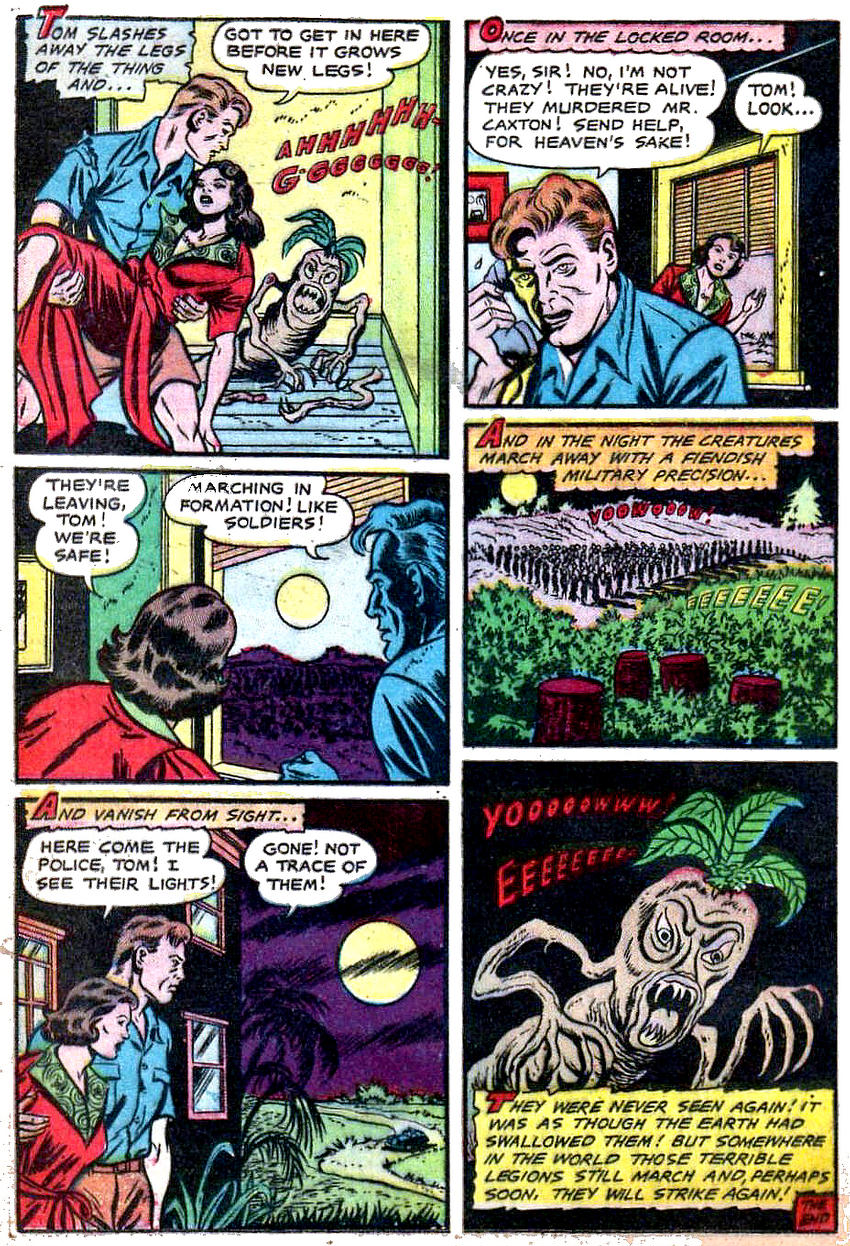
I'm only showing two today because if I read too many jungle stories my brain gets jungle rot. The second of our duo, “Plantation of Fear,” I am proclaiming a crazy comic classic. I love murdering-plant stories, and these plants are definitely murderous. Anthropomorphic, too, with cartoonish human facial expressions. You'll see what I mean.