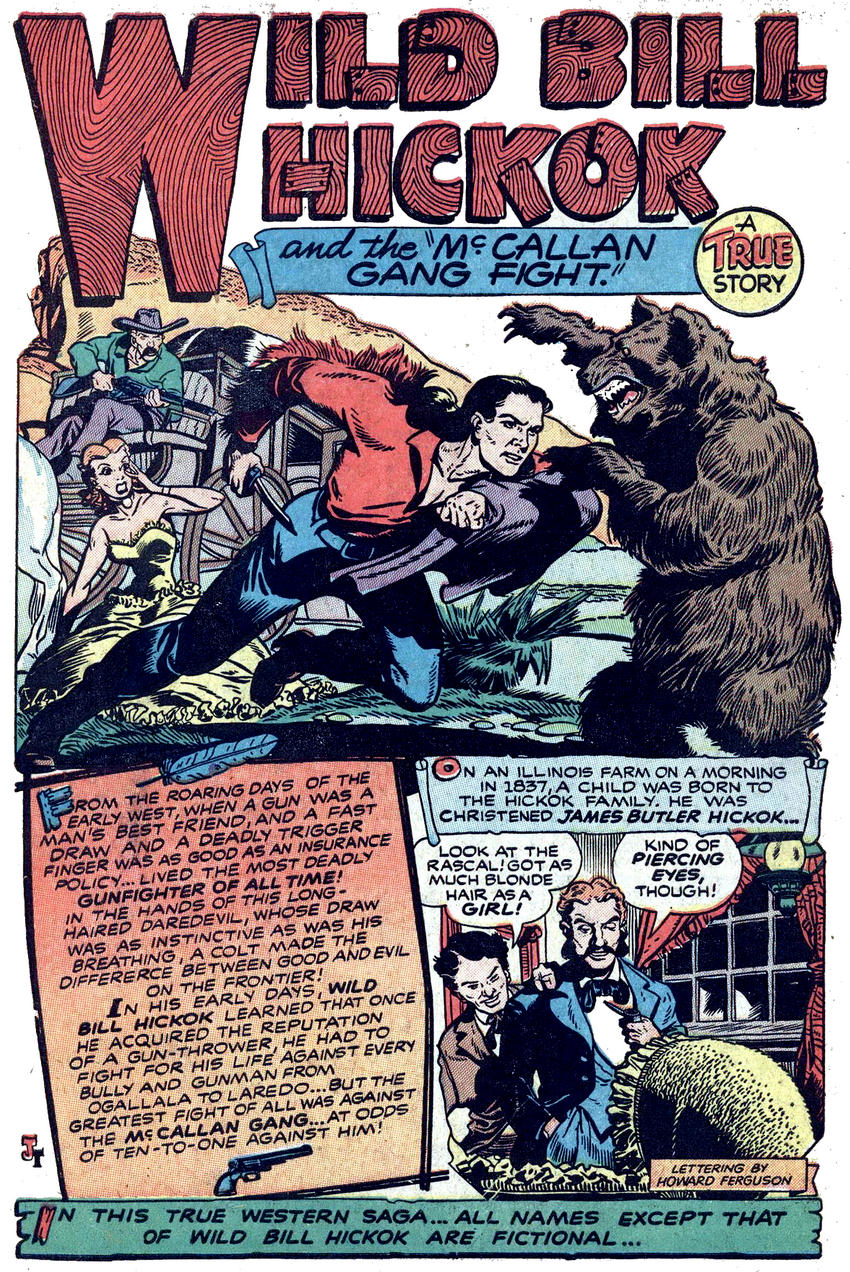
Although Wild Bill Hickok is an historic character from the American West, he's also accorded a legendary status. Much of the story that is written of him mixes in heavy doses of fiction. That includes the Wild Bill Hickok series from Avon, which began in 1949.

For the purposes of this blog, what interests us here is that Wild Bill’s origin story, told here in Wild Bill Hickok #1, is drawn by Jimmy Thompson. Thompson, as this article states so well was fully formed as an artist when he entered comic books in their early days. He drew for Timely and DC, and left both of them in the late forties. He showed up here at Avon in 1949, and then, as the article states, left comics after 1952.

Jimmy Thompson, like some other really good artists of the Golden Age, hasn't exactly flown under the radar — he's been written about, and his work shown, including here at Pappy's* — but most people who write about him don't believe he's accorded the status he deserves for his artistic skill. I think when you look at this story you'll recognize that he was a very good artist, right up there with the best of them, but whose proverbial light has remained mostly under the proverbial basket.


*See Pappy's #317, and Pappy's #1115
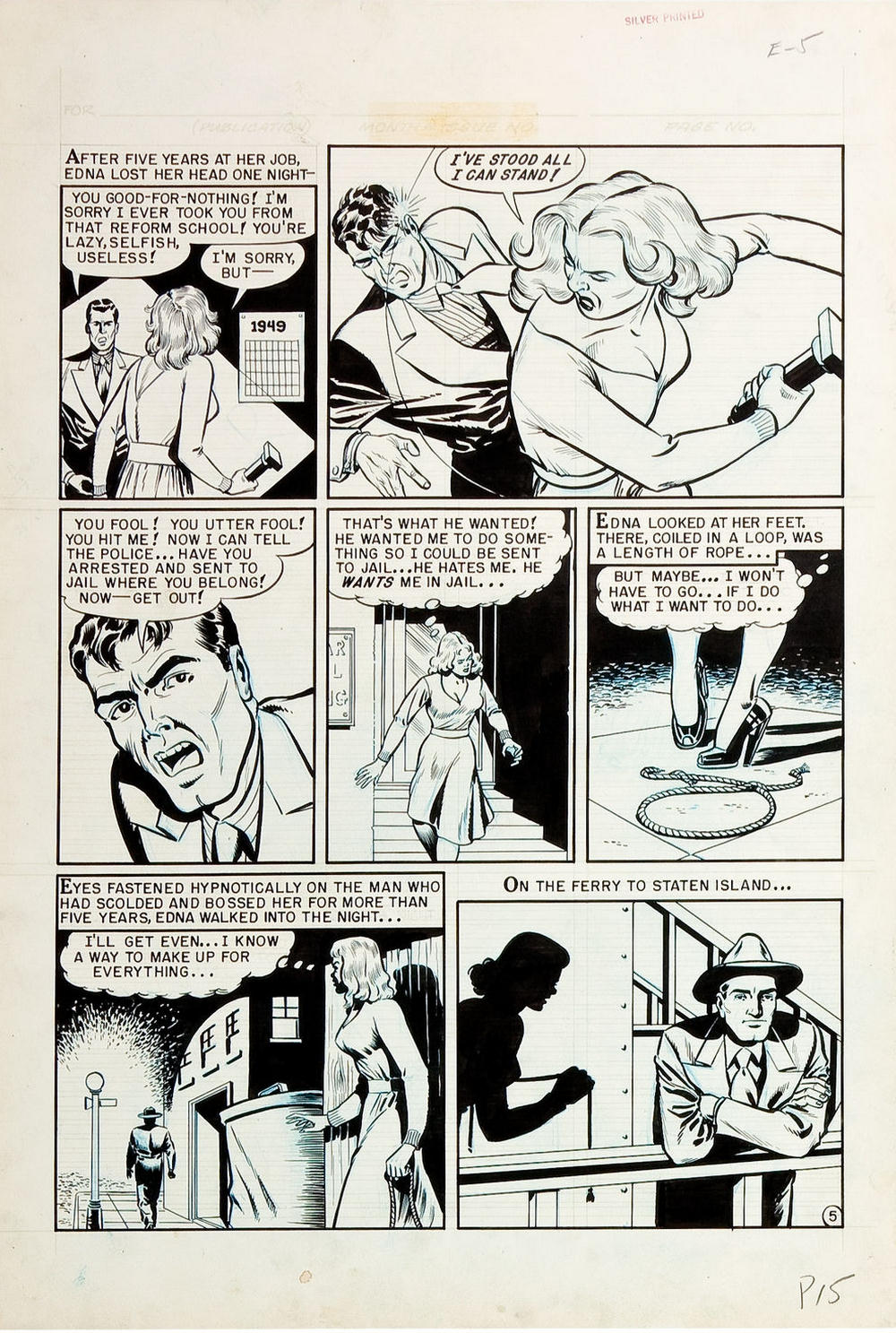
I love original art; I especially love original art from EC Comics, and love to share it. Well, I need to clarify that...the original artboards for these two stories don't belong to me. They were sold by Heritage Auctions, who — bless their Texas-sized hearts (they are headquartered in Dallas) — provide these excellent scans. I give them a tip of my 10-gallon Stetson in recognition of their (unwitting) contribution to Pappy’s blog. Thanks, pardners!

Now, on to the art. Johnny Craig and Al Feldstein did some collaborating during their early days working for Bill Gaines at EC Comics. In these two stories for Crime Patrol #13 (1949), signed by “F.C. Aljon” their styles sharply contrast. The first story, “I Fight Crime,” is credited by the Grand Comics Database as being penciled by Feldstein, and supposedly inked by Craig, and the process is reversed for the second, “Edna Sunday.” But in looking over both of these stories I see them differently. “I Fight Crime” is mostly drawn by Feldstein, pencils and inks, with a few panels by Craig. “Edna Sunday” is mostly drawn by Craig.

But really, is it all that important? Well, sure it is to those of us wonkish comic book guys who like to get the credits right, even though early comic book credits are often a lot trickier to pin down than we think.

The other thing of interest is the change of name and splash panels for “Edna Sunday” which covered over a violent panel with an innocuous portrait of the title character, and the title, “Hate,” There could be a practical reason for this, including concern over criticism of crime comics by Fredric Wertham, M.D. (his major attack against crime comics, the article that would grow into his 1954 book, Seduction of the Innocent, appeared in The Ladies Home Journal in 1948), and groups of bluenoses who were organizing comic book drives to feed bonfires. A year before this issue of Crime Patrol the Alfred Hitchcock movie, Rope, starring James Stewart, opened on a close-up of a man being strangled with a garrotte. Hitchcock could get away with it...maybe Bill Gaines didn't think in that climate of comic book criticism he could do the same. A couple of years later he challenged the critics, but in his early days as publisher he may not have been so brave.


***************
Haunted Horrors is a reprint comic, an anthology of the pre-Comics Code, non-EC horror comics of the early 1950s. It’s co-edited by Karswell of the popular blog, The Horrors Of It All. Craig Yoe is the other horror-meister. He has published some great hardcover books from what is called “The Chilling Archives of Horror Comics” — they've been so well received the bi-monthly comic was launched.

I think it’s a great comic; Karswell told me the idea was to use stories that he had not featured in his blog, but even if they had used those stories it wouldn't have mattered to me. I’m old-fashioned enough to believe having something available only in a non-tactile, digital form such as a blog is not the same as having it in print, on paper. (And yes, that includes the blog you’re reading now.)

Haunted Horror #2 is out, with a fine line-up of stories from a variety of publishers: Fawcett, Superior, Harvey, Standard and two stories from Ace by two of their top artists, Ken Rice and Lou Cameron. My personal favorite story this issue is from Adventures Into Darkness #6, drawn by the great George Tuska, “Corpse Convention.” The splash panel reminds me of checking into the hotel in the early days of the San Diego Comicon!

Karswell is presented as a horror host, and Craig Yoe, with his instantly identifiable hairstyle, is “Forelock the Warlock.”

It’s all great fun in that special way these old comics were fun, reviving the spirit of the forbidden, when kids read these under the covers with flashlights so their parents wouldn't know they were scaring themselves silly. And silly some of the stories are, but that’s their charm. For $3.99 you can’t miss with Haunted Horrors. And while you’re at it, go to Yoebooks.com or Amazon.com and check out the other titles in Yoe’s hardcover series...Christmas quickly approaches, and you know someone wants a gift suggestion for you.

...and speaking of great books, this just in...


I got Yoe’s latest book, Comics About Cartoonists, just yesterday, and have spent some enjoyable hours paging through, admiring how many comic book stories there are with references to cartoonists and comic book artists. It seems a natural — cartoonists live in a pretty insular world, often working from home or a studio. Their art becomes their own self-contained universe. I remember stories like this when I was a kid and loved them, because it was the artist stepping through that “fourth wall,” coming off the page to let us readers know that yes, there was a person involved in producing the comic book.

The book is credited to Yoe as editor and designer, and his wife, Clizia Gussoni, as producer. I admire this book very much, and will give a more thorough review when I’ve had the chance to actually sit down uninterrupted and read it. Until then, I’m recommending it based on the eye-popping visuals, because of the quality of all of the books from Yoe’s studio, and because I provided the copy of Weird Science Fantasy #22, from which Craig got the scans for Wallace Wood’s story, “My World.” As one of the most famous of the comics about cartoonists stories, it’s fitting that Craig used it to end the book.

This is the fourth and final posting of our silly science” theme week. I've saved this one for last, because when I first read it I was slack-jawed with amazement. Yep, sixty years ago in these United States we had a whole different mindset about gender roles, did we not? I grew up in that era; my mom was a housewife and stuck to her “traditional female” role. It was how we saw the world, and role-reversal is the gimmick of this story, from Mystery in Space #8 (1952). Boys reading it in those days would think this would never happen! When Mrs. Pappy and I got married in 1969 the feminists (we called them “women's libbers”) were making headlines, and from my own spouse I could feel the change a-comin’!

In 1971 feminism was so threatening to some men that a book like this could be published.

This Mystery in Space story, written by John Broome under the pen-name John Osgood, and drawn by Bob Oksner and Bernard Sachs, had a publication history that straddled the feminist movement, before and after. It was reprinted the same year as The Feminists, in 1971 in From Beyond the Unknown #11 (where I first saw it), and in 1980 in the Simon and Schuster compilation, Mysteries in Space, the Best of DC’s Science Fiction Comics.

The last two panels of the story are howlers. You'll see when you read them. Talk about a male fantasy. “Okay, you chicks had your fun, now move on over and the boys are back in charge!” As all of us have noticed in our 2012 society that kind of talk may have worked in 1952, but not now.


Green Lantern: New Guardians: The Ring Bearer, though flawed in its presentation, may be the best of DC Comics's New 52 Green Lantern titles.

There's nothing wrong necessarily with Tony Bedard's characterization of Green Lantern Kyle Rayner here, though in dialogue Bedard's Rayner still has inexplicable tics that grate through the whole book. Artist Tyler Kirkham's more animated style begins to gell here, even better suited to the wilder aliens of Guardians than it was to Green Lantern Corps previously, but the art has a tendency toward sexual gratuity that's just embarrassing.

Despite this, The Ring Bearer triumphs over Green Lantern and Corps's repetitive storylines and Red Lanterns's stilted introspection because here, something actually happens. The most interesting part of Geoff Johns's revitalized Green Lantern franchise has been the multi-hued Corps, and Bedard brings representatives from each together and plays them off one another in engaging ways. The identity of the person who brought together the "New Guardians" is amusing, full of story potential, and Ring Bearer deals with some of the better plot threads left hanging from War of the Green Lanterns.

At least for the first New 52 Green Lantern collections, the site of the franchise's forward action seems to be New Guardians.

[Review contains spoilers]

Though New Guardians starts slowly with a typical characters-misunderstand-and-fight, it quickly turns to two of the biggest open questions in Lantern lore right now: what did the Guardians do to former Guardian-Lantern Ganthet's mind, and whatever happened to the Guardian Sayd, Ganthet's love and prisoner of Agent Orange Larfleeze? Bedard takes up both of these, and especially strong is the inference that Sayd is secretly manipulating Larfleeze.

The "New Guardian" team is surprisingly compelling. They fight together, at first grudgingly against their common enemy, the Guardians, but after they save one another a few times, some loyalty begins to emerge. Bedard writes an effective speech at the end of the book in which Rayner notes that in working together, the Lanterns become "better than what our power rings say we are." This is a significantly "post-modern" idea -- Geoff Johns has spent a few years establishing the fearsome Sinestro Corps, the angry Red Lanterns, and others, and now New Guardians takes it a step forward to demonstrate how the characters are more complicated than just their rings.

It helps that Bedard populates New Guardians with fan favorites like Sinestro Corpsman Arkillo and Blue Lantern Saint Walker; even in the first issue's fight scene, there's always some entertainment seeing these characters together. Arkillo and Walker have an unexpectedly touching scene in the fourth issue, where Walker restores Arkillo's voice after the warlord Mongul ripped out his tongue some two years ago. For fans of the Green Lantern books, this is an authentic moment -- readers saw Arkillo's defeat and they've seen his shame in numerous stories -- and it suggests the kind of character spotlighting that Bedard can do in this book.

It's also a riot that Larfleeze plays Bosley to the New Guardian's Charlie's Angels, gathering the team and directing them on their first mission (with Sayd's help). Few would predict that Larfleeze would one day add "team leader" to his resume, though at the end of the book, the New Guardians switch to align with Larfleeze's enemy, the alien angel Invictus, and they're directed to kill Larfleeze. Hopefully, despite that Larfleeze is about to star in Keith Giffen's Threshold, Bedard is able to keep him around and to put the New Guardians back under his thrall; it's too much fun to think of him in charge of this team. Bedard also gets points for using Larfleeze's adorable orange construct Glomulus, and suggesting there might be more to the imp than it seems.

Bedard, however, hears a strange Kyle Rayner in his head. As in Green Lantern Corps, Bedard's Rayner is foolishly, inappropriately "hip" -- Kyle calls everyone "dude," from the construction worker he saves in the beginning to Invictus in the end. Bedard's Rayner has never met a colloquialisms he didn't like; rarely does Bedard let a "them" or "about" go by without spelling it as "'em" or "'bout," along with the numerous "wannas" and "gottas."

Bedard's Rayner is at least not the skeevy oversexed pat character here that Rayner has been variously portrayed as over the years (of which the audience saw shades in Bedard's Green Lantern Corps), but Bedard's speech patterns for Rayner just don't make sense. They are not consistent with how Rayner has been written by others (if anything, Bedard's Rayner sounds more like Lantern Guy Gardner) and they suggest a kind of inanity that in fact doesn't even match the actions Bedard gives Rayner, which are uniformly heroic. Ring Bearer emerges as perhaps the best Green Lantern book that Bedard has written so far, if only his Kyle Rayner could be adjusted slightly.

Tyler Kirkham's accentuated, oversized figures fare better here than they did in the War of the Green Lanterns crossover, where they stood out too much beside the straighter lines and smaller panels of Doug Mahnke and Fernando Pasarin. With the big personalities of Arkillo, Saint Walker, Larfleeze, Invictus, and others, Kirkham shines, and this is a rare New 52 collection where the book's art even seems to improve as the book goes on. Unfortunately, the sole woman in most of this story is the Star Sapphire Fatality, with her shirt unzipped and cleavage exposed, and Kirkham never misses an opportunity to include her breasts in a panel, even having her fly upside down at one point so her chest faces the camera.

Worse, Kirkham has at least two quintessential "she has no head" moments, in issue #5 and #6, where the panel lops off Fatality's head and her dialogue seems to come from her chest; in issue #6, a poorly-placed word balloon makes it seem as though her breasts are speaking. These are moments that make New Guardians seem juvenile, and it's a pity Kirham mars his work with them.

Of all of the first volumes of the Green Lantern books, Tony Bedard and Tyler Kirkham's Green Lantern: New Guardians: The Ring Bearer is the most fun, the one with the best sense of cosmic wide-eyed wonder. Both writer and artist, however, lose some points in the details, and it hurts a book that shows good potential. New Guardians's second volume will bear a look, and hopefully some of these issues get resolved as the series continues.

[Includes original covers, just two sketchbook pages by Tyler Kirkham]

From the cosmos to the supernatural ... next week, the Collected Editions reviews of Justice League Dark and I, Vampire. Don't miss it!
[Doug Glassman's got a month's worth of Kitty Pryde spotlight reviews for you, starting now!]

Chris Claremont wrote Uncanny X-Men for seventeen years straight. In retrospect, it’s surprising that the two most important stories from that run are only separated by four issues. With the death of Jean Grey at the end of the Dark Phoenix Saga, the X-Men: Days of Future Past trade opens rather appropriately with her funeral. This is actually a framing device for an intense retrospective of the X-Men’s history up to that point.

Claremont and Byrne pack a lot of details into such a small space, from Magneto turning into a baby to the “All-New, All-Different” X-Men attacking Krakoa. It also inadvertently serves as a checklist of Professor Xavier’s questionable decisions. At points, Byrne imitates Jack Kirby and Dave Cockrum to enforce the sense of the series’ artistic changes. The original Official Handbook to the Marvel Universe wouldn’t come out for another two years, so this was a brilliant way to bring new readers up to speed after the Dark Phoenix Saga.

Cyclops leaves the team after the funeral. Because the rosters have changed and expanded so often since the early 1980s, this may not seem so important, but Cyclops had appeared in every issue since the title’s inception. This makes Storm the new leader of the team, and while Cyclops would return later, it was a role she would keep for years. The first trial of this new roster comes in “Nightcrawler’s Inferno,” in which the team must rescue Nightcrawler’s soul from Hell with the help of Doctor Strange. It’s actually an alternate dimension created by Nightcrawler’s stepmother, Margali Szardos, as revenge for his killing her son. The dimension is an accurate interpretation of Dante’s Inferno, complete with the City of Dis and a three-headed Satan. Nightcrawler has been put at the very bottom in the level of traitors. It's all eventually cleared up and Nightcrawler finally gets to celebrate a birthday with both of his families.

Kitty Pryde officially joins the team in issue #139. The cover of this issue memorably reads “Welcome to the X-Men, Kitty Pryde . . . Hope You Survive the Experience!” This quickly became the standard welcoming phrase for new X-Men, and she does have some trouble adjusting to her new life at the Xavier School. She’s terrified of Nightcrawler despite his genial nature, and Wolverine puts her on edge. Conversely, Storm becomes a caring elder sister and the seeds of the Kitty/Colossus relationship are sown. Kitty is an audience surrogate character who doesn’t get on the reader’s nerves -- something rare with that kind of character. Despite being naive and scared, she holds her own and grows as the story progresses.

The three male X-Men have a fascinating camaraderie, as demonstrated when Wolverine and Nightcrawler head up to Canada to help Alpha Flight with the Wendigo. Having served together since the start of the “All-New, All-Different” roster, they have become a coordinated unit, but it’s comprised of two different friendships. Nightcrawler and Colossus have more lighthearted adventures together, while Nightcrawler and Wolverine are closer to drinking buddies. Colossus and Wolverine work well together in battle -- they invented the Fastball Special, after all -- but they don’t hang out a lot in their downtime. It reminds me of the friendships of Hal Jordan, Barry Allen and Oliver Queen. Hal and Barry are friends, and Hal and Ollie are friends, but Barry and Ollie never quite gelled on their own [gosh, but I wish Geoff Johns had written a Barry/Ollie team-up in the old continuity. Say what you will about Johns, Barry, or Ollie, but that would have been awesome.]

After Wolverine and Nightcrawler’s Canadian adventure, we head into the title story and encounter a dark future. The Sentinels are in control and superheroes are nearly extinct in the far-off future of ... 2013. A future X-Man, Rachel, sends the mind of the future Kitty Pryde into her younger incarnation to prevent the Brotherhood of Evil Mutants from assassinating anti-mutant politician Senator Robert Kelly. In a nice touch, the X-Men realize that something is wrong when Kitty isn’t afraid of Nightcrawler. Meanwhile, Rachel would later be revealed to be Rachel Summers, daughter of that universe’s Cyclops and Jean Grey, who would later cross universes and become Phoenix and then Marvel Girl. It took Claremont a long time to expand on this initial appearance of Rachel, notably withholding her last name in the story.

What follows is some rather fancy storytelling, showing the action in both the present and the hellish future. This was the first sign of the coming massive rise of anti-mutant bigotry, with the Sentinels returning in a huge way. By averting Kelly’s assassination, the X-Men only make things worse, leading him to ally with the Hellfire Club and sending the main timeline hurtling closer towards the dark future. Meanwhile, the rest of the future X-Men start to fall, including Wolverine getting incinerated by a Sentinel. Days of Future Past indulges in the theory that “it’s an alternate universe, so we get to kill everyone,” which happens a lot in What If?” stories.

The final story is Kitty’s first solo adventure, as well as the first issue to be called Uncanny X-Men. She’s been left behind by the other X-Men as they go to a Christmas party. Unfortunately for her, the mansion has been attacked by an N’Garai demon, menaces that appeared back in Uncanny X-Men #96. Kitty uses her powers, agility and basic knowledge of how the Blackbird flies to defeat the demon and earn her keep as a member of the X-Men. A few years later, in Uncanny X-Men: From The Ashes, Professor Xavier wanted to demote her to the New Mutants; Kitty had a point in calling him a jerk.

In the X-Men universe, Uncanny X-Men: Days of Future Past was extremely influential, with other bad futures like Age of Apocalypse and Age of X taking their cues from it. The next X-Men film will also use it as its basis. Moreover, it serves as proof that even after such a major event as the Dark Phoenix Saga, the title could hold its own and even improve as time went on.

Next time ... Kitty Pryde goes to Japan and gets a major revamp.
 This is the third of four “silly science” postings this week.

“Time Travelers” was a feature in ACG's Operation: Peril for the first twelve issues. The comic, which co-featured Danny Danger and Typhoon Tyler, then became a war comic. “Time Travelers” was a fun strip, even if its version of history was a bit screwy. For instance, in this episode from Operation: Peril #3 (1951), they go to the sixth century to find King Arthur's sword, Excalibur, so a college donor will make a $10 million donation. I know a little bit about history, and there's always been a disagreement about whether there was such a king as Arthur, and when he lived. Not to mention someone called Merlin.

But this is science fiction and comic book SF at that, so we don't want to think too much about it. Like when hero Tom Redfield says they're going to the sixth century to find King Arthur, he doesn't say exactly when in the sixth century. Like every other century, unless you've got an exact date, 100 years is a big span of time in which to look. Lucky Tom and girlfriend Peggy found King Arthur right off!

I have shown other stories from this entertaining series in the past (you'll excuse the expression). The first two Time Travelers' stories are from Operation: Peril  issues #1 and #2, in Pappy's #836 and Pappy's #840. The adventure from issue #4 is found in Pappy's #1001. In Pappy's #399 I featured the story from issue #11.

Grand Comics Database gives Ken Bald artist credit. Thanks to reader Scott Pell, who says the GCD is in error, that the art is actually that of Lin Streeter. After a second look I'm in agreement with Scott.


The fifth month turns out to be a rather good one for the DC Comics New 52 trade releases. The best of the lot is clearly Duane Swierczynski’s relaunched Birds of Prey, followed in distant second by Geoff Johns’s Aquaman: The Trench, which is more notable for how it revitalizes the Aquaman character than for the “Trench” story itself.

I’d definitely read a second volume of Scott Lobdell’s Teen Titans, if not for the relatively likable characters then for the Superboy/Legion Lost crossover. Voodoo had a good ending cliffhanger and I’m interested enough in the Daemonite story to get the second volume, letting alone that the book’s cancellation makes this an easy, no-commitments buy. I’ll stick with Legion Lost because I’m a Legion fan and it, too, is cancelled after its next volume. Fury of Firestorm: The Nuclear Men might be the easiest for me to drop because I’ve never felt a real connection with the title character, but given that a new creative team is about to come on, that’s almost like another volume one for me.

After Firestorm, Peter Tomasi’s Green Lantern Corps might be this month’s title that I’m mostly likely to drop, as I didn’t much enjoy it nor the latest volumes of the related series that preceded it, War of the Green Lanterns and Emerald Warriors. But to some extent I’m not sure one can be a “DC Comics reader” and not read Green Lantern and its associated titles simply as a cultural phenomenon, given how the Green Lantern franchise essentially brought DC back to life in the last ten years. I’m dismayed it seems like there’s two back-to-back Green Lantern crossovers on the horizon — they might as well give up the illusion that there’s four Green Lantern titles and just make Green Lantern weekly — but given that Geoff Johns has been writing Lantern for so long, I just bring myself to look away from any part of it until he finishes.

In terms of continuity this month, the most surprising commonality was between Legion Lost and Voodoo, which both include appearances by the Black Razers team. The new DC Universe has far too many rogue science/military groups (including Firestorm’s lackluster Zithertech), and I figured the Black Razers in Legion were just another one until they popped up in Voodoo, too, given pretty extensive background by writer Ron Marz. The Martian Manhunter also makes cameo appearances in both Legion and Green Lantern Corps this month, plus Stormwatch gets a nod in Voodoo. None of this reveals any deeper fundamentals about the new DC Universe nor hints at future storylines necessarily, but this was a strong month for the books feeling like a cohesive universe.

In this aspect Swierczynski’s Birds of Prey also comes off as a title worth watching. Not only did Swierczynski blend action and humor in a way reminiscent of classic Birds runs, but the first trade also introduces Katana, soon to appear in the new Justice League of America series. This way, a book that’s really an outlier in the Batman family also ties directly to the Justice League franchise. As well, Swierczynski guest-stars Batgirl and preserves the Barbara Gordon/Black Canary friendship, which at least takes a step toward mitigating the fact that a year into the DC New 52, there’s still no mention of Oracle’s status.

It’s December now and I’ve got all my DC New 52 collections in hand. It has been a wild year and a wild reading experience to be sure, especially reading fifty-two “first” volumes that did not involve pausing to read the preceding volume first. This process of always starting from the beginning instead of returning to an established series is exhilarating, but I’m looking forward the second volume of Aquaman, Batman: Night of the Owls, Justice League: Villain’s Journey, and others that are less about introducing the characters and more about getting on with the show.

Two more months of DC New 52 Volume Ones left, including Justice League Dark and I, Vampire, Hawkman, Superman and Supergirl, Nightwing, and Red Hood and the Outlaws. The Collected Editions review of Green Lantern: New Guardians will be up this Thursday. Thanks!

Logo by _____. [Want a link here to your site or webcomic? Send me an email to the Yahoo account, or DM me on Twitter or Message me on Facebook. This column needs a logo, and I'd be happy to link to you in exchange. Let's talk.]