Number 1121


Monsters from the deep freeze, part 2


This is number three in our week of monster postings.

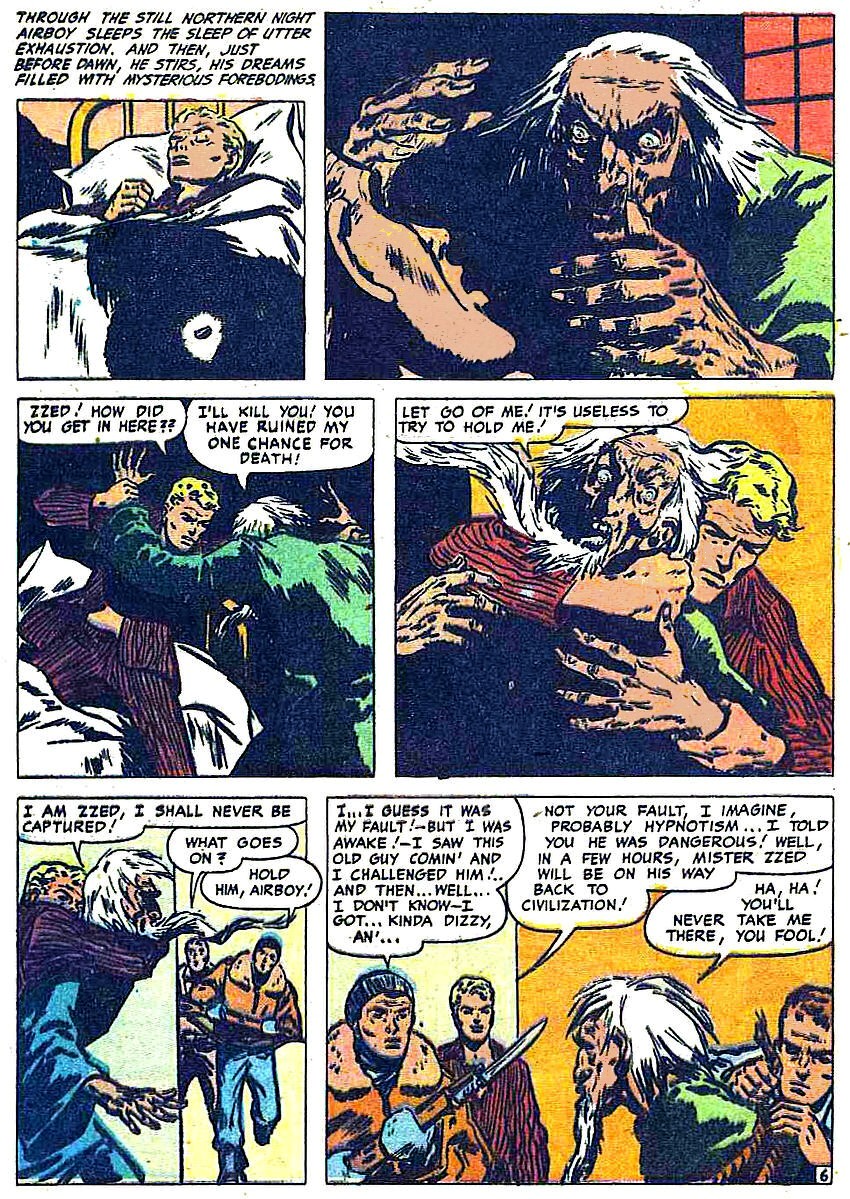
Welcome back to our two-day Airboy adventure. If you haven't read part 1 of this story, your reading assignment is to go back to yesterday's posting.

Read it now? OK, proceed to part 2. It's from Airboy Comics Volume 7 Number 5 (1950), drawn by Ernest Schroeder. There's just something so cool (ho-ho, I made a joke) about monsters frozen in ice. Think wooly mammoths in Siberia...think the movie versions of The Thing. Of course, in real life any animals found frozen are dead, not roaring and stampeding even though they've just spent the past hundred thousand, or 65 million, years encapsulated in ice. Personally, on a cold, icy morning my knees kind of lock up, and if released from a deep freeze, even if by some chance I was still alive I doubt I'd be doing any chasing.

But this is a comic book, isn't it? And anything goes in a comic book!


Number 1120


Monsters from the deep freeze


It's number two of our week of monster stories.

Since comic books stories of the Golden Age were mostly "one and done," it's somewhat unusual, although not unheard of, to have a story "continued next issue." Ah, for that part of the Golden Age...if you missed an issue you weren't lost.

This Airboy adventure is part 1 of a two-part story, set in the frozen north. It's got a villain named Zzed and some monsters frozen in the ice. It's drawn by Ernie Schroeder, from Airboy Comics Volume 7 Number 4 (1950).

Come back tomorrow for part 2.


We've had more Airboy stories on this blog, including one set in Paris and featuring Crabmen. If you like these monsters you'll probably like the Crabmen of Paris. I showed it in Pappy's #968.

Number 1119


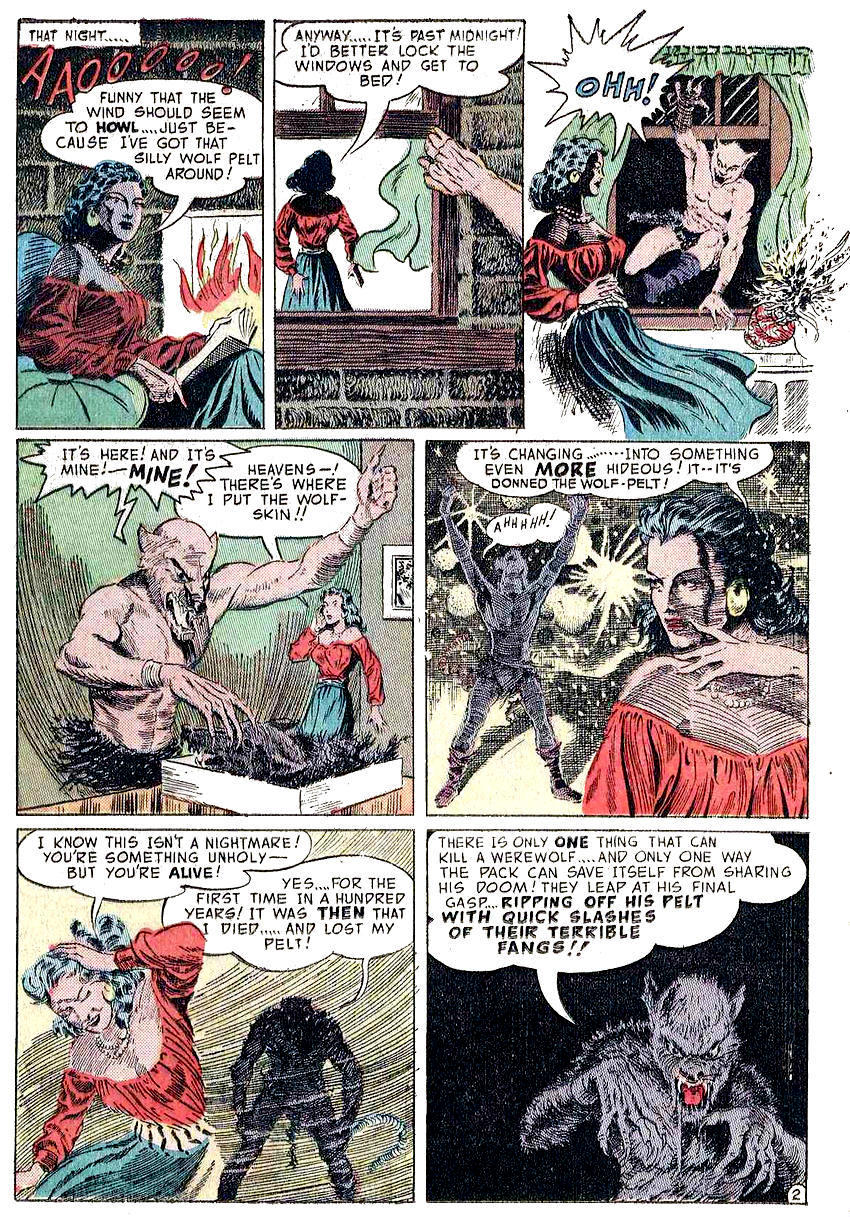
The werewolf comes from out of the night!


[I'm going to have some fun and show some monster stories; postings through Pappy's #1124 on March 24 will have monster stories of various types.]

Out Of the Night
, which is a great name for a horror comic, came from ACG to be an addition to their two best-selling horror titles (they actually called them "supernaturals"), Adventures Into the Unknown and Forbidden Worlds. Apparently the supply of stories featuring vampires, werewolves and zombies was endless, because they felt they needed a third book in the line. Out Of the Night lasted 17 issues, suspending publication after the November 1954 issue. The Comics Code was being implemented and that might have had something to do with it, but it could also be that sales on OOTN were down, and the book would have been killed, Code or not.

The first issue, from 1952, is strong, with a great Ken Bald cover and a sharp lead story by Al Williamson and Harold LeDoux, signed with the pseudonym Harold Williams. LeDoux went from comic books to the Judge Parker comic strip, eventually (after more than a decade) getting sole credit and his byline on the strip. He is retired and apparently still with us at age 85. Al Williamson died in December 2010.


[Welcoming guest reviewer Zaid Alawi, who very occasionally posts his ramblings, thoughts, and stories on his personal site, Frakking Off.]

One of the most anticipated Batman releases this past year was Lee Bermejo's original graphic novel, Batman: Noel. Batman fans know Bermejo as the artist who collaborated with writer Brian Azzarello in the original hardcover Joker a few years back. This time around, it's a solo effort, as Bermejo's taken over the writing duties as well.

Noel is an adaptation of Charles Dickens's classic story, A Christmas Carol, set in Gotham City, with the Dark Knight fulfilling the role of Scrooge. Most audiences will probably be familiar with the oft-adapted Christmas Carol's basic story -- Scrooge, a miserly old man is confronted by the ghost of his longtime friend and business partner, who tells him that he must repent his miserable ways or else face eternal damnation. Scrooge is then visited by three spirits (representing the past, present, and future, respectively), and ultimately learns his lesson and becomes a new man -- friendlier, kind-hearted, and generous in spirit.

Noel follows the same general arc, with familiar characters acting as stand-ins for Dickens's characters, though some deviations keep this from being a strict, by-the-numbers adaptation. This was a smart choice on Bermejo's part, making the story feel a bit more natural. It also keeps the story from being too hokey or unbelievable, as the "ghosts" are only metaphorically spirits, rather than being the fanciful apparitions of Dickens's tale.

Batman's transformation is also slightly different than that of the original Scrooge's. Here, the tension is between the dark, gritty, avenging Batman born of Frank Miller's The Dark Knight Returns and the earlier, friendlier Batman, found in Adam West's television series and the more light-hearted comics of the '60s and '70s. Batman starts out in Noel almost self-consciously over-the-top, as he decries all criminals as being lowlife scum. It's up to his friends, colleagues, and even his enemies, to remind him of his past, lest his future end in gloom and despair. Of course, one can also read a meta-textual commentary here -- like other creators have done, Bermejo seems to be reminding us that the Batman mythology is always in danger of becoming mired in its own darkness, especially since Miller's redefinition of the genre 25 years ago.

Noel might also be read on an even deeper level as being a commentary on the nature of storytelling, interpretation, and re-interpretation. Interestingly, "Scrooge" is the only name the Narrator uses when referring to our protagonist, as part of the framing narrative device. Throughout the book, small, seemingly deliberate inconsistencies lend the feeling that the Narrator is telling one story, and the pictures and dialog are how we, the readers, are meant to re-interpret it as a slightly different story. That is, they don't necessarily line up perfectly. The narrative trend continues, as the Narrator is actually re-telling a story originally told to him by yet another character (who, in turn, was presumably told the original Dickens story at some point). So the narrative text is the third interpretation, and the illustrations and dialogue are the fourth layer down. I don't know how deliberate this interpretation-within-an-interpretation was, but it's worth thinking about.

If I had one major complaint about Noel's story, it's the way in which the relationship between Batman and Gordon is wrapped up -- or rather, not wrapped up. Interestingly, we see that the grim and gritty Batman at the start is not entirely trusted by Gordon. Gordon places his faith in Batman, but it's potentially a dangerously misplaced trust, and Gordon is at least smart enough to be wary of it. We also learn that if things don't change, Gordon will lose everything for it. Presumably, after Batman's transformation, things will be different for Gordon and Batman. But we never quite see this. What makes this all the more frustrating is the fact that an entire page is devoted to Gordon and the police department after Batman learns his lesson. Everybody's happy, but it's never made specifically clear why. How do Gordon and the cops know that Batman's a new man now? I feel like a page -- or at the very least a few important captions -- were left out.

Of course, as good as the story might be, Bermejo is an artist first, and so the real treat in Noel is in seeing his gorgeous illustrations, which is the best I've seen from him so far -- and that's saying something. It's detailed, luscious, atmospheric, and rich, and doesn't suffer from the over-use of hard angles which affected his earlier work. In a word, it's simply fantastic. In the weeks since my first reading, several full-page spreads were memorable enough that I simply could not let them go in my mind, including a chilling portrait of the Joker. It's an unforgettable rendering, and you'll know it when you see it.

The universe of Bermejo/Azarello's Batman is one that sits between Chris Nolan's gritty realism and mainstream DC's superhero fantasy, with a leaning more towards the former than the latter. It's always a pleasure to revisit the unique visuals of this universe. Previous entries gave us interpretations of Batman, Superman, Joker, Two-Face, and Killer Croc. A few of these faces have naturally returned in Noel, but this time we're also treated to the addition of Catwoman. Bermejo's Catwoman is playful and sexy, without stooping to the adolescent fantasy that so many interpretations have often resorted to.

One of the few disappointments in Joker was the use of two different illustrative techniques -- most of the pages relied on standard pencils and inks (by Mick Gray), while a few pages were given a more deluxe, painted treatment by Bermejo. Bermejo's work would have been beautiful in its own right if limited to just the standard pencil-and-inking technique, but those pages inevitably fall flat when sitting side-by-side with the deeper, luxuriously painted pages. There simply is no comparison, which lead to disappointment whenever a turn of the page took the reader from painted panels back to the flatter, standard inked panels.

There's no such problem here, however, as every single one of Noel's pages have been given the full painted treatment. The artwork is eye-popping, with depth and texture that is simply unmatched, and the lack of transition from one technique to another means we're never jarringly taken out of the story as readers.

It should be noted that Bermejo adds a bit of exaggeration and cartooning to some of the faces in Noel, which we hadn't seen much of before in his previous Batman works. But rather than being distracting from the realistic take of the Bermejo/Azzarello universe, it seems appropriate, given the specific subject matter at hand.

Finally, I should also mention that the last few pages are devoted to behind-the-scenes sketch work and commentary by Bermejo. Such special features are always a welcome addition, so I was glad to see them here.

In short, Batman: Noel is well worth picking up, if you haven't already. Fans of the book would do well to seek out Bermejo's collaborations with Azzarello, for other entries in their Batman universe. And here's hoping that we'll continue to see more of this universe from Bermejo in the years to come.

Thanks, Zaid! Coming, it's Legion week as we blast off to the future with the Collected Editions review of the deluxe Legion of Super-Heroes: The Great Darkness Saga and more!
[Guest review by Doug Glassman]

Sometimes, all it takes to revive a good, but overused villain is some downtime. For instance, the Mandarin went unused in the pages of Iron Man for years because the writers and editors had difficulty reconciling his deep Communist roots with the post-Cold War world. John Byrne then brought him back for the epic “Dragon Seed Saga” and cemented him as Iron Man’s greatest nemesis once again.

Similarly, Carnage was one of Spider-Man’s most formidable villains ... in theory. In practice, his overexposure led to him becoming more of a joke and annoyance. When he was ripped in half and sent off into space by the Sentry in the pages of New Avengers, a good section of the fanbase wished him “good riddance.” But that was all the way back in 2005, and as per good old Marvel tradition, Carnage has returned. The explanation for all of this comes in issue four of Carnage: Family Feud, and it makes sense considering what we know about symbiotes.

Carnage has three main draws. First, he’s a symbiote, and again, despite overexposure, the symbiotes are some of Marvel’s most powerful and artistically interesting characters. Second, he’s completely insane. One reason why Carnage’s loss didn’t feel so major was because the new Venom, Mac Gargan -- the former Scorpion -- fit into his old niche quite nicely. Carnage: Family Feud feels like a thematic sequel to Sinister Spider-Man, although it doesn’t feel like a retread. With the Venom symbiote now in the hands of the much more boring Flash Thompson, that niche is open again, and Carnage can fill it with his own brand of terror.

The third draw of Carnage is his “family.” In the early '90s, Carnage had a killer cult, with which he carved a path of death and destruction through New York. It was made up of his girlfriend, the madness-inducing Shriek; Doppelganger, a mindless mutated version of Spider-Man left over from the Infinity War crossover; Demogoblin, a demon once merged with the second Hobgoblin; and Carrion, a plague-carrying clone of Dr. Miles Warren. This was the infamous Maximum Carnage crossover, which, like Carnage himself, suffered from overexposure. The idea was interesting, as was the premise that Spider-Man and Venom had to team up to stop him. However, the story didn’t need fourteen issues, and Captain America and Deathlok (amongst many others) didn’t need to get involved.

I bring all this up because Family Feud, despite the title potentially invoking Venom, is about Carnage’s resurrection and his reunion with Shriek and the Doppelganger. The Demogoblin and Carrion were thankfully left out; the last thing this story needed were direct ties to the Clone Saga. Shriek’s twisted loyalty to her symbiotic madman, and the Doppelganger’s pet-like nature, give Carnage a strong supporting cast. It brings to mind the Joker, who also inspires loyalty through fear ... and who, not coincidentally, was teamed up with Carnage during a Batman/Spider-Man crossover.

Writer Zeb Wells does an amazing job of making us care about these insane people, especially Shriek, who seems to be getting better just when her boyfriend returns. Loyalty and caring for others are major themes in the book, and they are combined with lots of symbolism surrounding dogs and their place in the lives of humans.

The main plot of the book is more of a set-up to get to Carnage’s full resurrection, and it’s telling that this series has Carnage in the title and not Spider-Man. When Cletus Kasady takes up the mantle of Carnage once again, he dominates the book by sheer force of will. His love of death, lack of intelligence and belief in his own invulnerability make him one of Spider-Man’s most chaotic foes. He comes across as an Unsub straight out of Criminal Minds.

Still, while Carnage drives the plot, Spidey is on hand to fight him, along with Iron Man. Wells is one of the primary writers of Amazing Spider-Man, and he certainly has a handle on the character’s mix of humor and responsibility. Back in 2005, Brian Michael Bendis and J. Michael Straczynski figured out somewhat independently that Peter Parker and Tony Stark would make a great team, and so Iron Man is here to give Spider-Man some much-needed muscle and guidance. As much as I like Luke Cage and the Thing, they would have felt out of place here. Tony is the straight man to Peter, and they have a strong older/younger brother relationship. (Imagine this book as Rossi and Reed taking on a symbiote-possessed Frank Breitkopf. If that made sense to you, then congratulations, you’re as big a Criminal Minds fan as I am.)

Carnage’s resurrection comes at the hands of one of Tony’s business rivals, Michael Hall, who uses symbiote technology to make a group of Iron Man knockoffs called the Iron Rangers. They are indeed Marvel’s versions of the Power Rangers, complete with visors and face masks molded in the shapes of noses and mouths. Hall treats them as a product line, and it ties in thematically with the business subplots of Invincible Iron Man. Wells’s sense of humor is on display here, usually in dark ways, such as how Carnage’s use of the Rangers evokes a major piece of Power Rangers technology.

Another character introduced her is Dr. Tanis Nieves, Shriek’s psychiatrist. She and Hall tend to carry the "idiot ball" when it comes to treating Carnage and Shriek, but Iron Man and Spider-Man at least point out their stupidity. Dr. Nieves has an interesting, if possibly unearned, fate at the end, which leads into the sequel to this mini-series, Carnage U.S.A..

The story is interesting, but the art is downright gorgeous. Symbiotes require some special artwork, or else they come off looking gloppy and boring. Again, see Sinister Spider-Man, wherein Chris Bachalo’s artwork made Venom stand out as a truly bizarre creature amongst the normal humans. Clayton Crain makes Carnage horrifyingly alien, with tendrils flying everywhere. Every panel is filled with immense amounts of detail.

On page three, for instance, when Michael Hall holds up a computer chip, you can see every individual whorl and wrinkle on his hands. That panel is one of a few that look like they’ve been drawn in 3-D without having to put on the nausea-inducing glasses. I do have some minor complaints -- Crain sometimes goes a bit too far with the shadows, and though he’s much better at it than Alex Ross, it’s sometimes difficult to follow the action.

Carnage: Family Feud brings back a memorable Spider-Man villain just in time to replace the newly dull Venom. The story is compelling, dark, and occasionally funny with what could be the best artwork of any Marvel book in the last year. It’s expensive in its current hardcover form, but a trade is coming out in March. Still, this is a book best enjoyed in a full-sized hardcover, where you have more room to digest the artwork. If you enjoyed Sinister Spider-Man, have a penchant for crazy villains or just remember how screwed up Carnage was the '90s cartoon series, then check this out.

Number 1118


Brand recognition


Fawcett marketed a self-contained universe, a brand which identified the Captain Marvel characters. From Captain Marvel came Captain Marvel, Jr., Mary Marvel, Uncle Marvel, the three Lieutenants Marvel, even Hoppy the Marvel Bunny, who is also called Captain Marvel Bunny. By using the same name or slight variation the readers were assured that they were a part of a whole, an instantly recognizable franchise. Pretty smart! They could start even the youngest children off with a funny animal version of Captain Marvel and then work him up to the Big Red Cheese himself. At least I think it's how it's supposed to work from a marketing standpoint. Hoppy came along in Fawcett's Funny Animals in 1942, then graduated to his own title after the war.

Chad Grothkopf, who created Hoppy/Captain Marvel Bunny, as well as Willie the Worm, was an animator and prolific comic book/strip artist, whose work appeared from the '30s to the '80s. He died in 2005. Hoppy appeared until the demise of Fawcett's comic book line in 1953.

I like Chad's art, recognizable by sweat drops popping off every character, as well as speed lines and puffs of dust or smoke in practically every panel. Chad's drawings are charming, but as you can see from this first strip from Hoppy the Marvel Bunny #1 (1945), sometimes suffer from crappy printing jobs. After DC shut down the Captain Marvel franchise as the settlement of a long-running lawsuit, Hoppy was bought, with other non-Captain Marvel Fawcett characters, by Charlton and renamed Magic Bunny.


That David Finch draws pretty pictures is not at issue here. Batman: The Dark Knight: Golden Dawn, the deluxe edition, is a visual feast. From Finch's depiction of Batman's new costume, to Finch's unique take on some of Batman's rogues, to his grotesque supernatural characters, to the sheer scope and detail of Finch's work as presented in this over-sized format, Golden Dawn is a joy to look at.

Coming at the cusp of the DC New 52 relaunch, however, Finch and Dark Knight find themselves the inheritors of all sorts of thorny issues.

Finch has been primarily an artist, given Dark Knight to write as part of the DC New 52's controversial trend toward writer/artists. However, almost as soon as Dark Knight was relaunched, Finch ceded writing duties to Paul Jenkins and then Gregg Hurwitz.

Though Finch has had a significant comics career already, his work wasn't known to me prior to his exclusive DC contract. What I saw of his art in the beginning was a now-infamous Justice League cover in which Wonder Woman is smaller and more sexually styled than the other characters, and some Brightest Day covers where the women were again sexually styled and to an extent cookie-cutter copies of one another. This at a time when DC is taking some heat for their portrayal of women.

Not to mention, I'm rather skeptical whether we need another Batman title on top of Batman, Detective, Batman and Robin, and Batman, Inc., especially one that seems to have been created specifically for a creator (which sometimes leads to DC mercilessly prolonging a title long after said creator has gone).

To that end, while I love these deluxe-size books (and that's what got me to pick it up), I went into Dark Knight: Golden Dawn with the following questions and concerns: Could Finch write a good story in this, his lone solely-created volume of Dark Knight? Would the volume have misogynistic or sexually-gratuitous overtones? And could Finch differentiate Dark Knight as something necessary among the glut of Bat-titles?

[Review contains spoilers]

The answer is that Golden Dawn is enjoyable, a good read that, if light, is made weightier due to the strength of Finch's art. I didn't feel that women got a worse shake here than in your average comic book, though Finch does not distinguish himself entirely well on this point. And if Dark Knight were to continue in exactly the same vein in which Finch presents this story, then maybe there is a place for Dark Knight out there, though this is by no means assured.

Dark Knight is my own first full-fledged exposure to Bruce Wayne since he's returned from the dead (the collection of Batman, Inc., which precedes this book, having not yet been released), and in that way it's a lot of fun. Finch's Batman is at the extreme end of angry and obsessed, though that's partially explained in the book, but he's also very cool and tech-savvy a la Grant Morrison's Batman, Inc. Batman.

This is a "classic" Batman story in the sense that it involves mainly Batman, Alfred, Commissioner Gordon, a mystery and a couple of rogues. More than a few times I found myself humming the Batman: The Animated Series theme or hearing those actors voices speaking the characters lines, and even the inclusion of Etrigan the Demon here doesn't lessen the book's TAS vibe (even enhances it). Finch's is an accessible Batman story you could give to just about anyone; the denouement comes especially quick, but again the greater part of the story is Finch's art throughout.


Finch can't help that when you tell a "classic" Batman story, the participants will likely make up something of a boy's club. I count, however, seven male actors in this book and just two female ones. One, the demon Blaze, appears if not sexualized then at least half-naked throughout the story (note J. Calafiore drew a clothed Blaze in Secret Six: Darkest House that I thought was considerably scarier than Finch's). The other, the eponymous Dawn Golden, is the book's McGuffin -- appearing only fleetingly, she has been by origin a pawn for various men, and she's ultimately killed at the end.

The book's interior art (covers notwithstanding) doesn't depict overly sexualized poses like Ed Benes's work often does. But story-wise, Finch does not put to rest the concerns that his earlier cover work has raised. Jim Lee, drawing DC's flagship Justice League, is undoubtedly DC's artistic frontman right now, and Finch's art looks uncannily like Lee's. Finch stands to be (perhaps already is) a big deal at DC, but it's for that reason I'm so invested in seeing him go the Lee and not the Benes route.

Golden Dawn is a supernatural Batman tale. Those are a rare-ish breed, and some disfavor them; Batman time-traveling, for instance, is interesting, but it doesn't go to the modern iteration of the character. Finch spares Batman most of the mysticism until right at the end, however, and this is largely in the form of Etrigan; again, hearkening back to the Batman animated series, there's something classic and fun about a Batman/Etrigan team-up. I wouldn't be disappointed in the slightest if Dark Knight were to become the supernatural-horror Batman book; this is what Finch suggested about the book early on, but there's no telling if the new writers will keep it that way. Again, I'd hate to see Finch's talents wasted on what becomes "just another" Batman book.

This first volume of Dark Knight ends with a reprint of Grant Morrison's Batman: The Return issue, drawn by Finch and also included in Batman and Robin Must Die; it's an additional indication of Finch's immediate stardom at DC that the book only mentions Morrison just before the actual issue and not on the credit page, letting Finch shine completely. There's also a nice two-page story from Superman/Batman #75, written and drawn by Finch, that looks at Damian Wayne and Conner Kent as the future Batman and Superman; I appreciated additionally that Finch builds this story off Morrison's future continuity from Time and the Batman.

In essence, time will tell for me in regards to David Finch's work. I'm happy to look at more -- it's a shame, probably, that DC isn't releasing the first DC New 52 volume of Dark Knight in deluxe format -- but we want DC's superstars to reflect the values of where we hope DC will go. Batman: The Dark Knight: Golden Dawn is nice to look at, but I'm not sure yet if it portends good things for DC or not.

[Includes original and variant covers]

You want new reviews? We've got new reviews. New reviews ... coming up!