Number 1035


"Tall! Blonde! Beautiful! That's Sleet--she's dangerous!"


As a reader of Harvey Comics' Dick Tracy reprints in the late '50s I was titillated (which was the intention of the copywriter) by the above ad at the end of the story in Dick Tracy #117. A month later I made sure I got my copy of #118. Sleet is sexy in a Chester Gould kind of way. Looking at this story now I see some cheesecake leg and high heel panels. I also noticed them in 1957, despite my youth.

"The Case of the Dangerous Blonde" even has a gorilla.

From Dick Tracy Comics Monthly #118, 1957:


Speaking of gorillas, here's a favorite song:


Number 1034


The world of your tomorrow is full of comic reprints!


Working with the black line reprint of Ibis the Invincible #1 for my posting the other day reminded me to dig out yet another Fawcett reprint.

When Alan Light, editor/publisher of The Buyer's Guide for Comic Fandom started his Flashback line of Golden Age comic reprints, there were very few reprints available. Not like today, with fantastic books from Yoe Books, Fantagraphics, Drawn and Quarterly and Dark Horse, to name a few. In the early '70s I paid $10 for 3 Flashback reprints at a time, until I had them all.

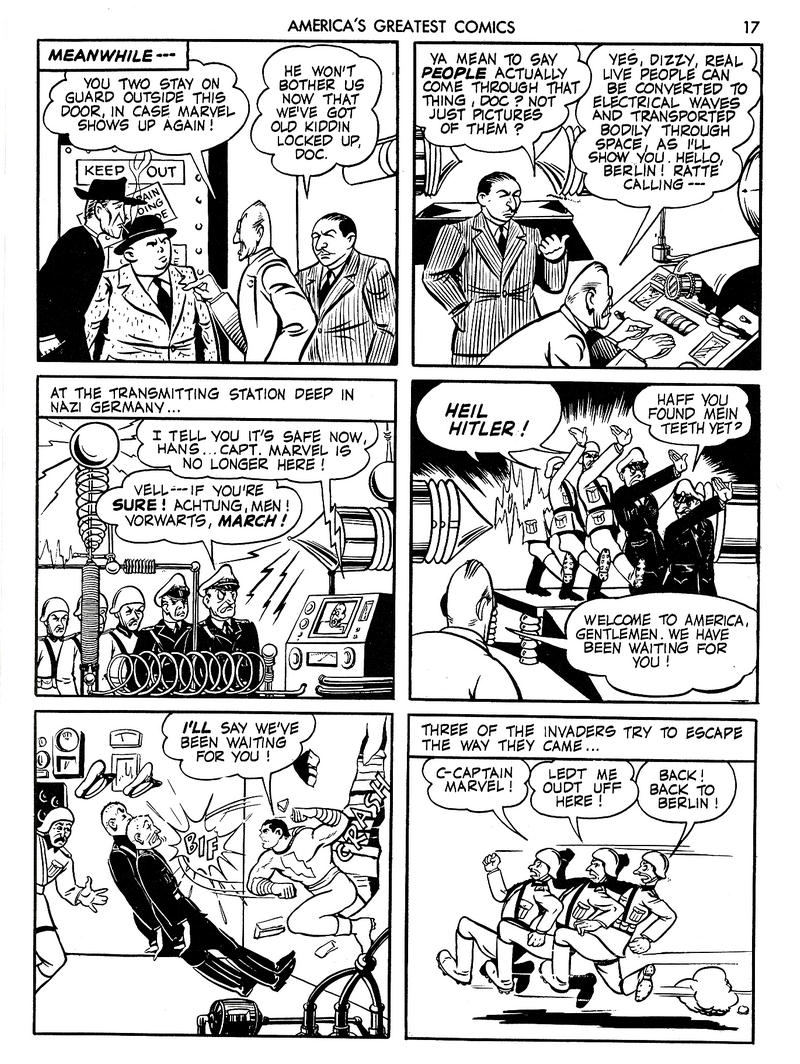
Some of the reprints were printed better than others, some so grayed down by the half-tones that they were almost unreadable. I got rid of the worst of them, but still have the rest. America's Greatest Comics #7, as it says on the inside front cover, was printed from photostats for all but 9 pages. They got the stats from a former Fawcett employee. The art wasn't the greatest on this 1943 comic, because it looks to be all shop drawn, either by C. C. Beck's shop (this Captain Marvel story), and some, or all, of the rest of the contents probably came from the Jack Binder shop.

The title, "World Of Your Tomorrow" is misleading. Issues of Fawcett's non-comics magazines like Mechanix Illustrated were full of prophecies of post-war inventions to make our lives better. That's what you're lead to believe from the title from America's Greatest, but it's about a scientist, his evil partner, and instantaneous transmission of matter, bringing Nazis to America via 3-D television. We have 3-D TV now, nearly 70 years after this story was published, but to the best of my knowledge still no matter transmission.


**********

I just read The Men Who Robbed Brink's, a 1961 book on the famous 1950 robbery, which for years held the record for most money stolen. The robbers wore Captain Marvel and Captain Marvel Jr. masks. When I came across that factoid in The Men Who Robbed Brink's I read this, by author Bob Considine:

"[Tony] Pino, who read comic and adventure strips in the Boston newspapers, discovered that novelty stores were offering plastic or rubber masks of a number of his cartoon heroes. He chose masks in the image and likeness of Captain Marvel and his cowlick zombie son, Captain Marvel, Jr. He made a trip to Chicago principally to buy the masks."

"Cowlick zombie son"!? Captain Marvel Jr is not Captain Marvel's son, yet the confusion because of the word "junior" is understandable. But cowlick zombie? I don't understand that remark at all. Here are FBI pictures of masks like the robbers used.

Writer Paul Cornell gives Lex Luthor everything he's ever wanted, and in this way demonstrates the tragedy inherit in the character. That much of the second volume of Superman: The Black Ring is good, and this is a successful examination of the Lex Luthor character, though it all does get somewhat marred by too much cosmic hoo-ha. As well -- as is the fate of many such long comic book story arcs -- the inevitable interruption of crossovers and threads from other stories creates some confusion here, preventing The Black Ring from ending quite as strongly as it began.

[Contains spoilers]

Lex Luthor merges with a Phantom Zone creature at the end of this book, and in that way attains the god-like power he's always craved. Lex can only keep the power, however, if he uses it for good, and Lex is only able to achieve that magnanimity for a moment before he devolves to base selfishness. All superhero comic books must ultimately be a tragedy for the villain, but Lex's fall is especially poignant because in failing to keep the power, he also fails to truly comprehend any of the lessons he's learned about himself over his two-volume "quest for self-realization," as one character calls it.

The second volume of Black Ring begins with the two-issue crossover with Secret Six (also collected in Secret Six: The Reptile Brain), an annual, two issues guest-starting the Joker and Orange Lantern Larfleeze respectively, and the two-part conclusion. Of these, the Joker's is the best chapter and the most like the great material in volume one. Most of the issue finds Lex and the Joker sitting across from one another in a cell, debating the differences between order and chaos. Though we've seen team-ups between these two arch-nemeses before, Cornell's issue seemed especially wise; Cornell never tries to find where the two villains coincide, but instead focuses entirely on their differences, and it makes their encounter unexpectedly fresh.

The rest of the book, however, never quite achieves that issue (or the previous volume's) studiousness. The Secret Six story is chaotic, not always as much about Lex as the conflict between Vandal and Scandal Savage. The Larfleeze issue feels tacked-on, an unnecessary pause between the Joker issue and the story's conclusion, though Lex's calm murder of one of his employees there -- reminding the reader that Lex is the villain, not the hero, of this story -- is likely one of the best and most horrifying moments of the story. In the annual, Cornell and artist Marco Rudy do a nice Jack Kirby impression, the story and art weird and whimsical like the best of New Gods, but the story doesn't tie to the rest of the book and so fits unevenly in the narrative.

I had suspected, and indeed internet spoilers suggested, that Brainiac was largely behind Lex's quest, and certainly the controlling force of Lex's Lois Lane robot. Cornell made this obvious indeed because the surprise is that Lex has been aware of the manipulation, and planned for it. Had Brainiac simply been the "power" that Lex had sought throughout these pages, I would have been disappointed, but Cornell turns it to one of the book's best revelations. There's a great nerd-chic moment that follows in which Lex and Braniac shout techno-babble at one another, and I've appreciated how both Black Ring and Grounded have called back to the "New Krypton" storyline more than I expected, as in the fight between Lex and Brainiac.


Unfortunately, said "power" turns out to be a Phantom Zone monster, quite inexplicably. Again, Cornell ties it all up well alongside "New Krypton," but it's tiring to find the Phantom Zone again at the culmination of another Superman story (as if every Batman story would have to end at Crime Alley). The various prophecies and hints from Vandal Savage, the Joker, and Death of the Endless all make sense at the conclusion, but a Phantom Zone monster is rather less than what I expected -- the monster's threatened destruction of the universe hardly seems enough to scare the Joker into remaining at Arkham Asylum or to cure Larfleeze temporarily of his greed. Not to mention that once Superman arrives on the scene, Lex at once seems seems the scheming super-villain and not the story's dashing protagonist, far less impressive with his god-like powers than he was in the Joker's cell in a trench coat and suit.

The final chapter of this book is Action Comics #900; we're not treated to the original issue's back-up stories (controversial as they were) and the main story is not quite an anniversary tale (though a good ol' Superman/Lex Luthor battle never hurts in a pinch). What the issues does is show a number of tragedies from Superman's life, drawn by different artists -- again, not the most hopeful anniversary fare, and especially not for the last Action Comics anniversary issue before the DC New 52 Relaunch, but we are treated to Dan Jurgens drawing once again the death of Superman, and Gary Frank drawing again the death of Pa Kent. Artist Pete Woods, a favorite since his Robin days, gets much of the credit for the nuanced, often silent scenes of Black Ring, but Frank's Superman is bar none, and the sequence where Lex realizes Clark's secret identity is gripping.

Even as Lex has hunted this mysterious power over the past two books, the conclusion is incongruously cosmic; after Lex has wheedled his way through the villains of the DC Universe, to blast Superman back and forth with power beams comes off pedestrian. The climax also turns on Lex having sicced one or more Doomsdays on Superman's allies, something never shown in the book but discussed in dialogue after the fact. Informed readers know this relates to the Return of Doomsday and Reign of Doomsday crossover books, but someone picking up Black Ring in the bookstore because they like Lex Luthor, for instance, might think they lost a page.

All of this contributes to the unraveling of Black Ring's conclusion; there's a bit in the middle here that's of the quality of the previous volume, but much of the rest is confusion and battles of the kind you might find most everywhere else.

Taken as a whole, however, Superman: The Black Ring has been a great romp through the DC Universe, and notable especially for Paul Cornell's use of Sandman's Death, and as a fairly faithful story of the aftermaths of both the Blackest Night even and "New Krypton." If nothing else, this storyline has made me take notice of Cornell's writing, and I'm eager for his Reign of Doomsday (awkward ties to this book notwithstanding) and also his Demon Knights and Stormwatch in the new DC Universe.

[Contains original and variant covers, sketchbook and text pages by Pete Woods]

Loved Lex Luthor in Action Comics? Wanted to see Superman return?  Excited for the return of Doomsday, or just ready for the new 52 already?

Number 1033


The zombie death


With Halloween approaching I suppose I need to make at least a token attempt to have some sort of Halloween theme. I don't care to celebrate Halloween, especially by giving out candy to trick-or-treaters, lest my curmudgeon status with neighborhood children be endangered. That they shriek in terror and scatter when I approach them waving my walking stick and hollering, "Get off the sidewalk, you damn little monsters!" is enough Halloween celebration for me.

Today I have a zombie story from Adventures Into the Unknown #20, "The Zombie Death," with art by Lin Streeter. These zombies are the pre-George Romero zombies, back before the preferred method of getting rid of zombies was to shoot them so their heads explode like watermelons. As is usual with this ACG fare the story is not only illogical, it's awfully silly. I like those things when they come from ACG.


I'm skeptical of one claim bandied about in the run-up to the DC Comics relaunch, that the relaunch would clear the decks of years of continuity choking off writers creativity. Letting alone that I believe continuity to be essentially inescapable, Gail Simone's Secret Six: The Reptile Brain is a perfect example of how the long history of a shared universe can be strikingly, immensely powerful. Some of what Simone uses (or re-uses) here is her own, something I found distracting in Secret Six: Cats in the Cradle, but works considerably well here; others of what she uses borrows from the edges of the DC Universe's wide tapestry in very effective ways.

[Contains spoilers. Not much more I can say without spoiling elements of this book]

The first few pages of Reptile Brain, despite that they star the "replacement" Secret Six and not our favorite anti-heroes, are one of those perfect comics sequences, self-contained, that appear to be going one direction and then twist in another for a perfect punchline. Such is the case when the Six's "routine" shakedown on a yacht is suddenly interrupted by none other than Simone's Spy Smasher Katarina Armstrong, late of Birds of Prey.

Someone unfamiliar with Simone's previous work might just see the Six surrounded by US officials, but for fans of Birds (and Checkmate, for that matter), the trajectory of Reptile Brain becomes suddenly wonderfully clear -- Armstrong's Six on one side versus Mockingbird Amanda Waller's Six on the other. The chill of understanding that the reader receives when Armstrong makes the scene only comes by being a dedicated reader -- only comes through the virtues of continuity -- and I daresay a comics universe without those instances (if such were even possible) would be poorer indeed.

(Aside: I'm writing this just as the new DC Relaunch/Amanda Waller controversy is breaking. Reptile Brain contains some fantastic Amanda Waller scenes, and I can't help but read this book as something of a farewell to this iteration, at least, of one of the great characters original to the post-Crisis on Infinite Earths, pre-Flashpoint era. I do not think the "thinning down" of Waller for the new DC Universe necessarily represents a greater racism or sexism than what otherwise underlines society insomuch as I think this is another attempt by DC to reflect the greater media depictions of their characters; that does not mean, however, that it's a change rather poorly thought-out and executed.


Further, there is considerable comedy to a scene in Superman/Batman: Public Enemies in which a Kryptonite-addled Lex Luthor grabs up artist Ed McGuinness's significantly rotund Waller in a passionate kiss that just wouldn't be as absurd with the new younger, slimmer Waller nor would be as funny without knowing the decades-long individual and shared histories of these characters. Here, once again, is the power of continuity, not so easily dismissed. End aside.)

To add continuity on top of continuity, Simone then takes both Six teams and drops them unceremoniously in a dinosaur-infested jungle, expertly revealing little by little that they're in fact in Skartaris, the magical alternate DC dimension of Warlord fame. And this is not just Skartaris-as-background, as its often the case when DC characters make a visit. Simone actually drops the Sixers right at the end of Warlord creator Mike Grell's most recent 2009 series, which ran for sixteen issues but so far under the radar that DC never even released a collection of it -- and Simone makes that series' final events key to what happens in Reptile Brain. A turn off to some, maybe, but I love that Simone cares enough about DC Comics continuity to make use of it (in an accessible way), reader familiarity be damned.

What emerges is Secret Six at its best -- two groups of villains, neither quite right or wrong, debating the finer points of colonialism and their own friendship with one another as they battle over whether the United States will annex Skartaris. It is bloody and morally gray, and in the end both teams decide to abandon their mission completely rather than keep fighting -- a peaceful ending that's perfectly against type. That Simone grounds the underlying conflict in political and interpersonal issues helps to balance the swords and sorcery setting that otherwise wouldn't serve Secret Six. From when Simone reintroduces Spy Smasher in the beginning to where she tidies up elements of her All-New Atom run in the end, the "Reptile Brain" storyline is riveting from start to finish.

I picked up Reptile Brain, however, most specifically because it crosses over with Paul Cornell's Superman: The Black Ring, volume one of which I absolutely adored. Unfortunately, as good as a Lex Luthor/Secret Six Simone/Cornell crossover sounds, I found these issues markedly dull. Luthor hires the Six to be his hidden bodyguards in an encounter with Vandal Savage; the Six are almost immediately revealed, and spend most of the rest of two issues standing around while Luthor and Savage bicker about blowing up the building they're occupying. Savage comes off whiny here and the perceived danger to the characters is near nonexistent; even despite that Sixer Scandal Savage confronts her dad and we delve further into Scandal's origins, these issues lack the pep of "Reptile Brain" before them, and they were less than I expected.

Still, four good issues balance out two lesser ones, and Secret Six: The Reptile Brain is ultimately a prime example of the Secret Six series we've grown to love. Unfortunate doesn't even begin to describe that the next book coming down the pike will be Secret Six's last; more on that when it arrives.

[Incluides original covers.]

Reptile Brain crosses over with the second volume of Superman: The Black Ring, and coming up is our review of that book. See you then!