Number 1013


The Cosmic Secret


Edmond Hamilton, writing here as Hugh Davidson, had a long career in the science fiction, weird tales and comic book field. I believe he wrote mainly, if not all, his comic book stories for DC, under editors Mort Weisinger and Julius Schwartz. The story, "Secret of the Ages" is a fantasy about living for centuries with an "elixir of youth." It's a variation on the type of story I showed Monday, from The Twilight Zone. In "Secret of the Ages" a scientist, Roger Bacon, predicts the scientific miracles that will come to the human race in time. An acolyte, Alleyn (later Allan) Kent takes the elixir, keeping him young for centuries while he follows scientific progress, keeping the formula for the "greatest secret" from his villainous rival.

The artwork is by comic book journeyman John Giunta, who drew comics from the 1940s through the '60s. He died in 1970; Hamilton died in 1977.

From Mystery In Space #2, 1951:


[A new guest review by Doug Glassman, who blogs at Astrakhan Industries.]

In my review of Armor Wars, I mentioned the Iron Man animated series from the early 1990s, and I would like to continue investigating comics relating to that second Golden Age of Animation. My generation was brought into comic books with animated series such as Iron Man, Fantastic Four, Spider-Man, X-Men, and of course Batman: The Animated Series. Also running at the same time, but in a very different genre, was The Tick.

As a child, The Tick was barely on my radar, partly because I was completely obsessed with Mighty Morphin Power Rangers and partly because the series was really never meant for kids -- not that it was vulgar, but just written for a much older audience, with puns and references which flew over my head. What eight-year-old would get a pun about a furniture-obsessed villainess called the “Ottoman Empress”? (I do remember a particularly brilliant one in which the United States was invaded by the Swiss, who had massive Swiss Army Knife backpacks with helicopter rotors.)

Coming back from that tangent, the first few issues of The Tick, collected in The Naked City, are more about parodying specific targets than the broader superhero parody it would eventually become. The last story, involving supervillain rentals so that neophyte heroes can show off their skills, is closer to the rest of the series’ tone. The first two issues are about a parody of Superman, and the middle issues are, in my opinion, the greatest Daredevil parody ever written. Yes, better than the Teenage Mutant Ninja Turtles.

Little is revealed about the Tick in these issues ... but then, there is not much to reveal about him. He has no actual secret identity and no past; the first thing we see him do is escape from an insane asylum. Important supporting characters, including Arthur and Paul the Samurai, are also introduced. Paul never made his way into the animated series, which mostly went on its own path in creating its characters, although another comic book hero, Man-Eating Cow, did appear on the show.

Like writing a funny movie, reviewing a funny comic is difficult. Make no mistake, The Tick is still as brilliant as it was back in the late 1980s. Most of the superhero humor is broad enough to withstand the test of time, and the sequence between the Tick and “Ban-Al”, the father of Superman parody Clark Oppenheimer, is an effective skewering of Marlon Brando’s performance in the first Superman film.

There are some subtle references and shout-outs as well. For instance, one panel in the first issue features the Tick at the restaurant from Edward Hopper’s painting Nighthawks. Naturally, the restaurant is called “Hopper’s.” The parody of Marvel Comics’ Electra is named Oedipus; her full name is Oedipus Ashley Stevens. The Tick’s rooftop soliloquies are spot-on parodies of Frank Miller’s narration boxes.

Considering that Ben Edlund was a novice when he created The Tick back in 1988, the artwork in The Naked City is quite impressive, especially when it comes to comedic timing. For instance, the title card for the third issue, “Night of a Million Zillion Ninja,” first appears as a yellow box on a wall. This just seems to be an interesting placement ... but as the sequence continues, it is revealed that the title card is a sign, albeit a fourth wall-breaking one. Over the next two pages, as a fight scene rages, the title card can be seen in the background at a variety of angles.

My one major complaint about the art is the lack of variety of facial expressions, which border on “dull surprise” at times. However, since this was Edlund's first real foray into the world of comics, it is certainly forgivable, and he does improve later on. Fans of the animated series may also be surprised to see how fat Arthur is.

As an aside: My absolute favorite characters in this volume are the ninjas. Clad completely in black uniforms with extremely expressive yellow visors, they provide some of the best laughs of the ninja story. They are the most wimpy, pathetic ninjas ever written, to the point that when one is run over by a car, the driver brushes it off with, “It’s not like we hit a collie.” If you have ever seen the “Ninja Hedge” images around the web, they come from “Night of a Million Zillion Ninjas.”

There are a variety of ways to get the story. This volume, The Naked City, is a colorized version of the first six issues, which were released under the “Chroma-Tick” title. Like Teenage Mutant Ninja Turtles, Usagi Yojimbo and other contemporary independent comics, The Tick was published in black and white. Although the colors in The Naked City seem a little washed out -- reminiscent of colorized films -- I feel that The Tick almost needs to be read in color. You can also buy updated omnibus editions with extra features.

Although the trades go in and out of publication, you are likely to find at least one edition in your local comic book store or used book store. Edlund is very business-savvy, as seen in the lengthy catalog at the end of this trade, which features comics and lots of animated series memorabilia.

Every comic book fan should own a copy of the initial twelve-issue miniseries of The Tick, whether or not you watched the animated series. Quite simply, it is the best superhero parody ever created, both art-wise and story-wise.


Number 1012


Crandall and Evans in the Twilight Zone


The first issue of the comic book version of the popular TV show, The Twilight Zone, came out in 1961. The entire issue was blessed by the artwork of two top comic book artists, Reed Crandall and George Evans. This shows them at the tops of their form, Crandall penciling and Evans inking. Both had years of experience behind them, and both spent a few years at the ne plus ultra of comics, EC.


This issue was published as part of the Dell Four Color series, #1173, 1961.


Number 1011


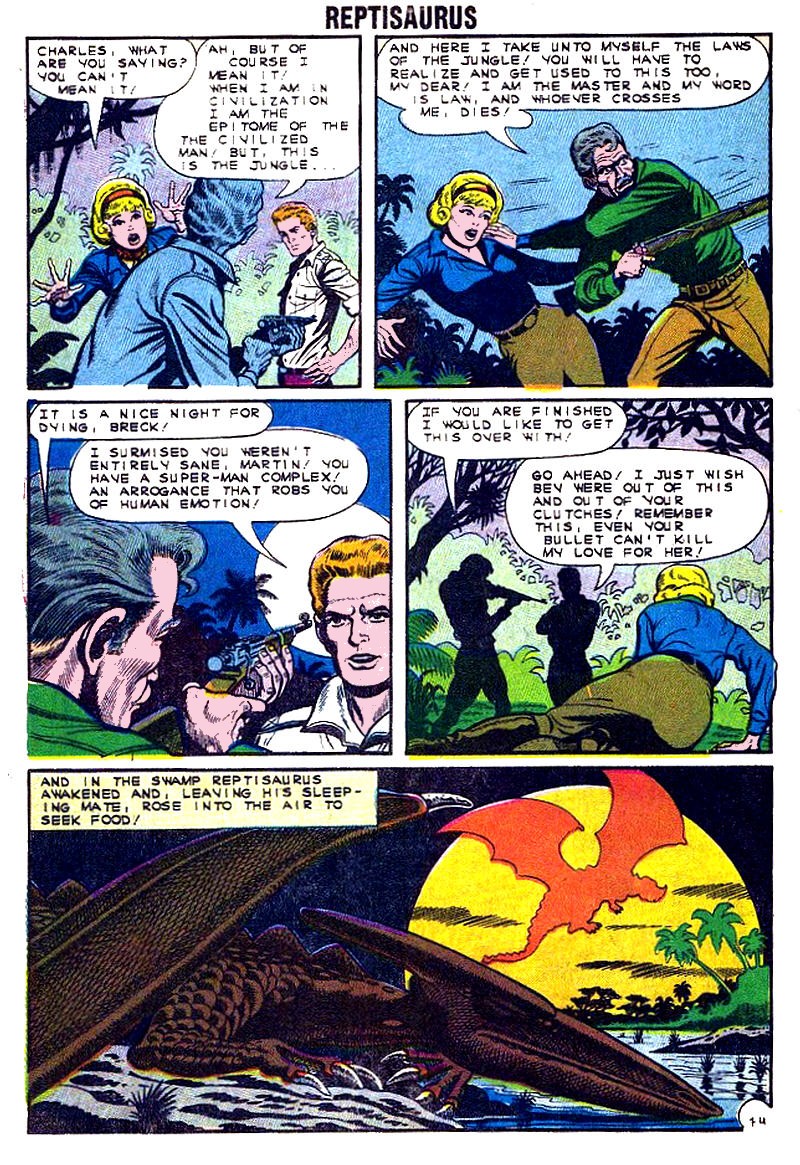
Reptisaurus and the jungle love triangle


This entertaining Charlton comic is new to me, even though it was published in '63, when I was visiting the comic book spinner rack in my local drug store every week. I missed a monster book where the monster, Reptisaurus, is almost a bit player in the story, and the main plot involves a love triangle. Rich man, his blonde fiancée, and a white hunter who bags the babe! Oh yeah...they also figured in some Aztecs who worship Reptisaurus.


The artwork is by Montes and Bache. I don't know the work of Bill Montes at all, and what I know about Ernie Bache is that he worked with Dick Ayers during Ayers' original 1950's Ghost Rider days. A quick search of the internet didn't turn up any information on Bill Montes, and all I found about Bache is what I already knew. If anyone knows if these two men are still around please let me know.


A criticism I have is of the ashen gray the colorist made the Aztecs. I know this portrait I found online is heroic, glorified artwork, but it's probably closer to the real Aztecs than Charlton's colorist made them.


There were 6 issues of a Reptisaurus comic in 1962; Montes and Bache drew the last two issues, preceding this "special edition." From Reptisaurus Special Edition #1, 1963:


Ernie Bache also inked this four-page humor strip from Charlton's Abbott and Costello #5, penciled by Grass Green. Grass was an early member of comics fandom, one of the first fans to attempt to turn pro. Most comics companies were by then closed shops, and what work he got was sporadic at best. I think the Steve Skeates script is funny, and Grass' artwork with Bache's inks serves it well.


Number 1010


The Eerie Mirror Of Isis


Joe Kubert's dramatic early '50s artwork highlights this horror tale, saving it from its major comic book sin, speech balloons in some panels that nearly crowd out the drawings. As always Kubert did the best with the material he was given. In "The Mirror Of Isis" he even got to draw a babe in a brass bra.


From Avon's Eerie #3, 1951:


J. T. Krul's Green Arrow: Into the Woods is akin to J. Michael Straczynski's Superman: Grounded and Wonder Woman: Odyssey. That is, though we didn't know it at the time, Krul's Green Arrow is essentially a limited series of about a dozen issues where Krul can recreate Green Arrow Oliver Queen as he sees fit, all to be wiped away after the DC Relaunch. And Krul does take some surprising liberties with Green Arrow's character and origins; I like Krul's take on Green Arrow and enjoyed the tone of this book better than I thought I would, but this is a book geared more toward a new Green Arrow reader than an experienced one.

[Contains spoilers]

Based on cover images and assorted previews alone, I was concerned J. T. Krul would turn Green Arrow into a "swords and sorcery" book, defined as you see fit -- appearances by King Arthur's knights, the Lady of the Lake, and in the next volume, the Demon Etrigan. None of that is the case, however -- Into the Woods is not near so urban as Andrew Kreisberg's recent Green Arrow/Black Canary run (and light years from Mike Grell's) but Ollie fights techno-soldiers and gang members just as much as he does Black Lantern zombies here, so the tone isn't quite so different than in Green Arrow series past.

Matter of fact, I have liked and continue to enjoy Krul's take on Green Arrow -- important, since Krul continues with the character (if not this exact iteration) after the DC relaunch. Krul's Oliver Queen is old and wry, self-deprecating but tough -- perhaps one of the best early scenes of the book is Ollie defending a powerless Green Lantern Hal Jordan from the aforementioned soldiers, when it's often Green Lantern that's more imposing in a fight. In these pages, Krul's Green Arrow doesn't have the space to be as socially conscious as he was under Judd Winick or Dennis O'Neil's pen, but Krul's Green-Arrow-as-Robin-Hood aesthetic is fitting; Ollie steals food from Star City's fat cats' banquet to give to the city's poor, for instance.

Even the more fantastic elements of Into the Woods work. Krul's conflating of the Robin Hood and King Arthur legends is strangely charming, and Green Arrow's Galahad leans enough toward "kooky mental patient" than Knight of the Round Table to make him an appropriate foil for the curmudgeonly Oliver Queen. Against type, Krul quickly kills off the "Sheriff of Nottingham" character Commissioner Nudocerdo and instead pits Ollie against "the Queen," one of his father's former lovers -- his wicked stepmother, essentially. Aside from the appearance by the Lady of the Lake, the most "magical" thing Green Arrow deals with stem from this book's Brightest Day crossover elements -- White Lanterns and Black Lanterns and the like, as much science-fiction as fantasy and therefore about par for the course for a Green Arrow title with ties to the larger DC Universe.
I am of two minds, however, about Into the Woods's last two chapters, in which Krul picks up on an obscure Scott McCullar story from 2002's Green Arrow: Secret Files & Origins that shows young Oliver Queen's parents mauled by lions because of Ollie's unwillingness to kill with, you guessed it, a bow and arrow. Krul suggests, though does not explicitly state, that Green Arrow's murder of the villain Prometheus in Justice League: Cry for Justice specifically stemmed from his pent-up guilt over not saving his parents.

This is interesting, and offers a useful through-way for those who can't stomach Ollie's current direction, but it's a bit of putting the cart after the horse. Prometheus's murder was really for shock value and thematic aspects of Cry for Justice, characterization be damned, and to suggest Green Arrow had a deep-seated psychological motivation for it comes off as exactly what it is -- a quickie attempt at patching over a controversial plotline that probably didn't need the patching. I'd just as soon stick with Cry for Justice's reasoning, that Prometheus was a bad guy and Green Arrow had finally had enough, than mitigate Ollie's actions in this manner.

Also, given how obscure the McCullar story is (it came out during the Kevin Smith/Brad Meltzer runs almost nine years ago, but I don't recall it being referenced since), Krul has too much faith in its ability to move the long-time Green Arrow reader. At the end of the book, Ollie literally sobs at the ghostly appearance of his mother; the scene might be passable with a young Justin Hartley-esque Green Arrow, but seems especially maudlin with our grizzled, Van Dyke-bearded Oliver Queen. Krul is true to what's come before in suggesting Ollie tortures himself in part because he misses his parents, but when the source material is only McCullar's story, and otherwise we haven't witnessed Ollie's distress over his parents in hundreds of other stories, it's hard to have emotion for Ollie here. The book ends with a whimper and not the emotional bang I think Krul intended.

Overall, however, what Krul has here is entertaining, especially at the beginning and in the guest appearances by Hal and Martian Manhunter J'onn J'onzz (neither of whom, pleasantly, seem to want to set aside years of friendship with Green Arrow just because he murdered Prometheus). Green Arrow: Into the Woods does not open insights into Green Arrow greater than Kevin Smith or Judd Winick's runs did and this will not be known as a defining Green Arrow run, but it's a good start. J. T. Krul has the tone and tenor of Green Arrow Oliver Queen down pat, and that's a good starting point as he recreates the character entirely a few books from now.

[Contains original and variant covers. Printed on glossy paper.]

Next week, by popular demand, the Collected Editions review of Wonder Woman: Contagion. Be there!