Number 994


I dream of mushrooms...


If I'd seen the story, "He Pierced the Unknown," in 1968 instead of when it was published in 1958, I'd have had a different interpretation of young Albert Huraki's dreams. Instead of just interpretive drawings of Albert's gift for precognition, I would have seen drug references, especially with the big mushroom. I shamelessly use that panel above in order to provoke knowing readers to nudge the person next to them, then point at it and snicker.

Sorry to disappoint. There are no drugs involved. The story, presumably written by editor Richard E. Hughes, is well thought out. Albert can see the future in his dreams, couched in mystic, almost biblical, symbolism. Artist Ogden Whitney did a fine job interpreting the dreams.

I have one more observation about this story: the description of Albert, especially in the early panels, seems to be describing what we now know as an autistic child. I wonder if the writer knew someone who fit this description...?

From Adventures Into the Unknown #101, 1958:


This is a letter (from "Alfred E. Neuman") with a response from editor Richard E. Hughes in that same issue of Adventures Into the Unknown:

Hughes answers the question I've had about the artist of "Space Adventurer," who I now know is Edmond Good. A couple of weeks ago I showed the origin of Tomahawk from Star-Spangled Comics, drawn by Good.

"Space Adventurer" is more typical Hughes: guy is a failure, makes good, impresses girl. In this case the story, published in 1958, takes place in 1991, one of the future-in-the-past stories I love. The future it describes is in the past for us, so we can see how it stacks up against the reality of 1991. Um, not so well, but I enjoyed the part about the hero buying a used rocket ship for $416. That's about what my first car cost in 1963.


Each chapter of Justice League: Generation Lost opens with a stylized cover by Tony Harris or Cliff Chiang, creating a strange category of Justice League International deco art. Judd Winick's comeback story in these pages, therefore, emerges as a kind of fetishized version of Keith Giffen, J. M. DeMatteis, and Kevin Maguire's Justice League; I'm not sure the good old days were ever quite as good as Generation Lost's fond remembrances make them out to be, but they sure seem good in retrospect.

Winick's Generation Lost itself is a fine book, really quite well done, though International purists might find a little to pick at. To be sure, Generation Lost is not Giffen and DeMatteis's Justice League, but rather Giffen and DeMatteis's Justice League filtered strongly by way of Winick, to good result.

[Contains spoilers]

The premise of Winick's Generation Lost is especially strong, and drives the book as a whole. The newly resurrected Maxwell Lord has erased himself from everyone's memory except a choice group of former Justice League Internationalers; those that remember Max are considered crazy. Generation Lost becomes a dizzying paranoid tale with plenty of twists and turns -- namely, whether the characters remembering Max is an accident, or part of plans within plans within plans.

The best part is, Max may not be the villain of the story. Resurrected as he was by Brightest Day's White Lantern, it may be Max's bad actions have good consequences. Winick reframes Maxwell Lord entirely in this manner; rather that the severe disconnect between the "friendly" Max of Giffen's Justice League and the Black King Max that killed Blue Beetle Ted Kord, Winick suggests that all along Max has been pursuing his "world-saving" agenda, sometimes on the side of the good but never, despite what those around him may think, entirely on the side of the bad. This adds to Generation Lost's thriller appeal, in that the reader can't complete trust nor distrust Max, and this redeems Max as a villain with some reader appeal.

With this and other tweaks, however, it's clear Winick is taking his cues from, but not necessarily being constrained by, Giffen's original source material. Most significant in this volume is how Winick drastically revises the character Ice's origin -- conflicting, even, with Justice League stories previous. Even before that revelation, however, Winick's Ice is still not Giffen's nor writer Dan Jurgens's; that Ice wouldn't have said "hell," at least, letting alone calling her friend Fire, "You're such a @#$%" (whatever that's supposed to be, given that I thought "bitch" was on DC Comics's approved bad words list).

Blue Beetle Jaime Reyes, too, is a far more reluctant hero and less admiring of Booster Gold than he has been also under Giffen and Jurgens's pens, all to fit the story Winick wants to tell (letting alone these characters have met Reyes before, even though they seem not to remember). I don't necessarily think Ice's new origin adds much to the character, but I'll reserve judgment pending a further explanation in Generation Lost volume two. I can't sweat new origins much given the DC Relaunch only a few months away, and because Generation Lost works so well despite these assorted nitpicks.

Generation Lost, volume one, collects the first twelve issues of this series, making this feel like an especially thick book as far as DC hardcovers go. Winick's story quickly distinguishes itself as more than just a Justice League-centered book like Giffen and DeMatteis's Formerly Known as the Justice League miniseries -- there are elements here of Brightest Day, Kingdom Come, and detailed Checkmate material with great art by that series's artist Joe Bennett. Add to that some unexpected jaunts to the future, and Generation Lost will remind the reader of DC's other weekly series 52 and Trinity -- real DC event comics, rather than just a Justice League reunion book.

If Generation Lost is more than Justice League, however, it's got that, too. The boisterous new Rocket Red is the ultimate International fanboy (think TV's Brave and the Bold's Aquaman with a wonderfully bad Russian accent), and he remembers the glory days of this Justice League that, among Kooey Kooey Kooey and fat jokes, maybe never quite actually existed. Kevin Maquire provides alternate covers to the book, but you have to squint to find Maguire's big-toothed faces among all the Hi-Fi gloss effects.

It's a thrill to have these characters back together, but the entire package suggests a time better, cooler, and more polished than it was, especially toward the end (they were defeated by Despero in L-Ron's body, people). To suggest that Justice League International holds up to modern standards of "cool," almost thirty years later, is to suggest leggings and shoulder pads were cool, too -- in retrospect, they were not. It is however, as they say, pretty to think so, and gives fans of International something to be proud of nowadays even if we all remembered International entirely differently during the Grant Morrison JLA era.

Justice League: Generation Lost is a pretty package, and a fine story to boot. In the first splash page depiction of the main characters, Rocket Red declares Fire, Ice, Booster, Beetle, Captain Atom and himself the new Justice League International, and there's a greater sense here than in previous International reunion books (two plus in Blue Beetle and Booster Gold) that the purpose here is team building and not just nostalgia, fancy trappings aside. It remains a thrill to have these characters back together, and even more so to have Judd Winick writing another team book after Outsiders. More's the pity that Winick won't keep with this title in the DC Relaunch, but I very much hope DC has something else from the writer on the way.

[Contains original and variant covers.]

Up next, we're continuing our look at the Brightest Day/Generation Lost with Booster Gold: Past Imperfect. See you then!
We've seen DC Comics 2012 trade solicitations for the Flashpoint hardcovers, for a pseudo-Batman by Grant Morrison Omnibus, a bunch of massive Wildstorm collections, and the second volume of the Flash by Geoff Johns Omnibus.

What comes next is the second volume of the New Teen Titans Omnibus, notable because it could be the first hardcover release of one of DC Comics's most famous storylines, "The Judas Contract."

The first New Teen Titans Omnibus collected issues #1-16 of the New Teen Titans series, plus their debut in DC Comics Presents #26 -- that is, most of the previously released DC Archives: New Teen Titans volumes one and two (see Death of the DC Archives?").

It stands to reason that the next volume would collect issues #17-32 -- more than DC Archives: New Teen Titans volumes three and four, but not quite through the "Judas Contract" storyline, which had its prologue in New Teen Titans #28-34 (the storyline later dubbed "Terra Incognito") but is most specifically in New Teen Titans #39-44 and their third annual.

However, DC's initial solicitation for the New Teen Titans Omnibus volume two reads:
The New Teen Titans -- consisting of the sidekicks to heroes from across the DCU, including Robin, Kid Flash, Donna Troy and more--battle threats large and small and from outside and in. Betrayal comes from one of their own when it's revealed that their teammate Terra is secretly working the Titans' deadly enemy Deathstroke. [Unfortunate typo there, but no less true.]
Two possibilities:

One, that the New Teen Titans Omnibus volume two is massive, collecting issues #17-40 of New Teen Titans, over twenty issues, plus an annual. That's pretty darn well unheard of, but not impossible -- note that the Starman Omnibus volume six itself collects twenty issues.

Two, given that "Terra Incognito" has only of late been added to the "Judas Contract" canon, it might be that DC has decided to split this storyline up in the omnibus editions. Not terribly controversial, I don't think, but notable -- whereas "Judas Contract" has historically been New Teen Titans #39-44, now it's #28-44, just as DC recently expanded Legion of Super-Heroes: The Great Darkness Saga to include earlier issues in their new deluxe collection. Alternatively, maybe the distinction of the "Judas Contract" storyline falls away completely now in our new post-trade, omnibus edition, DC Relaunch reality, and "Judas Contract" is just another aspect of the overall collected New Teen Titans story.

Either way, "Judas Contract" is certainly deserving of hardcover treatment, and it's been a long time coming from DC. Whatever form the second New Teen Titans Omnibus volume takes, the fans win.

And more ...
* Batman: Venom

Still working those movie tie-ins, we see a re-release of Dennis O'Neil's Venom storyline that later factored into Bane and Knightfall.

* Superman: The Secrets of the Fortress of Solitude

This strikes me as a weird release, what seems to be a collection of Golden Age Fortress of Solitude back-up stories, given that the Superman and Fortress features here doesn't exist any more after September. Given that some stories here are written by Jerry Siegel, maybe this is DC flexing its post-court case muscles (or otherwise paying restitution!).

* Showcase Presents: All-Star Squadron Vol. 1

I'll need a little help with this one, but I believe All-Star Squadron dovetails somewhat with Infinity Inc., making this a companion to the new line of Infinity Inc. hardcovers.

* Teen Titans: Prime of Life

My guess is this will go up to issue #100 of the series, making it the final Teen Titans collection before the DC Relaunch.

* Legion of Super-Heroes: When Evil Calls

Initial solicitations have this in paperback, and I'd say I'm disappointed; I'd rather this be in hardcover to sit beside The Choice. Chances are the next DC Relaunch volume will be in hardcover.

* Batman: No Man's Land Vol. 2

The current solicitation for this is wild, and wildly inaccurate. Take a look:
After suffering a cataclysmic earthquake, the U.S. government has deemed Gotham City uninhabitable and ordered all citizens to leave. It is now months later and those that have refused to vacate "No Man's Land" live amidst a citywide turf war in which the strongest prey on the weak.

Batman and his allies continue their fight to save Gotham during its darkest hour. Taking on a new costume and persona as Batgirl, the Huntress joins forces with Barbara Gordon, the former Batgirl, while Nightwing, the former Robin, tries to help the city's remaining citizens in any way he can. But as Batman begins to realize that he is fighting a fight he can't win, he collapses into a state of despair from which he may never recover.
A state of despair? I don't remember that from No Man's Land ...

Again, three cheers for "Judas Contract" in hardcover! What'll you be picking up?

Number 993


Don't make a spectacle of yourself


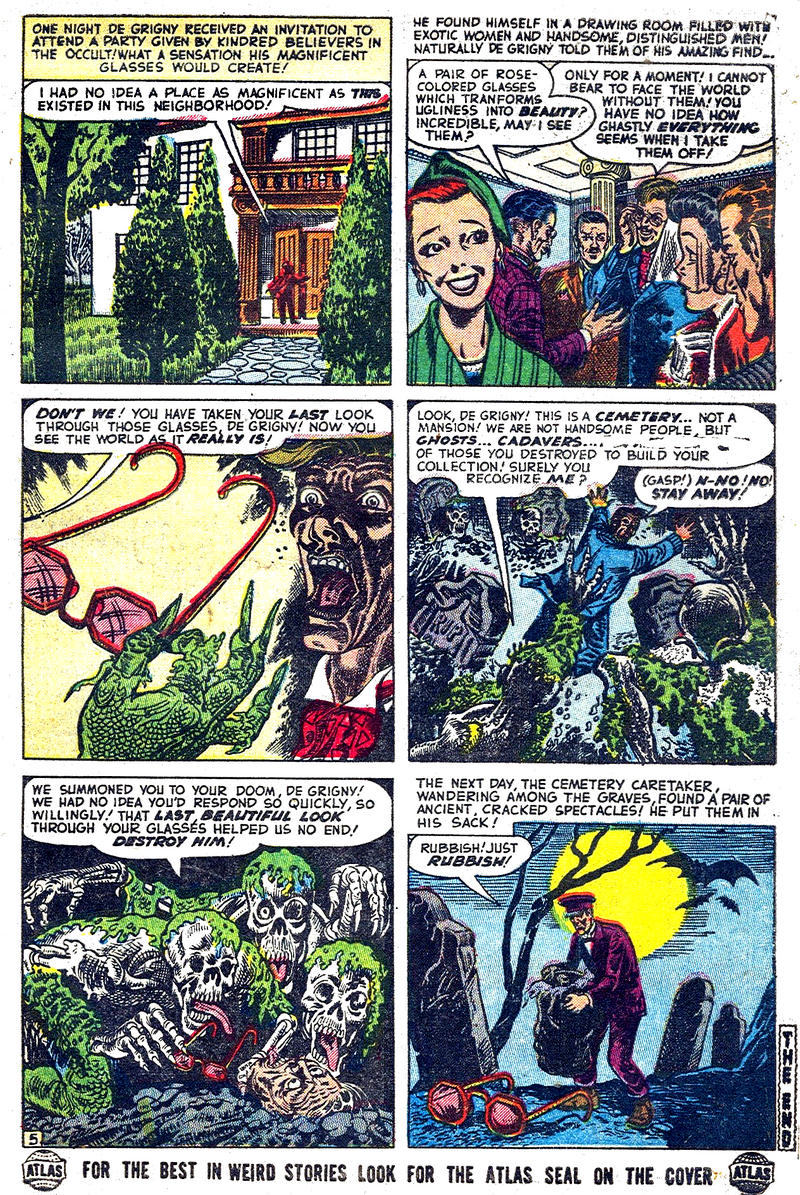
In our two stories today spectacles, meaning eyeglasses and not exhibitionist behavior, play a major part. They are similar, both from Atlas horror comics: "Spectacles of Doom" by Bill Everett and "The Last Look" by Robert Q. Sale. "Last Look" I showed a few years ago, but have re-scanned it for you.

Bill Everett had some fun with "Spectacles of Doom," drawing some very funny characters. I love Everett mixing cartoon exaggeration into his art. Robert Q. Sale was another veteran comic book artist, who at one time shared studio space with Harvey Kurtzman, Will Elder and John Severin. He also mixed in some comic exaggeration--check out his graveyard dead on the last page, with their lolling tongues, or the cucumber-nose baby--and gave a nod to Kurtzman with panel four of page four, which is an homage to "Smilin' Melvin" by Wally Wood from Mad #7.

From Marvel Tales #94, 1949:


From Mystic #31, 1954:


Peter Tomasi and Patrick Gleason's Green Lantern Corps has been a perennial surprise hit for me -- from Sins of the Star Sapphire to Emerald Eclipse to the Corps volume of Blackest Night, I have enjoyed this title immensely, and every time more than I expected. Unfortunately, new series writer (as least until September's DC Relaunch) Tony Bedard's first outing, Revolt of the Alpha-Lanterns, is dull by comparison, lacking both the excitement and nuance of Tomasi's work. It's a good thing Tomasi returns to Green Lantern Corps after the relaunch, else it's possible I might have dropped Corps entirely.

[Contains spoilers]

The "Revolt" story takes Bedard five issues to tell, when I couldn't help but think Tomasi or Green Lantern writer Geoff Johns could have covered the same material in one or two issues. Every step of the story seems to require its own chapter -- an entire chapter for Lantern John Stewart to arrive on the robot planet Grenda, another entire chapter for Kyle Rayner, Soranik Natu, and Ganthet to arrive to rescue him, still another while the heroes hide out from the villain, and so on.

Corps has seen in Emerald Eclipse, for instance, the Green Lanterns take on the issue of capitol punishment as Rayner and Guy Gardner placed their own bodies between the Alpha-Lanterns and villains to be executed. In Revolt, in contrast, the story is black and white with no shades of grey -- Alpha-Lanterns are kidnapped by the evil Cyborg Superman, Stewart and company arrive for the rescue, and they're successful.

When the Lanterns fought the Sinestro Corps's baby-stealing Kryb in Sins of the Star Sapphire, their battle was weird and violent and shocking. Revolt has not the cybernetic Borg-esque horror it could have; rather a good amount of the real nitty-gritty battles with the Cyborg take place in an artificial dream-space. Letting alone that I don't quite get the sci-fi science that lets Alpha-Lantern Boddika and the Cyborg Superman fight it out in their subconsciouses (nor how Boddika can be so sure this kills the Cyborg), this dream fighting lacks the drama "real" fighting might have brought. Revolt's story turns on Boddika and the other Alpha-Lanterns being unable to act for themselves; Boddika's moment to shine has her standing still, and I found this unsatisfying.

Bedard does achieve some nice character moments in the book, especially in regards to Boddika. Boddika is a long-standing, brusque Green Lantern character, and her transformation to an emotionless Alpha-Lantern pained the reader the same as her fellow Lanterns. Bedard has a perfect sense of continuity here, bringing up some of Boddika's greatest moments from stories ten or more years ago and this thrilled me as a fan, as did the two-part spotlight on Boddika by Sterling Gates that closes out this book.

Bedard's focus on new Green Lantern Ganthet is also interesting, including Ganthet forging his own ring, and I very much enjoyed Bedard's depiction of the Cyborg Superman during Blackest Night and the ties this book has to the upcoming War of the Green Lanterns. This is not quite enough to offset the other difficulties of the book -- and I groaned at the silly jealousies Bedard seems to be setting up between Rayner and Natu -- but there are some moments here that Corps fans might want to see.

I had liked artist Ardian Syaf's work on Superman/Batman: Big Noise, but here I felt it came off too dark and rough, often with distorted open-mouthed faces; artist Nelson's faces are equally distorted in Gates's story, with every character wearing a perpetual sneer. I'm not sure if Bedard's story might have shined more if Gleason drew it, but the combination of both unremarkable story and art lead ultimately to a book that doesn't meet its own standard. This is a small thing, but Syaf draws the Red Lantern Atrocitus incorrectly in the first pages, with red fire coming perpetually out of his mouth like a solid cloud hanging around the character, and it's an indication of the kind of extra care this book needed and didn't receive.

Another "care" issue: Gates's Alpha-Lantern story came out five years ago, roundabouts Final Crisis, whereas Bedard's are more recent, but Bedard's are presented first in the book. I don't mind this necessarily -- Bedard's issues are the more important of the volume, though reading Gates's first gives greater insight to the characters -- but there's no indication given to the casual reader to explain the discrepancy. It's not hard to read the beginning of Gates's story as following rather than preceding Bedard's, and a casual reader could certainly be confused.

Also, Gates's story ends with a tag directing the reader to follow the events into Green Lantern: Rage of the Red Lanterns, a book which indeed follows Gates's old story, but not Bedard's, essentially moving an uninformed reader backward. In comparison to Green Lantern: Brightest Day, which not only directs the reader to War of the Green Lanterns but even includes a preview of it, Green Lantern Corps: Revolt of the Alpha-Lanterns seems an unfortunate slapdash production that doesn't get help from any of its sides. More's the pity, because this is a good series that deserves better.

[Contains original and variant covers]

Let's put this uncharacteristic stumble behind us, however, because up next comes the Collected Editions review of Justice League: Generation Lost Vol. 1. Be there!

Number 992


Joe Kubert Tor it up...


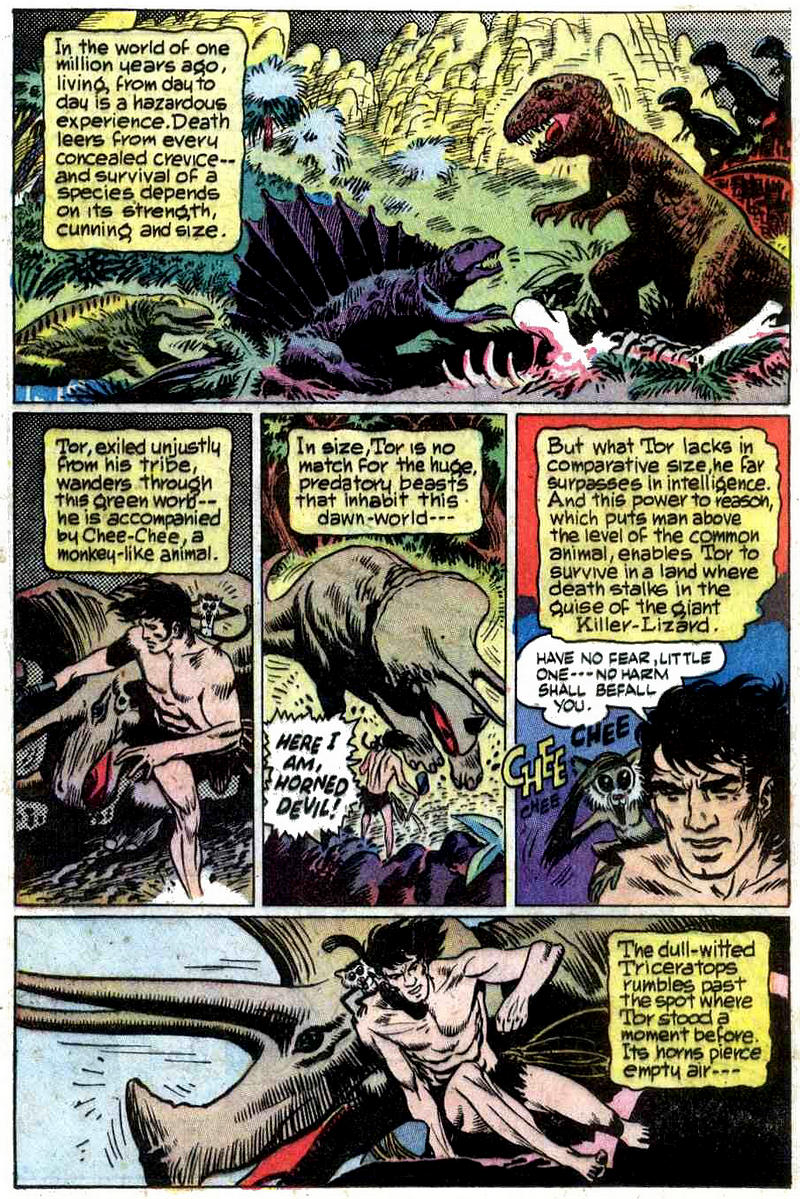
Tor, the comic book character from "1,000,000 years ago" was created by Joe Kubert and Norman Maurer, and copyrighted by the creators. Kubert later licensed the character to DC and then Marvel. This is from the last issue of the original St. John series in 1954.

The first story is a prehistoric soap opera tale of adultery and murder. It seems a bit out of place for a setting of a million years ago, but I'm sure people had trouble with spouses (or "mates") in those days, too. The second story is more typical, with Tor doing battle with an ape. I've also included a page with Kubert and Maurer defending their comic books against the attacks on comics that led to the Comics Code, and a page where Kubert and Maurer offer schooling in how to be a comic book artist, letterer or colorist, by practicing as little "as 15 minutes a day in the privacy of your own home," pre-dating the now famous Joe Kubert School of Cartoon and Graphic Arts.

I posted another story from Tor #5 in Pappy's #647, and a 2-D version of a 3-D Tor in Pappy's #850.