Number 891


Dancing the roomba with Moomba


Today's posting is courtesy of Pappy's readers John Kaminski and Jim Sharpe. John was kind enough to pass along a request to Jim to scan the first two pages of "The Unbelievable Menace of Moomba" from Tales To Astonish #23, and as a bonus they sent the entire story, "The Strange Fate Of the Statue Maker" from Tales To Astonish #34.

You can see from this scan of my copy of TTA #23 why I needed help with the splash and second page.

Jack Kirby and Dick Ayers drew the story. I get a kick out of Moomba not because it's a monster story (typical for the era), but because of the title. Marvel used some creative names for the monsters: Vandoom, Fin Fang Foom, Groot, and my favorite, Tim Boo Ba. "Moomba" is in that rich tradition of ridiculous sobriquets with the "oo" sound.

"The Strange Fate Of the Statue Maker", drawn by Kirby and Paul Reinman, has a typically outrageous plot: inventor builds ray that turns the living into stone.* What got my attention wasn't that silliness, but the ad the scientist placed, "Wanted -- Sculptor's Model. Must be without friends or family." A girl would be really smart to answer that ad, wouldn't she?

Thanks, John and Jim.


*A short-sighted businessman, he rejects his own invention as a failure, when the military would have paid anything for a ray that could turn enemy soldiers to stone.


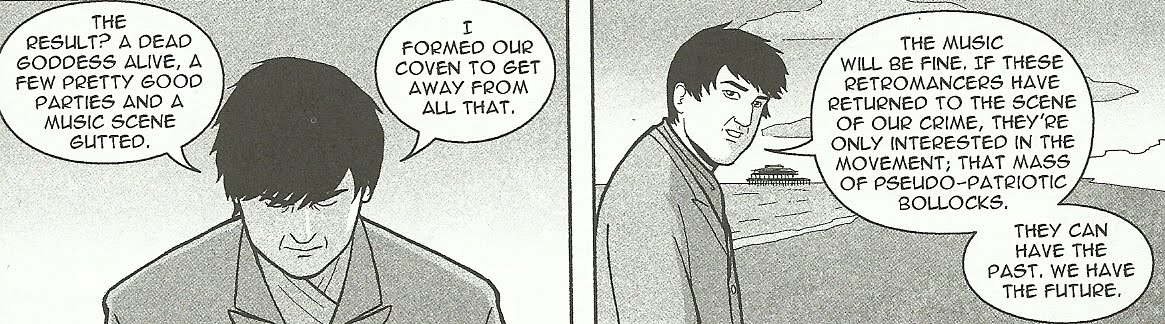
In which the blogger finds himself taking an unexpected detour from his own plans to wonder why "Phonogram: Rue Britannia", a book playfully and yet profoundly concerned with ethical issues, succeeds in never appearing to be lecturing its audience. Why not?


8.

It'd be ridiculous to suggest that "Rue Britannia" is a book whose meaning can be reduced to that of a feminist primer. Thankfully, the truth of the matter is far more complicated and nuanced than that. For it's the fact that this comic seems to come to some pretty definite ethical conclusions, while also providing some rather qualified and even contradictory supporting evidence for them, which helps give the book its sense of being alive. And "Rue Britannia" does succeed in lending the reader the sense that they're listening in on a great mass of opinions, and through that experiencing a whole series of ways in which its story might develop, even as the narrative works purposefully towards suggesting one particular solution to the problems at hand. To succeed in making a text seem so apparently open-ended when it's in fact driving towards a deliberately preordained and traditionally-minded solution is no little achievement, and it's one which is, I'd suggest, well worth paying attention to.


One of Mr Gillen and Mr McKelvie's techniques in creating this sense of possibility and plurality in a book which is in truth heading towards a definitive moral conclusion is to make sure that their characters are more than just two-dimensional symbols of the values they're representing. And so, the fact that the end of "Rue Britannia" gives the sense that Dave Kohl has become something of a new man is, to a degree, tempered by the realisation that he's never shown actually fulfilling such a role. We leave him before he can be shown entering into a relationship of equals with a woman, his previous associations with the not-so-opposite sex having always been previously marked by exploitation or a calculated advantage. And, as we've already discussed, the insensitivity of his rant against Richey Manic near the book's close shows that he's still quite some way from the kind of total moral, empathetic transformation that marks, for example, Phil Connors at the end of "Groundhog Day". In such a fashion do Gillen and McKelvie ensure that their characters have a life that's separate to and partially distinct from the moral purpose that their thoughts and actions are used to illustrate. Their existences help to illustrate the principled themes of "Rue Britannia", but they're not simply thin and unengaging representations of right and wrong thinking. In short, Dave Kohl's experience helps to accentuate why feminism is a damn good thing without turning Dave Kohl into an unconvincing paragon of feminist virtue.


It's this process of creating great broad ethical brushstrokes across the narrative as a whole while providing more subtle and less morally specific character development within the story which prevents the first book of "Phonogram" from feeling like a moral admonition from a humanist lectern. (Instead, it most often feels not unlike a great mass of competing conversations and lectures, a comic-book Speaker's Corner, where the declaimers are at the very least as interesting as the points they're offering up to their audience.) Nothing would have killed the energy and argumentative goodwill that characterises "Rue Britannia" so much as such a closing example of two-dimensional worthiness, especially considering how formal and traditional the comic's structure was designed to be, drawing as it does on the form of the monomyth. Such a recognisably conventional form can lead to a simplistic, stilted dialectical brew in which good is presented here, evil here, and the outcome never in doubt and never counting for much either. Without the appropriate care, there was every chance that the first book of Phonogram could have ending up as a rigid, self-righteous harangue.


And so, rather than ending with an utterly reconstructed Dave Kohl, it could rather be argued that "Rue Britannia" ends not with his adapting a feminist point of view at all, but rather a regressively chivalrous one, in which he sees it as his responsibility as being to save women from both their own weaknesses and their male oppressors. For he's not collaborating with women at the end of "Rue Britannia" so much as he's rescuing them, freeing both the undead goddess and Beth's shade from the expectations of patriarchal order. From that point of view, Dave Kohl's transformed himself not into a new man, but into a paternalistic knight errant, and if that's at all so, then he's certainly not crossed the floor from the party of blokedom to the community of gentle and respectful kind citizens.


It's a form of deliberate symbolic restraint which keeps Dave Kohl feeling like a individual rather than a type, and which prevents Rue Britannia from setting in the shape of a diatribe. In short, the struggles which the arc of the character's development represent stand relatively separate from the nature of the characters themselves. Dave Kohl shows us something of why we really ought to be gentle and kind, but he's never shown coalescing into a two-dimensional representation of a totally reconstructed new man.

Or, if we were at this point to try to reduce the script of Rue Britannia as we've discussed it so far to a formulae, which is of course exactly what Rue Britannia cautions us against, it might read: M( Monomyth) + H (humanism) + IC (characters which exist in part separate from their thematic purpose) = PRB


9.

But then, part of the purpose, and indeed the fun, of "Rue Britannia" is that it isn't concerned to debate a single ethical point, though it finally resolves itself on one, but rather a vast mass of them. Just like the greatly lamented cacophony once howled up each Wednesday by the towers of Babble that were the four British music papers, the first book of Phonogram seeks to present us with a vision of the world in which every seven inch single and every pair of shoes is incredibly important and fantastically meaningful far, way beyond any question of mere functionality. More importantly, perhaps, Mr Gillen and Mr McKelvie present us with a world in which moral debate is engaged in with a similar fervour to that practised by the gatekeepers of popular culture, as if the supposedly weighty and the apparently insubstantial, ethics and pop life, are all part of the same piece, as of course they are. In that, these characters are constantly shown engaged in the kind of meaningful debate about the macro and the micro dimensions of their lives which are, shall we say, not entirely typical of the great mass of everyday existence. (Debate is to "Rue Britannia" as fisty-cuffs and energy-blasts are to superhero comics. It's a mark of character and identity, virtue and moral purpose, plot, theme and closure.) And to fulfil this purpose of presenting an everyday world of ideas, even if they're being used to close off questions rather than open them, "Rue Britannia" is designed to be as dense a reading experience as possible, while never allowing that to slow down the forward momentum of its (anti) hero's journey. It's a difficult balancing act, to drive an adventure right through a great conflagration of concepts and arguments, movements and ideologies, but Rue Britannia achieves it.


As a result, the reader is constantly being pushed to ask questions of what they're being shown, and there's always space left purposefully in the text for the creation of alternate readings of what's going on. We'll discuss the detail of this process next time out, but perhaps we might at this point note how the narrative of "Rue Britannia" simultaneously carries a whole string of themes, several of which overlap and can be used to make sense of the events on the page. For example, we've already discussed something of how the book carries a specifically feminist meaning, just as the details of that theme become all the more hazy and less resolved the closer the text is examined. Yet it's interesting to note that Dave Kohl's tipping point, his tumbling-off-a-donkey moment, is actually a specifically humanist one, and an apparently damn odd one too. For the roots of his final transformation lie not in his relationship with women, but from his encounter with a far younger and considerably less ideologically exacting version of himself. In choosing to fight for the right of a Libertines fan to know nothing of the ideology of Britpop, Kohl finally manages to create a statement of principle to act according to, and yet he does so after a fashion that's filtered through his own experience and in the light of his own tastes. He doesn't adopt humanism, and he's no convert to a deeply caring liberalism. Instead, he creates his own version of them from his own history. He's inspired by experience, not theory, which is, after all, a rather British way of conceiving of a political stance.


And so, rather than seeming to parrot truisms that he was obviously created to ultimately represent, Dave throws us back a familiar principle in an involvingly unfamiliar guise. Everyone, he decides, everyone has got ".. a right to be stupid ... Their own stupid, unblemished by any of mine". As a political call to arms, it's framed in opposition to a great optimistic mass of democratic theory, but it makes perfect sense in terms of what Dave Kohl's been and all that he's perceived. For he can see now that the greatest danger is posed by those who would impose their own narrow ideological constructions of the world upon others, as we'll soon discuss. The right to be stupid is Dave's way of framing the concept of the right to the freedom of thought and expression and conscience, and it makes perfect sense that he'd fasten onto such a way of expressing that principle. For he's learned that the business of fixing the meaning of myth and imposing such upon anyone else isn't a magical, life-enhancing tool for engaging with and defining reality, but a totalitarian weapon of subjugation, whether delivered up by the inkies, big business, "blokes", magicians or whomever.


Again, it's another way in which the themes of the book and the thoughts and actions of the characters dove-tail together without working in an oppressively mechanistic fashion. Dave Kohl may end up representing some rather straight-forward and well-established ethical principles, but Dave Kohl himself is anything but traditional and obvious.


To be continued with, now that I'm finally in a position to do so having finished the above, a discussion of some aspects of Mr McKelvie's artwork in PRB.


.

Number 890


The Ghastly Killers


Gather 'round, murder fans. I've got some tales for you from this charmingly titled ME comic book, The Killers #2, 1948. I've chosen two because they're drawn by "Ghastly" Graham Ingels during his pre-EC days. The story of the Assassins is based on truth with the usual disclaimer: "true" in comics is a concept usually stretched beyond recognition. I'm not going to make any political observations about the story that could apply to the times in which we live. Make of the story what you will.

"Drums of the Jungle" is a more routine jungle story set in South Africa, but with "natives" who with their long straight hair look as if they'd be more at home in the Amazon.

After looking at Ogden Whitney's artwork for over 50 years my observation on this cover is that it may be the most violent he ever drew. Those who know him strictly as the Herbie artist, ACG stalwart for years, and a Golden Age career drawing Skyman, may also be surprised at this illustration. I was.


I can't help but compare Keith Giffen's Doom Patrol: We Who Are about to Die, his first trade of the series, to Bill Willingham and Matt Sturges' first Justice Society outing in The Bad Seed. Both are fresh starts for the titles, and the Justice Society story is passably good (and I hear the next volume is better). Giffen's Doom Patrol, however, is so edgy, so dynamic, and takes such great pains to acknowledge existing DC Comics history while forging new ground, as to put other such premieres completely to shame.

[Contains spoilers]

Giffen's Doom Patrol seems to me the direct descendant of Judd Winick's late Outsiders series (even though historically the former predates the latter), and not just because artist Matthew Clark drew the heck out of both. The members of Giffen's Doom Patrol are wonderfully dysfunctional, as Winick's Outsiders were; when a member of their team dies, they're barely able to feel bad about it, though they hate themselves later for their lack of emotion. Each is being obviously, even blithely manipulated by the "Chief" Niles Caulder, whose indifference to the Doom Patrol's emotional and physical well-being is simultaneously disturbing and riveting.

The real achievement of Giffen's Doom Patrol is to cut through all the chaff that's hung on this team over many years, and get right to the wheat -- the core, easily recognized group of four: Robotman, Elasti-Woman, Negative Man, and the Chief. Like the Tony Bedard/Dan Didio Outsiders series (in team, not in quality), reducing the Doom Patrol to the original members heightens the emotional quality of the story; these heroes don't care much if they live or die themselves, but they've known each other a long time and care about each other, and they becomes relatable to the reader in that way.

Of course, what's old is new again, too. Giffen only actually gets to pit the Doom Patrol against one enemy, and then an enemy that becomes an ally, before Blackest Night intrudes (well-illustrated by Justiniano); what we find in this volume, however, is that the Doom Patrol is now the police force for the mad scientist nation of Oolong Island, which became sovereign in 52 Aftermath: The Four Horsemen. Not only does this work to put the Doom Patrol just slightly on the wrong side of the law -- sometimes their goal is to save the experiment, not the scientist -- it also gives Giffen plenty of opportunity to introduce the trademark Doom Patrol weirdness, like their aforementioned fight with a human-bug hybrid and a living black hole. The moral grayness of the Doom Patrol's missions also reminds me of Winick's Outsiders, and nicely differentiates Doom Patrol from other superhero teams.

After three introductory issues and the two-part Blackest Night crossover, Giffen's piece de resistance in the book is his final one-issue focus on Negative Man. I'll admit I didn't even understand all that Giffen reveals about Negative Man in this issue, so steeped is it all in long-time Doom Patrol lore, but what Giffen does accomplish (and what an accomplishment it is) is to tie together and make valid all the disparate incarnations of the Doom Patrol over the years -- from the original Arnold Drake incarnation to Grant Morrison's Vertigo series, John Arcudi and even John Byrne's "imaginary" series (Matthew Clark does fantastic impressions in this sequence of Byrne and of artist Tan Eng Huat). If ever a team's history did not make sense, it was Doom Patrol's, and I love the way Giffen acknowledges and even makes more relevant your favorite incarnation, like Geoff Johns did with the Legion of Super-Heroes in Final Crisis: Legion of Three Worlds.

What this first volume of Doom Patrol accomplished for me, read right after Justice Society: The Bad Seed, was to remind me what good comics are. I liked Bad Seed, but I found the plot rather uninspired, whereas Doom Patrol had me surprised and interested and excited, rooting for the characters and cringing at their self-inflicted wounds. Giffen presents both the characters and the weirdness you'd expect from a Doom Patrol title, but with a sense of menace and moral uncertainty that raises the title well beyond just heroes fighting villains.

I'm so impressed by Doom Patrol: We Who Are about to Die, I'm willing to say this: Doom Patrol is the best series I wasn't reading, and now I am. You should be, too.

[Contains full and variant covers, Matthew Clark sketchbook]

All of this, and there's a trailer page at the end for the next Doom Patrol volume! I can't necessarily credit Giffen with that specifically, but how nice to see an advertisement for a series' next trade inside the volume before it. This is an acknowledgment, overdue I'd say, that if a reader is holding one trade in their hand, there's good reason to believe they might be looking for the next one. Rather than a publisher banking on all comics fans watching the interwebs to know when the next book comes out, it seems to me an in-volume affirmation that "yes, there will be another volume" should be standard practice; this is just one more reason this Doom Patrol volume left me very pleased with comics.
In which the blogger finds himself continuing without concluding last Saturday's piece, causing a discussion of the estimable Mr McKelvie's art to be delayed until the next and final piece on PRB, which will appear here soon;


6.

Of course, these first six books of Phonogram present the reader with a thoroughly feminist cautionary tale, in which Dave Kohl begins his redemption by declaring the callous nature of his sins against women without ever realising how utterly he's damning himself by doing so. He truly is, as Mr Gillen has him announce;

"not a man ... (but) a mutation, a genetic dead-end .... a monster with a tumour hanging between its thighs ..... a white man in a clitoris palace ... such a cock"

Kohl imagines that he's speaking there with an amusing degree of self-awareness and irony rather than ignorance and uncaring, and in that, he's a deftly-sketched cartoon representation of the tits-out-for-the-boys, lad's-mag extrapolation of Britpop which the mass media of Loaded and the Fleet Street gutters brought to such public prominence. For Kohl believes, as so many of the period allowed themselves to, that the very fact of recognising something of his own sexism while expressing it with an unreconstructed sense of joyful irresponsibility somehow renders the whole business less abhorrent, somehow alchemically transforms, with the addition of irony to bigotry, cruelty into raucous good humour.


If the holy trinity of Damon, Jarvis and the Janus-head of Liam/Noel were saving British pop through an apparent rejection of both foreign and contemporary influences, so the thinking seemed to be in some quarters, then a stripping away of what was labelled political correctness and agit-prop might reveal a truly British sense of humour, all suspender-belts and naughty seaside postcards, all supposedly traditional and harmless fun.

But simply knowing that a thought is cruel and an act is oppressive, and then guffawing while the thought is expressed and the act committed, doesn't make either fair or tolerable, no matter how much end-of-the-pier, last-house-of-the night gagsterism is spewed out to make the sexism seem amusingly self-aware and transgressively daring. And the fact that Dave is so very conscious of how his behaviour could be seen by kinder and more decent folks doesn't mean, as if it ever could, that that behaviour is somehow now redeemed by his own laddish self-knowledge. It's the strangest aspect of nineties laddism, that boys and men might feel that the fact of their advancing along the evolutionary scale far enough to learn the nature of their insensitivity, and far worse, might of itself excuse their perpetuation of oafish behaviour. As if men had such low expectations of themselves that the mere fact of their simply grasping why women might disapprove of them could earn their massed ranks enough credibility points to excuse business continuing as unpleasantly as usual.


Dave Kohl's gradual and painful and piecemeal conversion to a practically-grounded, theory-free brand of feminism, of humanism, is, mercifully and quite to the credit of Mr Gillen and Mr McKelvie, a gradual and incomplete one quite unmarked by sudden heavenly transformations of the spirit. Britannia is certainly rescued from further oppression by being reminded by Dave that her first incarnation had been as a goddess who "didn't care what anyone thought", who could be a "girl with the best record collection and a killer fringe" without conforming to anybloke's definition of what a woman ought to be, which marks the intensification of his shuffling towards a more kindly state of mind. And yet Dave still refers to the "Mod-Goddess of Britpop" as a "girl". Ah, that word "girl", that insensitive and status-diminishing pronoun that can mark out even a goddess as a supposed child, a slip that shows us how Dave's reconstruction is as yet ongoing. Similarly, when the ghost of Beth's past is freed through Dave encouraging her to define her own strange existence rather than "waiting for a man whose main characteristic is his absence ... ", his suggestion that Beth's shade "follows" Richey into another plane of existence is as linguistically insensitive as his compassion isn't, for Dave could have rather suggested she pursue her own destiny rather than following that of Richey Manic's. But Dave's sentiment is feminist, even if his language lags behind the caring good sense of his newly compassionate heart.

If "Rue Britannia" is a hero's journey, then the way that Dave Kohl begins to earn his passage into adulthood is by learning to respect women as his equals, and to treat them accordingly, regardless of who they are or what advantage they may or may not offer to him.


7.

I do realise that the whole matter of gender in "Rue Britannia" is so straight-forward a business that my discussing it is on a par with a wanna-be film critic highlighting the fact that Star Wars has really big spaceships in it. I know that I'm not mentioning anything that isn't incredibly obvious, that hasn't been artfully established years ago in the text and sub-text by Phonogram's laudable creators. After all, the double-pun of "Rue" in the tale's title, of "regret" and of a woman's name, sets the story's tone and meaning before the cover is ever turned. I know there's no need to discuss in any measure of detail at all the meaning of the curse that curdles Kohl's stomach, or the fact that Dave travels to rescue Beth's shade from her half-life despite having already escaped the threat of the goddess, or the bloke-dominated dreamscape of the memory-kingdom of Britpop. "Phonogram: Rue Britannia" does all of that for itself. Yet, in an era often so strangely characterised by an almost complete insensitivity to feminism, and to the fundamental rights and simple respectful human kindnesses that it represents, "Rue Britannia" and its gentle and inclusive heart feels well worth the celebrating.


For if there's a heart that isn't warmed by Beth's love for her husband in what seems evidently to be a marriage of equals, and by her ability to inform her tenderness towards him with "Motorcycle Emptiness", a nihilistic declaration of utter despair transformed by fondness and time and experience, and Dave's good actions, into an expression of the romanticism that so obviously underlies it, well, it's probably a heart that's had a long, long day.


To be concluded, where we may very well touch upon, amongst other things, Mr McKelvie's finely judged design sense and love of form, and the question of whether Dave has merely adopted chivalry rather than feminism;

.

Number 889


Ibis and Taia into the maelstrom


Despite sharing its title with the famous short story by Edgar Allan Poe, this is an Ibis the Invincible story, and Ibis has a couple of things the protagonist of Poe's story didn't have: a babe like Princess Taia and a vibrating Ibistick.

It's also illustrated by the remarkable Kurt Schaffenberger, who does his usual fabulous job, even considering the bad guys are cartoon turtles.

From Whiz Comics #99, 1948: