Number 873


The good line


Johnny Craig is featured in day three of our EC theme week.

Craig was a slow artist, working and reworking his drawings, which limited his production. But what you saw when it was published was as good as he could do, and that was good indeed.

I've scanned an early 1949 story by Craig from Crime Patrol #14, which shows him as an artist still working toward his best. The story is fairly routine for a crime comic, and his art is better than the script. I've also included one of his later EC jobs for Extra #3, a 1955 New Directions title. I believe the original art (four pages originally posted by Heritage Auctions) and the last two pages, scanned from Russ Cochran's hardbound Extra collection, shows much more sophistication in his style.

For the purpose of this posting I looked at quite a bit of Craig art, including his Warren art, and his contributions to ACG. He re-entered the comic book field part-time in the 1960s after he had left comics and gone into advertising.

Johnny Craig, during his EC years, gave everything he drew a very polished look; Max Allan Collins, in the hardbound Extra volume, says of Craig that his art ". . . clearly comes out of the Caniff/Sickles school . . . a more illustrative Raymond/Foster influence creeps in later . . . Craig is probably at his best when the cartoonist and illustrator in him are collaborating. His best work . . . has elements of both." What I like best about Craig is usually in those EC Comics published between 1949-50 and 1955, and many of those stories, to me, are exceptional.


Given that DC Comics decided to cancel most of their co-feature backups -- holding their comics' prices at $2.99 and reducing each issue's pages to 20 -- perhaps we might call the newest co-feature endeavor a failed experiment. It's unfortunate, because it gave a second chance to a number of deserving characters, not in the least Manhunter and Blue Beetle. And despite being truncated co-features, the stories in Matt Sturges's Blue Beetle: Black and Blue read rather well, awarding the characters some nice moments.

As has long been the case with the Jaime Reyes Blue Beetle series, it is the characters far greater than the plot that makes this book so readable. Sturges picked up the characters from previous writers John Rogers and Keith Giffen with no discernable difficulty, and the voices of Brenda, Paco, and the rest remained consistent throughout.

That I found the villainous Black Beetle unsatisfying is beside the point; the emotion Jaime feels when the Black Beetle harms his sister comes through perfectly. That the Unimate robot plot was entirely predictable doesn't matter; Sturges ties it in to a fight between Brenda and Paco that is entirely true to the characters, and their conflict becomes almost more important than that between the hero and the villains.

Indeed, however, I must note that while Black and Blue is big on characterization, the reader shouldn't expect a detailed plot. Perhaps the best is Jaime's fight with misguided cosmic rebels, which has lots of alien action even if Carlo Barberi's art comes off a bit dark at times. Mike Norton does a beautiful job on the back-up features, but Sturges telegraphs the mystery Unimate villain's identity from the beginning, stealing some of the story's suspense; alternatively, the Black Beetle's identity is confusing enough (he's Hector, then he's Joshua, then he's Jaime, and then ... ?) to make that long-awaited story rather disappointing.

Black and Blue contains two finales, one of the main Blue Beetle series and then one ending the co-features. Both are great -- the former, with an unexpected Ted Kord cameo, doubly-so -- emphasizing Jaime's humanity and the support he gets from his friends. Sturges has a little fun breaking down the fourth wall the second time as the characters decry the cancellation of their favorite comic book (as Peter David did once upon a time in Young Justice), and it's a jab well-suited for this book, and with which the reader can agree.

I expected the co-features to feel shorter than a regular story, but Sturges packs a lot into the ten pages (or doesn't try to accomplish too much). With Norton's art consistent throughout, I never felt like I was missing much. It's good that the co-feature approach works, but then it's also unfortunate that they've been largely cancelled -- and even moreso that while Blue Beetle, Ravager, and The Question all get co-feature collections, the Manhunter: Forgotten trade didn't get enough orders, so it was cancelled.

We never saw a collection of the Captain Atom "New Krypton" co-feature, either -- this may suggest that if wait-for-traders are truly passionate about any future co-features, it might be something to actually pick up in issues.

Blue Beetle: Black and Blue is not the most complex of comics, but fans of the series so far will likely enjoy the last part. Jaime's appearing next in Justice League: Generation Lost, I understand, and here's hoping the character finds another home after that. I, for one, would read direct to digital adventures of Blue Beetle Jaime Reyes, if such a thing were in the offing.

[Contains full covers for the single issues, including two fill-in issues by Will Pfeifer]

Coming up this week ... the Collected Editions review of Brightest Day Vol. 1. Don't miss it!

Number 872


Freddy Firefly lights it up


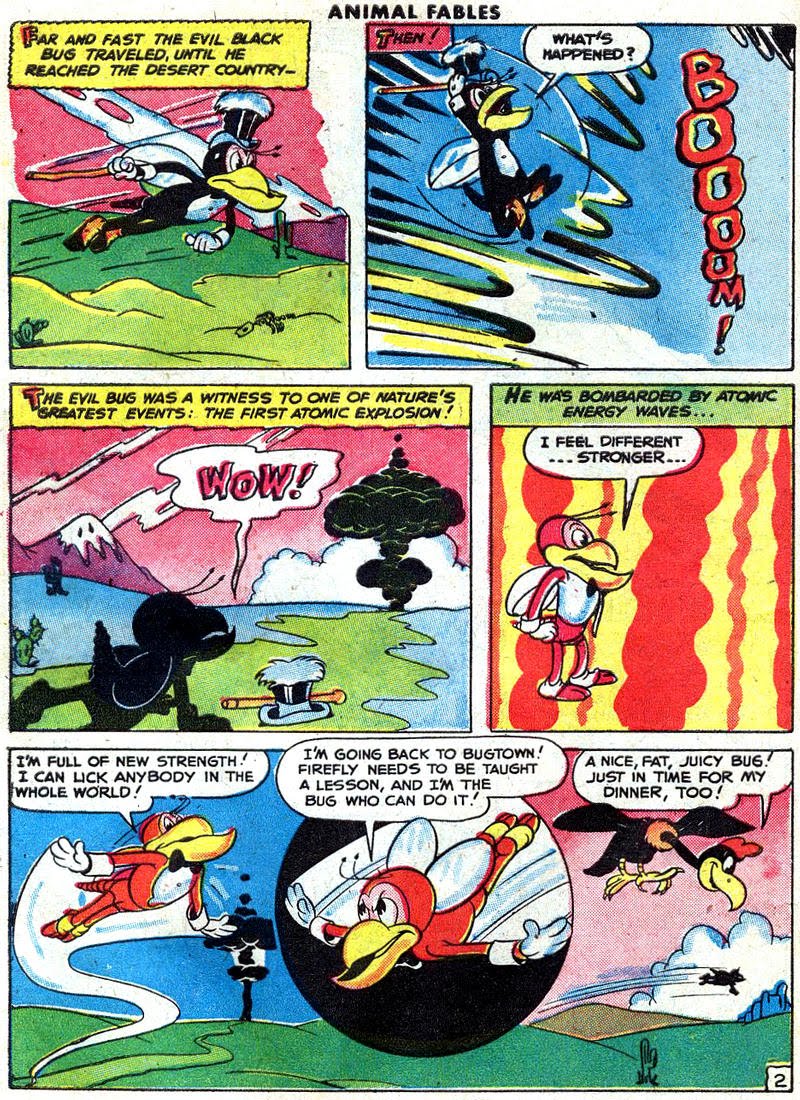
We're into a theme week on EC Comics, and today we've got examples of EC's funny animals from the 1940s. Animal Fables, which ran for seven issues in 1946 and '47, featured some covers with Freddy Firefly, who did a Human Torch imitation. He could burn through walls just like the Torch. He just had to yell, "Take fire!" and the young bug became the flaming firefly.

I don't know who drew Freddy; I haven't been able to find any reference material from the Grand Comics Database, or even my usually reliable EC sources. But what I think is that Freddy probably looked a little too close to the Human Torch for the purposes of Martin Goodman's Timely Comics.

By #7, the last issue of Animal Fables, Freddy was burning with "green fire", a creative way to solve the problem of the lookalike characters, but too late.

Actually, I don't think anyone, even very young children, would've confused the two, but that's what lawyers are for, to bring up those subjects. Freddy wasn't seen again after 1947.

By the time the last issue of Animal Fables was published EC founder, Maxwell C. "Charlie" Gaines, was dead, killed in a boating accident, and his son, Bill, was sent by his mother to take over the company. Although it eventually led him to become a millionaire with Mad, in 1947 he wasn't interested in comic books. Within a short time the funny animals published by EC were gone, and over the next couple of years it became the notorious EC Comics we know and love.

From Animal Fables #4, 1947:


From Animal Fables #7, 1947:


I thought I'd just let any folks who're dropping by know that, due to some unexpected and rather pressing business out there in the real world, there won't be another post up on TooBusyThinkingAboutMyComics until Friday, January 7th, in four or so days time, when I'm rather looking forward to chatting a touch more about Mr Bendis's work on The Avengers.

I just thought that I ought to forewarn anyone just in case they were thinking of popping over before that. There's no reason why I should be wasting your time, after all.

I will be around should anyone care to add a comment at any time. I don't mean to give the impression that the world is being turned upside down!

Finally, I do hope that the New Year is treating you splendidly. My very best to you!


.

Number 871


African Scream


If you love old movies like I do, then you've probably seen The African Queen with Bogart and Katharine Hepburn. Wallace Wood did this exceptional parody of the movie in EC Comics' own Mad imitation, Panic.

The experience of filming the movie was so memorable to Hepburn that in 1987 she wrote a memoir:

Clint Eastwood played a Huston-like director making an African Queen-like movie in White Hunter Black Heart in 1990.

The Wood version is from the Al Feldstein edited Panic #2, 1954:


This first week of 2011 is a theme week. Well, sorta. It's an EC week with obscure stories you may not have seen. Tomorrow, meet Freddy Firefly, from EC's Animal Fables.

Sex Video - Thailand Pretty Girl

Wtf !! She's pretty,got big boobs and Very nice pussy.OH i know you will like to have sex with her if you got a chance right?Maybe you like to record Personal Sex Video With her... haha..you can watch this online or just download it for free.

Download Link : - Megaupload

Stay to next Update

<!--362f4d4a978b45bbb9ec076ed85dc2bf-->