Number 344


Walt Kelly's Brownies and the Baby Chick


This is the 10th appearance of Walt Kelly in Pappy's, which shows both that he was prolific--lots to choose from--and good. The public demands Walt Kelly! Pappy gives what the public wants. Sometimes he gives what the public doesn't want, but hey...

Where was I? Oh yeah, Walt Kelly. This story is the first from The Brownies, Dell Four-Color Comic #244, dated April, 1949. Like all of Kelly's funny and whimsical adventures, regardless of the characters involved, the story goes where Kelly sends it. One description I read of Kelly was that he wrote these as he went along. Kelly was a fast artist and the artwork might seem a little rushed, but even rushed Kelly is good, if not downright great. There was never anyone quite like him.

Other stories from this issue of The Brownies are posted in Pappy's #13, and Pappy's #143.


Number 343


Man O' Mars


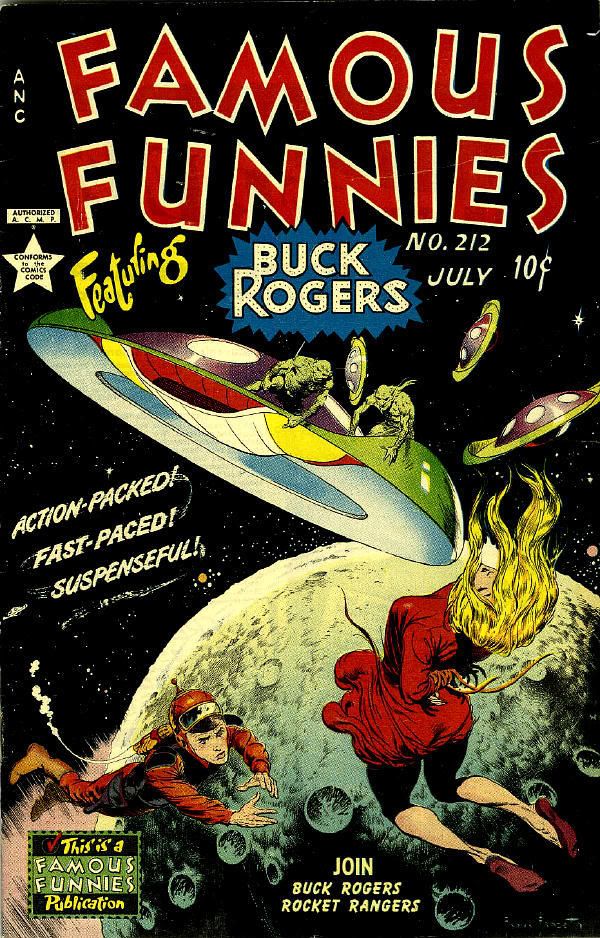
The cover above is one of my favorites. The Grand Comics Database guesses it's by Sid Check, but it looks more like Gray Morrow to me. It looks like it was inspired by Famous Funnies #212, a Buck Rogers cover by Frazetta. Man O' Mars is a reprint of a Fiction House one-shot from the early '50s. The original cover from Fiction House is also good, but I'm not sure of the artist on that one either. Maybe Maurice Whitman?

While the 10-page lead story, "Man O' Mars" looks to have been new in 1953, the rest of the comic is made up of reprints from Planet Comics.

I.W. Comics (later Super Comics) was Israel Waldman, who would buy printing plates and the rights to reprint from the original publisher, then issue the books three to a bag for 25¢. Since he wasn't going through newsstand distribution channels he didn't have to deal with the Comics Code. I have great affection for these comics. I bought the I.W. comics in 1959. I was too young to have read their original printings, so they were my introduction to those wicked pre-Code comics. I became an innocent seduced!


Number 342


The Marksman


With this story of the Marksman we're asked to accept a guy in a white t-shirt and red cape, a bow strung across his chest, operating behind German lines in Poland. He can make assassination attempts on an important Nazi commander, even follow that commander "by devious ways" halfway around the world from Poland to the island of Formosa (!!!). We're asked to believe he can hide in plain sight among some American soldiers who are prisoners of the Japanese, still wearing the white t-shirt, red cape and bow across his chest. Hey, c'mawwnnnnn... There's typically good Quality Comics artwork, but there's a lot to strain credulity in this 7-page filler by Fred Guardineer from Smash Comics #46, September 1943.


Number 341


One man's art is another man's drippings...


The Real McCoys, starring Walter Brennan, a fine character actor, ran for six seasons from 1957 before going off the air in 1963. The other lead in the show was Richard Crenna, an equally good character actor. I didn't watch the show regularly, but I had seen it a few times. I picked up this comic book, Dell Four-Color #1164, in 1960 because I recognized the artwork of Alex Toth. I may have been a kid, but I knew what I liked.

I'm sure I hadn't read this comic book for at least 40 years until I picked it up to scan this story. I was pleased to see some things I wouldn't have noticed as a kid. The art teacher working with the young girl, Hassie, is hot for her, and I got a kick out of the panel where Grampa's index finger is straight up in the air while he proclaims, "He's got no more interest in her soul than a goat!" I wouldn't have caught that bit of symbolism when I was 13. The story also goes after pretentious art gallery owners and the Jackson Pollock "Jack the dripper" school of painting. The title, "Rembrandt McCoy," is misleading, since the plot is about modern art, not an old master.

The horny artist is seen no more while the plot veers off to Grampa's faux painting and how he puts one over on the art establishment. That may have appealed to Toth. Beyond that it reads like the basic plot of a 1950s-early 1960s sitcom, where unlikely plots like that were common.

Finally, and then I'll let you read the story, I really like that Toth's art is done like a storyboard, strict page layout. He does so much with his storytelling abilities, and they elevate this cornpone sitcom plot. The art is also all his: penciling, inking and lettering.


Here are a couple of bonus one-page gags, including the inside back cover in black and white.


Number 340


Whodunnit? Rudy dunnit!


Longtime comic artist Rudy Palais contributed this story to Crime Does Not Pay #49, from 1947. It's easy to spot a Palais story even without his distinctive signature. Just look for the flying sweat drops. Funny animal comic artists like Floyd Gottfredson of the Mickey Mouse comic strip did this regularly, but they seem wildly out of place in an otherwise melodramatic crime story.

This potboiler of a "mystery" is straight out of some 1940s Hollywood B-movie programmer. Like one of those old movies you don't want to take it seriously, but it's fun to look at.