Number 207


Locked Up!


This story is from a 1970s issue of Crypt Of Shadows, reprinted from one of the '50s Atlas horror comics. Sorry I don't know which one. The credit lines are clear, though. Carmine Infantino drew it, Hank Chapman wrote it. The ending to the this story is totally off-the-wall, like a shaggy dog story. Or I should say, it's shaggy, just not a dog.


Number 206


Grass Green's American Man


There were a few superstars in comics fandom, circa the early 1960s. Richard "Grass" (for "Grasshoppa") Green was one of the top fan artists of the day. After being discharged from military service, he lived with fellow artist, Ronn Foss, and Ronn's then-wife, Myra, in Northern California. I don't think the arrangement lasted long, maybe less than a year. In that time they were known as Triad, and took over publishing The Comicollector and Alter Ego from founder Jerry Bails.

Grass and Ronn had gone to high school together in the 1950s, and were budding artists of their time. In his fan art, Ronn seemed more influenced by Joe Kubert, and Grass by Jack Kirby. Grass told me years later in a letter he wanted to be the "black Jack Kirby." He had sporadic success over the years, but he never achieved what I believe he wanted. Grass had the talent, but at the time he and Ronn tried to break into pro comics in the 1960s, the comic book industry was a closed shop. There was enough work to keep the established artists busy, but newcomers just didn't have a chance. Later on when the field opened up and older artists retired Grass and Ronn's styles were superseded by a new generation of artists.

Grass was African-American. In a moment of candor, he told me he had been discriminated against by comic book editors. I have no way of knowing if that's true. Over the years many African-American artists have worked in comics, and some have been extremely successful, but in retrospect, during the time of the early 1960s the comics do appear to have been a white man's industry.

Grass Green did some pro comics, some underground comix, some self-published comics. He kept himself busy over the years with his appealing art style and had the advantage of a great sense of humor, which made his work a lot of fun to read.

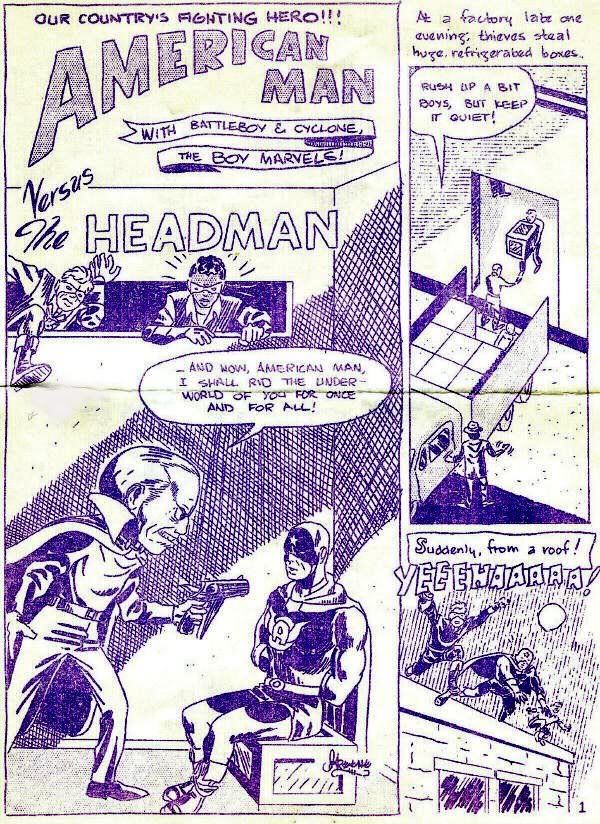
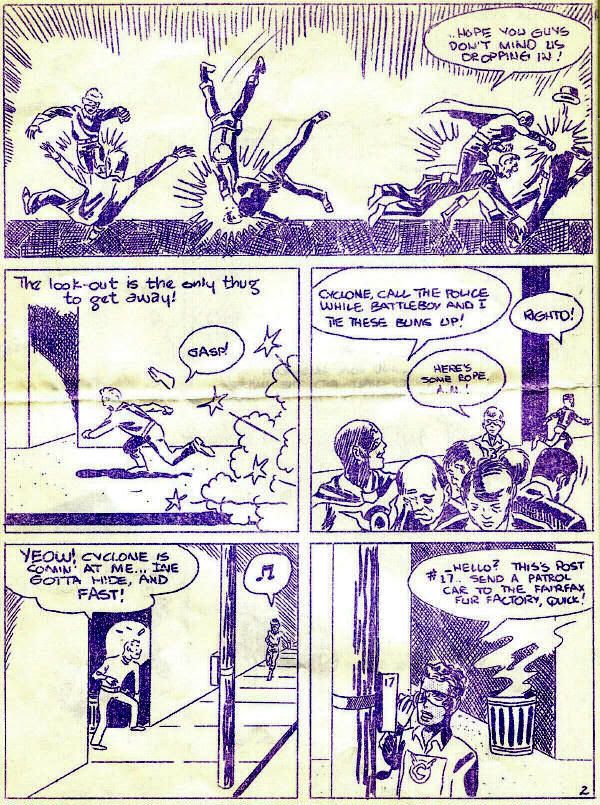
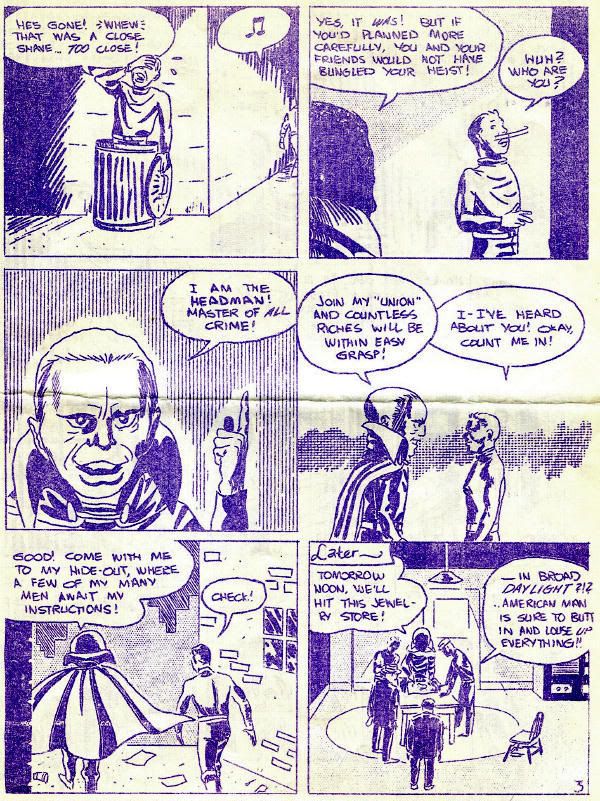
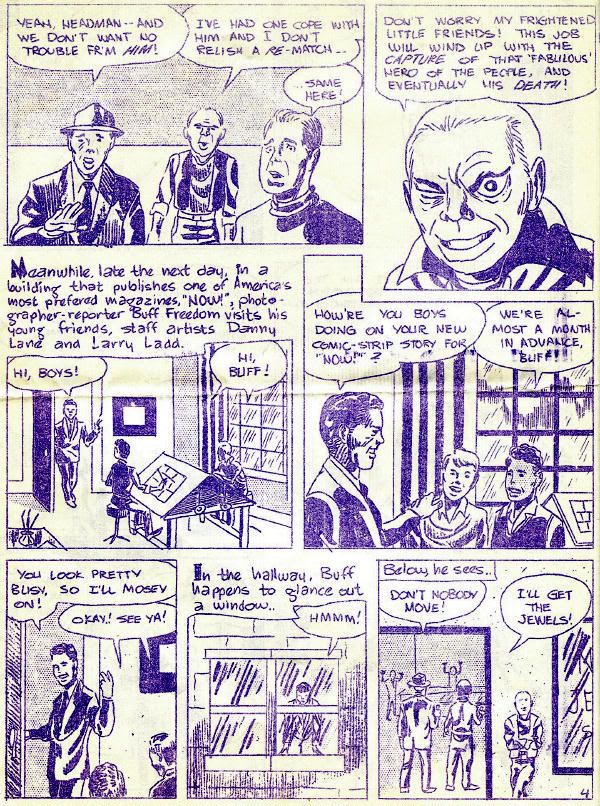
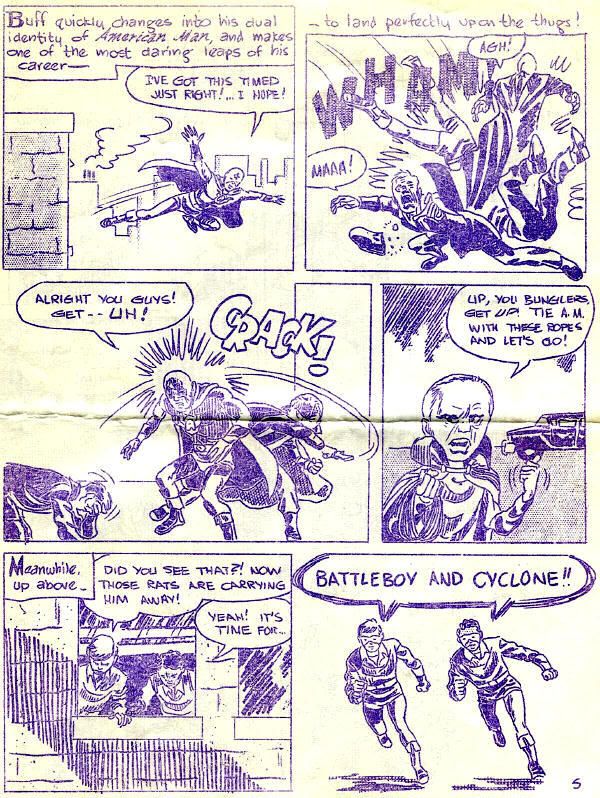
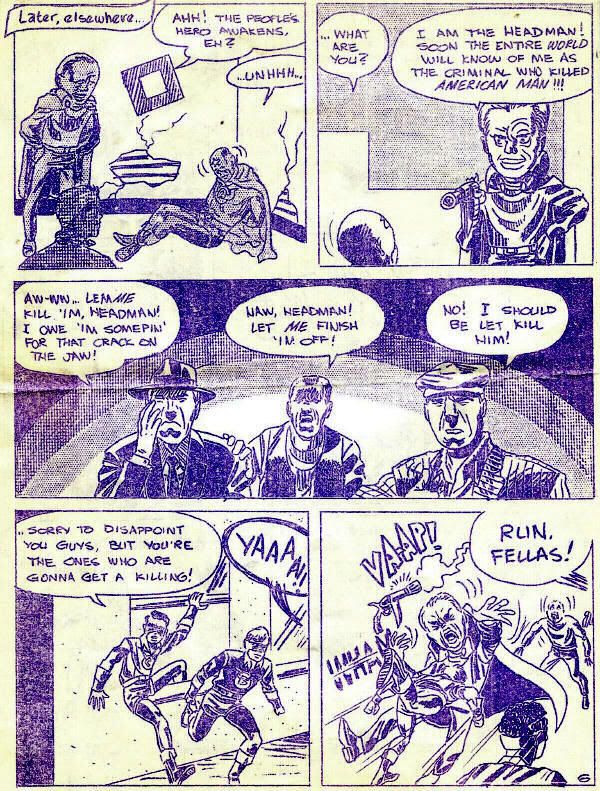
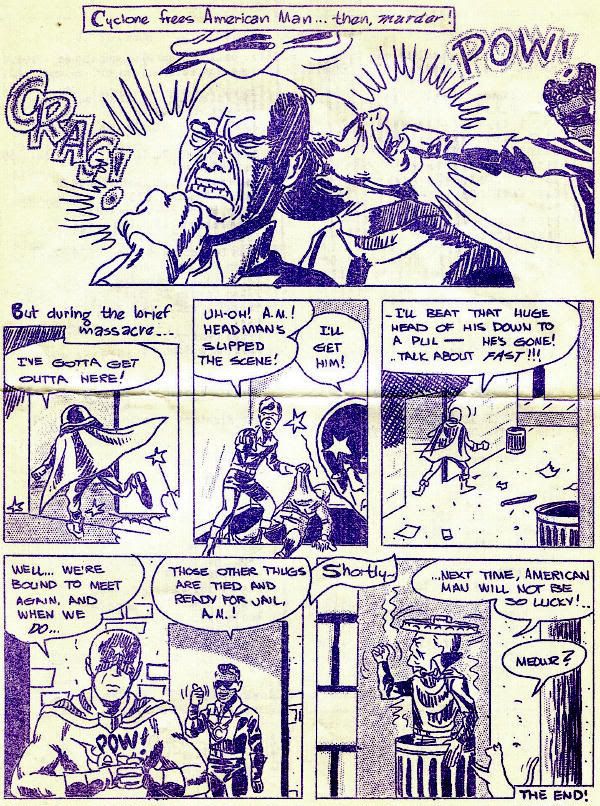
"American Man" appeared in The Comicollector #7, dated September, 1962. It's printed by an old-fashioned spirit duplicator, just like the tests and worksheets our teachers handed out in school. It required drawing same-size on a stencil. This particular strip was redrawn from a story he had done during his high school days. It's Kirby-styled, influenced by Grass' favorite, Fighting American. If you'll notice, the hero, whose real name is Buff Freedom (!) has two kid sidekicks, one of whom is African-American. Both of the boys are artists doing comic strips for a magazine. Ronn and Grass?

I scanned this from its source over a year ago and had to bump up the contrast to make it readable. The bumping brought out a horizontal line, the fold of the fanzine when it went through the mail. I tried some ways to get rid of the line. In looking at it recently I thought it gave it more of the feel of how it looked to me when I read it originally over 45 years ago. There is a funky charm to those old crummy-looking dittoed fanzines, and this is a good example of their appeal.

Grass Green died of cancer in 2002 at age 63. His lifelong friend, Ronn Foss, preceded him in death by six months.

Page 1 / Page 2 / Page 3 / Page 4 / Page 5 / Page 6 / Page 7


Number 205


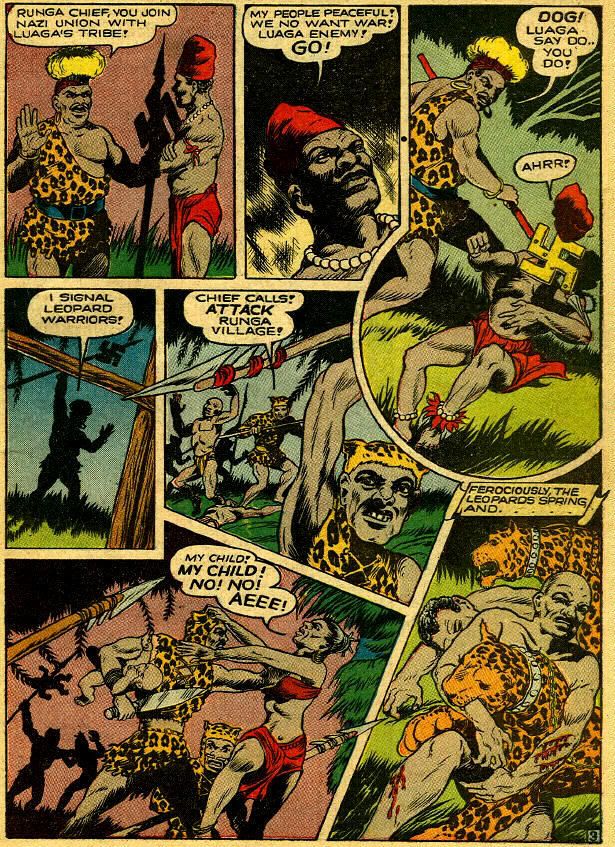
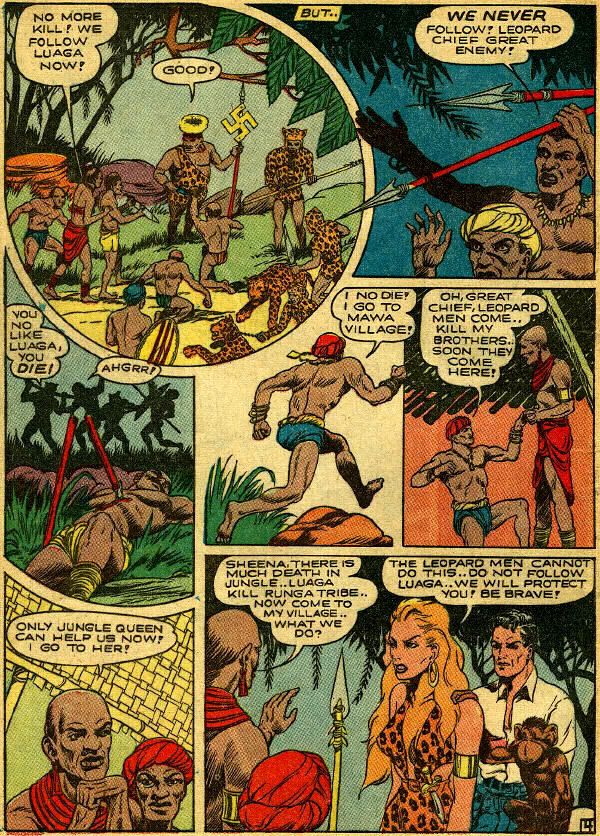
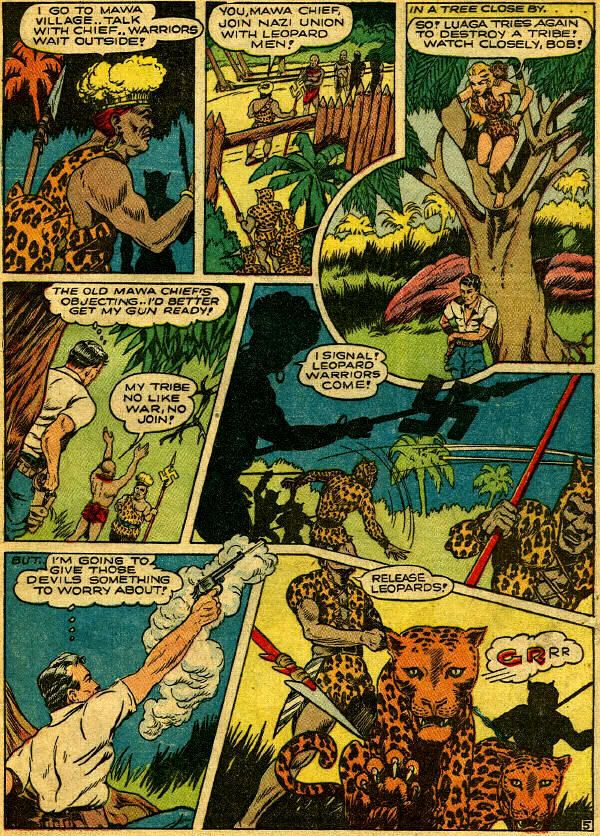
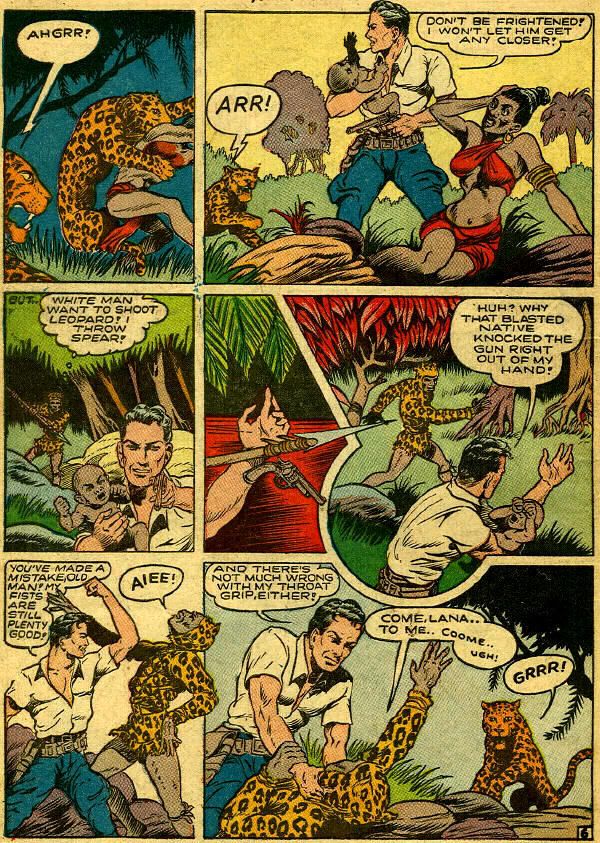
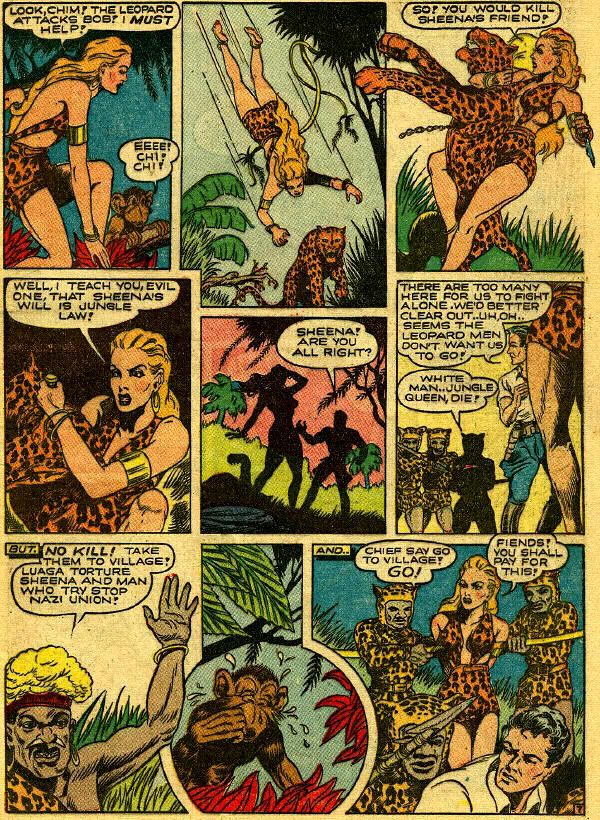
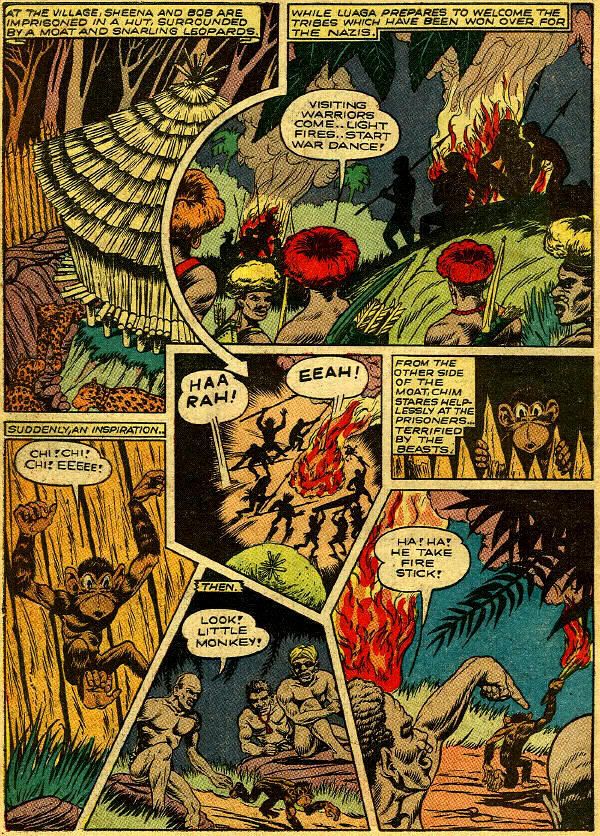
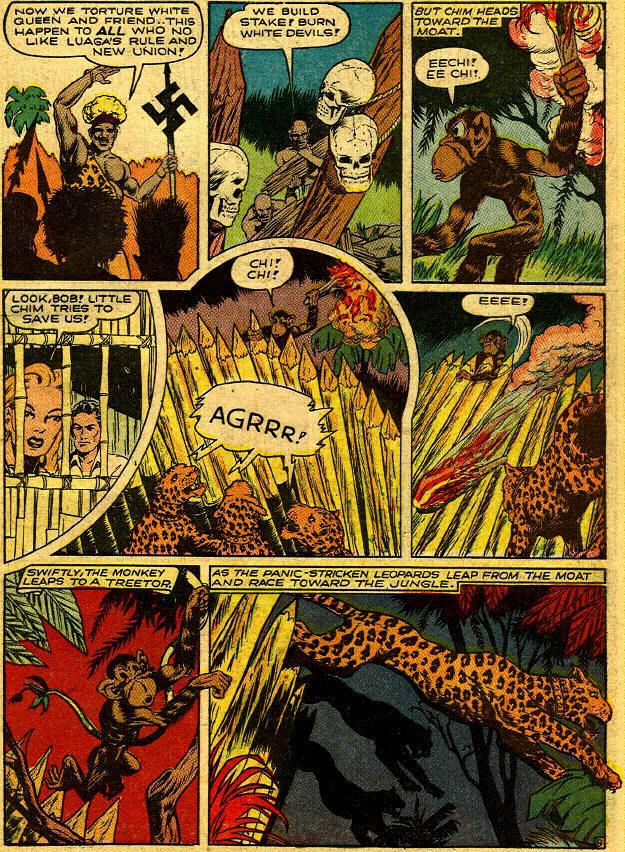
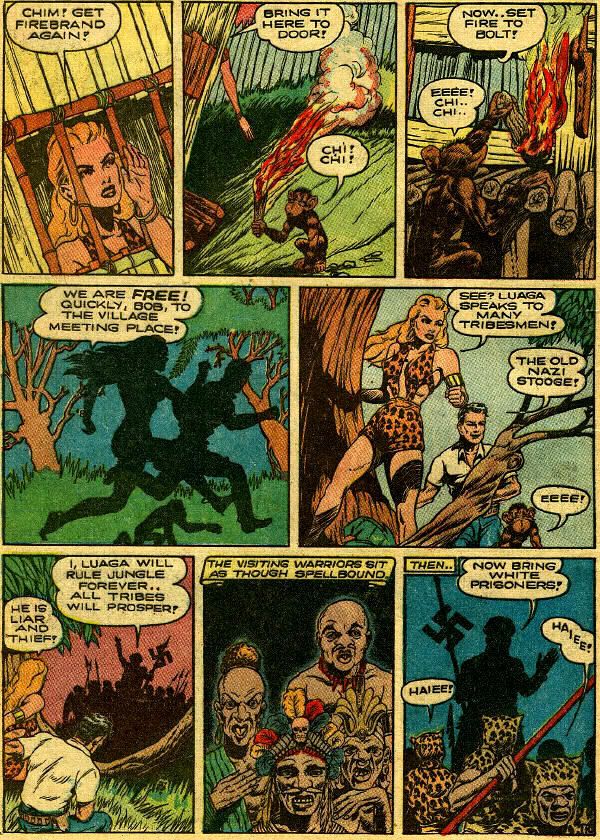
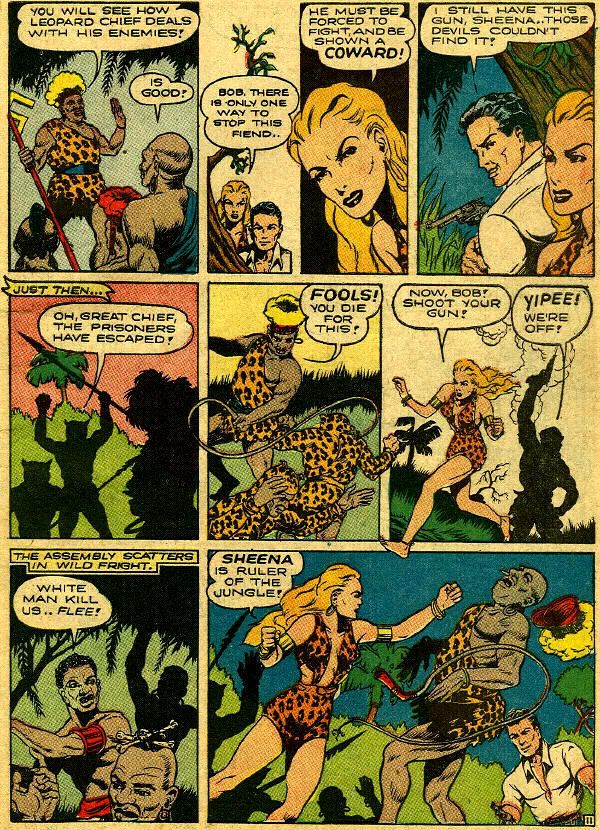
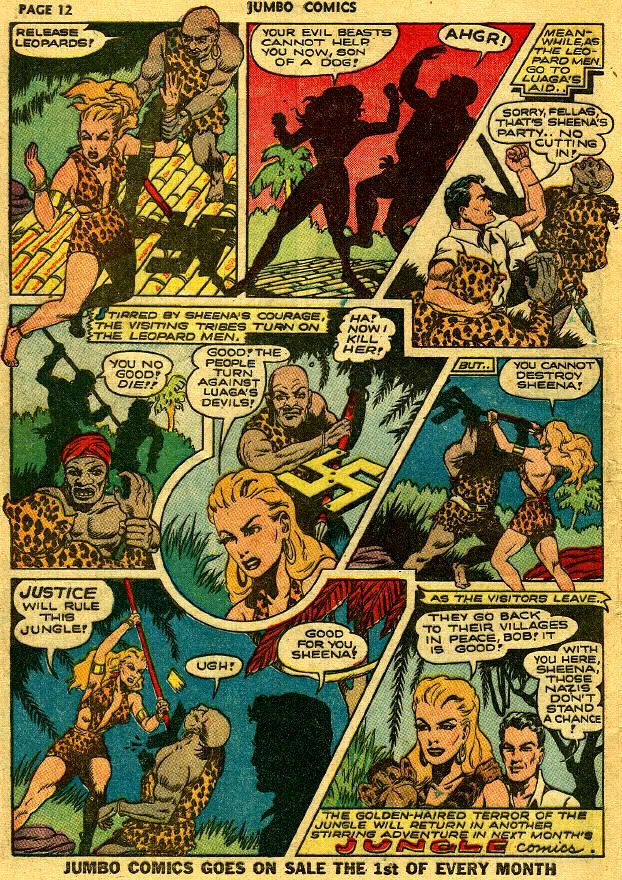
Sheena rules!


If memory serves, Sheena, created by Will Eisner, was the first of the female Tarzan-types to star in comic books. Sheena was also a young guy's dream girl. Especially if the guy liked girls who could protect him from hostile natives, bad white hunters or wild animals, and could kick some major butt in the process.

There's a genre for this sort of fiction featuring the dominant, strong female. Sheena took care of her "mate," Bob (Bob?!) pretty well, keeping him involved in the action, doing the heavy lifting, but letting him know that when they went to the bushes, or wherever it was they co-habited, she was the one on top.

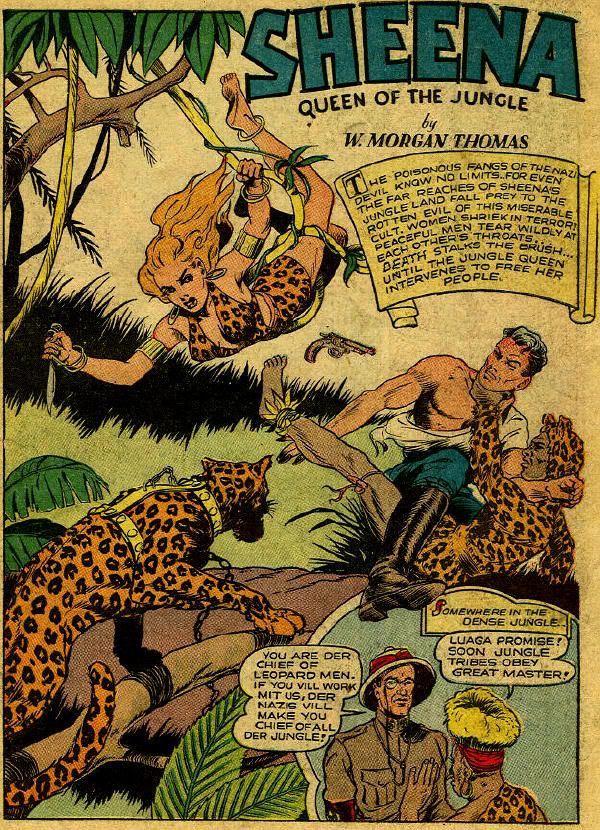
Fiction House, publisher of Jumbo Comics, was aimed at the young male audience. I've never been able to remember the plot of a Fiction House story, because they didn't really need plots. The stories were just excuses to string together lots of pin-up art. While some of the subsidiary characters in this story, from Jumbo Comics #42, August, 1942, aren't well drawn (the chimpanzee is ridiculous, and some of drawings of the "natives" look rushed), Sheena is drawn in loving detail.Hey, soldiers were fighting Over There, but when--and if--they got to the PX, there was always the latest Jumbo Comics, with pictures of Sheena to make them remember why they were fighting. In this story the Nazis have gotten some natives to work for them. You can see they're working for the Nazis because they carry a spear with a big swastika.

Page 1 / Page 2 / Page 3 / Page 4 / Page 5 / Page 6 / Page 7 / Page 8 / Page 9 / Page 10 / Page 11 / Page 12


Number 204


The rope-a-dopes


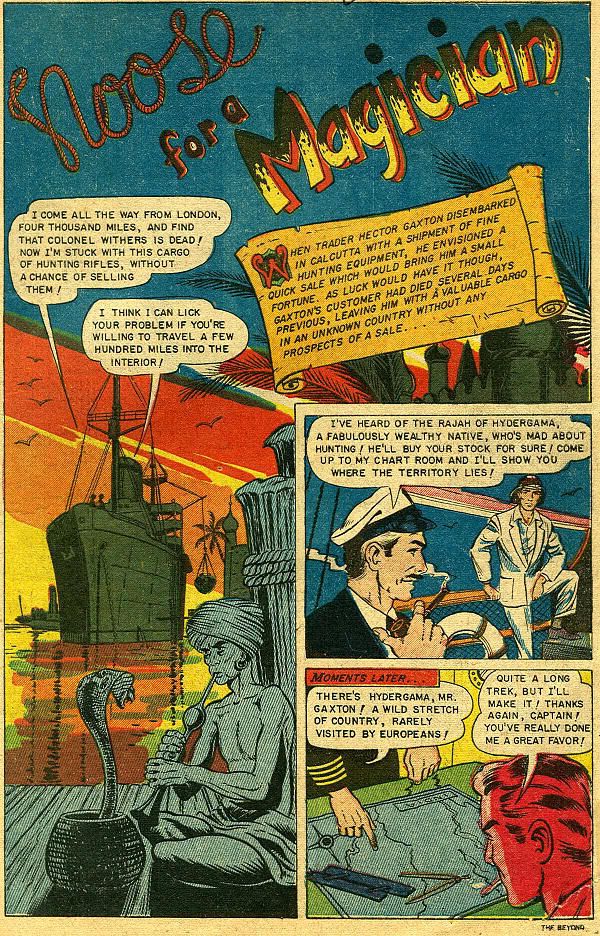
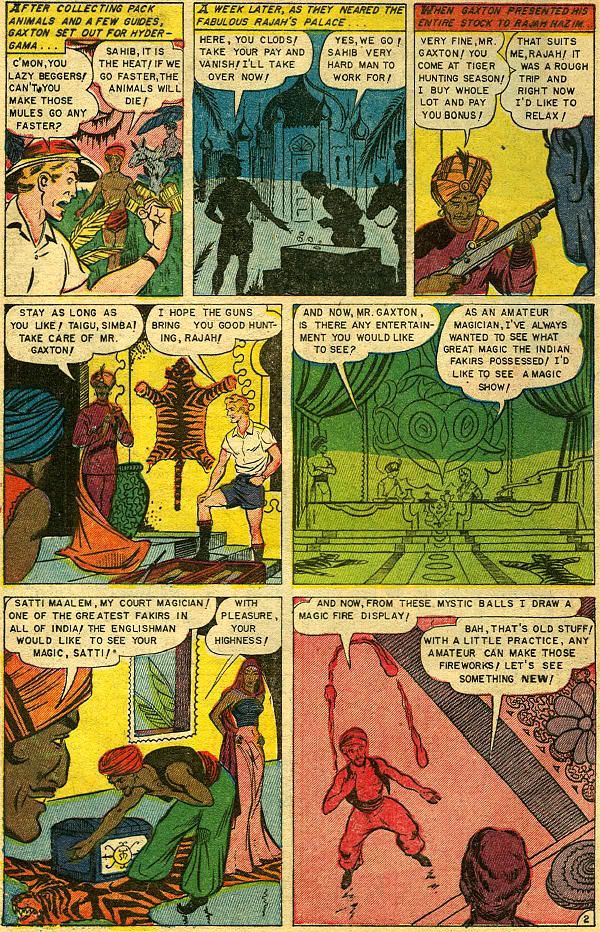
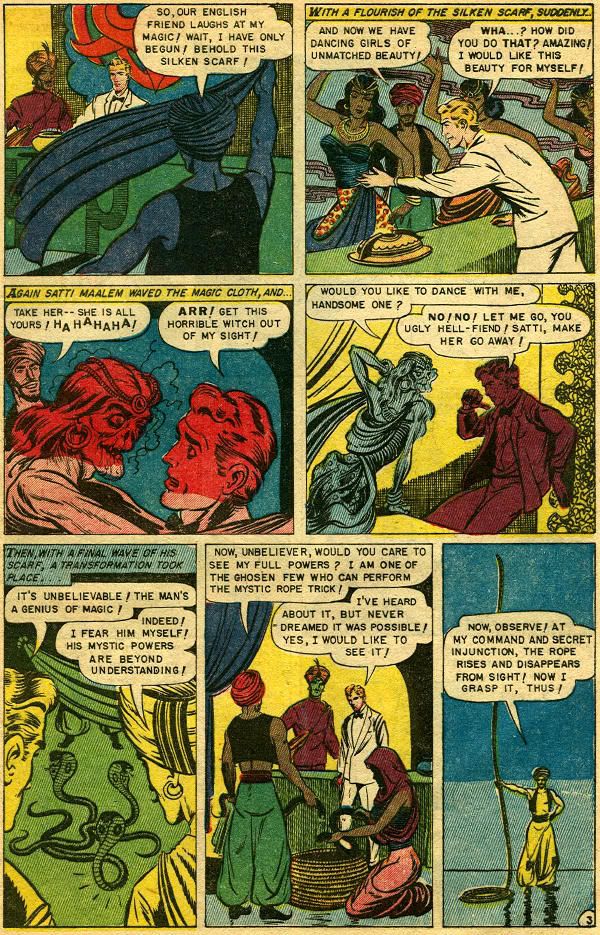
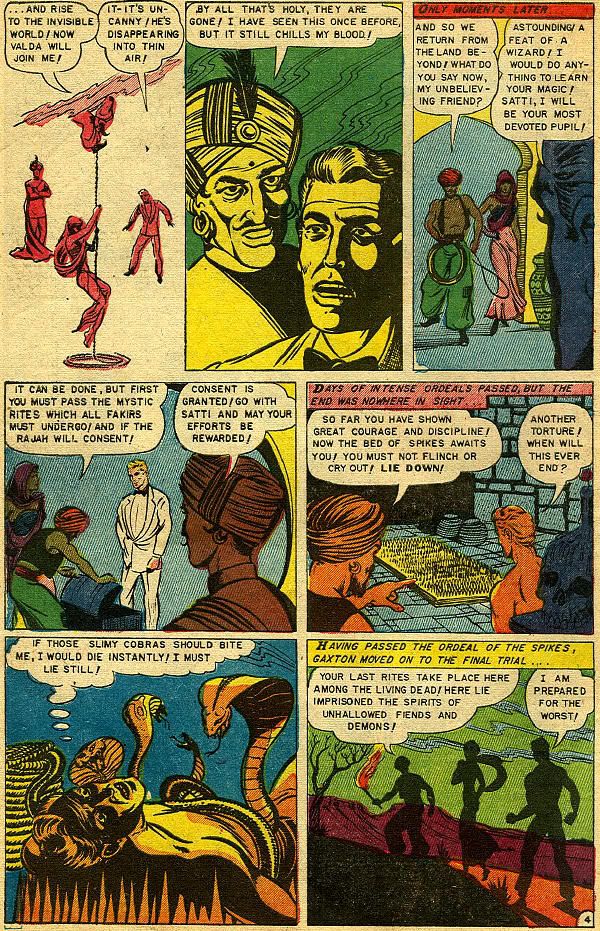
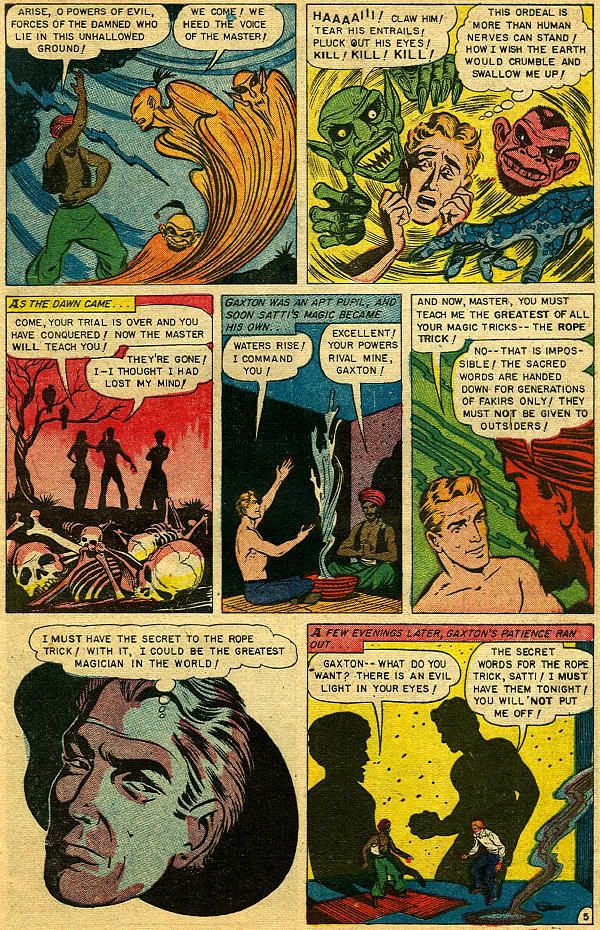
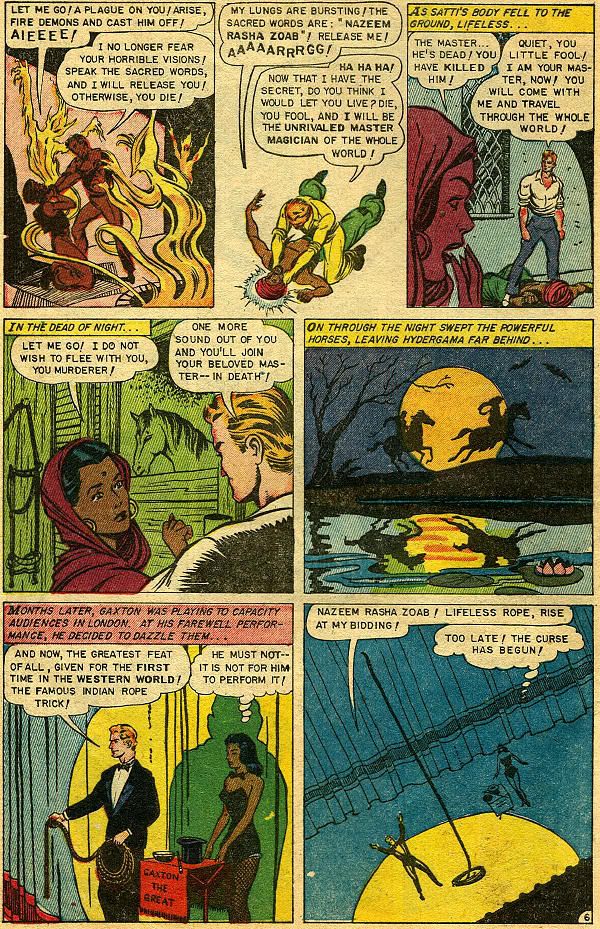
"Noose For A Magician" is from a coverless issue of Beyond. I don't know the issue number.

I also don't know the artist. Except for the fact that the main character follows Pappy's First Law of Horror Comics: "The main character shall be as unpleasant and unredeemable as possible," there's not a whole lot I know about this story! If you want to send me corrections or information that will enable me to go back in and include it for later readers to this blog entry, please contact me. This is why blogging is more handy that printing. Unlike a mistake in print, a blog is fixable.

Our little horror story from Beyond uses the legendary Indian rope trick as its hook. Here's a two-page text story from the Story of Magic issue of Classics Illustrated The World Around Us to tell you about the Indian rope trick. Click on the pictures for full-size images. For those of you not wanting to wade through the text, here's the short course: the Indian rope trick, as it's known in legend, doesn't exist.Something I like about Ace, publisher of Beyond: the coloring. They had an interesting way of laying whole colors over panels. It's very attractive.

Page 1 / Page 2 / Page 3 / Page 4 / Page 5 / Page 6 / Page 7

Number 203


More comic book paperbacks


Little Lulu turned into a paperback edition sometime after The Mad Reader. This Is Little Lulu appeared in November 1956. It's apt: Lulu was considered hip, chic, in the 1950s, like Mad and Pogo. Adults liked them. The first part of the book has Marge cartoons from The Saturday Evening Post, but the bulk of the book is made up of the John Stanley-Irving Tripp combination that modern Lulu fans know. It includes this particularly hilarious segment, as Tubby disrupts a girls' Halloween party:
I showed you the original Batman paperback, issued shortly after the TV show debuted. Batmania wasn't unlike Beatlemania of a couple years earlier. It hit for a short period in '66 and '67, and left a lot of merchandise behind. These two books were part of a series. I'm sure I owned #2 of the series at one time. I liked seeing comic book stories in black and white, because I could look at the artwork without the layers of muddy coloring. Of course, as Pogo might say, "I had stronger eyebones then." Nowadays paperback pages seem a lot smaller to Pappy's eyes.

"Oh honey, sugar sugar…you are my candy girl, and you got me wanting you…" Who didn't hear that song by The Archies on the radio in 1969? We called it bubblegum music with a sneer in our voices and a curl to our lips. But the bubblegummers sure loved it. It was played constantly. We found out "The Archies" wasn't a real group, but some studio musicians and a singer named Ron Dante. The Archie paperback reprinted stories from the comic books, centering on the rock group.In 1970 I visited comic book writer and novelist, Otto Binder, at his home in Chestertown, NY. At some point in our beery and smoky conversation Otto asked if I had a copy of his 1966 version of Dracula. He had none in his files. I said I could get some from my local used paperback store. He told me that he and artist, Alden McWilliams, had met with publisher Ian Ballantine ("a really nice guy," according to Otto), and that Ballantine was strong on comics-style material. Otto told me he was paid $500 for writing the book, and McWilliams was paid $1500 for drawing it. I notice from the credits page that Craig Tennis is also credited with writing. I don't remember Otto mentioning either Tennis or book packager Russ Jones, but then, Otto was talking about himself. I came home from my visit to New York, found two copies for Otto and shipped them off to him. Since finding those two copies I don't believe I've ever seen another copy of this book except my own.


Number 202


Supermouse gets hot under the collar!


"The Good Old Wintertime" is from Supermouse #2 (1948. Supermouse, created by Kin Platt in 1942, first appeared in Coo Coo Comics.

I've seen quite a few Supermouse stories, and it was my opinion this was drawn by Gene Fawcette. However, after initially posting this entry I got a note from cartoonist Jim Engel with the following information:

For some reason, I can't post this under "comments"...if you CAN, please DO... The 2 Supermouse stories you've posted are not by Gene Fawcette---they're actually drawn by Milton Stein. Fawcette DID draw SM stories and covers, but later in the series. Fawcette's SM has weird "chopped" or "squared off" feet, as an identifying tip...and he did a lot of SM cover where SM is drawn pretty huge, catching Terrible Tom in nets, etc... Many people DO seem to regard Stein as "THE" SM artist, but the strip was drawn by a veritable WHO'S WHO of funny animal greats, including Al Hubbard, Jack Bradbury, Dan Gordon, and Don Arr... best, Jim Engel

Thanks for your input, Jim! You're quite the great cartoonist, yourself.


Number 201


Somewhere Lurks A Thing!


Boo! It's October! Halloween month…and we need to get into the mood.

I haven't posted a strip by Dick Briefer in a long time. If you want to see more of his work, click on the "Dick Briefer" link below. After his run on Frankenstein ended, Briefer freelanced. This very fine strip appeared in Atlas Comics' Uncanny Tales #20, May 1954.