[Guest reviewer Greg Elias writes for Speed Force]

DC Comic’s focus on notable Batman artists continues with Tales of the Batman: Don Newton, Vol. 1. Featuring the first reprints of the late Newton’s run from the 1970s and early 1980s, this volume collects a stretch of Bronze Age gems heavy on action in a high-quality format.

As with the first edition in the series, which spotlighted Gene Colan, stories are presented here in the original order of publication. This method recreates the experience of pulling original issues to read only the Newton tales. In the Colan volume, some plot elements were resolved outside of issues he penciled. Here, Newton’s prodigious production is recalled with, for instance, a Brave and the Bold story splitting chapters from his run with O’Neil on Detective Comics. This provides more of an “off the rack” reading experience than the necessary story holes in the Colan volume.

The collection also represents the first reprints of the final issues of Dennis O’Neil’s classic 1970s Batman run. This includes a Maxie Zeus cycle and a complete League of Assassins saga, which featured the death of Kathy Kane and the introduction of Bronze Tiger into the DC Universe. There’s also a fantastic done-in-one, “The Perfect Fighting Machine,” that includes elements later used in O’Neil’s Venom storyline from the Legends of the Dark Knight series. Although the focus is Newton and other writers are present, this has to be a major selling point for fans of Batman and O’Neil’s work with the Batman Family.

Newton’s artistic legacy at DC Comics includes the first “realistic” interpretation of Captain Marvel and the Shazam! Family (1978-1982), a turn as Jack Kirby’s artistic successor on New Gods and a run on Aquaman that was partially collected in the fantastic Death of a Prince trade paperback. His Batman work is the definition of Bronze Age Dark Knight, with dynamic fight scenes and a powerful command of emotion. Of the artist-focused Batman collections released so far, the Newton volume has the widest appeal. Including Brave and the Bold material alongside vintage O’Neil -- mixing sci-fi with street-level -- allows this book to showcase the best aspects of the Caped Crusader through the pencils of an underappreciated master. Michael Fleisher, Bob Rozakis, Cary Burkett, and Martin Pasko join O’Neil behind the typewriter, with equally compelling plots involving The Riddler, Man-Bat, The Crime Doctor, and Batgirl.

The only bone to pick here is, in some chapters, the reproduction. The majority of the stories are sharply reproduced with a clarity never before applied to the original material. Other stories such as the Red Tornado and Man-Bat chapters inexplicably feature muddy details affecting both lines and text. The dip in quality is quite noticeable when it comes to an artist like Newton, whose style was even a difficult match for most of DC’s inking stable. Spotty reproduction was a major problem with the Marshall Rogers collection, which was published the month before.

Despite a couple of low-fidelity chapters, it’s hard to declare this volume as anything less than a must-own. There are still no higher-quality reproductions available and, in addition to the brilliant work by Newton, what is featured here includes the finale of one of the great Batman runs by any writer. The length allows for an immersive experience that was somewhat lacking in the shorter Colan volume and would presage the epic Jim Aparo volume to follow. Plus, it celebrates a flavor of Batman that has never been given any treatment beyond the magazines themselves.

Tales of the Batman: Don Newton, Vol. 1 is essential reading for any Batman fan and an crucial purchase for Batman completists. The never-before-reprinted status of the stories and the intersection of two all-time-greats make this a rich, rewarding read worthy of multiple, lenghty sessions.
[The fianal review in Doug Glassman's month-long spotlight of Kitty Pryde stories.]

After the “Schism” event in the X-Men titles, Cyclops took over the mutant micro-nation of Utopia while Wolverine founded a school for mutants in honor of Jean Grey.

If this sounds backwards to you, then you’re not alone. Wolverine himself questions this turn of events in the first few pages of Wolverine and the X-Men Vol. 1, as do numerous X-Men and the inspectors sent by the New York school board to investigate the Jean Grey School for Higher Learning. In fact, writer Jason Aaron seems to be on the defensive throughout the first issue, outlining many of the inherent problems of the school, such as a lack of teachers with certification and bathrooms that turn into Danger Rooms. Is this Aaron having fun with the reader, or is he airing his grievances with the plot he was given by the editors?

Either way, Aaron swiftly introduces the incredibly large cast. After Schism, Kitty Pryde and Piotr Rasputin went their separate ways, and Kitty is the glue that holds the school together as its headmistress. Beast is still present as the school’s technical genius -- a necessity given that the school is equipped with advanced Shi’ar technology. The other original X-Man at the school -- at least until issue four -- is Iceman, the least mature but potentially most powerful of the first five. When the school is attacked, Bobby Drake finally steps up. Another key faculty member is Rachel Grey, the resident telepath who keeps the kids disciplined.

One of the oddest choices in faculty members is Husk, who is forced to change her skin during an English lesson to silence the students. Another oddity is the perpetual sad-sack Toad, now the janitor at the school. I’m not exactly when he changed sides, but like having Beast and Iceman present, it adds authenticity to the title.

The student body consists mostly of memorable characters from previous younger X-Men titles. Some, like Rockslide and Glob Herman, have been around since New X-Men: Academy X. Others, like Idie Okonkwo from Generation Hope and the kindly Brood member Broo are becoming new favorites, especially because of the adorable romance developing between the two. The most important student is Quentin Quire, a.k.a. Kid Omega, a super-powerful anarchistic terrorist put under Wolverine’s custody by Captain America. Quire actually warranted his own mini-series, Wolverine and the X-Men: Alpha and Omega, which was a neat riff on Days of Future Past.

Just as the school opens, it faces a threat from something bigger than the New York Board of Education. The new, controversial Hellfire Club arrives to destroy the school. The mixed reaction comes from the members being super-powerful, psychotic pre-teens. Personally, I don’t mind them. The X-Men have faced far weirder foes, like Mojo and the Mutant Master, and the age difference makes sense considering the school element. Along with other threats, like an army of Frankenstein’s Monsters, the Hellfire Club unleashes Krakoa the Living Island, who makes an intriguing choice near the end of the initial arc. The attack even ends up solving the school’s problems, both with the school board and with their monetary woes, complete with a cameo from the X-Men’s lawyer, Matt Murdock.

After the first three issues, we get a stand-alone story introducing elements from Uncanny X-Force into Wolverine and the X-Men. I’m not a huge fan of X-Force in any of its non-X-Statix incarnations, but this is actually a storytelling necessity along with a probable editorial mandate. Two new students are introduced; one is the new child version of Apocalypse, the key figure in Rick Remender’s overall X-Force version. The other, surprisingly, is Angel, whose mind has been wiped. The sadness felt by the faculty, especially the other original X-Men, is palpable when they see what happened to him. However, there’s some comic relief when Deathlok, a cyborg from the future, predicts the fates of the kids with ... mixed results.

The other most controversial element of Wolverine and the X-Men is the artwork of Chris Bachalo. I’ll admit that it’s not to everyone’s taste, as it’s extremely cartoony and exaggerated. There are some moments where the action is obscured, such as when Husk intimidates her students with her rocky form, or when Krakoa attacks. However, I think a lot of this comes down to some very heavy inks, which were provided by seven different inkers, indicating that there were some scheduling issues. Nick Bradshaw’s art in issue #4 is far more clear and crisp. Future stories alternate the two artists, allowing fans of both art styles to be happy.

Along with the usual design sketches in the extras, two of the letter columns are included. These are answered by Kitty and Iceman, respectively, and other faculty members answer columns in other issues. There’s also a live Twitter session of issue #4, which I don’t entirely get. Why do a Twitter version of an existing issue? I think it would have been better to do a session of an unseen class for extra humor. A cool infographic provides cute stick figure versions of the characters as an organizational chart. It even includes characters not seen in the book itself, but are in the Astonishing X-Men sister title, such as Rogue and Karma. Finally, there’s the brochure, which could be the best extra ever included in a comic book. There are too many brilliant jokes to list them all here, but I’m particularly fond of “Algebra Sucks, I Know, But You Still Have To Learn It,” taught by Iceman.

Kitty Pryde, a.k.a. Shadowcat, has undergone an incredible character evolution, going from a naïve teenage girl, to a ninja, to a key member of the modern main team, to running the newest incarnation of the school that started it all in Wolverine and the X-Men. I hope you enjoyed this month's look into one of the most prominent (and earliest identified) Jewish characters in comics.

Next year (just a week away!) my reviews begin again with a return to Walt Simonson’s The Mighty Thor and a story he could only call “Ragnarok and Roll!”

Everybody have a nice holiday? I did, but I'm back on the job today.

Today I have a wild story from Forbidden Worlds #6 (1952), which is self-referential. It's about a writer creating a story for the magazine Forbidden Worlds (which, in the story has its own building — see page 4, panel 4.) It also features editor Richard E. Hughes in a co-starring role. Editor Hughes insinuated himself into his supernatural comics through chatty editorials and letter columns, but “The Devil's Typewriter” is the only time I know of that he was shown as a character in a story.


If you're hanging around the blogoverse today, Collected Editions has an open thread today for your chatting enjoyment.

Stop by, pour yourself a cup of cheer, and tell us all about what you've unwrapped today, or earlier this month, or the latest comics and trades you bought yourself -- or anything at all!  Tuesday Talkback -- talk it up, if you like.
[Guest reviewer Zach King blogs about movies as The Cinema King]

The "Greatest Stories" series doubles down (or maybe goes double or nothing) with a return to Metropolis for Superman: The Greatest Stories Ever Told, Volume 2. While the first volume contained good Superman stories, you'll recall that not all were great in my estimation; none, however, were so atrocious as to leave a bad taste in my mouth.

But while a second Superman "Greatest Stories" volume is in some ways inevitable, is it any good? As before, none of the stories are flops; the editors have done a good job assembling nine entertaining reads without padding this trade with unnecessary fluff. This collection, however, contains several very puzzling editorial choices, made no clearer by Robert Greenberger's rapid-fire introduction which attempts to sum up 60 years of publication history in two pages.

The sum of the parts being more than the whole in this series, let's take a look at what's inside this volume.

"The Mysterious Mr. Mxyzptlk" (Superman #30, September/October 1944): We begin not with our hero's origin, but with the debut of his littlest foe, that bowler-wearing fifth-dimension imp whose name has been the plague of spell checkers for nearly seventy years. This is a puzzling choice, since the focus is unmistakeably on Mr. Mxyzptlk and not Supes, but the story seems to be included to make sense of the book's final story in which Mxy returns. But while it likely wouldn't be a first choice for "greatest," the story is still entertaining, representing Jerry Siegel's gift for supernatural slapstick, and it may be worth noting that much of this character hasn't changed with each retcon; Mxyzptlk's behavior, appearance, and abilities have remained consistent, and the McGurk statue gag was even used in the character's animated debut (and Gilbert Gottfried's voice rings in my head for this story, too).

"Superman's Other Life" (Superman #132, October 1959): Representing Superman's sci-fi phase, this story by Otto Binder finds Superman, at the suggestion of Batman, using his super-computer to see what would have happened if Krypton had never exploded. It's a classic imaginary tale, but it's not very thrilling since Superman continually interjects to remind us that the story is not "in continuity." While Wayne Boring's use of video screens as panels is initially inventive, it quickly becomes a distracting gimmick that never lets the reader fully enjoy the story. Indeed, the best part of this tale is not the glimpse of Krypton but the constant interjections from Batman to point out how much happier Superman's life could have been. While these moments make Batman out to be a jerk in hilariously unintentional ways, the story overall suffers from too much telling and not enough showing (a common complaint, I suppose, of the Silver Age).

"Superman's Return to Krypton" (Superman #141, November 1960): In some ways, this is a more successful version of "Superman's Other Life," making the previous story seem less successful by comparison. Siegel and Boring team up to take Superman back to Krypton's past after he accidentally flies too quickly through the sound barrier. If the inciting action seems hokey, Siegel quickly does justice to the premise by writing a story that carries emotional weight even as it reaches its inevitable climaxes. We know that Krypton is doomed and that Superman will find a way home (although the sudden resolution is unsatisfying), but Siegel fills the middle with memorable scenes that play fast and loose with the rules of time travel but ultimately give us a better sense about what Superman's past means to him.

"The Team of Luthor and Brainiac" (Superman #167, February 1964): The first team-up of Lex Luthor and Brainiac is unquestionably an important moment in Superman continuity, and Edmond Hamilton's story is engaging since he's mastered the voices of the two villains. It's a great story, but its inclusion in this volume raises two questions. First, where's Superman? The focus is understandably on the dastardly duo, but in a "Greatest Superman Stories" trade it's a bit disappointing that the Man of Steel spends much of his time powerless, unconscious, and in a Kandorian hospital. Second, the inclusion of this story (for me, at least) raises the question, where's "Whatever Happened to the Man of Tomorrow?" (Short answer: it's in DC Universe by Alan Moore.) Since Mr. Mxyzptlk gets a twofer in this volume, it's a bit of an oversight that one of the indisputable best Superman stories is missing, especially considering it's also the "last" Luthor/Brainiac team-up. Again, a solid tale, but one which may or may not be a "Greatest" Superman story.

"Superman Breaks Loose!" (Superman #233, January 1971): Everyone knows this is the one in which Denny O'Neil tried to update Superman, and most of us know it didn't stick for very long. Also collected in Kryptonite Nevermore, this story introduces Superman's new status quo, including his immunity to Kryptonite and his work as a TV reporter. Here is the kind of story I was expecting to fill these collections back when I assumed that "Greatest Stories" meant "primer on the history of the characters and what makes them tick." What can I say about this story? It's a classic, with spot-on characterization of Superman and wonderful art by Curt Swan. If I have a complaint, it's that the focus is more on changing Superman's surroundings than on how he reacts to those changes, but then I suppose as the first part of a longer arc I'll have to go to Kryptonite Nevermore for the rest of the story.

"The Legend from Earth Prime" (Superman #400, October 1984): A four-page headscratcher by Elliot S! Maggin and Frank Miller, "The Legend of Earth Prime" finds a future Metropolis discovering footage of the George Reeves Superman television show from our world (Earth-Prime) and learn the secret identity of Superman. While the premise and metafictional capacity of the story are intriguing on the surface, Maggin can't do much with them because of the space constraints. It's a more successful version of "Exile at the Edge of Eternity" from the same issue in the last volume, but it's unclear what Maggin is trying to say with this story other than elicit a chuckle from its cutesy premise and the seemingly significant wink in the last panel. Is Noah Mandell really Superman? (No Man-El?) Or am I reading too much into a story that is good but not great?

"The Secret Revealed" (Superman #2, February 1987): Scientist no more, Lex Luthor is now the industrial tycoon of the Byrne Age, but we see that his hubris remains fully intact. "The Secret Revealed" is the one where a computer deduces Clark Kent's identity only for Luthor to refuse to believe it on the grounds that no powerful being could be selfless enough to masquerade as a "mere human." The focus is more on Lex Luthor than on Superman (it would have fit better, perhaps, in the Superman vs. Lex Luthor collection), but the moments when Superman learns that Lana and the Kents may be in peril are stellar, gripping for their sentimental verisimilitude and for the effective communication of Superman's fury. A+ for John Byrne, who pens and scripts.

"Life After Death" (Adventures of Superman #500, June 1993): I think I read this single issue fifty times when I first bought it, and "Life After Death" -- in which Pa Kent suffers a heart attack but refuses to die without saving his adopted son from the funereal specters -- is still an exciting read, even excerpted from its longer narrative. Indeed, Superman titles from the "Triangle era" almost read like soap operas with expansive casts, extended story arcs, and long-form payoffs. But as a "greatest" Superman story? "Life After Death" doesn't quite make the cut. For one, Superman's dead for the whole story, and knowing what we know about his "resurrection," it's conceivable that the Superman we meet here might just be Pa Kent's imagination. What's more, the cliffhanger which leads into "Reign of the Supermen" feels out of place as the penultimate tale in this trade. This might fit in a "Pa Kent: The Greatest Stories Ever Told," but its sole virtue here is that it's a great story, Superman notwithstanding.

"Narrative Interruptus Tertiarius" (Adventures of Superman #638, May 2005): We close with a Greg Rucka story (something about which I'd seldom complain) in which Mr. Mxyzptlk weighs in on the "Man of Steel, Woman of Tissue" question by introducing Lois and Clark to their daughter from a "possible future." While the story isn't as strong as we might expect from Rucka, the art by Matthew Clark redeems the whole affair, especially when he riffs on the styles of Sin City (rendered as a spot-on satire of all Frank Miller's excesses), Calvin and Hobbes (here, a loving tribute to the style and tone of Bill Watterson), and the Dini/Timmverse (meant to convey the unselfconscious and high-flying mood of the animated series). While Superman isn't the focus of this story -- the spotlight is instead on his daughter Lara and on Mxyzptlk -- it does explore his relationship with Lois Lane in a way that no other story in these two volumes has. Especially in light of the absence of a Lois-and-Clark in the New 52, stories like this are made even sweeter by appreciation of the marriage we didn't know we'd miss.

As with much of the preceding trades, Superman: The Greatest Stories Ever Told, Volume 2 has left me uncertain about a final evaluation. On the one hand, the stories here are all entertaining and have factors which redeem their collection in a permanent form like the collected edition. As a grab-bag, this volume is successful and makes me wonder about the viability of trades that simply collect ten stories that haven't been collected elsewhere. [I like this suggestion -- kind of like what they did with those DC Comics Presents books. -- ed]

On the other hand, I would only label two of the nine stories in Superman: The Greatest Stories Ever Told, Volume 2 ("The Team of Luthor and Brainiac" and "Superman Breaks Loose" -- maybe "The Secret Revealed" as a third) as among the greatest Superman stories ever told. The rest are all either great stories with Superman in a negligible role or merely good stories with Superman. For a diehard fan like myself, the trickery of the book's title is permissible on the strength of the material therein, but for newcomers looking for more of a statement on the character, there are better places to look.  

All-Star Superman, especially issue #10 (which needs to be in Volume 3, if such a book comes to pass), is for my money the greatest Superman story ever told, but what this book -- and the series in general -- needs more than my personal favorite is a sense of purpose, a theme to link together a statement about the character of Superman.

After a mixed reaction on Superman's second anthology, next time we revisit Gotham City for the third (but not final) time in this series with Batman: The Greatest Stories Ever Told, Volume 2. Stay tuned!

More Greatest Stories reviews: Superman, Batman, Wonder Woman, Green Lantern, Flash, Justice League, Shazam, and Batgirl.
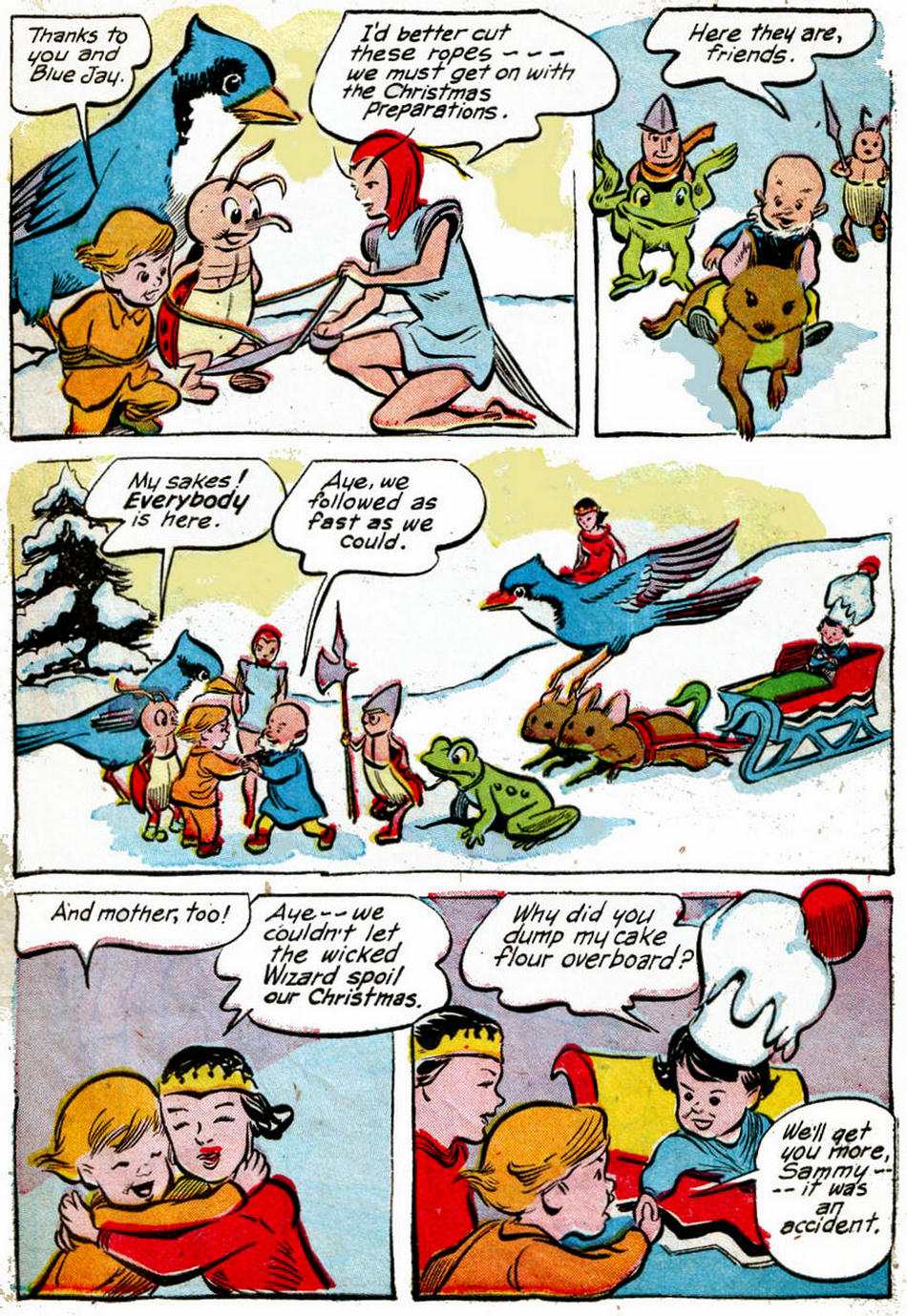
It’s Christmas Eve, and ol' Pappy wanted to put something in your stocking. So here's an episode of the Bakers Associates giveaway comic, Peter Wheat, done by the super-talented Walt Kelly.

Enjoy, and I’ll see you in a couple of days. Merry Christmas, all!

From The Adventures of Peter Wheat #29 (1949):


Postino's blog, Insomnia Notebook, posted a Walt Kelly classic that's close to my heart: "How Santa Got His Red Suit".
Even if Daring Love #1 (cover dated Sept.-Oct. 1953) was not the obscure (Overstreet says “scarce”) love comic that contained Steve Ditko’s first published story, it might be known for its cover by Bernard Baily, which illustrates the historic Ditko tale.

It’s not the kind of sex we see in our porn-saturated age,but harkens back to a simpler time, when a picture like this and its implications would evoke an immediate reaction. You saw a picture of a couple in a hayloft and you just knew...they were gettin' it ON!

For its time Daring Love was aptly named.


**********

While we’re on the subject of Steve Ditko, Craig Yoe’s book, Ditko Monsters Gorgo will be released on February 12, 2013. I’ve read a pre-release PDF copy of the contents and it was enough to send me into nostalgic nirvana. Gorgo was a comic book I loved and bought when it came out on the comic book rack, but only the issues drawn by Ditko. (Craig has wisely chosen not to include the non-Ditko issues.)


Something I remembered about the artwork was Ditko’s underwater scenes, which I found striking at the time, and still impress me.

From the PDF copy:


I was also particularly impressed with Ditko’s design sense and dramatic staging.


This is a book I highly recommend, and if you’re a Ditko fan you’ll love it. It’s available from the usual booksellers, or you can ask your local comic book store to get it for you.