Concluding Tuesday's piece;

VI.
But Metropolis isn't the only unfriendly environment in Mr Straczynski's "Superman: Earth-One". We're shown nothing good of Smallville, beyond some folksy conversations with the Kents, that might indicate that Clark's life there was anything other than utterly miserable. At least the folks in Metropolis mostly just walk unheedingly past poor desolate Clark, or sit having fun in bars while he gazes longingly in at their happiness. In Smallville, things were apparently far worse, and we're shown Clark being beaten by fat bullies and mocked for being a "chicken" and a "coward" (30:5/3). And this intensely unfavourable impression of his hometown is strongly reinforced by the fact that the only place in Smallville we're actually shown any detail of is the church and graveyard where Jonathan Kent is buried (31.1). Smallville, it seems, is little but football fields controlled by obese bullies and the dead. Certainly, when Clark is lonesome in Metropolis, and when the reader is supposed to empathise with his isolation, there seems to be no-one from his hometown to call up and chat to. Perhaps there was no Pete Ross or Lana Lang in the world of "Earth-One", and perhaps poor Clark actually made no friends at all for the first 18 years or so of his life.

It's a cold, excluding world that Mr Straczynski's Clark is forced at first to wander through, from his violently oppressed childhood in his hometown to his isolation from the unwelcoming masses of Metropolis. And it's made absolutely plain to us that this wistfully isolated Clark is an unhappy, rootless boy who deserves our concern and support, so that we want him to do well. Yet, at the same time, Clark's counter-intuitively shown succeeding in everything he does, because, it must be presumed, Mr Straczynski doesn't want us to think he's anything of a loser. And so, "Superman: Earth One" does seem to be a comic designed to make the reader feel tremendously sorry for a character who, after just five pages of alienation and self-pity, becomes without the slightest breaking of sweat a football star, a commercial scientist and a master of the building trades (15). And by constantly showing the reader shots of poor sad Clark brooding and hunched in his jacket, and by never showing a single panel displaying the benefits young Kent undoubtedly earns from his various careers, Mr Straczynski provides us with a hero who has the powers of a god, the achievements of a contemporary Alexander, and the right to our perpetual sympathy as the underdog of this tale.

Certainly, whatever it is that drives world-class athlete and brilliant commercial scientist Clark Kent to apply for a job at the down-at-the-dumps Daily Planet is simply never coherently explained. Suddenly, Clark is a tremendous success story in a variety of fields, and then he's talking to Perry White; the reader can assume what they want about why Clark should be there, but there's not the slightest shred of evidence that's he's driven by anything of any particular moral or intellectual depth to investigate the world of journalism. Perhaps wealth disappointed Clark, but we can't know that. He mentions his money once, to Martha, and with some pride too, so it doesn't seem as if he's morally troubled by the substantial economic benefits that his Kryptonian powers have secured him (12.2) . And if he were seeking a sense of mission or the warmth of belonging at The Daily Planet, you'd've expected him to tell Perry White just that, just as you'd expect, surely, that somebody at the Planet would have recognised this amazing young man who's so new and so massively successful in town. But, no, there's only the insubstantial clue to Clark's motivation in visiting the Planet provided by a silent page of five panels, in which Clark looks at a cover of the Planet with a headline of "City Hall Scandal" and buys the paper. (16). My guess is that we're supposed to see this as the rise of a social conscience on Clark's part, but there's nothing in the text or sub-text to suggest it. He just sees a newspaper, reads a newspaper, and then goes for a job, and that's all we know.
In essence, that first visit to the Daily Planet is just one more of a whole host of scenes which can be read in a sense favourable to Kent if the reader assumes, despite the mass of evidence elsewhere in "Superman: Earth One", that this Clark is pretty much the clever and decent young man they've met in other comics and films and so on. But the comic itself tells us nothing, or rather, it tells us something other than that which Mr Sraczynski wants it to convey. All the silent shots of Clark looking thin and handsome and thoughtful can't obscure the fact that there's nothing of depth going on in this story at all.

And so, it must be said, it's a most undeniably brave move to make the Clark of "Earth-One" as shallow and socially uncaring as the rest of his fellow citizens apparently are. A less adventurous writer might have shown Clark having different values from the big city and its people, and then presented the young Superman coming to terms with an anomic, atomised environment while holding onto his principles and good-heartedness. But Mr Straczynski's Clark is a most radical departure, being neither community-minded nor morally-motivated. Indeed, we follow him through the pages of "Earth-One" not because of what he does or because of what he represents, and certainly not because of what he learns, but simply because he's the point-of-view character in the story. And rather than there being any ironic distance in the text that might show us JMS is presenting us with a world so perverse that even Superman is corrupt and ethically ignorant, it's clear that we're supposed to empathise with his sense of rootlessness rather than shudder at his lack of purpose and direction. Ultimately, we're expected to cheer for Clark getting what Clark wants because he's called "Superman", and therefore he must be "Superman".

VI.
Mr Straczynski has his take on "Clark Kent" express some fascinating if ill-considered beliefs about the responsibilities of being a superhero at the end of "Superman: Earth One". These are expressed in some considerable detail in the "interview" that young Mr Kent fabricates with "Superman" in order to get a job as a reporter with The Daily Planet (125);
"Clark": Why did you wait so long before revealing yourself?
"Superman": Wasn't any reason to do so earlier. What I can do wasn't needed then.
It's a fascinating insight into Kent's mind, and into Mr Straczynski's as well. For even if we credit that there was no reason for Clark to become a public figure before Tyrell's invasion, we surely have to concede that there was no shortage of people that greatly needed his help either. The world is full to bursting with people who need the assistance of a Superman, even if that super man is a hero who acts in secret and seeks neither fame nor reward. Yet Clark had clearly never thought to help others before he helped save himself in the fight with Tyrell. If he had, he'd've declared that he'd been working secretly before to help his fellow women and men. But he didn't, because he hadn't been. And in truth, this Clark Kent seems incapable of grasping that he might have used his secret super powers without trying to occupy the limelight. This will explain why we're never shown a single example of Clark helping a single person in the slightest way before he belatedly joins the punch-up against Tyrell. For there's not a panel of evidence in the whole of "Earth One" that this Clark had ever so much as saved a kitten from behind a cupboard before the alien invasion inspired such compassionate ideals as "actually helping folks" to become reality. Although it seems beyond imagining that anybody could be so dense, or stupid, or callous, the simple idea of helping others never occurred to Clark, or showing him doing so never occurred to Mr Straczynski. In truth, the only times we ever see Clark using his super-powers prior to the second when he pulls his costume on are those moments when he's fooling folks into giving him money.

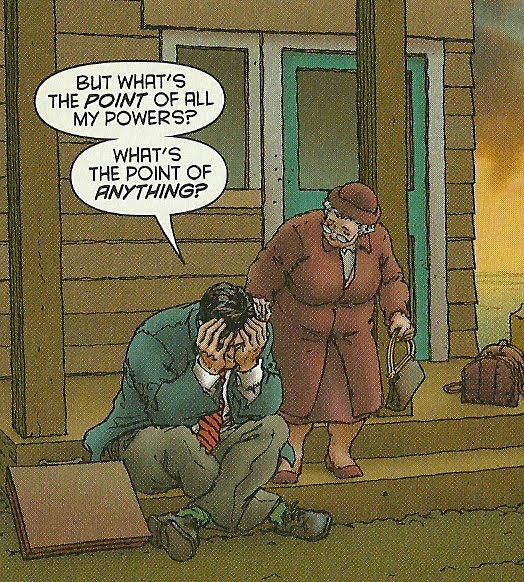
And so, where the Clark Kent of "All-Star Superman" learns from his step-father's death to look after others, the Clark Kent of "Earth-One" learns instead to apply his unearned gifts to winning big in the marketplace. It's a choice that Mr Straczynski has his Clark justify at Jonathan Kent's graveside, where the tearful Kent jr explains his selfishness by saying that he just wants to "fit in ... be one of the guys". If he should expose his alien origin to others, Clark argues, he'll "always be on the outside". (32.4/5)
Well, this reader wanted to shout, help people in secret, you idiot, and get on with your private life as everyone else does. But such is a possibility that Mr Straczynski's script never raises, and the reader is dissuaded from thinking Clark ever should have been assisting his fellows by the depiction of Smallville and Metropolis as such unendearing places full of distant if not actively unpleasant people. Everything that's cruel and selfish in that world is, the text shouts, everybody else's fault, but not Clark's.

And so, "Superman: Earth One" seems designed to make it easy for the reader to sympathise with Clark, regardless of what Clark does or doesn't do. In such a way are we expected to applaud the manner in which Clark solves the problem of respecting the divergent wishes of Jonathan and Martha Kent as regards how he'll use his powers in his adult life. For Clark's step-mother, as we've seen, essentially advises him to follow his own bliss, while his step-father swamps him with vague encouragements to serve a greater cause "when the time comes" (90.1). Clark's solution is as elegant as is it unique where the role of "Superman" is concerned; he'll serve as a man of steel when he wants to under his own conditions while living his personal life and using his super-powers to satisfy his private desires. He'll be, in essence, a Superman who sacrifices little of what he wants while making sure he enjoys himself at no great cost to himself in all other circumstances.
A hero for the 21st century!

VII.
At times it's hard to know whether Mr Straczynski is playing an exceptionally clever political joke in "Superman: Earth One". Is it possible, perhaps, that Mr Straczynski has created a text which only seems to present an utterly callow and rather dense Clark Kent as a heroic figure, while in truth leaving clue after clue scattered around as ideological snares to show how he's mocking modern ideas of heroism and self-interest?
This suspicion becomes even more pronounced when the "interview" which Superman supposedly grants to Clark Kent, after the battle with Tyrell, is read. (It's presented at the back of "Earth-One" in the form of a unconvincing sham mock-up of The Daily Planet.) In this "interview", which Clark Kent claims occurred straight after the showdown with Tyrell, "Superman" explains how he sees his role as a superhero, declaring that he'll only deal with events which "average men and women" can't "rise to the occasion" to stop. He also makes his evident that he'll do nothing which involves "politics or policy" either, while stating that his aim is to "help create the peace by doing what's right for people without trying to change them". It's a typically confused statement where the pages of "Earth One" are concerned, and unless Mr Straczynski meant it to show how shallow and daft Kent's thinking is, it merely reveals how confused both author and character are. For if Clark wants to preserve the peace in people's lives without changing them, then he's abandoned the moral purpose of all the previous takes on Superman. The Kal-El of "All-Star", as we've discussed, has as his central purpose the mission of inspiring individuals to be more community-minded, to be kinder and braver and less selfish. But Mr Straczynski has his Superman declaring himself to be nothing more than a passing presence of a crime-fighter, an invisible helper, a jolly nice superhero who doesn't want to rock the boat even through the process of setting a noble and self-sacrificing example. He wants everything to stay as it is, not even wanting to inspire change through others observing his actions.

Of course, the correct response to this intention would be to, again, advise the JMS Superman to take the costume off and work in secret. In such a way, he could act covertly without influencing anyone, because they'd never need see him.
But then, the lack of intellectual and emotional intelligence on the part of Mr Straczynski's Clark Kent is so total that his job-earning interview contains the following toe-curlingly stupid section, where Clark describes and then quotes "Superman" (126);
"He looks out the window. It's getting dark. "I should head out, there's still a lot of work to be done clearing the streets and digging people out from under the mess."
How well that must have been received by even the jaded and selfish masses of Metropolis, to read of how Superman supposedly stopped for a detailed interview with a young man, an unqualified teenager without a position on even a local paper, to discuss his philosophy and intentions while he knew that "people" needed "digging ... out from under the mess".

It's important that we're clear about what we're being told at this point. Mr Straczynski is having his Clark Kent write that Superman placed his media profile, an interview with a young and unaccredited amateur journalist, above saving lives which were put at such great risk and harm by Kal-El's very presence on Earth in the first place! And part of that "mess" that Superman so belatedly says he'll help with will be the debris from the skyscraper-tall alien mothership that Clark destroyed directly above Metropolis, no doubt! Let's ignore the shock-wave caused by the reactor-breech and the impact of the ship as it hit Metropolis, as we will the environmental disaster that would inevitably follow such a catastrophe, and let's just instead consider the simple fact of the victims buried alive. Any other take on Clark Kent that's designed to be seen as heroic that I can think of would be frantically rescuing victims and then rebuilding the city. But not the Superman of Mr Straczynski. He's either putting together fake interviews or, at best, so thick that he doesn't realise he's just written a front-page article which states Superman would rather give good media chat than save lives.
Now, I think it's conceivable that the JMS Superman could write something so stupid without noticing how offensive and reputation-shattering it is. Indeed, I've come to believe that Mr Straczynski's Clark would be unlikely to write anything other than such a daft article. But how are we to imagine that the supposed and self-declared Lord of all Journalists Perry White failed to spot this confession of unconcern for the many buried victims of Metropolis? Perhaps White's professional incompetence in not fastening onto the material before him and immediately posting a headline declaring what a selfish monster this "Superman" is might help explain something at least of The Daily Planet's decline on Earth-Straczynski?
And how did Mr Straczynski ever write this and not notice it for what it was, unless, of course, he really is cunningly presenting us with an ironic sub-text under the smug, selfish-minded and stupid surface of "Superman: Earth One".

9.
I.
We readers are informed in "Earth One" that Clark Kent is an impossibly intelligent young man. He's shown solving equations he's never seen before, whose values are unexplained to him, the symbols of which aren't defined, and the workings for which aren't apparently displayed in any detail. (It's an understanding of the cognitive processes involved in solving equations which rivals the grasp of human intelligence and the process of being a genius shown in "Good Will Hunting".) "The gaps are noted on the big screen in the other room." (12.3) conveniently declares the suit at "Neodyne Industries", who's inexplicably agreed to see the qualification-less Clark for a job interview even though his business only hires "the top five PHD graduates every year from Harvard, Yale and Princeton" (11.2). (By this statement, the reader is surely being invited to think of the many, many ways in which this executive at Neodyne Industries knows nothing of what he's talking about, of course.) Clark, as we might wearily expect, solves the problems immediately, causing the various "top five PHD graduates" to jump for joy while Clark claims their bonuses and probably their jobs too. (12.5)

How we reconcile this hyper-genius intellect with the idiocy of the Clark Kent who supposedly wrote the poppycock that is the Daily Planet article is impossible to work out. I suppose we're supposed to think that Clark has super-genius powers when it comes to equations but little or no grasp of basic political science and sociology, let alone any common sense. Perhaps that's so. If we can believe a man can fly, we can also surely believe that he's almost a hyper-autistic savant too. But another sad truth of "Superman: Earth One" is that intelligence plays very little part in how the JMS Superman operates. He's incredibly slow on the uptake, as we've discussed, during Tyrell's invasion, or at least that's the kind presumption of his behaviour then; perhaps he was just too indecisive or even cowardly to try to fight the alien forces that he was watching strafe the city. And Mr Straczynski's Superman wins his climatic battle with Tyrell through nothing else but violence and blind luck. There's not a stroke of wisdom or knowledge in how Mr Straczynski has Clark defeat his alien nemesis. Instead, his young Superman simply punches Tyrell alot before the Kryptonian spaceship that brought him to Earth arrives by chance rather than design and proves rather fortunately to be capable of flying right through the supervillain's previously-thought invulnerable defences (101/2). (It's certainly fortunate for Clark that Tyrell himself has already explained that his defences are "nearly as impervious as Kryptonian metal": well, who knew there was such material on the Earth and that it'd just turn up at the right time? (101/7)) In truth, Clark doesn't win out because he's moral, or wise, or self-sacrificing. He doesn't even win through his own physical exertions. Instead, he wins because he's Superman. When he needs a previously unknown piece of alien technology of his own to arrive at exactly the right moment to save him, it arrives. When that alien technology takes him right into his enemies spaceship, Superman's super-vision powers immediately find and destroy the machinery that empowers Tyrell, who is then left to die without the slightest effort on Clark's part being made to save him. Why any time at all was ever invested in establishing the scientific genius of this Superman quite escapes me.

Certainly, Clark never seems to grasp that there's a cities-worth of spacecraft about to crash on Metropolis, and that he might try to avoid that happening. It never seems to cross his mind, and Metropolis fortunately never seems too damaged either. (104.6)
But then the very first incarnation of Superman was perfectly happy to let bad guys go down with their own ships too. And yet, the very first Superman did also very much want to change the world, did want the powerless to be protected against the powerful in more than just a passing fashion. He was violent, yes, but he had a social agenda. This Superman just wants everything to stay as it is, or, he does if the journalism of one Clark Kent is to be trusted, and his victories are achieved through powers he's been born with and luck he never wins the right to deserve.

10.
I began these pieces wondering why I was so deeply moved by "All-Star Superman", and, of course, why I found it impossible not to be so profoundly annoyed by "Superman: Earth One". And in all honesty, I really had found it so hard to make sense of either text because of my intense emotional responses to them. To my surprise, for this has been something of a step into the unknown for me, the old teacher's trick of"compare and contrast" has proven remarkably useful. I hope, if anybody has found a reason to persevere with these pieces up until this point, that the process has been of some small worth, some passing entertainment, to you too.
But for the first time, I think I have a glimmer of the detail of why I feel so strongly about both graphic novels, and, given that I've explained myself in some detail above, I shan't exhaust whatever patience is left to you, dear reader, by summarising the points already made. That really would be teacherly, and you deserve better.

But I would highly recommend this process if you're ever extremely angry or deliriously happy about a comic book and those dictatorial emotions just get in the way of understanding why you're feeling them in the first place. Because I'm not angry at "Superman: Earth One" in the slightest any more. I'm not even irritated. The poison's well and truly drawn, for I've managed to gain a glimpse or two of why the book was affecting me so. It's been named, if you liked, and so there's no power there any more.
Which is all to the good, because "Superman: Earth One" was, after all, no less and no more than a graphic novel produced by two talented and able professionals who simply wanted to express their gifts and earn a fair return on them. And having helped them in the second purpose, by spending a fair percentage of this month's disposable income on "Superman: Earth One", I'm glad to say that I can now put away how they've expressed themselves and never give it a second thought again.

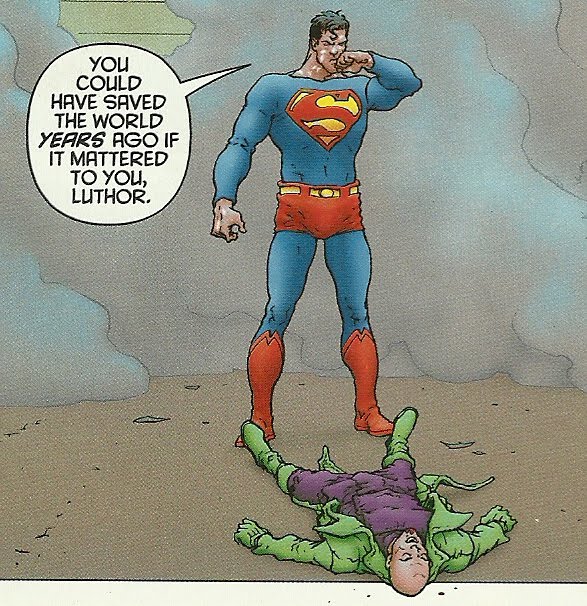
But "All-Star Superman" seems so much more remarkable a text than it did just a week ago, when I began these posts, and my liking and respect for it then was already substantial. I had no idea that my respect would increase so considerably when I started to take notes on the two graphic novels, but it's surely a mark of how wonderful a book "All-Star Superman" is that I admire it all the more after having interrogated it so. In fact, as you've no doubt long since noticed, I lack the language to express how much I respect the achievement of Mr Morrison and Mr Quitely where "All-Star Superman" is concerned. I wish I had the words, but I don't. But I do hope that I've been able to express something of why I feel the way I do, some small measure of why "All-Star Superman" seems to me to be such an outstanding piece of work. And yet, in the end, just as it was when I began writing this, attempting to explain why "All-Star Superman" is so fine is to try to catch the sense of something of an awed expression, of a tearful little sniffy sound caught in the throat, and of a straight-forward, sincere, and rather traditionally-restrained declaration of "It's good, isn't it?"
Because it is, isn't it? Inspiringly good.

If anyone has been kind enough to reach this far after all these pieces on "All-Star Superman" and "Superman: Earth One", then I can only express my sincerest thanks to you. It's been a pleasure to have you drop in here, and I wish you the most splendid of days!
.

VI.
But Metropolis isn't the only unfriendly environment in Mr Straczynski's "Superman: Earth-One". We're shown nothing good of Smallville, beyond some folksy conversations with the Kents, that might indicate that Clark's life there was anything other than utterly miserable. At least the folks in Metropolis mostly just walk unheedingly past poor desolate Clark, or sit having fun in bars while he gazes longingly in at their happiness. In Smallville, things were apparently far worse, and we're shown Clark being beaten by fat bullies and mocked for being a "chicken" and a "coward" (30:5/3). And this intensely unfavourable impression of his hometown is strongly reinforced by the fact that the only place in Smallville we're actually shown any detail of is the church and graveyard where Jonathan Kent is buried (31.1). Smallville, it seems, is little but football fields controlled by obese bullies and the dead. Certainly, when Clark is lonesome in Metropolis, and when the reader is supposed to empathise with his isolation, there seems to be no-one from his hometown to call up and chat to. Perhaps there was no Pete Ross or Lana Lang in the world of "Earth-One", and perhaps poor Clark actually made no friends at all for the first 18 years or so of his life.

It's a cold, excluding world that Mr Straczynski's Clark is forced at first to wander through, from his violently oppressed childhood in his hometown to his isolation from the unwelcoming masses of Metropolis. And it's made absolutely plain to us that this wistfully isolated Clark is an unhappy, rootless boy who deserves our concern and support, so that we want him to do well. Yet, at the same time, Clark's counter-intuitively shown succeeding in everything he does, because, it must be presumed, Mr Straczynski doesn't want us to think he's anything of a loser. And so, "Superman: Earth One" does seem to be a comic designed to make the reader feel tremendously sorry for a character who, after just five pages of alienation and self-pity, becomes without the slightest breaking of sweat a football star, a commercial scientist and a master of the building trades (15). And by constantly showing the reader shots of poor sad Clark brooding and hunched in his jacket, and by never showing a single panel displaying the benefits young Kent undoubtedly earns from his various careers, Mr Straczynski provides us with a hero who has the powers of a god, the achievements of a contemporary Alexander, and the right to our perpetual sympathy as the underdog of this tale.

Certainly, whatever it is that drives world-class athlete and brilliant commercial scientist Clark Kent to apply for a job at the down-at-the-dumps Daily Planet is simply never coherently explained. Suddenly, Clark is a tremendous success story in a variety of fields, and then he's talking to Perry White; the reader can assume what they want about why Clark should be there, but there's not the slightest shred of evidence that's he's driven by anything of any particular moral or intellectual depth to investigate the world of journalism. Perhaps wealth disappointed Clark, but we can't know that. He mentions his money once, to Martha, and with some pride too, so it doesn't seem as if he's morally troubled by the substantial economic benefits that his Kryptonian powers have secured him (12.2) . And if he were seeking a sense of mission or the warmth of belonging at The Daily Planet, you'd've expected him to tell Perry White just that, just as you'd expect, surely, that somebody at the Planet would have recognised this amazing young man who's so new and so massively successful in town. But, no, there's only the insubstantial clue to Clark's motivation in visiting the Planet provided by a silent page of five panels, in which Clark looks at a cover of the Planet with a headline of "City Hall Scandal" and buys the paper. (16). My guess is that we're supposed to see this as the rise of a social conscience on Clark's part, but there's nothing in the text or sub-text to suggest it. He just sees a newspaper, reads a newspaper, and then goes for a job, and that's all we know.
In essence, that first visit to the Daily Planet is just one more of a whole host of scenes which can be read in a sense favourable to Kent if the reader assumes, despite the mass of evidence elsewhere in "Superman: Earth One", that this Clark is pretty much the clever and decent young man they've met in other comics and films and so on. But the comic itself tells us nothing, or rather, it tells us something other than that which Mr Sraczynski wants it to convey. All the silent shots of Clark looking thin and handsome and thoughtful can't obscure the fact that there's nothing of depth going on in this story at all.

And so, it must be said, it's a most undeniably brave move to make the Clark of "Earth-One" as shallow and socially uncaring as the rest of his fellow citizens apparently are. A less adventurous writer might have shown Clark having different values from the big city and its people, and then presented the young Superman coming to terms with an anomic, atomised environment while holding onto his principles and good-heartedness. But Mr Straczynski's Clark is a most radical departure, being neither community-minded nor morally-motivated. Indeed, we follow him through the pages of "Earth-One" not because of what he does or because of what he represents, and certainly not because of what he learns, but simply because he's the point-of-view character in the story. And rather than there being any ironic distance in the text that might show us JMS is presenting us with a world so perverse that even Superman is corrupt and ethically ignorant, it's clear that we're supposed to empathise with his sense of rootlessness rather than shudder at his lack of purpose and direction. Ultimately, we're expected to cheer for Clark getting what Clark wants because he's called "Superman", and therefore he must be "Superman".

VI.
Mr Straczynski has his take on "Clark Kent" express some fascinating if ill-considered beliefs about the responsibilities of being a superhero at the end of "Superman: Earth One". These are expressed in some considerable detail in the "interview" that young Mr Kent fabricates with "Superman" in order to get a job as a reporter with The Daily Planet (125);
"Clark": Why did you wait so long before revealing yourself?
"Superman": Wasn't any reason to do so earlier. What I can do wasn't needed then.
It's a fascinating insight into Kent's mind, and into Mr Straczynski's as well. For even if we credit that there was no reason for Clark to become a public figure before Tyrell's invasion, we surely have to concede that there was no shortage of people that greatly needed his help either. The world is full to bursting with people who need the assistance of a Superman, even if that super man is a hero who acts in secret and seeks neither fame nor reward. Yet Clark had clearly never thought to help others before he helped save himself in the fight with Tyrell. If he had, he'd've declared that he'd been working secretly before to help his fellow women and men. But he didn't, because he hadn't been. And in truth, this Clark Kent seems incapable of grasping that he might have used his secret super powers without trying to occupy the limelight. This will explain why we're never shown a single example of Clark helping a single person in the slightest way before he belatedly joins the punch-up against Tyrell. For there's not a panel of evidence in the whole of "Earth One" that this Clark had ever so much as saved a kitten from behind a cupboard before the alien invasion inspired such compassionate ideals as "actually helping folks" to become reality. Although it seems beyond imagining that anybody could be so dense, or stupid, or callous, the simple idea of helping others never occurred to Clark, or showing him doing so never occurred to Mr Straczynski. In truth, the only times we ever see Clark using his super-powers prior to the second when he pulls his costume on are those moments when he's fooling folks into giving him money.

And so, where the Clark Kent of "All-Star Superman" learns from his step-father's death to look after others, the Clark Kent of "Earth-One" learns instead to apply his unearned gifts to winning big in the marketplace. It's a choice that Mr Straczynski has his Clark justify at Jonathan Kent's graveside, where the tearful Kent jr explains his selfishness by saying that he just wants to "fit in ... be one of the guys". If he should expose his alien origin to others, Clark argues, he'll "always be on the outside". (32.4/5)
Well, this reader wanted to shout, help people in secret, you idiot, and get on with your private life as everyone else does. But such is a possibility that Mr Straczynski's script never raises, and the reader is dissuaded from thinking Clark ever should have been assisting his fellows by the depiction of Smallville and Metropolis as such unendearing places full of distant if not actively unpleasant people. Everything that's cruel and selfish in that world is, the text shouts, everybody else's fault, but not Clark's.

And so, "Superman: Earth One" seems designed to make it easy for the reader to sympathise with Clark, regardless of what Clark does or doesn't do. In such a way are we expected to applaud the manner in which Clark solves the problem of respecting the divergent wishes of Jonathan and Martha Kent as regards how he'll use his powers in his adult life. For Clark's step-mother, as we've seen, essentially advises him to follow his own bliss, while his step-father swamps him with vague encouragements to serve a greater cause "when the time comes" (90.1). Clark's solution is as elegant as is it unique where the role of "Superman" is concerned; he'll serve as a man of steel when he wants to under his own conditions while living his personal life and using his super-powers to satisfy his private desires. He'll be, in essence, a Superman who sacrifices little of what he wants while making sure he enjoys himself at no great cost to himself in all other circumstances.
A hero for the 21st century!

VII.
At times it's hard to know whether Mr Straczynski is playing an exceptionally clever political joke in "Superman: Earth One". Is it possible, perhaps, that Mr Straczynski has created a text which only seems to present an utterly callow and rather dense Clark Kent as a heroic figure, while in truth leaving clue after clue scattered around as ideological snares to show how he's mocking modern ideas of heroism and self-interest?
This suspicion becomes even more pronounced when the "interview" which Superman supposedly grants to Clark Kent, after the battle with Tyrell, is read. (It's presented at the back of "Earth-One" in the form of a unconvincing sham mock-up of The Daily Planet.) In this "interview", which Clark Kent claims occurred straight after the showdown with Tyrell, "Superman" explains how he sees his role as a superhero, declaring that he'll only deal with events which "average men and women" can't "rise to the occasion" to stop. He also makes his evident that he'll do nothing which involves "politics or policy" either, while stating that his aim is to "help create the peace by doing what's right for people without trying to change them". It's a typically confused statement where the pages of "Earth One" are concerned, and unless Mr Straczynski meant it to show how shallow and daft Kent's thinking is, it merely reveals how confused both author and character are. For if Clark wants to preserve the peace in people's lives without changing them, then he's abandoned the moral purpose of all the previous takes on Superman. The Kal-El of "All-Star", as we've discussed, has as his central purpose the mission of inspiring individuals to be more community-minded, to be kinder and braver and less selfish. But Mr Straczynski has his Superman declaring himself to be nothing more than a passing presence of a crime-fighter, an invisible helper, a jolly nice superhero who doesn't want to rock the boat even through the process of setting a noble and self-sacrificing example. He wants everything to stay as it is, not even wanting to inspire change through others observing his actions.

Of course, the correct response to this intention would be to, again, advise the JMS Superman to take the costume off and work in secret. In such a way, he could act covertly without influencing anyone, because they'd never need see him.
But then, the lack of intellectual and emotional intelligence on the part of Mr Straczynski's Clark Kent is so total that his job-earning interview contains the following toe-curlingly stupid section, where Clark describes and then quotes "Superman" (126);
"He looks out the window. It's getting dark. "I should head out, there's still a lot of work to be done clearing the streets and digging people out from under the mess."
How well that must have been received by even the jaded and selfish masses of Metropolis, to read of how Superman supposedly stopped for a detailed interview with a young man, an unqualified teenager without a position on even a local paper, to discuss his philosophy and intentions while he knew that "people" needed "digging ... out from under the mess".

It's important that we're clear about what we're being told at this point. Mr Straczynski is having his Clark Kent write that Superman placed his media profile, an interview with a young and unaccredited amateur journalist, above saving lives which were put at such great risk and harm by Kal-El's very presence on Earth in the first place! And part of that "mess" that Superman so belatedly says he'll help with will be the debris from the skyscraper-tall alien mothership that Clark destroyed directly above Metropolis, no doubt! Let's ignore the shock-wave caused by the reactor-breech and the impact of the ship as it hit Metropolis, as we will the environmental disaster that would inevitably follow such a catastrophe, and let's just instead consider the simple fact of the victims buried alive. Any other take on Clark Kent that's designed to be seen as heroic that I can think of would be frantically rescuing victims and then rebuilding the city. But not the Superman of Mr Straczynski. He's either putting together fake interviews or, at best, so thick that he doesn't realise he's just written a front-page article which states Superman would rather give good media chat than save lives.
Now, I think it's conceivable that the JMS Superman could write something so stupid without noticing how offensive and reputation-shattering it is. Indeed, I've come to believe that Mr Straczynski's Clark would be unlikely to write anything other than such a daft article. But how are we to imagine that the supposed and self-declared Lord of all Journalists Perry White failed to spot this confession of unconcern for the many buried victims of Metropolis? Perhaps White's professional incompetence in not fastening onto the material before him and immediately posting a headline declaring what a selfish monster this "Superman" is might help explain something at least of The Daily Planet's decline on Earth-Straczynski?
And how did Mr Straczynski ever write this and not notice it for what it was, unless, of course, he really is cunningly presenting us with an ironic sub-text under the smug, selfish-minded and stupid surface of "Superman: Earth One".

9.
I.
We readers are informed in "Earth One" that Clark Kent is an impossibly intelligent young man. He's shown solving equations he's never seen before, whose values are unexplained to him, the symbols of which aren't defined, and the workings for which aren't apparently displayed in any detail. (It's an understanding of the cognitive processes involved in solving equations which rivals the grasp of human intelligence and the process of being a genius shown in "Good Will Hunting".) "The gaps are noted on the big screen in the other room." (12.3) conveniently declares the suit at "Neodyne Industries", who's inexplicably agreed to see the qualification-less Clark for a job interview even though his business only hires "the top five PHD graduates every year from Harvard, Yale and Princeton" (11.2). (By this statement, the reader is surely being invited to think of the many, many ways in which this executive at Neodyne Industries knows nothing of what he's talking about, of course.) Clark, as we might wearily expect, solves the problems immediately, causing the various "top five PHD graduates" to jump for joy while Clark claims their bonuses and probably their jobs too. (12.5)

How we reconcile this hyper-genius intellect with the idiocy of the Clark Kent who supposedly wrote the poppycock that is the Daily Planet article is impossible to work out. I suppose we're supposed to think that Clark has super-genius powers when it comes to equations but little or no grasp of basic political science and sociology, let alone any common sense. Perhaps that's so. If we can believe a man can fly, we can also surely believe that he's almost a hyper-autistic savant too. But another sad truth of "Superman: Earth One" is that intelligence plays very little part in how the JMS Superman operates. He's incredibly slow on the uptake, as we've discussed, during Tyrell's invasion, or at least that's the kind presumption of his behaviour then; perhaps he was just too indecisive or even cowardly to try to fight the alien forces that he was watching strafe the city. And Mr Straczynski's Superman wins his climatic battle with Tyrell through nothing else but violence and blind luck. There's not a stroke of wisdom or knowledge in how Mr Straczynski has Clark defeat his alien nemesis. Instead, his young Superman simply punches Tyrell alot before the Kryptonian spaceship that brought him to Earth arrives by chance rather than design and proves rather fortunately to be capable of flying right through the supervillain's previously-thought invulnerable defences (101/2). (It's certainly fortunate for Clark that Tyrell himself has already explained that his defences are "nearly as impervious as Kryptonian metal": well, who knew there was such material on the Earth and that it'd just turn up at the right time? (101/7)) In truth, Clark doesn't win out because he's moral, or wise, or self-sacrificing. He doesn't even win through his own physical exertions. Instead, he wins because he's Superman. When he needs a previously unknown piece of alien technology of his own to arrive at exactly the right moment to save him, it arrives. When that alien technology takes him right into his enemies spaceship, Superman's super-vision powers immediately find and destroy the machinery that empowers Tyrell, who is then left to die without the slightest effort on Clark's part being made to save him. Why any time at all was ever invested in establishing the scientific genius of this Superman quite escapes me.

Certainly, Clark never seems to grasp that there's a cities-worth of spacecraft about to crash on Metropolis, and that he might try to avoid that happening. It never seems to cross his mind, and Metropolis fortunately never seems too damaged either. (104.6)
But then the very first incarnation of Superman was perfectly happy to let bad guys go down with their own ships too. And yet, the very first Superman did also very much want to change the world, did want the powerless to be protected against the powerful in more than just a passing fashion. He was violent, yes, but he had a social agenda. This Superman just wants everything to stay as it is, or, he does if the journalism of one Clark Kent is to be trusted, and his victories are achieved through powers he's been born with and luck he never wins the right to deserve.

10.
I began these pieces wondering why I was so deeply moved by "All-Star Superman", and, of course, why I found it impossible not to be so profoundly annoyed by "Superman: Earth One". And in all honesty, I really had found it so hard to make sense of either text because of my intense emotional responses to them. To my surprise, for this has been something of a step into the unknown for me, the old teacher's trick of"compare and contrast" has proven remarkably useful. I hope, if anybody has found a reason to persevere with these pieces up until this point, that the process has been of some small worth, some passing entertainment, to you too.
But for the first time, I think I have a glimmer of the detail of why I feel so strongly about both graphic novels, and, given that I've explained myself in some detail above, I shan't exhaust whatever patience is left to you, dear reader, by summarising the points already made. That really would be teacherly, and you deserve better.

But I would highly recommend this process if you're ever extremely angry or deliriously happy about a comic book and those dictatorial emotions just get in the way of understanding why you're feeling them in the first place. Because I'm not angry at "Superman: Earth One" in the slightest any more. I'm not even irritated. The poison's well and truly drawn, for I've managed to gain a glimpse or two of why the book was affecting me so. It's been named, if you liked, and so there's no power there any more.
Which is all to the good, because "Superman: Earth One" was, after all, no less and no more than a graphic novel produced by two talented and able professionals who simply wanted to express their gifts and earn a fair return on them. And having helped them in the second purpose, by spending a fair percentage of this month's disposable income on "Superman: Earth One", I'm glad to say that I can now put away how they've expressed themselves and never give it a second thought again.

But "All-Star Superman" seems so much more remarkable a text than it did just a week ago, when I began these posts, and my liking and respect for it then was already substantial. I had no idea that my respect would increase so considerably when I started to take notes on the two graphic novels, but it's surely a mark of how wonderful a book "All-Star Superman" is that I admire it all the more after having interrogated it so. In fact, as you've no doubt long since noticed, I lack the language to express how much I respect the achievement of Mr Morrison and Mr Quitely where "All-Star Superman" is concerned. I wish I had the words, but I don't. But I do hope that I've been able to express something of why I feel the way I do, some small measure of why "All-Star Superman" seems to me to be such an outstanding piece of work. And yet, in the end, just as it was when I began writing this, attempting to explain why "All-Star Superman" is so fine is to try to catch the sense of something of an awed expression, of a tearful little sniffy sound caught in the throat, and of a straight-forward, sincere, and rather traditionally-restrained declaration of "It's good, isn't it?"
Because it is, isn't it? Inspiringly good.

If anyone has been kind enough to reach this far after all these pieces on "All-Star Superman" and "Superman: Earth One", then I can only express my sincerest thanks to you. It's been a pleasure to have you drop in here, and I wish you the most splendid of days!
.