Hiển thị các bài đăng có nhãn Catwoman. Hiển thị tất cả bài đăng
Ann Nocenti's Catwoman Vol. 3: Death of the Family transforms the series from the gritty crime drama that it was under previous writer Judd Winick to something funnier, more madcap, more akin to Jimmy Palmiotti and Justin Gray's Power Girl, for instance. That's not my preference, but I was among the minority enjoying watching Catwoman bite people's ears off, so I guess now the public's got what it wants.

I was not familiar with Nocenti's work prior to the New 52; the franticness found in her Green Arrow Vol. 2: Triple Threat is reflected here, so perhaps that's Nocenti's style. Again, the tone is not for me, though I do have to acknowledge there's something admirable in the frenetic pace Nocenti keeps up in this book from beginning to end. Art and story at times seem to be chasing each other around the page, struggling to stay together, and there's a lot of energy in this book even if it's not how I like my Catwoman.

[Review contains spoilers]

Nocenti is helped handily here by artist Rafa Sandoval, who draws all six issues of the main story (this ought not be a notable feat, but in today's comics it is). Sandoval has a cartoony style that puts one in mind, again, of Power Girl's Amanda Conner, but with the touch of absurd, grotesque figures that we sometimes see in Doug Mahnke's work. The result is issues that sometimes read as very realistic (as when Catwoman and Batman face off over the fallout from the "Death of the Family" crossover) and sometimes read very zany, as in Catwoman's ARGUS/black diamond caper, all with the same artist.

I'm less interested in Catwoman fighting against demons, as she does here, than I am in her squaring off against mobsters, but at least Sandoval makes it fun to look at. A handful of colorists providing bright, computer-generated colors seal the deal.

The first four pages of Nocenti's "Death of the Family" two-parter give a good sense of the fits and starts from which this book suffers. Nocenti trips out of the gate in suggesting that Catwoman's fence Lola died in an explosion (she was shot in the head by someone trying to get to Catwoman), and then Catwoman is skipping across rooftop chessboards and negotiating giant robots. Sandoval plays with perspective such that the toys attacking Catwoman seem to grow and shrink unaccountably. It's all terribly trippy and that's only partially because it's a Joker story; later, in ARGUS's Black Room, Catwoman's encounters a ghost boxer's disembodied fist and a sentient tattoo.

I did appreciate that Nocenti's story cuts through some of the artifice of "Death of the Family" to establish quite directly that the Joker's quarrel with Catwoman is specifically over Batman's affections -- and they do mean "affections." That Nocenti's Catwoman thinks to herself that the Joker is "so blind he can't see he just wants to be Batman be-yotch," the sentiment is right on if perhaps not so artfully stated.

I most looked forward to Catwoman's encounter with ARGUS here because I've enjoyed the depiction of Steve Trevor and his spy organization in the Justice League titles (also, Eclipso!). Unfortunately, the story is more farce than caper, with Catwoman battling the aforementioned demons and monsters. Nocenti tries to go funny with Catwoman's interactions with nerdy scientist Darwin, but what emerges is simply silly, not funny. That Eclipso possesses Catwoman is perhaps to be expected, but Nocenti handles it with an awkward narrator switch to Dawin's point of view that's wobbly in how it seems to turn on and off at random.

The black diamond story is essentially another crossover foisted on Nocenti's fledgling run, and I appreciated at least that Nocenti tries to tie the story into Catwoman's overall characters, turning Catwoman's trials with the diamond into a larger existential crisis about what Catwoman steals and why. There's another stumble in the close, however. Catwoman's new source for jobs is one Trip Winters, who arrives so suddenly and becomes Catwoman's love interest so smoothly that the audience is sure something else is afoot. And that something else appears to be that Winters is Batman, as per one of the final panels of the fourth chapter (Catwoman #16) where Winters, in silhouette, has a cape and bat ears. The story moves away from it almost immediately, depicting Winters handing over the black diamond to Eclipso, but the earlier scene is another of those bizarre moments that makes it tough for the reader to find their footing here.

The final "main" two-part story in the book is another where it's tough to tell just how to receive it. At the outset it's another un-funny heist tale with Catwoman against a morbidly obese rival thief rendered in ridiculous detail by Sandoval. The story breaks for Nocenti's Catwoman Young Romance story, which basically establishes Batman as a cold bully; in the second part, Batman pursues Catwoman after the heist, and again Batman comes off as first a jerk, and then even abusive as he pounds Catwoman's motorcycle helmet to smithereens. This is problematic stuff, and it's only saved by a sudden left-turn revelation by Nocenti, hinted at nowhere else in the book nor even in the collected issue's cover, that Batman's mad-on is due to the death of his son Robin Damian Wayne over in Batman, Inc. Vol. 2. To Nocenti's credit, what comes next is a reasonably touching scene of Catwoman commiserating with Batman, but it's a strange journey to get there. Arguably this is a "crossover," too, making Nocenti's book three-for-three in having to deal with storylines started by other creators.

The third Catwoman volume ends with the Zero Month origin issue. This book is, at least, consistent in its storytelling; the origin is another flippy-floppy story that delves in and out of Catwoman Selina Kyle's childhood, at points showing the end of an event and then doubling-back later to show the beginning. The story culminates with a couple of notable points; first, that Nocenti shows Selina thrown off a building by her corrupt boss, something that unexpectedly seems to take its cues from the Catwoman origin in Tim Burton's Batman Returns, of all places, complete with the cats waiting for Selina at the bottom.

Second, Nocenti suggests that Selina Kyle is not actually Selina Kyle, but instead took on the name at some point for reasons she can't remember. This is not only an issue of theoretical identity -- who is Selina Kyle, and who is Catwoman if she's not Selina -- but there also appears to be some physical fallout, as Selina is struck by fits of violence she can't control, as if she might have some mental damage. This is potentially interesting, but the weird time-jumping lead-in to the story hurts the overall affect; also at times Nocenti and guest artist Adriana Melo aren't quite together, as when Catwoman shown strangling a security guard while at the same time the dialogue has her apologizing to him.

Ann Nocenti's Catwoman Vol. 3: Death of the Family is a spirited trade, running full steam on Nocenti's imagination and Rafa Sandoval's wacky art. The tone it achieves, however, is basically that of an adventure story for all-ages readership, with just bits here and there that lean it more "mature." It is not a mature book, however, a step in the wrong direction away from Judd Winick's Catwoman and certainly a far cry from Ed Brubaker's. Personally I'd as soon DC stop the madness, quit trying to make a Catwoman book work, and just feature the character as part of the recurring cast of the Batman book.

[Includes original covers and variant cover, Rafa Sandoval sketchbook]

Later this week, my look at the print collection of the Injustice digital series.
Catwoman Vol. 2: DollhouseThe shame of it is that Judd Winick’s Catwoman: Dollhouse gets good only right at the end, when Winick leaves the title. Leading up to that point is a passable Catwoman story, but one that seems to play a little safer than Winick’s previous, outrageous Catwoman: The Game, and that’s a disappointment.

I can’t help but wonder, however, whether the story in Dollhouse would fare better too if Darwyn Cooke or Cameron Stewart were drawing it, instead of Adriana Melo or Guillem March. The model for the New 52 Catwoman appears to be costume unzipped, cleavage exposed; Catwoman’s chest ends up in every panel and there’s no in-story reason for it (especially since she went through so many of Ed Brubaker’s Catwoman issues with her costume zipped up) besides a paltry attempt at titillation. In this way, the book’s art does its story a disservice.

[Review contains spoilers]

It’s perhaps unfair to judge Judd Winick’s Catwoman (and everyone else’s) by how they fare in comparison to Ed Brubaker’s, but the bottom line is that Brubaker did it right. On its own, or maybe compared to some 1990s Catwoman stories, Winick’s story might get more credit: Catwoman Selina Kyle witnesses the mysterious Dollhouse kidnapping prostitutes and begins stalking Dollhouse herself, while at the same time beginning a relationship with her new parter-in-crime Spark.

Though it’s interesting, in the New 52 “starting from scratch” vein, to see Winick depict the awakenings of altruism in Selina, versus Brubaker’s “basically good” version, in the main we’ve seen this all before — Dollhouse is kidnapping prostitutes just like the villain in Brubaker’s Dark End of the Street. Also, while Winick writes a believable relationship between Selina and Spark (and actually made me like the one-note Spark by the end), it’s too obvious from the beginning that Spark is meant to somehow betray Catwoman (a la Brubaker’s Relentless), such that Spark’s ultimate turn lacks any suspense at all.

Where Winick finally scores is at the very end, when Catwoman’s friend and fence Gwen Altamont kills Spark, on a tip from the Penguin that Spark is working with the corrupt Gotham police. He is, but Winick leaves it nicely ambiguous whether Spark would have betrayed Selina or not, so we don’t know if Gwen has saved Selina or damned her. Here — unfairly again — Winick is getting into the meat of what made Brubaker’s Catwoman work: a group of characters who love each other so much that at times they do absolutely horrible things to one another out of that love.

Spark’s death is the moment where Winick stops telling the story by rote — villain appears, character must stop villain, character must manage questionable sidekick — and takes it in an unexpected direction. Hopefully writer Ann Nocenti will pick up some of this and use it in her Catwoman stories going forward.

The side result, however, is a Catwoman story that may be more palatable to the average reader. Batman appears mainly at the end (saving Catwoman when I might prefer to see Catwoman save herself) and there’s none of the sex that The Game contained; neither is there any of The Game’s truly gory violence. Some may have felt The Game was “too much,” but in contrast, Dollhouse seems toothless; I’d prefer a story that shocks and even appalls me in a purposeful manner than one that generally fails to surprise from one page to the next.

Adriana Melo draws the majority of Dollhouse; her style is cartoony, evocative but still too far away from Guillem March, who draws some issues here and still seems “the standard” for the New 52 Catwoman. With inker Julio Ferreira, there’s appealing shades of Tom Grummett in Melo’s work, but with Mariah Benes, Melo’s figures are too cartoony, too overstated, further lessening the seriousness with which the story can be taken.

Melo also almost always has Selina’s costume open (whether Melo’s choice or editorial’s), and the colorists always add texture and shadow to Selina’s cleavage, to create a kind of “look at me” effect. Winick tries to tell a good story, but the atmosphere created by the art is exploitative, such that overall again Dollhouse comes off as a less consequential story than it could have under different artists.

Winick gets points for tying Dollhouse into Tony Daniel's Detective Comics: Faces of Death and also for referencing another long-time DC villain who hasn’t yet appeared in the New 52, though whether the next writer to use that villain will know about this is questionable since that other villain usually appears in a different “family” of titles. At the same time, whereas this Catwoman has already fought her share of male villains, the end-of-the-book reveal that Dollhouse is a woman felt like a poor surprise to me, as if (like in Batgirl: Knightfall) if Catwoman is going to trade punches with an enemy, she “must” be a woman and not a man. And neither March nor Melo could quite make it clear to me whether Dollhouse’s dolls were meant to be still or moving, such that the final sequence in which Dollhouse’s house catches fire was confusing as far as who was doing what where.

Judd Winick’s Catwoman: The Game remains a book I think is worthy of study, for better or worse. His Catwoman: Dollhouse is a worthy sequel only at the end, and at that point it’s too late. I can’t help but feel the censors won, and this is what we got, unfortunately; maybe Ann Nocenti can bring some edge back to the book next time.

[Includes original covers, Guillem March cover designs and sketches]

Coming up Thursday, the Collected Editions review of Scott Snyder’s Batman Vol. 2: City of Owls. Don’t miss it!
Judd Winick writes a wild, violent, sexual tale of Selina Kyle in the DC Comics New 52 debut Catwoman: The Game. Here, Winick tries to fill gigantic shoes that preceded him, the iconic Ed Brubaker run that redefined both the look of Catwoman and what a Catwoman story could be -- nuanced and intelligent and steeped in crime noir. Winick follows in this tradition, but he is less apologetic than Brubaker, for better or worse -- his Catwoman bounds from impulse to impulse, disaster to disaster, without the altruism that writers often feel compelled to inject into Selina's stories.

That Winick's story and Guillem March's art offer content perhaps better suited for a Vertigo or Marvel Max line have earned Catwoman: The Game no end of controversy. Still, even if Winick's content is taboo, that Winick pushes taboo boundaries is not in and of itself a bad thing.

[Review contains spoilers]

The first chapter of The Game, on its own, is macabre to the extreme. No sooner is her apartment firebombed in revenge for one heist than she's taken on another, and in the middle of that she's distracted by an old foe; twelve pages in, and Winick shocks the reader with Catwoman committing violence of the severity not often seen in DC's best-recognized titles. And no sooner does Catwoman escape than Winick presents the infamous Catwoman/Batman sex scene.

Never in the six issues collected here does Selina throw a brick to help Batman stop a villain, as she did in the first issue of Brubaker's Catwoman series, nor does she meditate on joining the side of the angels. Winick's Catwoman blissfully, even foolishly, does wrong -- she steals a bag of money, discovers it's a far greater and more dangerous sum than she'd believed, and rather than leaving town, Selina spends it in an ostentatious show that lands her in even greater trouble. Winick often even puts the reader ahead of Selina, telegraphing that Selina's run afoul of the corrupt Gotham City police far before she knows it herself.

Brubaker's Catwoman was unquestionably brilliant, a nuanced exploration of addiction and co-dependence that deserves its current re-release in expanded trade form; also, in its respectful, classy, but still sexy presentation of Selina Kyle, Brubaker's Catwoman was largely un-controversial. Whereas Brubaker's Catwoman, however, made Selina likeable, Winick's Catwoman does not, necessarily. Rather the reader likes those around Selina who like her, like Lola and Batman, and this makes Selina a readable if difficult protagonist.

The Game is at times a heist comedy, at times a graphic and violent crime story, but despite Selina's blitheness, the book itself is not blithe.  Winick may be pushing boundaries, but not blindly -- see the book's tight narrative structure, including the three specific times Batman shows up in the story.  From the moment of Selina's nonchalant reaction to an attack on her own home, those around Selina can tell she's not "all right," and her self-destructive behavior escalates to The Game's conclusion, when Selina finally admits her own death wish. Whether comedy or tragedy, The Game is at its core a purposeful psychological drama -- controversial and even offensive, but not aimless.

Winick depicts Catwoman and Batman having sex, something that earned Catwoman great notoriety and derailed to an extent DC's initial New 52 launch (MTV Geek says, "This is not a mature take on Catwoman"; the Discriminating Fangirl calls the last scene "embarrassing and unnecessary" and Digital Spy describes it as "a work of unnecessary and unimaginative crassness"). Whether this is suitable content for a mainstream DC Comics title is worthy of debate; under other circumstances, however, it makes what Winick examines no less interesting. Batman is a hero and Catwoman is a villain, but yet it's always been understood (whispered, even, in the halls of the Justice League satellite) that they share an attraction, that they do at times "shack up," and that because of it Batman may even look the other way when Catwoman commits crimes.

Brubaker, and Jeph Loeb in Batman: Hush*, rationalize the relationship by making Catwoman Batman's ally. Winick, again, is unapologetic; the two "hook up," in the crassest sense, Selina out of this same thrill-seeking and Batman -- Winick doesn't go into Batman's head, actually, but in words and in March's pictures, the reader is constantly shown how "angry" Batman is -- disappointed in himself, to be sure, and embarrassed and ashamed by his illicit relationship with one of his foes.

When Batman sleeps with Talia al Ghul in Mike Barr and Jerry Bingham's classic Son of the Demon, the events have an almost royal, romantic air. They do not get to the root contradictions that Batman, meant to be the hero most completely in control of his surroundings and himself, is romantically involved with a number of his enemies. What does it say about Batman, that this is the case? What weaknesses, on significantly deep levels, does this reveal? How does Batman justify this to himself?

Winick's Batman is not Scott Snyder or Grant Morrison's Batman -- it's quite unlikely Winick's Batman could exist and be viable as a character in the light in which Winick displays him. But the aspect of Batman that Winick examines here is no less valid or worthy of consideration than Brian Azzarello's young, spoiled Bruce Wayne in Batman: Broken City or Martha Wayne's rejection of Bruce's Batman persona in Death and the Maidens. This is not super-heroic Batman but rather disturbed loner Batman, not the Batman you'd want to read every week but still one that deserves contemplation.

Guillem March's art is right for this story, but may not at times help defray the controversy. Selina is objectified, half-naked, from the beginning of the book, whether by March's fiat or Winick's decree, but since the story is not specifically about objectification (as opposed to Morrison's Seven Soldiers: Bulleteer), this muddies what the book tries to say. When March is on track, as in the book's closing sequences, his Batman and Catwoman resemble Tim Sale's; when March swings wide, as in the sex scene or the third chapter's two-page spread of an upside-down Catwoman flung through the air, the composition borders, intentionally or not, on the absurd. Still, March has a leg up on his contemporary artists; Catwoman is depicted sexually because Winick's Catwoman is a sexually-charged book, a far cry from tentacles attacking spread-eagle teenagers in Jose Luis's Teen Titans: The Hunt for Raven or Ed Benes's super-buxom, chained Wonder Woman in Justice League: The Injustice League.

Winck's misstep in The Game is Reach, the only overtly super-powered foe that Catwoman faces. Setting aside that March's design for the denim-clad, ripped-stockinged bruiser is far too straight from the 1980s, Reach's presence also ruins the magical realism of Winick's story. Thus far -- setting aside men dressed as bats and women as cats -- Catwoman has been mostly believable, a crime drama of good thieves and bad cops, but Selina's fight with Reach makes the story mundane; it becomes, all of the sudden, just another superhero versus supervillain story. That Selina actually bites off Reach's ear is in the top most outlandish moments of The Game; hopefully that marks the end of that character, as well.

Judd Winick's Catwoman: The Game cries out, even begs, to be controversial, from the front cover image of a half-undressed Selina Kyle scattering white diamonds across her chest to the first chapter's final Catwoman/Batman mash-up, through the book's copious mayhem and to the end. There is plenty to be upset about here, not in the least that DC published this at all instead of letting Winick take the same ideas to a creator-owned Vertigo series; a better option might have been Winick exploring these ideas in another forum and publishing a more Brubaker-esque Catwoman in the mainstream.

But the chips have fallen as they have, and Winick's book, if inappropriate, at least appears to have something going on, as opposed to the same old thing in DC's New 52 Green Arrow, for instance. Whether Winick's second volume is equally layered will be the real test of whether something is actually going on in Catwoman or not.

* In the introduction to the Absolute edition of Batman: Hush, Jeph Loeb reveals he wrote a scene where Batman and Catwoman have sex with their masks on, and artist Jim Lee, later an architect of the DC New 52, nixed it, saying "This feels like ... something children shouldn't see." The times, they have a'changed.

1. I Love You More When You're Undressed

There are moments when I wish to partially undress in front of strangers.

No. Please. Wait a minute!

It isn't quite like that.

Let me explain.

2 The Hero Revealed, Not The Hero.

My wife is convinced that I want to be a super-hero. She's sure that if only I was a little fitter, my ligaments less pingable, my short stubby legs less like two chipolata sausages bent awkwardly in half to approximate knees, that I would have the Lycra and the thigh-high boots dragged on at the drop of a car-alarm.

But I don't think that I want to be a super-hero. At least, I don't think that I do. I've given the matter some considerable thought across a significant portion of my 47 years on Earth, and I think that what I actually want to be is be a super-hero at that moment of the action when the hero's existence is revealed.

I want to be in that moment when my chubby little, not-suitable-for-guitar-playing, fingers rip apart the front of my Premierman extra-large shirt to reveal my identity-defining insignia beneath. (I don't actually know what insignia that would be, actually, but I have no doubt I'll be compelled to give the matter some serious thought now. If anybody might care to design one, I'll wear it in my heart forever.) I want to see fear mixed with significant, almost adulatory, respect on the faces of the people I'm showing my top under-garments to. And then I want whoever it is that's been shown my vest and the symbol scrawled on it to just go away. I'm not too concerned how they do it. Running away in fear and terror swearing never to return would be acceptable, as long as they're not being too loud in their distress, because that always attracts attention. Backing off trying to look undaunted while leaving the neighbourhood with surly expressions would be tolerable: I know some folks have a surfeit of pride. And to tell the truth, I'd even be happy with a nod of the head, a swift non-demonstrative apology, a shake of the hands and a promise on the evil-doers part never to darken my tiny little hometown ever again.


I don't care who they are. Super-villains. Robert Mugabe. Anti-social drunk footballers in early middle age thinking the concrete balls outside the Hawthorn Hotel should be hauled into their deer-killing family tanks and taken home as a trophy of diminishingly-potent masculinity. That bloke at the end of our road who covers his flower beds with tautly-affixed black plastic bags and leaves his garden like that all year round. (I mean, why? Why?) It doesn't matter who they are, all I care about is that they go away.

But actually striping off the rest of the clothes and trading punches with the ne'er-do-wells before me? It's not on, really. The simple logistics are too challenging. I am a man who regularly stumbles and trips his way across the bedroom floor like a one-legged ex-ballet dancer hopping in his sleep simply by trying to take off his socks at night, and who never remembers to make something other than his socks the last thing to be removed. I have actually several times managed to twist my ankle while standing still. This is true. So public undressing while preparing to engage in superhuman - or even standard-issue ordinary human - combat is a bad idea.

But far more importantly, hitting people has consequences. And I suspect that most people who like super-heroes have a profound dislike of consequences, of responsibility beyond the bills and the housework, of the real and threatening world beyond their doorstep.

I mean, if you hit someone, if you really hit someone, it never ends. It has consequences. And comics tell us this. How many times has Batman to capture the Joker again before we all learn that partial disrobery and violence isn't the solution?*

* Though neither is the chosen solution of the testosterone-positive minority of "I've-missed-the-point" fans who feel that Batman ought to just execute his arch-enemy. What is wrong with these people? Have they never heard of the Law Of Character Perpetuation? Kill off one smiling white faced smiling psychopath and pretty soon they'll be another one just like him, but with even less history and questionable charm.

3. Not Thinking About My Superhero Career, Baby

The aching bones, the swollen muscles, the twisted ankles, the wrenched backs, the burnt retinas, the post-traumatic stress disorder, the guilt, the shame, the endless and irreducible responsibility, the anxiety, the constant worry about whether we look good in unforgiving Lycra.

As I have tried to explain to my long-suffering wife, racing the onset of the inevitable "Oh not comics again" cognitive protective process that causes her eyes to glaze over and her left hand to reach out for a gardening magazine, being a superhero is an unbelievably hard job. I don't think we'd want that job.

I wouldn't. I wouldn't want to be hunted down through the gutters of Apokolips, no matter how glorious the cause that brought me there. I wouldn't want to be standing in front of an exasperated Hulk, wondering why until that point I'd never noticed my mutant ability to unconsciously retract my testicles to a quivering point directly behind my lil'man-nipples.

I always imagine that iconic Steve Ditko/Stan Lee sequence where an exhausted Spider-Man, tormented by the certain death of his Aunt May if he allows himself to be trapped, hauls an unbelievable weight of machinery and debris off of himself. It's possibly the most involving, most moving example of action in Spider-Man's almost 50 years of comic-book existence, but as a middle-aged man who struggles to haul himself in and out of a very low-rent gym every day, because I pretty much have no choice in the matter, all I can think of when I review those pages is: "That is going to hurt in the morning. No amount of deep heat and shallow exhausted sleep is going to untweek those biceps. Peter Parker, my young lad, you have got to start taking better care of yourself."

For, yes, I think we'd all like to be the Spider-Man who has just thrown tons of Ditko-debris away and freed himself from certain death, who stands in the moment of triumph, the devil behind him, sweet victory ahead. But the Spider-Man who had to exceed super-hero design specifications to free himself? The Spider-Man who has to try to stand up afterwards and, worse yet, walk forwards while his muscles spasm and his nerves start to send the signal to begin numbing up the surface of his skin?

No. You don't want to be that Spider-Man, not really. At least, I don't think you do. I certainly don't.

4. His Back, His Poor Scarred Back

There's a touching scene in an old Batman story by Alan Brennert and Joe Staton where Catwoman sees the Bruce Wayne's naked back for the first time and flinches because it's a patchwork quilt of scar tissue, impact wounds, and all the other visible manifestations of 40 years of impromptu battlefield surgery. (You'll find it in "The Brave And The Bold" # 197, from 1983) It's a scene which has been "homaged" time and time again over the years since, most notably in an Alex Ross black and white poster page, though Ross chose to graphically show what Brennert and Staton only referred to. It's a mark of Brennert's almost entirely unrecognised brilliance as a comic-book writer that he nailed something which everyone who read it must have immediately recognised as "right" and "true" for the character, and yet pretty much no-one would have thought of it before. For being a superhero, particularly for "normal" folks, as we so often laughably think of The Batman, could only come at the most terrible and traumatic physical cost.

We may be used to the idea now that most sane folks wouldn't want to be the Batman outside of a temporary immersion into a computer game. But I'm not sure that all of us who continue to dabble in this strange little hybrid genre of ours have quite cottoned onto the idea that it isn't simply Batman whose super-hero life would be an unending trauma. It would be all of them. All of them. Physically progressively broken down, mentally scared and with a high probability of early-onset neurological disorders, they would all be, sooner rather than later, hobbling around, confused about who they are and wondering where they were going.

Because that's what happens when people fight all the time, when they're in a consistent state of heightened anxiety and awareness. Alan Brennert opened a right can of worms with that one panel all those years ago. He pointed at something which the genre still hasn't - no matter how many painkillers Daredevil so injudiciously guzzles down - come to terms with, and probably never will. Perhaps it simply can't.

Human beings, and pretty much all of the super-human beings too, weren't made to be in the trenches of a never-ending apocalyptic war. Not whether its a war on super-crime, super-gods, or whatever other overwhelmingly evil opponent you might think of.

But of course I'm telling you something you already know. Doc Samson is the single most over-worked mental health professional on Marvel Earth. Night Nurse? Never gets to sleep, has to drink from a drip while she sets an endless line of broken superhero femurs. Dr Midnight? Is really called that because he never gets out of superhero surgery until the witching hour at least.

And the closer and closer superhero comics get to the event horizon of their spurious if-often-affecting obsession with "realism", the more this central fact of the realities of human anatomy and psychology will loom as the elephant in the room:

These folks should all be dead. 100 times over. Dead, dead, dead. Deader than Deadman.

And he's really dead. As far as dead comic book characters go.

Which isn't very dead, really. But there you go.


5. If We Don't Believe That That's Violence, What's All That Violence For?

The truth of the matter is, of course, that one of the least important ingredients of a superhero comics is the violence. We know this. If it were the violence that sells, then it'd be a simple matter to conquer the Diamond Top 10. Now, this would seem counter-intuitive to many folks who'd never willingly turn the glossy cover of a costume-and-cape book over unless mockery was their mission in mind, but it's so. And I think we can establish this with the simple expedient of looking at the work and extreme popularity of Brian Bendis, who, with the odd visceral dismemberment of Olympic deities aside, actually tends not to push his artists in the direction of mindless, page-after-page violence. Sometime is indeed going on here, Mr and Mrs Jones, but you really don't know what it means. Because there's a secret that superhero fans have keep quietly to themselves, and even from themselves, for decades now. A counter-intuitive truth that anybody contemptuous of the underpants-over-their-tights brigade would never consider.

Whisper it. Superhero comics aren't really about superheroes, or superheroes and supervillians fighting each other, although the colours of the spangly uniforms and the Kirby-krackle spitting off their powers are fascinating and exciting in their own way. Because if Superman belly-pokes the Toyman with his super-strong Kryptonian finger, we superhero fans aren't really that interested in who's going win. We know who's going to win. The children of the 1940s might have been concerned that Captain America or The Red Bee might loose their life in battle. But readers aren't worried now. We're older, more media-savvy and we've been reading these comics for so long now that we can reel off a whole series of case-series where capes have died and returned to life before the hearse was even filled up with petrol and checked for oil.

So what do we want, if we don't want endless scenes of mindless violence?

I mean, what's the point of all that muscle if it isn't driving someones nose into someones brain? (It could be the brain of the person who owned the nose. It could be somebody else's brain. The nose could have been removed from its' owner body. The nose might not have been. But the question remains the same.)


6. Civil War: Civil Disobedience In The Name Of Irresponsibility

When Marvel Comics ran their elephantine cross-over event "Civil War", it was billed as a battle between those who supported the comic book US Government's demand for the super-powered to register their identity with them, and those who refused to do so in the name of individual freedom. And of course most readers were appalled at the idea that the likes of Spider-Man and Squirrel Girl would have to give up their secret identities and possibly go to work for the man.

But I don't believe the popular response had anything to do with a libertarian versus state power conflict. It can't have. Anyone with half a brain in their heads, or at least one without a nose inserted into it, could see that any government would be utterly irresponsible if it allowed masked super-powered vigilantes to roam their streets. Governments protect the rule of law, not Daredevil's right to pop out on a whim and whack anyone he suspects of being really rather bad.

No. The fan's objection to Super-Hero Registration in Civil War was rooted in something far more prosaic. For most fan's like to imagine popping out, bashing a few anti-social louts smoking outside the late-hours supermarket, and then dashing back for a cup of tea and Newsnight. The idea that they might have to clear their lout-bashing with someone, or explain their actions to a professional superhero manager, or put in some mandated community hours patrolling the town's all-day summer music festival while cider-drinking punk rockers shout obscenities at their colourfully-attired backs; that's what the objection was about.

Because there's as many reasons for the popularity of superheroes as there are people reading superhero comics. But certainly one of them is the straight-forward appeal of irresponsibility. We don't want so much to fight crimes or right wrongs as fight some crimes very occasionally when we can be bothered and when it doesn't cause too much fuss and bother.

7. Except For The Real Nutters Of Course

Of course, there are a small number of comic fans who would take whatever super-powers they could get and embark upon a killing spree the likes of which only the Great Dictators of the Twentieth century could match. These are the posters who type in really big capitals GIVE SUPERMAN HIS MASCULINITY BACK, by which they mean "Have him kill lots of people". And if I ever seem a little contemptuous of all those, like myself, whose superheroic dreams only go as far as clipping a few surly teenagers round the ear as they ask for 20p for some ciggies outside the newsagents of a Tuesday night - and without saying 'please' I might add - then don't let me obscure the fact that a healthy society is better served by idle would-be superheroes than potential mass murderers dreaming of proving their manhood by flash-frying all and sundry with their stupid-vision powers.

8. A Return To The Point About Exhibitionism

And that's where my idle daydreams of flashing my fearsome chest-insignia at threatening criminals come into play. Because the insignia of super-heroes have a simple purpose, beyond the cash-raking practises of modern marketing. The insignia is the equivalent of a really big, mean dog's growl. It wins the fight before it's started by letting everyone know exactly what's going to happen before it needs to happen at all. In a world where would-be urban gangsters push strangers into the road to avoid their attack dogs, where roads are a stage to allow scowling louts to wander in front of cars while sneering that "What you gonna do about it?" look that can strip a bonnet of paint and a man's face of a long-cultivated beard, in a world where neighbours come to blows about grass that's too high and borders that are too broad; that colourful symbol of "I'm gonna whoop you sucker" would be worth it's weight in gold.


Until of course that lover of wild flowers and high looping grass rips open her shirt too and reveals her own badge of super-poweredness, because then we'd have to fight. And if we wanted to be fighting, if we really wanted to be fighting, we probably wouldn't have been designing our chest-symbols in the first place. Or dreaming of the deterrent effect of selective super-hero undressing. We'd just be out there punching people.

And I suspect that for alot of us, the slight desire to actively fight the good fight is actually the desire to not have to fight the good fight at all. We don't want to change the world so much as be left alone by it.

Which is quite rightly a sin by the lights of political activism. But not so sinful once the day has already been filled with nappies, the school run, the plumbing, the bills, the cats, the bats, the aspirins to ward off heart attacks, the stumbling across the carpet naked except for two socks and a pair of glasses.

Listen to me, you. Gggggrrrrrrrr.

Good doggie. Doggie go home. Me doggie go home. Work on trouser-and-sock removal 'stead of fighting.

9. Ah. More Socks, And Superhero Socks too


Warren Ellis is a crafty devil. For someone who's public persona would have him spending all his time endorsing deviant sex, psychedelic indulgence and non-conformist anti-state agitation, he really has spent alot of time thinking about what superhero fans want from their comic books. (Perhaps because superhero comics aren't by his own admission anywhere near his favourite kind cup of tea.) Underneath the cutting-edge scientific concepts, the smart "I'm a rebel me" dialogue and the widescreen ultra-violence, there's also some charming staples of superhero convention hiding in plain sight. There's always a secret base, some measure of sentimental team-bonding, and, in "Ultimate Secret", the best superhero-changing-clothes scene in many a long year. The details of why and where aren't relevant to enjoying the moment where Captain Marvel (2005 version) disrobes in preparation for activating his Kree battlesuit. For not only is the scene a collection of snippets evoking most every great "where can I change" scene in superhero history, it's also a significant innovator, for Ellis and Steve McNiven have remembered the importance of socks in this vital moment of transition from mortal to super-mortal. And it's the little touches like this that matter, those previously unthought of moments which tell us so much about the character concerned. Look, he can't even leave his socks on. Captain Marvel has to be naked before he can flash anything at anyone. Which again is counter-intuitive, but, for all of those too sock-challenged to pull something like this off before combat, admirable too.

9. The Hero Revealed
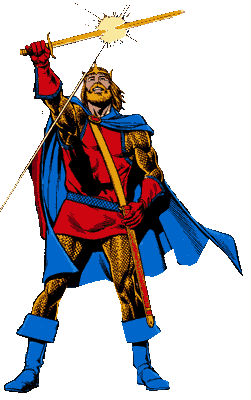
It's when Arthur pulls Excalibur from the stone we love him most. Everyone around him can see that he's the King. He's won the battle without doing any more than waving the sword around. Before him is the slaughter of the children, the fall of Camelot, the betrayal of Guinevere with Lancelot. But in the moment he held that sword, he must have felt that there wasn't a soul in this world or any other that wouldn't back off the moment he lowered Excalibur in their direction.

Safe at last, sword in hand. The worst long before him, a distant future when folks know that he holds Excalibur, and yet don't back off at all.
Catwoman: The Long Road Home ends on a note that is irreverent, difficult, disturbing ... essentially, many of the things the Catwoman series has been all along. Throughout his run, writer Will Pfeifer's portrayed Catwoman Selina Kyle as just this side of self-destructive, and he finishes the story with the same wonderful ambiguity he's provided all along.

At the end of Long Road Home, we find a Catwoman returned to her thieving roots -- not, even she admits, because she wants or needs to steal, but because it's her nature -- and, we sense, because she's a little mad at the world. And yet, the world may not even be her target; when Selina admits that she gave up her baby Helena not because she had to, but because Helena interfered with Selina's Catwoman identity, we understand in the end Selina's truly angry at herself.

Pfeifer and artist David Lopez do an admirable job ending their Catwoman run. Pfeifer, who's had his stories interrupted by no less than One Year Later, Countdown, Amazons Attack, and Salvation Run ends the Catwoman/Salvation Run crossover with breakneck speed (with no ending, really), and someone who hadn't read Salvation Run would be largely confused.

Instead, Pfeifer turns quickly back to the story of Catwoman's hunt for the Thief, an essentially anonymous character with a grudge against Catwoman. It's readily apparent that Pfeifer intends the Thief as a symbol more than a character; Selina's beating of the Thief suggests a break with her old life just as she, in contradiction, perhaps becomes an even more devious thief herself than before.

There's much to be considered here, and much we won't really understand the implications of for years to come. I always thought giving Catwoman a child was a bad idea, since we all knew the writers would never let her keep it; now we find a Catwoman -- maybe good, maybe bad -- who takes as much of her own motivation her guilt over giving that child up. Will Catwoman remain a petty thief, forgetting her East End hero days? Will Helena ever be seen, heard from, or mentioned again? Has this past storyline been the next step in the natural evolution of the Catwoman character, or a sign of this character returning to the Batman-villain status quo? It'll be a while before we know the answer.

I congratulate Will Pfeifer and David Lopez on a steady, respectable run on the Catwoman title. Ultimately, I feel perhaps the concept ended up being greater than what any writer could plot for the character, but Pfeifer and Lopez's consistent quality on this title is something to be admired.

[Contains full covers]

Next up, we're heading back toward the Countdown to Final Crisis with a stop first to finish the Jack Kirby Fourth World omnibuses. See you next time!
I've come to realize in thinking over Will Pfeifer's Catwoman: Crime Pays that what I've been expecting isn't exactly what Pfeifer's delivering. Whereas your average Teen Titans storyline, for instance, is a six-part tale where every chapter builds on the next with a conclusion that ties up threads from the beginning, Pfeifer's story is more of a picaresque, moving Catwoman from escapade to escapade often with no real tie between them.

This manner of storytelling is largely annoying for a trade reader, because instead of anything much really happening in the story, it often just feels like Pfeifer's wasting time. If it were not for the fact that Pfeifer writes a really nuanced, respectful Catwoman character, and artist David Lopez, I might not bother, but it's apparent on every page that these two know what they're doing (even if the reader doesn't always).

For instance, Crime Pays starts out with Catwoman on the trail of a master thief who's stolen all her belongings, including her own bed while she was sleeping on it. (How? We never find out.) Because she doesn't have a costume, Catwoman robs a billionaire with a collection of villain memorabilia (we never see said billionaire again). Catwoman goes to apprehend the thief, but is whisked away to the Salvation Run planet (we never see or hear from said thief again). Catwoman only briefly interacts with other villains on the planet before whisked off to an alternate reality story (which factors on the main story, in the end, not even a little).

It's disjointed, to be sure. And lest I paint with too broad a brush, Pfeifer is using many of these events to explore Catwoman's broken inner psyche after giving up her daughter, something Pfeifer does quite well. It also couldn't be terribly easy for the writer to fit in his own storylines between Amazons Attack and Salvation Run. But both the "costume stealing" storyline and the "alternate reality" storylines especially feel like softballs -- issues to fill space rather than ones with real bearing on the Catwoman story overall.

Catwoman ends with the next trade. In my opinion, this has been one of the all-time greatest character reimaginings; if you consider the purple-costumed Chuck Dixon/Bronwyn Carlton series that preceded this (which had, at some point, Catwoman fighting in the showers of a women's prison), the crime-noir, sensibly-costumed run that began with Ed Brubaker and ends with Will Pfeifer was nothing short of brilliant. Pfeifer's putting Catwoman talking about alternate realities and multiple earths signals to me it's time to bring the story to a close, but hopefully DC Comics will keep the character much as is. Co-feature, anyone?

[Contains full covers, "What Came Before" page]

We'll finish up Catwoman next time, and then on to some Jack Kirby Fourth World goodness.

Number 509


Cathy the Cat Girl


Mrs. Pappy, whose name is Sally, went on a collecting binge a few years ago, finding and buying anything with the name Sally on it. Among the other stuff she found she bought a 1975 Sally Annual from the UK. She liked the cover, but she opened it, saw comics, and closed it right back up. I've told you before about the balance in the Pappy marriage. I love comics, she hates them.

I took a look and found this cute 4-page duotone strip featuring Cat Girl, who is Cathy, a prepubescent girl with a cat suit that gives her the agility of a cat. The story is as fluffy as my own cat; it's also unsigned, as is everything else in the Sally Annual. But it gives me an excuse to show you some other stuff about Catwoman, who we all know. These are panels from Batman #35, by Bob Kane.


Here's a babe in a Halloween costume who could trick or treat at my house:

Here's a photo called "catsuits" my son sent me last year. He knows what his Pappy likes:

I dunno if those are really catsuits, but I like the picture and wanted to share.