Hiển thị các bài đăng có nhãn Flash. Hiển thị tất cả bài đăng
Writer and writer/artist team of Brian Buccellato and Francis Manapul have big shoes to fill in Flash Vol. 3: Gorilla Warfare. Indeed it was Geoff Johns and Scott Kolins's Grodd story that made many sit up and take notice of what became their classic Flash run, and Buccellato and Manapul have the unenviable task of essentially re-telling the same story, of Grodd running rampant through the Gem Cities.

It turns out, Gorilla Warfare is the best of Buccellato and Manapul's three Flash volumes so far, a worthy successor to what came before. Much of what dragged on the team's first two volumes (which were still good in their own right) has been fixed here, suggesting the creators really hitting their stride. Pity the next book is their last, but Gorilla Warfare is a high note to (start to) go out on.

[Review contains spoilers]

While again I liked Flash Vols. 1 and 2, Move Forward and Rogues Revolution, the former focused too much on a contrived and too-convenient long-lost friend of Barry Allen's who just happened to be the villain of the piece, and the latter told its story in a backward fashion that only made sense at the very, very end. Volume 3 is more straightforward in that it boils down to a heroes versus (gorilla) villains story, and also the book makes great use of the Flash's established supporting cast instead of turning to distraction. Manapul's art on this title has always been superlative, and now the book has a story that functions just as well.

Indeed, aside from excellent Flash Barry Allen work (good in the "Gorilla Warfare" story, but even better in the two-parter than ends this story), the creative team highlights Flash's supporting cast really well here. Patty Spivot, Darryl Frye, Iris West, and even the new Turbine (a kind of New 52 Top) have roles to play, along with the Rogues, and villain Dr. Elias even affects things behind the scenes. I appreciated that the writers went against type when Patty finds out Barry's secret, and had her pretty well OK with it rather than throwing a melodramatic fit; Patty also shines when she plays cavalry in "Gorilla Warfare"'s last chapter, a moment that serves to really make the audience feel like the characters are at war.

In fact, it's really hard not to like Patty, and the writers have something akin to Arrow's Felicity/Laurel triangle here in that we know Barry is meant for Iris, but it's tough not to favor Patty instead. There's an equally wonderful "CW moment" in "Gorilla Warfare"'s conclusion that demonstrates Barry's mixed feelings. Of course, Barry can't be with Iris any more than Clark can be with Lois, else we trip the wire that blows up the New 52, but I tend to wonder exactly how long DC writers can wait before they go there. Clark proposed to Lois 50 issues into the post-Crisis on Infinite Earths universe, and then there were another 240 issues (of the Superman title alone) before DC rebooted the universe. Can New 52 writers wait another 300 issues and 25 years before they get Barry and Iris together? If he's looking longingly at her now, I'd have to say I'm skeptical.

There's plenty to like about Buccellato and Manapul's Flash Barry Allen when he sacrifices himself to Grodd, and then again when he gains the upper hand in the Speed Force. But in the book's final two chapters (issues #18 and #19), the writers tell the story of a powerless Barry Allen (see Dial H) using the Rogues' weapons to fight off a mob, and for a bowtie-wearing stiff, he's really, as one character says, a "badass." That Buccellato and Manapul can make Barry, once thought to be DC's dullest hero, a "badass" is a feat indeed. The two chapters also benefit from a Cyborg cameo (great to see Cyborg with some Flash again) and from guest art by Marcio Takara, whose style best matches Manapul's of all the guest artists in the book.

Manapul is one of DC's best and most distinctive artists, one they really can't afford to lose. His nine-page spread in the book's third chapter is a superlative achievement, gorgeous in its panelling (though a little tough to interpret). I rather wish DC had reprinted it Mind MGMT-style as an actual fold-out, though there's a thumbnail image at the end that shows it all together. If Manapul can top this in Flash, Vol. 4, that'll be something to behold. This book's bonus material has some of Manapul's "finishes," pencilled and mildly colored pages, and I'd love to see one of DC's "Unwrapped" volumes with more of Manapul's work like this.

With the next and last volume, Buccellato and Manapul equally venture into a realm where lightning has already struck twice, a Reverse Flash story, done well once by Mark Waid and then again by Geoff Johns. Given how well Flash Vol. 3: Gorilla Warfare turned out, my bet is that the team can capture lightning in a bottle a third time (to really beat the metaphor to death). At the start of the New 52 run, I really thought Dr. Elias would turn out to be Zoom, but with this book's conclusion the writers have given me two or three more candidates to consider as well; I can't wait to find out what the answer is.

[Includes original covers, two-page "WTF" cover, Francis Manapul sketchbook]

We won't have to wait long ... Flash Vol. 4: Reverse coming up next.
There's some interesting concepts -- and perfectly workable revised origins for some major villains -- in Francis Manapul and Brian Buccellato's Flash Vol. 2: Rogues Revolution. Unfortunately, for a couple of reasons this is a less impressive follow-up to their stellar New 52 debut; also, no matter what new ideas the authors bring, they're still treading on well-worn and hallowed ground, making it difficult for their stories to measure up.

[Review contains spoilers]

Manapul and Buccellato already demonstrated a talent for unusual storytelling in Flash Vol. 1: Move Forward, in which the reader learns an explosion early in the book is actually the time-displaced result of the characters' actions later on. In Rogues, the audience understands there's a conspiracy afoot only after they've seen the results of that conspiracy -- that the Flash's supposed friend Dr. Elias is actually working with the Rogues and is responsible for the bizarre changes that we've already seen the Rogues undergo.

This is jarring for two reasons. First, I think many of us assumed that the Rogues' changes -- that Captain Cold, Heat Wave, and the rest no longer use weapons, but that their powers are now ingrained -- simply stemmed from New 52 fiat, and had therefore made up our minds about them. The changes didn't bother me as much as it might have some, but I did think Cold came off reckless and over-angry at the end of Move Forward; if I had known then, as I know now, that there was "more to the story," I might not have written off the character so quickly. The writers can't be faulted for making their story complex, but I wonder if the pre-revelation appearances of Cold and Heat Wave might've been too subtle for serialized storytelling.

Second, the writers offer an Elias in this volume radically different than the one in the first volume. This is supposed to be part of Elias's motif -- he pretended to be friendly with the Flash purely for his own aims, and then he turned his back on the Flash when it suited him -- but the portrayals are so different as to seem incongruous. The Flash is understandably caught "flat-footed" by Elias's about-face, but again, I felt the writers veered too-subtle in terms of what the audience understood. I would further fault the authors for giving the Flash a villain too similar to Lex Luthor, if it weren't already so clear what Flash villain Elias will turn out to be (though how that will work with established New 52 continuity, I'm not sure).

Once I understood the breadth of the story -- Flash versus the Rogues, the Rogues versus themselves, the Rogues versus Elias, Flash versus Elias -- I rather liked it. Certainly having an in-story explanation for the Rogues' new powers, and having it matter to the story, is better than it being just a throwaway change. However, the storytelling remains wonky in almost a Silver Age way -- the Pied Piper has suddenly returned to action off-camera, Barry Allen finds himself an entirely new identity off camera; maybe "Silver Age" is the right direction for this title, but in reading I felt continually off-balance. Added to this is the fact that Manapul only draws three of the book's six issues -- excluding, even, the extra-sized annual that wraps up the Rogue story -- and that makes it hard for the book to measure up to the tighter, Manapul-drawn first volume.

Again, once I understood, I did enjoy the writers' new take on the Rogues. Cold can't get a drink without it freezing; Glider (nee Golden Glider) is only an astral projection from her paralyzed body; Mirror Master is trapped within his mirror world -- all of these changes add new pathos to the Flash's Rogues. At the same time, we must acknowledge that Geoff Johns used the Rogues extensively, and in great detail, in his Flash run, and this new team's portrayal doesn't hold a candle to what came before, especially where Cold is concerned. I liked the Grodd spotlight issue that starts off this book, drawn by Manapul, but even then I doubt that the Grodd battle promised in the next book can stack up to the same devastating sequence by Johns and Scott Kolins previously.

Similarly, I appreciated how Barry Allen's secret identity played a role in the story. After secret identities essentially fell by the wayside pre-Flashpoint, it's a nice change of pace to see Barry having to consider how to account for his absences as the Flash and struggling with whether to reveal his identity to girlfriend Patty Spivot. The difficulty, of course, is the same as above -- as Barry hides out in the rougher parts of Central City and looks for work where he can lie low, I couldn't help but be reminded of Geoff Johns's Ignition. The fine details are not quite the same, but both are stories of Flashes "roughing it," and again, Johns's comes out on top while Rogues seems like a pale recreation.

What Francis Manapul and Brian Buccellato offer in this volume is still good comics -- the real stumble in Flash Vol. 2: Rogues Revolution is not the storytelling, but really the uneven spate of guest artists that leaves Flash looking like every other comic book rather than a Manapul masterpiece. The majority of the next twelve issues seem to have Manapul on art, however, and with Grodd and then the Reverse Flash in the offing, I'll be along for the ride. One "off" volume hasn't shaken me from this series just yet.

[Includes original and variant covers, Francis Manapul sketchbook section, and a great shout-out to Kelson at Speed Force.]

Coming up, a review of Superman Vol. 3: Fury at World's End. Don't miss it!
DC Comics's New 52 initiative has been a successful fresh start for the company, but to some extent it's still been "comics as usual" -- crossovers, creative team changes, stories that work and stories that fizzle out.

One title that has seen a real reinvention of comics -- not "comics as usual," but rather something truly different and new that would appeal to non-fans who already think they know what comics are "all about" -- is J. H. Williams and Haden Blackman's Batwoman. The strong plot aside, Williams utilizes not just complex paneling, but also a number of inventive artistic tricks that enhance the story. The art in Batwoman says something on its own; it doesn't just sit on the page in companion to the dialogue.

Another of these impressive titles is Francis Manapul and Brian Buccellato's Flash: Move Forward. The creators offer a Flash Barry Allen that is thankfully free of years of excess baggage, including the specter of his own death. In the previous iteration of his title, Barry been routinely anachronistic and also terribly dour; even despite what Flash fans have lost in the transition to the New 52, Manapul and Buccellato's Flash recaptures much of the joy inherent in Barry that makes him a viable character, which creators like Geoff Johns have championed but failed to be able to show. Barry is a little nerdy, a little square, but he also loves his powers and loves learning about them, and the reader gets caught up in Barry's enthusiasm.

Moreover, however, Manapul's art in Move Forward is a visual feast. Manapul's work already deserves praise for his meticulous action sequences and his ability to draw attractive characters without sexual gratuity; but in Flash, Manapul employs all of that plus creative paneling, perspective shift, and numerous outstanding visual cues all to bring the Flash and his world more alive for the reader. Flash is more than just the average comic; they should all look this good.

[Review contains spoilers]

In Move Forward, the Flash faces conflicts from within and without. An old friend of Barry's resurfaces, chased by an army of clones called Mob Rule. An electromagnetic pulse, seemingly related to Mob Rule, plunges Keystone and Central cities into a blackout. And Barry realizes his ability to "think fast," considering millions of options in seconds, though he finds this brings him as much utility as danger. These subplots coexist on the page, often plaguing Barry simultaneously -- in effect, Move Forward is about a lot of different things, separate but related, and this works well, both to keep Flash constantly interesting and to reinforce the sense that the reader is moving with Barry at lightning speed.

The audience later learns that Barry is responsible for the blackout due to inadvertent time travel; if the readers go back to the book's second chapter, they can see where Manapul and Bucellato pull a slight of hand to conceal this until the final revelation. Flash quickly becomes a book that has to be read very carefully. There's a set of five pages also in the second chapter that form a kind of Rube Goldberg, non-linear puzzle in which Barry visualizes and stops a handful of crimes before they happen, depicted through a series of panel cues. Lest this become old hat, the creators shift this trick in the fourth issue such that what the panels depict and what Barry visualizes isn't always what happens, but sometimes only what Barry incorrectly thinks might happen. This is complicated stuff, wonderfully requiring more from the reader than the average issue of Batman or Green Lantern does.

All of this is without even mentioning Manapul's deftly shaped double-page spreads (at times, multiple double-page spreads in succession), or that at times the creators even have the characters fall through three-dimensional panels. It's something else.

Arguably, Move Forward isn't quite a Flash story. Barry appears here, has speed-related conflicts, and Manapul and Bucellato get points for making Mob Rule an old friend of Barry's and not just a citizen in distress. But Manuel Lago is too new a character for Flash, even despite the New 52 reboot (rather this was Chunk, for instance, or one of the Rogues), so it's difficult for the reader to sympathize with Barry over the plight of his friend -- the conflict is Flash-specific, but emotionally Lago could as easily be an old friend of Bruce Wayne or Clark Kent. At one point Barry, unconscious, leaves the story entirely; this offers a good spotlight for Lago and the Flash supporting cast, but Barry is gone long enough that the first arc of Move Forward begins to feel like Lago's story with Barry in a secondary role and not vice versa.

The last three chapters of the eight-issue Move Forward jump, somewhat jarringly, from the Mob Rule story to Barry's conflict with a newly-enhanced Captain Cold, and from there Barry is thrust into the Speed Force. Keeping with Move Forward's overall aesthetic, the creators never "slow down," but it seems to make it hard to collect the Flash title -- the book ends on a jarring cliffhanger. If five issues would have been too small a collection for Move Forward and eight issues is at the extent of what DC has collected for the first New 52 volumes, it would appear there's just no good place to break Flash between books. More Forward doesn't read poorly, it just ends suddenly, and it'll like read better with the next volume in tow.

There are a wealth of nods to Flash stories past in Move Forward, from the Cosmic Treadmill to Rogues like the Top ("Turbine"), Pied Piper, Trickster, and Golden Glider. In-jokes are fun, but at times these get cloyingly too clever, akin to similar teases on Smallville, for instance. More than in other DC New 52 titles, Manapul and Buccellato position Barry as at the beginning of his career, but they also drop more hints than most as to how Barry might someday grow to become the "old" DC Universe Flash.

This is entertaining, but it seems the wrong way to go. From this beginning, the reader can already see the Rogues returing and Barry inevitably dating Iris West, and as such those aspects lack suspense. Manapul and Buccellato offer a gorgeous book package, not to be overlooked, but in some ways it's too similar to what came before.

Those concerns aside, however, Flash: Move Forward sets a standard for a smart book, deftly drawn. As these reviews have stated before, if every artist drew like Francis Manapul, the DC Universe and the comics landscape would be a much different place. If this Flash book stumbles only slightly, there's plenty of evidence that the writers will get it back on the right track.

[Includes original covers, comprehensive Manapul layouts and art section]

Next week -- back on our "Young Justice" track with the Collected Editions review of Legion Lost: Run from Tomorrow. See you then!
[Guest reviewer Zach King blogs about movies as The Cinema King]

After a less than positive experience with Green Lantern, let's charge into Flash: The Greatest Stories Ever Told and see how the Scarlet Speedster fares.

On a quick thumb-through of the book, it looks like my complaints about the preceding trade were rectified; I see Jay Garrick, Barry Allen, and Wally West, which gives me hope for a fair shake for all (no Bart Allen, which is worth debating, although this volume was published before Bart's tenure as The Flash). More enthusiastic already, I'm eager to see if this volume makes the case for Barry Allen's return that Geoff Johns never really did; I'm also expecting fewer Johnsian echoes, since Flash: Rebirth and its subsequent run was less about solving canonical problems than introducing new ones.

The sum of the parts being more than the whole in this series, let's take a look at what's inside this volume.

"Stone Age Menace" (Flash Comics #86, August 1947): The decision to open the volume with an appearance other than Jay Garrick's first appearance is surprising, but it's hard to be upset about a story that features Jay as the Flash battling a giant dinosaur while attempting to cover for his jailed alter ego. The story by Robert Kanigher (who, you'll recall, was hit or miss in his entries in Wonder Woman: The Greatest Stories Ever Told) never quite ties up at the end -- there's a one-panel wrap-up that doesn't resolve every plot thread satisfactorily -- but there's tremendous fun to be had at seeing Flash zip back and forth between crime-fighting and maintaining his secret as the unjustly imprisoned Jay Garrick. Other than that, I've always been a big fan of the mercury-helmet costume, particularly in what I've fondly dubbed the "stubby style" of the Golden Age.

"The Rival Flash" (Flash Comics #104, February 1949): This story seems included for two reasons -- its succinct retelling of The Flash's origin, and its introduction of Jay's opposite number, The Rival (who's also a college professor, like Barry's foe Professor Zoom). For modern readers, "The Rival Flash" offers two treats -- early Carmine Infantino work and unintentionally hilarious plotting, as when Joan recalls blowing the Flash's secret identity to a classmate but quickly shrugs it off as inconsequential. The end of the story is also hysterical, when someone believes that The Flash must secretly be someone who entered the lab after Jay Garrick inhaled the "hard water" fumes that we know gave him his powers. While The Rival doesn't live up to either incarnation of Zoom, the sequence where The Flash loses, then regains, his powers, is surprisingly exciting, considering we all know that Jay was running around as recently as August 2011.

"Flash of Two Worlds" (Flash #123, September 1961): Not much to say here. This story is iconic and classic, and its exclusion would have undermined the entire "Greatest Stories" project. "Flash of Two Worlds" is the story that started it all -- the crossovers, the Multiverse, the legitimation of the legacy hero. While modern readers will be scratching their heads about The Shade's characterization or the continuity of this Multiverse as opposed to the ones we've known since, what's important to note is that this story has aged remarkably well and has lost none of the appeal of two characters meeting for the first time, and mercifully not fighting on first sight. As great as this story is, it reveals a major flaw of the "Greatest Stories" series -- full covers are not reprinted, and the "Flash of Two Worlds" cover is one of the most quintessential Flash images (although the panel of two Flashes rushing toward a falling construction beam is included as a panel within the story).

"The Gauntlet of Super-Villains" (Flash #155, September 1965): The Barry Allen Flash has perhaps the second best pantheon of villains in the DC Universe (second only to Batman, in my estimations), and this story sees The Rogues teaming up against their common foe. And while this story doesn't have a lot of depth to it, it's a fantastic primer on all of Flash's best enemies (save Zoom, who appears in the following story). The Rogues mysteriously escape from prison and band together to disintegrate The Flash; little do they know, however, that Flash has merely vibrated through the floor and is well on his way to uncovering the real ringleader of The Rogues . . . Two things stand out here -- one, the Silver Age-y introduction of The Rogues' tailor, an unnecessary but whimsical in-canon hanging-lantern who must have been the prototype for Paul Dini's Milton "The Broker" Fine; and two, in spite of the fact that the plot doesn't quite matter, the whirlwind tour of Flash's Rogues more than entertains.

"One Bridegroom Too Many" (Flash #165, November 1966): With the Barry Allen/Iris West marriage annulled by the onset of the New 52, this story seems both inevitable as a collectible and irrelevant as far as continuity goes. John Broome's story translates Barry's wedding-day angst well, but the Professor Zoom plot often feels too convenient by half; while Zoom is clearly a force to be reckoned with, the story plays fast and loose with his abilities and his history. The art by Carmine Infantino is strong as always, solidifying his stance as a DC creative legend, although there are moments when Barry's lips are distractingly large like something out of a Dick Tracy strip. The story is unquestionably in here as a Zoom feature, although the wedding angle helps emphasize the fact that Barry Allen was once the most well-adjusted superhero in the DC Universe (that is, until Professor Zoom "pulled a Johns" and retconned his life).

"The Flash - Fact or Fiction?" (Flash #179, May 1968): To my memory, The Flash was one of the only DC heroes to know he existed in a comic book (over at Marvel, Dr. Doom once met Stan Lee and Jack Kirby), and this story is clearly in the volume as a testament to that. Here, The Flash is transported to our earth and enlists the help of Julius Schwartz in building a new cosmic treadmill to return home. Unfortunately, it's also a return to a much less compelling main story, in which The Flash has to battle some kind of renegade dream monster called Nok. A hit or miss entry by Cary Bates and Ross Andry, "Fact or Fiction?" is probably not the best metafictional entry the editors could have chosen. (That reminds me, does the Earth where Superboy-Prime met Dan Didio still exist in the New 52? [I believe the rule is nothing exists until we see that it does. Or everything exists until we see that it doesn't. Or something -- ed.])

"Beyond the Super-Speed Barrier" (DC Special Series #11, 1978): The longest story in this volume (and possibly in the entire "Greatest Stories" series, at 63 pages), this Bates-penned epic tale finds the three Flahes of 1978 -- Jay Garrick, Barry Allen, and Wally West -- in three interconnected stories drawing them together for a confrontation with a "silent simian" after the execution of Gorilla Grodd.

While I definitely appreciate this volume's overall attitude to the Flash legacy, parts of this story go on a little too long -- especially (and perhaps appropriately) the Barry Allen chapter with The Turtle. Jay's segment feels quicker, perhaps because Johnny Quick also appears to double the speedster quotient, and the Wally chapter is great, capturing the "teenage hero" mentality without delving too deeply into soap opera angst. Ultimately, the story isn't terrible, but it's mostly forgettable, although modern readers won't help but remember the Combo-Flash formed by the three vibrating to inhabit the same space, or the hilariously memorable image of Barry Allen's ring ejecting its costume while he's in bed with Iris- - tell me Bates didn't have something a little naughtier in mind! (Iris's actual reaction: "Barry! You can't be serious!")

"Out of Time" (Flash #91, June 1994): In the final story of this volume, Wally takes center stage and dons the red tights in this Mark Waid piece. Here, Wally boosts his own speed with Johnny Quick's formula (3X2(9YZ)4A!) and freezes time like something out of a Twilight Zone episode. Max Mercury comes along to dole out some zen wisdom about the speed force, and Wally's left excited about the future. In one way, it's a great way to end the volume, musing optimistically about what's next (Wally's current nonexistence in the New 52 notwithstanding). But it's more frustrating than anything else -- if Wally's now moving faster than light, why does he complain about being powerless to save a helicopter crash directly in front of him? Why doesn't Max Mercury help Wally instead of complaining that Wally isn't fast enough? Moreover, aren't there Wally stories that don't fall into the "Hero can't do everything" trope of the 1990s? Maybe I'm overthinking it, but "Out of Time" is too restless for its own good.

Overall, Flash: The Greatest Stories Ever Told is a strong volume, imperfect like the others but with enough of an overall survey to give a holistic sense of what the Flash legacy means. I'm surprised that there's nary a Geoff Johns story in here, especially considering how highly praised his Flash run was. I also would have liked to see more of the traditional Rogues, but I suppose I'll have to read The Flash vs. The Rogues for that.

Next time around, I'll cover the world's greatest superheroes in JLA: The Greatest Stories Ever Told. See you then!

More Greatest Stories reviews: Superman, Batman, and Wonder Woman.

[Thanks Zach! Next week, come back here for the DC New 52 debut of the Legion of Super-Heroes. Excelsior!]
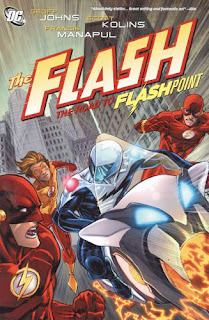
If it's possible for a book to be exceptional and significantly disappointing at the same time, Flash: The Road to Flashpoint is that book. The story is action-packed and emotionally complex, and beautiful, to boot; however, it fails as the next volume in the Flash series, if not also as a lead in to the Flashpoint crossover. Knowledgeable readers won't find what they're looking for here, and the casual reader is likely to be confused.

[Contains spoilers]

A word, first, about the art of Francis Manapul. His airy pencils will always be synonymous for me with his depiction of rural Smallville in Superboy: Boy of Steel, such that his Central City also seems old-fashioned, more 1950 than 2011, despite the prevalence of cell phones in this book. Despite this, Manapul's lines are clean; his action sequences exceptionally clear; and the women that he draws in the book, specifically, are all pretty without sexual gratuity. (Scott Kolins does an equally good job mimicking Manapul in his fill-in sequences, with neither artist inking over their pencils).

What would comics look like, I wondered, if Francis Manapul drew everything? What would the public perception of comics be? It's unfortunate, I think, that what we find in Flash is the exception, and not the rule.

The story itself involves Flash (and forensic scientist) Barry Allen in a rather intriguing mystery, at least to start. Super-powered children are showing up dead, unnaturally aged; the first is a new "Elongated Kid" wearing a variation of Barry's late friend Ralph Dibney's old costume. This alone should be enough to hook most Flash fans, and writer Geoff Johns is at his best when a police officer asks if Barry recognizes the costume and Barry, in plain clothes, must utter a simple "no." It's a quiet and painful moment, the first of a number of such in this book.

Unfortunately, abandon hope all ye hoping for much clarity after this point. A motorcycle-riding speedster named Hot Pursuit emerges, chasing a time anomaly related to the murders. Pursuit reveals the details of the situation to Barry in an elaborate speech over the course of one issue, but then inexplicably refuses Barry's help in solving the case. In the conclusion, Pursuit mistakenly believes Kid Flash Bart Allen has caused the anomalies, for no good reason this reader could understand; it turns out to be Professor Zoom, conducting "experiments" that also involve him de-aging himself.

Why does Pursuit take up half of one of the scant four issues of this story (a fifth issue is devoted to a Professor Zoom profile) to explain to Barry a situation for which he doesn't want Barry's help (other than Johns offering exposition to the reader)? What value is there to Professor Zoom to becoming a kid and pretending to have witnessed a murder for an issue? Why does Pursuit think Kid Flash is a "time anomaly" when as far as Flash and the reader are concerned, he isn't? None of this is explained in the book, couched in Zoom's "secret plans" and vague "you'll find out soon enough" statements.

It's a reasonable expectation that some of these items might be addressed in Flashpoint itself, this book being a prologue to that. However, the phrase "Flashpoint" never warrants a mention in Road to Flashpoint, despite that Pursuit mumbled about it to himself in the previous volume, Dastardly Death of the Rogues. Road ends on a rather uncertain note -- Zoom says, "It all changes," a lightning bolt strikes, and that's it. A casual reader, at this moment, knows no better whether Flashpoint will be about alternate realities or a Sun-Eater; some surprise is good, but at this same penultimate point in Green Latern/Blackest Night, I felt the reader had a better sense of the story as a while. I count that as a failing of this as a prologue.

What Johns does well here is present Barry's emotion. Barry has struggled since his rebirth (or, Rebirth) to engage with his family and not withdraw, feeling he doesn't deserve his new life. Learning Zoom killed his mother in the past because of his hatred of the Flash was another significant blow, but not one much mentioned in the previous volume. That revelation is now in the forefront; Barry pulls away from his family for fear of enticing Zoom to kill one of them, too. It's an interesting time-traveler's dilemma, and at the same time Barry's depression seems very real -- he can't enjoy a family picnic, for instance, because he imagines his mother there and feels her absence is his fault. Barry's wife Iris stages a speedster intervention, and Johns paces the scene with a slowness that conveys the seriousness of the moment. All convincing and moving.

Only, Barry's sorrow over his mother really isn't mentioned all that much in Dastardly, and this issue of Barry pulling away from his family is one seemingly already solved in Rebirth. Barry, it seems, is regressing, and to Road's credit that's a point Iris makes within the book. But why? Are we to attribute this to the secret emotional weapon that the Rogues used in Dastardly? If so, the book never even hints at it -- nor do the Rogues appear here at all, nor Captain Boomerang, who was so much a part of the last book's cliffhanger.

In terms of solid storytelling, Road to Flashpoint succeeds, but in terms of a sequel to Dastardly Death of the Rogues, it emerges largely disconnected -- not a satisfying reading experience in terms of the Flash book. Similarly, and perhaps by necessity as a lead-in to Flashpoint, Road doesn't offer much closure for the Flash series -- there's the absence of the Rogues, to start, but also the reintroduction of Barry's old flame Patty Spivot. The informed reader knows Patty plays a role in the DC New 52 relaunch version of Flash -- creating a strange relationship between new Flash and old -- but the casual reader may have trouble determining what Johns tried to say with all of this. Road to Flashpoint is, in a sense, a fair preview of the series that replaces it, perhaps, but not an entirely solid package on its own.

Crossover-mad fans (like me) will undoubtedly feel incomplete without Flash: The Road to Flashpoint on their shelves next to the main event, but the story was less than what I'd hoped for -- a tease, more than a lead-in, to Flashpoint itself. New readers drawn to Flashpoint by news of the DC New 52 might not feel they miss much if they leave Road to Flashpoint back on the shelf.

[Includes original and variant covers]

Unfortunately, Road to Flashpoint wasn't the lead-in to Flashpoint that I'd hoped -- then again, Salvation Run and Countdown to Final Crisis weren't so stellar lead-ins to Final Crisis, either. Coming up later this week, however ... the Collected Editions review of Flashpoint. Don't miss it!
Beautifully drawn and full of fantastic superheroic saves, Geoff Johns writing a Flash title again with Francis Manapul and former collaborator Scott Kolins feels like coming home. If I had wondered if Johns had exhausted his arsenal of fantastic Flash saves, there's more; if I had wondered if Johns had revealed all he could about the Flash's Rogues, there's more. And to an extent, I appreciate Flash: The Dastardly Death of the Rogues, a story about a man who can accomplish things very fast, the most because of how it wastes time -- with scene setting, with conversation, with silly bits of humor. All of it suggests that Johns's intention here is to give the reader a firm introduction to the character of Flash Barry Allen and his supporting cast, even if this story might proceed more slowly than Johns's audience is used to.

[Contains spoilers]

It is not just because of Francis Manapul's art that Johns's first book of the Flash ongoing series reminds me of his Superboy: Boy of Steel. As with Superboy, this Flash volume is a slow, methodical book, from the initial splash page not of our hero, but of Central City, to seven pages of the Flash restoring a decimated apartment building that has no real tie to the ongoing story. This includes a page and a half dedicated to the Flash fixing a little girl's doll; Spawn this is not. That sequence is followed by two pages of Barry chatting with his wife Iris, and then again Barry and Iris sit down for coffee for four pages an issue later.

I'm not complaining, mind you. Johns writes Barry's saves with the right mix of fun and exhilaration, as when Barry leaps into midair to save the pilots of a crashing helicopter (and I appreciated that Johns knows Barry's limits; the Flash saves the people, but the helicopter crashes in flames). Barry's relationship with Iris and their meetings over coffee form the backbone of this book; they are exactly the right mix of confidantes and professional rivals, and Johns makes the writing of the relationship seem so effortless that its a wonder scores of Superman writers haven't been able to accomplish the same over the years. Johns's circuitous route in the story -- Barry fixing the girl's doll, for instance -- seems to me to stem from the same place as Johns's Justice Society riding in a fire truck with cutesy dalmatians, but this feels much more natural, maybe because Manapul's art lends itself better to the pastoral than Dale Eaglesham's did on Justice Society.

Time travel plays a large role in this story (one that will likely increase with the coming Flashpoint crossover), but I liked that Johns didn't cover ground already well-tread in Booster Gold. Flash's time travel issues are less "is it OK to go back in time and kill Hitler," and more determinism -- if the future exists somewhere, do I have any say over my own actions? Am I destined to make my mistakes or can I change them? Johns cleverly has Barry interpret time travel not as physically changing the past, but rather as overturning the wrongful conviction of a young man. The future Reverse Flash Task Force arrest Barry because they're trying to prevent all crime in their time; Barry works to do the same, but by uncovering the truth rather than shaping the truth to his own ends.

I chuckled at Johns's assertion on Flash: Rebirth that Barry Allen is the wellspring from which all other heroes emerged. Johns is accurate in that we credit the Barry Allen Flash for launching the Silver Age of comics, including Green Lantern Hal Jordan and the Atom Ray Palmer, though for Golden Age Flash Jay Garrick to give Barry that credit in-story seemed too much Barry worship (let alone that I dislike DC Comics's move of late to give Hal and Barry greater roles than Superman). Barry is perhaps a bit too perfect in this story, too, always dutifully worried about others, whereas even Hal Jordan gets overconfident or runs his mouth off once in a while. Johns reinforces Barry's "wellspring-ness" in a scene toward the end of the book where he single-handedly convinces the Central City police to re-open all of their hastily finished cases for the past six months; the scene is true to Barry as Johns presents him, though I worry if Johns presentation of Barry as never tripping or sneezing might at some point get old.

Johns certainly differentiates the adventures of Flash Barry Allen from "previous" Flash Wally West at least in Barry's approach to superheroics, which is always dutifully steeped in the language of police investigations. As a fan of Johns's last Flash series, however, I was glad artist Scott Kolins played a role here, and in a "Rogue Profile" issue no less (Kolins' art even blurs a bit to look more like Manapul's). I'm not sure we learned much more about Captain Boomerang Digger Harkness than we knew before, though the villain is a favorite of mine and I was happy to have him in the spotlight nonetheless. Boomerang's face-off with the Reverse-Flash was interesting, since I believe Reverse-Flash's daughter was the mother of Boomerang's child -- this was not addressed in the issue, but I hope Johns gets to it at some point.

The hardcover of Dastardly Death of the Rogues, at least, contains a couple of Johns's one-page "Flash Facts" backups, and a teaser for Flashpoint. As an advocate for collections readers getting as many of the little extras as the monthly readers, I was glad to see these here. Johns emphasizes both in one of the "Flash Facts" and in the story that the first Mirror Master Sam Scudder had control over forces in his mirrors that the reader never knew; if I thought Johns had said all he had to say about the Rogues in his first Flash run, it's interesting how he's now even exploring the history of dead Rogues. My guess is that the "alternate reality" that Barry sees here in Scudder's mirror is in fact the way events were "supposed" to unravel, with Barry's mother alive to old age; I wonder if one aspect of Flashpoint will be Barry having to decide between the life of his mother or preserving DC Comics reality as we currently know it.

Flash: Dastardly Death of the Rogues will be intriguing for fans of Geoff Johns's Flash new and previous, and certainly if you intend to pick up the Flashpoint crossover, that all starts here. It's clear Johns is playing the long-game with Flash, however, and this book's story delays and digressions will delight some but potentially alienate others. Johns's Green Lantern, to be sure, doesn't move this slow, and I wonder how well the Flash title will support a major crossover in just a few short months, with all the world watching.

[Contains full and variant covers, "Flash Facts" and Flashpoint teaser. Printed on glossy paper]

More reviews on the way!
One thing about a Rebirth is that when you finish it, invariably you're left with a handful of easily encapsulatable nuggets that help to sum up the newly reborn character.

One of these after Flash: Rebirth is this: the Silver Age Flash Barry Allen is one of the few fellow heroes that Batman genuinely likes. The significance of this, of course, is that if we understood nothing else after Green Lantern: Rebirth, it was that Batman didn't like Hal Jordan. But Batman likes Barry and Barry likes Hal, and all of the sudden fans know exactly where Barry fits in the DC Comics pantheon -- even if you were thirteen when Barry died and never really experienced him inside the DC Universe.

Someone who was thirteen when Barry Allen died, by the way, is Rebirth writer and newly minted DC Comics Chief Creative Officer Geoff Johns. Sure, I recognize there's back issues, and Johns is undoubtedly familiar with the entirety of Barry Allen's history by now, but I can't disregard that there was never a time for Johns when Barry was "the" current Flash. Whereas I overall enjoyed reafing Flash: Rebirth, the story distinctly like a modern-era recreation of Barry Allen by someone approaching him second-hand, and not a rejuvenation of the original character.

[Contains spoilers]

Johns likely had first-hand experience with Hal Jordan prior to resurrecting him in Green Lantern: Rebirth, and that story served to present all the cool things about Hal Jordan that had already been there but we never fully realized. Flash: Rebirth makes up a couple of things about Barry Allen that are indeed pretty cool and make one want to follow the character, but they're made up nonetheless and not true to the original source.

For instance, if the most a modern fan knows about Barry Allen is that he had a penchant for bow ties, is considered DC Comics' enduring patron saint (by virtue of his long-standing sacrifice and death in Crisis on Infinite Earths), and otherwise seemed like something of a stiff, Johns turns all of these on their ear. Barry himself confronts his reputation as a saint, repudiating it with a host of "angsty" bad deeds including killing the Reverse Flash and abandoning his friends to live in the future. As for the bow tie, Johns retroactively reveals, Barry didn't even wear one until it was slipped on him last minute and his wife Iris liked them. So, Johns seems to say, not so much a stiff as you might have thought.

All of this is clever, especially Barry's sainthood being within the DC Universe as well as without. But, it's a far cry from Johns re-explaining Green Lantern's yellow weakness in light of new evidence; rather it's more like Identity Crisis re-imagining earlier adventures of the Justice League. What we learn in Flash: Rebirth is that Barry Allen truly is so much of a stiff that Johns needs a villain to alter the time-stream in order to make Barry cooler; that it's not enough for Barry just to be a police scientist and a good Flash, but that he needs some kind of "edge" to appeal to audiences, something I thought comics outgrew in the late 1990s.

Even as Flash: Rebirth heralds the return of Barry Allen, it also apologizes for Barry's lack of coolness, when really no one expected Barry to be all that cool to begin with. In this way, we find in Rebirth that Barry Allen isn't returned so much as the DC Universe now has a new Barry Allen-Prime, so to speak -- but I like this Barry Allen-Prime. Rebirth is heavy in Speed Force double-take, but Johns suggests that the forthcoming Flash series will be more of a police procedural, something that's often suceeded in the DC Universe. Barry will solve cold cases against the backdrop of a corrupt police force -- this has worked for most every CBS police drama (complete with an equally "angsty" murder that Barry witnessed in his childhood) so likely it'll work for Flash, too, and I'm excited.

Not to mention that, even as Johns wrote a dynamic Flash Wally West for a number of years, here Johns surprisingly serves to suck most of the remaining fun out of Wally, leaving Barry as the only viable Flash choice. The best part about writer Mark Waid's recent brief return to Flash was how charmingly cute he made Wally's children; Johns presents them here as absolute brats. Even as Barry is the mentor and Wally the sidekick, Barry ends the series seeming the more youthful of the two. Wally gains a new costume reminiscent of his metallic, white-eyed costume again of the 1990s; whereas this does speak to the era from which Wally is best-known, it makes him look dated and Barry the more "modern" Flash.

Yet, there is plenty for Flash fans to like in this story, though as with Johns' Superboy: The Boy of Steel, some might venture it suffers from too much nostalgia. At the end of Rebirth, the Flash-family status quo is essentially the same as around issue #100 of Mark Waid's Flash run, with Jesse Quick back in the Flash fold and Max Mercury resurrected. This latter item is one of the few great surprises of the book, and as happy as I am to see Max, it feels like something of a regression for the Kid Flash character to have his teacher looking over his shoulder again.

The book's other great cameos are of Wally's villains Savitar and Lady Flash; again, I like these characters and I'm glad to see them, but they've each been out of comics for fifteen years, such that Rebirth's intended audience does seem to be fans who've followed the Flash that long, and not necessarily ones who might've joined the DC Universe more recently. In fact, a good 99% of the knowledge you need for Flash: Rebirth comes from the one story where Savitar appeared, Dead Heat -- now, that's a great Flash story, but it makes Flash: Rebirth feel more insular whereas Green Lantern: Rebirth was more expansive.

Early in Flash: Rebirth, the Golden Age Flash Jay Garrick explains how Barry Allen actually inspired him to become a hero again after Jay's initial retirement. Johns is being cute here, too; this is a not-so-subtle reference to the Barry Allen character heralding the Silver Age of comic books in 1950s, which itself helped return the Golden Age heroes to popularity. As such, Johns posits Barry Allen as the DC Universe's preeminent Flash (Barry created the Speed Force, we learn, and gifted every speedster past or present with their super-speed [though completely by accident]) and perhaps even the DC Universe's preeminent superhero (I, for one, like that accolade to go to Superman, but what can you do?).

The irony of the story, ultimately, is that even as Johns takes great pains to suggest that Barry isn't as perfect and unrelatable as we all thought he was, Johns also offers a dozen reasons why Barry is the greatest superhero who ever lived, not to mention having created a multi-dimensional cosmic force that apparently contains the answer to every question ever asked in the entire universe ever. It's a lot to live up to, and I'd venture Flash: Rebirth might've done well to have reigned itself in just a bit. If one detriment of Barry Allen the first time around was too much perfection verging on sainthood, Geoff Johns toes a dangerous line this second time. I'll be watching to see what happens to Barry Allen next in the DC Universe, but if the skies turn red again, he might just want to watch out.

[Contains full and variant covers, introduction, original proposal by Geoff Johns, Ethan Van Skiever sketchbook]

I hope you've enjoyed our Flash week at Collected Editions. Don't miss this week's other Flash reviews, Flash: The Return of Barry Allen, Flash: Emergency Stop, Flash: The Human Race, Flash: The Wild Wests. Tip of the Flash hat, of course, to Kelson Vibber of the Flash-centered Speed Force blog for his guest reviews this week, and also to everyone who posted and re-tweeted about the Collected Editions Flash Week -- thank you!
Continuing Flash Week at Collected Editions!

Undoubtedly one of the prices of a successful run for a comics writer is that your fan base expects you do to the same every time. Such must certainly be the case for Mark Waid; his Flash: Wild Wests is nothing like The Return of Barry Allen, nor should it be, even though I might have been hoping so. Wild Wests is a fair entry into the genre of superhero family stories, if there is such a thing; but unfortunately, it doesn't really distinguish itself as a Flash story nor rise much above standard superheroics.

Without a doubt, the very best thing about Waid's new foray into Flash is Wally West's children Jai and Iris. Waid ages the twins, but wisely not too old, such that they're rare adorable preteens in a DC Universe mostly populated with smarmy Damian Waynes. That Iris notes she's special because her parents say so, or Jai delights in his mother wearing a funny hat, is just plain cute, and Waid does well mining a "cute" vein that DC doesn't much else see outside Tiny Titans. Even the kids' powers are cute -- Jai bulks up to a tiny muscleman, but has to take a nap after he does so; Iris teases her brother by vibrating through him to steal his breakfast.

Under the cuteness, however, Waid addresses a problem to which many parents can likely, unfortunately, relate: how to let a sick, possibly terminal kid still have a childhood? Wally and Linda (Park) West are exactly the parents that long-time Flash readers would expect -- cool, funny, understanding, and up-for-anything, but with a significant undercurrent of constant worry about their children, who could rapidly age, even to the point of death, at any moment.

Waid does well to let Wally receive some criticism from the Justice League for putting his children in harm's way (not unlike the parents of recently-stranded sixteen-year-old sailor Abby Sunderland). Wally decides in full, after a heart-rending talk with Jai, to let his children face danger if that's what they want; it's a decision that seems obvious on the pages of a comic book, but has proved more controversial in real life, and I appreciated Waid approaching the issue.

The character moments, however, don't make up for a rather lackluster plot involving a very standard alien invasion. The aliens are bad guys all along and end the story as bad guys; as such, there's no nuance to the story, short of the children, beyond the Flash running around and punching things. To make the unfair comparison, Waid's previous Flash stories were so full of Speed Force mythology and cool speed tricks; here, Wally's speed is mostly a weakness in that the aliens make him dehydrated (of all things) faster, and not much of a boon.

Daniel Acuna's art in the first chapters has a fluidity that shows off both the West kids' powers and the aliens well, but later Freddie Williams' pages suffer from lack of detail (no one has eyes, for instance) and awkward poses that keep the story's climax from popping.

In addition, I have to pick at a production level difficulty, too. When these Flash issues came out, they had a backup story about various Flashes visiting the planet Savoth; DC collects those backup stories all together at the end of the book. Only thing is, something that happens in that story is vitally important to understanding the main story's resolution, but reading this book in order, the main story's resolution is unintelligible (out of nowhere, they're on a friendly alien planet) and lacks much of its intended weight.

(Not to mention -- if I can be really picky -- I remain entirely confused about what's meant to have happened to Wally West after Infinite Crisis. Distinctly we saw Wally go into the Speed Force with Bart Allen, Max Mercury, and Barry Allen; Bart himself recalls living on a duplicate Earth with Wally and Barry where they imprisoned Superboy-Prime; but Wild Wests would tell us Wally was never there and on Savoth instead. My hope is that Flash: Rebirth will explain all this, but I'd bet it's just an overlooked story point that'll ultimately just be ignored.)

Little of that is Mark Waid's fault, but ultimately this story doesn't have the gusto of a Flash comeback; I really wonder if the run collected in Flash: The Wild Wests was ever meant to be ongoing, or if it was instead a miniseries-posing-as-series (as, if you believe DC, Flash: Fastest Man Alive was supposed to be). I would read a West family miniseries by Waid, no doubt, but for the content of the main Flash title, this isn't quite it.

[Contains full and variant covers, brief bio page, backup story]

Coming tomorrow, the main event ... the Collected Editions review of Flash: Rebirth. Be here!
This week, we're featuring all things Flash at Collected Editions! Here's another guest review from Kelson Vibber of the Flash-centered Speed Force blog and Those Who Ride the Lightning Flash reference site.

Flash: The Human Race covers the second half of the year-long Grant Morrison/Mark Millar run on The Flash from the late 1990s, plus one more short story. This volume rushes even deeper into "mad ideas" territory than the first, with the Flash racing across time and space first against his childhood imaginary friend, and then against death itself.

The Human Race
The Flash is forced to compete in a cosmic footrace, or else the Earth will be destroyed. The concept is simple, but the details are crazy: The racetrack loops across space and time. One obstacle is a collapsing star. Another is running through the last moments of the exploding planet Krypton. And the Flash's opponent -- Krakkl of the radio-based people of Kwyzz -- is Wally West's childhood imaginary friend (who turns out to have been not so imaginary after all).

This book absolutely revels in the kind of crazy stories you can tell when you don't need to worry about a special effects budget.

Despite that, it manages to feel very familiar. Several of the Bronze-Age races between Flash and Superman had them running across space and time. One race was controlled by cosmic gamblers. Krakkl looks vaguely like Sonic the Hedgehog if he were made out of energy (with Kirby Dots, of course). Even the twist is similar to something Morrison himself does just two years later near the end of his JLA run. (Come to think of it, that same twist fits in well with certain elements of Flash: Rebirth.)

The Black Flash
I'm surprised that this wasn't used as the title of the collection, considering that the concept of death for speedsters has had so much more impact. The Black Flash has shown up in Full Throttle, was referenced in Final Crisis, and showed up again in Flash: Rebirth. Radioland? Not so much.

The basic premise: Max Mercury learns that Wally West is about to die, and tries to save him. But death doesn't leave empty-handed, and takes Linda Park instead. Wally is devastated . . . and death isn't satisfied. It begins stalking him in the form of the skeletal Black Flash.

Two things change with The Black Flash: Grant Morrison drops out, leaving Mark Millar flying solo as writer, and Pop Mhan and Chris Ivy take over the art. The writing comes off a bit awkward in some places, while in others it's absolutely dead on. For instance, at one point, Captain Cold is holding the city for ransom in a way that makes absolutely no sense for Captain Cold; Impulse's characterization, however, is absolutely perfect.

The story bounces back and forth between the utterly ridiculous and the devastatingly real. It's at its best in the character beats in the middle chapter. Sure, several Rogues show up, and the third chapter is one long stuck-in-time battle with the Black Flash . . . but Impulse saying, "Wrote you a letter when you blinked," or Wally West trying to explain to Jesse Quick why he can't handle super-heroics anymore in the absence of Linda, or the absolute bleakness of the funeral . . . those are the moments that that stick in my head.

The ending, unfortunately, relies on not one but two of those cool-when-you-read-it ideas that make absolutely no sense if you think about them for more than a half-second.

I remember severely disliking Pop Mhan's art when this first came out, and I still feel it's not a good match for the Flash. People's features are very exaggerated, and everyone seems to be about 9 feet tall. At the same time I have to admit: he does the best rendition of the Black Flash that I've ever seen.

Flash of Two Worlds
The last story in the collection is a short from 1990 in which Grant Morrison tries to adapt the classic "Flash of Two Worlds" into modern continuity. The original story had Barry Allen crossing from one universe to another and meeting Jay Garrick, but Crisis on Infinite Earths had changed things so that Central City and Keystone City were in the same universe, on opposite sides of a river.

The solution: The Thinker, Fiddler and Shade (who had simply gone on a crime spree in the original story) have cut off Keystone City from the rest of the world, and Barry manages to cross through that barrier.

It's told as a mix of standard comic book panels, childish sketches, and narration by an eight-year-old who witnessed part of the event and heard the rest from the Flashes themselves, giving the whole thing a fragmented feel, as if we're not really getting the whole story.

In a way, that's almost better, because like "The Black Flash," the story works better if you don't think about it too much. Sure, the Rip Van Winkle angle works great as a substitute for crossing dimensions, but it opens up questions that DC has never really been sure how to answer. How long was Keystone City kept separate from the world? Months? Years? Decades? Did people age? If they didn't, that's got to make for some awkward families. If they did, imagine all the young children who woke up as adults without actually growing up.

Overall
This is a much more uneven collection than Emergency Stop on creative team alone. Paul Ryan drops out part-way through "The Human Race," to be replaced with Ron Wagner, but their styles are similar enough that it's not too jarring (John Nyberg inking both of them has to help); whereas Pop Mhan's exaggerated style is a huge change, even coming at the beginning of a new story. "Flash of Two Worlds" feels even more out of place, but given how critical it is for the modern Central City/Keystone City dynamic, it's good that the story is available somewhere that today's audience can find it.

On the plus side, the stories of Flash: The Human Race are far from the fill-in tales they could have been. Just as Emergency Stop introduced the Speed Force costume and set up Jakeem Thunder and the modern incarnation of the Thinker, this volume introduced the Black Flash and set up Wally and Linda's engagement . . . a major development which would factor into the next two years of stories when Mark Waid and Brian Augustyn returned to the book.

Tomorrow at Collected Editions, we'll look at the last trade paperback of Wally West's adventures, before the Collected Editions review of Flash: Rebirth on Friday. Don't miss it!
The Collected Editions Flash Week continues! Today, we're thrilled to have a review from Kelson Vibber of Speed Force, your one-stop blog for all things Flash! Also don't miss Kelson's Flash reference site, Those Who Ride the Lightning.

Flash: Emergency Stop is the first of two volumes collecting the Grant Morrison/Mark Millar run of The Flash from 1997-1998 (the second volume is The Human Race). They stepped in for a year while the regular writing team of Mark Waid and Brian Augustyn took a year off to work on such projects as The Life Story of the Flash and JLA: Year One.

The first half of the book is the actual "Emergency Stop" storyline, while the second half is made up of three one-shot stories.

"Emergency Stop" is about a suit, or more specifically, it's about two suits. One: the ultimate super-villain suit come to life. The other: Wally West's Speed Force-based Flash costume.

The story also introduces an idea that shapes most of this volume and the next, a line that Wally West attributes to Barry Allen: "With powers like ours, you have to learn to fight the way a science fiction writer writes." The Flash is confronted with his own dead body and given an hour to solve his own murder. A sentient costume runs around possessing minor super-villains, draining their life energy and using their powers. Wally West breaks both his legs.

Wait, what? Yes, early in the story, the Flash is taken out of commission. What follows is a lightning-brigade story, with Wally having to act as strategist and send Jay Garrick, Max Mercury and Impulse out to do the actual fighting. As you might expect, he doesn't take well to being out of the action, and tries to find a way to fight through his injury.

There are a whole bunch of new villains who appear in this story, but most of them are incredibly generic. Only a few are even named, and I can't think of a single one who appears again. But then, they aren't really there to be individuals, or even a team; they're there to be a mob.

Next up is a tale of the Mirror Master in full-up "mad ideas" mode. A mirror dimension where time goes backwards? Check. Sending the Flash through a prism at light speed, splitting him into a whole spectrum of Flashes? Check. Mirror duplicates? Check. A second Earth about to crash into Keystone? Check!

The next two stories settle down a bit.

"Still Life in the Fast Lane" is a solo story focusing on Jay Garrick, and is one of my favorite single-issue stories from the series. It's a day-in-the- life story, but because Jay is the Flash, it's a very full day!

The main plot involves the Thinker, who is dying of inoperable brain cancer. Jay has been visiting his one-time arch-enemy in the hospital, and they've become friends. Not one to let go, Jay sets on the idea of tracking down the Thinker's old Thinking Cap to boost his intelligence and find a cure.

So in and around visiting most of the original Justice Society members, he also finds time to do nanotech research, fight three supervillains (including a single-panel fight with the "Golden Age Reverse Flash"), have lunch with Wally West and Nightwing, give a TV interview, give a talk at a school, and have dinner with Joan!

It's a fascinating look at the sheer potential of super-speed for living, not just for fighting.

The final story isn't really a stand-alone story, but the third part of a crossover with Green Lantern and Green Arrow, "Three of a Kind." It mostly works on its own, since it's structured as a courtroom drama with flashbacks to the incident set up in the first two parts, but it still feels like something's missing. It's an odd choice, and one which makes it clear that DC's real interest in these volumes was in the name recognition of the two writers. Still, there are nice touches, like Green Arrow Connor Hawke applying martial arts philosophy to a legal case, Linda complaining that Kyle Rayner's power-ring- created coffee mugs make everything taste like vinegar, and an explanation of how super-heroes testify in court while preserving their secret identities.

Over the course of Emergency Stop, it's interesting to see just how many elements introduced in these six issues have ended up sticking around. Jay losing Johnny Thunder's pen was deliberate setup for Jakeem Thunder. The speed-force suit that Wally uses to support his shattered legs is still the way he changes into costume, and was used to justify redesigning everyone's costume in Flash: Rebirth. The quest for the thinking cap became the setup for the new, completely computerized Thinker.

Looking back at Flash: Emergency Stop, from a time when DC is being accused of "bringing back the Silver Age," I can't help but think that Morrison and Millar did it a decade ago . . . and did it the right way. They didn't bring back just the trappings of the Silver (or Bronze) age -- the characters, settings and situations; instead they brought back the energy and creativity of a period in comics in which everything was new.

Join us tomorrow as we continue the Collected Editions Flash Week, leading up to the Collected Editions review of Flash: Rebirth!
It's Flash Week on Collected Editions! Check back every day this week (yes, now five reviews this week!) for special Flash reviews.

One of my favorite collected stories is writer Mark Waid's Flash: The Return of Barry Allen. It was my gateway and first introduction to all things Flash in the form of Wally West, as I imagine is true for many modern readers; as I'm on the precipice of reading Flash: Rebirth, which replaces Wally West with Barry Allen as the titular Flash of the DC Universe, I re-read The Return of Barry Allen with some uncertainty. The book builds the case for Wally West as the Flash so well that it's difficult to imagine an equally strong argument in the other direction.

[Contains spoilers]

I recall from the text pieces of 52 that Mark Waid has some affinity for "locked room" mysteries; similarly, Return of Barry Allen distinguishes itself perhaps first of all because it's such a cogent whodunit. Waid gives air to all the readers' natural suspicions, through Wally, in the first chapter, and seemingly brings that mystery to a close; for much of the book, the reader's question becomes "What's wrong with Barry Allen," not "Who is Barry Allen," effectively distracting from the mystery's solution. Waid can't possibly let slip the book's mystery villain's name else the surprise be spoiled immediately; instead the book offers clues in supposedly innocuous mentions of the death of Wally's Aunt Iris -- without saying so outright, Waid gives the readers all the clues they need to solve the mystery.

(It's interesting to note, reading The Return of Barry Allen trade paperback, that the trade dress veritably shouts the book's conclusion in as much as possible. Look at the image of Barry on the back cover. Now look at Barry on the very first title page. Note Barry uncolored on the last page of the introduction. I wonder if this was intentional or not; reading the book with this in mind, I found a number of instances in artist Greg LaRocque's artwork -- mirror images, uncolored flashbacks, statues -- all of which hint at the same thing.)

Waid's later Wally West stories like the also-great Terminal Velocity and Dead Heat would give character arcs to a veritable Flash-family around Wally, but Return remains for the most part Wally's story. The three speedsters who fight alongside Wally serve primarily to represent a kind of "ghosts of Christmas" -- Johnny Quick, for instance, tries to teach Wally about speed through science, much like Barry Allen did in Wally's past, and Wally finds little he doesn't already know. Jay Garrick, the Golden Age Flash, represents Wally's present; neither he nor Wally really think about their speed so much as they just let it come naturally. And though Wally is skeptical of the "zen" teachings of Max Mercury, Max ultimately represents Wally's future in both offering the solution to defeating the faux Barry Allen and also later introducing Wally to the concept of the Speed Force.

Wally realizes through Max that his memory of Barry Allen has been holding him back; I was never a Barry fan myself, but I imagine this to be Waid's specific message to the Barry fans of the time -- that their love for the past hindered their enjoyment of the present. To drive that home, Wally ultimately finds an even more slavish Barry fan than himself in his mysterious enemy, someone who's so even in love with Barry as to want to replace him; in that way, Wally sees the healthy way toward honoring Barry when faced with the decidedly un-healthy way. Long before Superboy-Prime, the faux Barry Allen is the reader here, and as such we must accept Wally when shown the evil of our ways.

As someone who was new to the Flash, what I believe made me accept Wally as "one to watch" at the conclusion of this story is the leadership he demonstrates. In the presence of much older, experienced heroes, Waid has Wally concoct a truly ingenious plan to not only reveal the mystery villain but also to send him on his way, and Wally fulfills the plan with much aplomb. Of course, I also credit Waid for any number of just-cool moments in Return of Barry Allen, from echoing for Wally a deadly scene from Barry's own life to one of the first (and still the coolest) cameos of Barry Allen's ghostly spirit, and from four heroes just sitting around talking about speed for a while to a shout out to Stan Lee and John Romita's "Spider-Man No More," there's little in this story that doesn't work extremely well.

(Though, one picky item I noticed, foremost because it changes sharply in every Waid-era Flash story afterward, is the complete absence of a meaningful female protagonist here. This is perhaps accentuated by LaRocque's artwork, which offers standard superheroics until a woman comes onscreen, and then every one is posed like a magazine model, especially Wally's girlfriend Linda Park, such that women seem even moreso like objects than people than is usual for comics. Waid's Terminal Velocity, Dead Heat, and others will have strong roles for Linda, Jesse Quick, and Iris Allen, but I was surprised in re-reading Return how centered on male relationships -- Jay's friendship with Max, Wally's admiration for Barry -- the book seems to be.)

It's been a couple years since Green Lantern: Rebirth, and while I recall some trepidation at the time about accepting Hal Jordan as Green Lantern when he'd bored me before, it's nowhere near what I feel about Barry now replacing Wally. Wally's personality has come and gone in recent years, hindered tremendously by his more jokester portrayal in Justice League Unlimited, but in a story like Waid's Terminal Velocity or Dead Heat, the reader has a sense that Wally was the guy, a leader, someone who was going to pull off a magnificent feat. Geoff Johns' later Flash run only cemented Wally as a deep, mature, edgy-but-still sunny hero. In this first story, Waid introduced me to Wally West as the Flash and put to rest for me immediately what hero deserved to be inside that red suit; right now I feel like Barry Allen will have to have a heck of a rebirth to replace what Flash: The Return of Barry Allen set in motion.

[Contains full covers, introduction by Mark Waid]

The Collected Editions Flash Week continues ... tomorrow! Don't miss it!
Starting Monday ... it's Flash week on Collected Editions!

Join us for not one, not two, but four five Flash-centered reviews in a row this coming week on Collected Editions -- including a review two reviews by Kelson Vibber from the fantastic Flash blog Speed Force -- all culminating with the Collected Editions review of Flash: Rebirth!

Lightning strikes four five times on Collected Editions this week -- don't miss it!

UPDATE: In case you missed it ...

Number 692


Speed freaks!


A popular character like DC's The Flash was ripe for imitation. An early imitator from 1940 was Quicksilver, although the story below doesn't seem to show much in the way of super speed. It was toward the end of Quicksilver's run in National Comics #71, published by Quality. Don Markstein's Toonopedia has some observations on Quicksilver:
. . . There was no explanation of how he got his super power or why he put on a costume and mask to fight crime.

. . . he also didn't have a personal life or even a name other than Quicksilver (unless you count "The Laughing Robin Hood", which is what newspapers sometimes called him), and was never seen out of costume. He lived with his young Chinese servant, Hoo Mee, in a cave, fitted out with living quarters and a chemical lab, in Oakwood Park, which was located in an unnamed urban area.
This particular story was drawn in fine fashion by Dan Zolnerowich.

Johnny Quick was a knockoff of the Flash by DC Comics, themselves. Johnny was the creation of Mort Weisinger. Johnny said a magic formula for his speed. This episode is drawn by comic book journeyman Ralph Mayo. Again, from Toonopedia:
Johnny's real name was Johnny Chambers. An orphan, he'd been raised by a family friend, Professor Ezra Gill, a scientist who dabbled in Egyptology in his old age. In translating an ancient scrap of papyrus, Gill discovered a "speed formula", capable of bestowing blinding speed on its user. He considered himself past the stage of life where such a thing would be useful to him, and so passed it on to Johnny, to be used in the cause of justice.

It wasn't a "formula" in the usual sense, but worked more like a magic word. By saying "3X2(9YZ)4A", Johnny gained the power of super speed — to the point where he could even fly short distances, which may not have made sense aerodynamically but didn't seem to bother comic book readers of the time. Saying "Z25Y(2AB)6" would return him to normal.
The final story is a previously unpublished story of The Flash. They're scanned from the 100-page Super Special, The Flash #214, from 1972.