Hiển thị các bài đăng có nhãn Greatest Stories. Hiển thị tất cả bài đăng
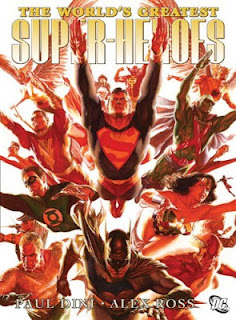
World's Greatest Super-Heroes by Paul Dini and Alex Ross[Guest reviewer Zach King blogs about movies as The Cinema King]

I've spent the past few months looking at DC's newest version of the "Greatest Stories Ever Told" trades, which sought to collect the best and the brightest of DC's most iconic characters. As far as iconic goes, though, you could do worse than Paul Dini and Alex Ross, the creative team behind The World's Greatest Super-Heroes, which collects the pair's six oversized graphic novels on top DC characters facing real-world problems.

While The World's Greatest Super-Heroes isn't a part of the twelve-book "Greatest Stories" series proper, both projects seem similar -- collect in one volume a snapshot of the characters that encapsulates the heart of who they are and why they're heroes. The latter is especially significant; aside from fleeting references, there's not a super-villain in the whole book.

Instead, each tale finds a hero faced with an everyday threat like hunger or poverty or just loneliness; these are stories, beautifully rendered by Ross's photorealistic paints, that recall the Norman Rockwell-esque "day in the life" chapters of Geoff Johns's JSA, catching the heroes on their more low-key days and positing interpretations so down-to-earth that they'd fit right at home in the hyper-realist Nolanverse.

The style of each is the same, with the stories functioning more like picture books than comics. Panel divisions are subtle and infrequent, allowing Dini's internal monologues to meander over Ross's lush artwork. It's not inconceivable to picture reading this book to a child before bedtime, and indeed some day I plan to do precisely that. Even for adults, though, there is much to enjoy in this surprisingly earnest and delightfully iconic book.

The sum of the parts being more than the whole in this series, let's take a look at what's inside this volume.

Superman: Peace on Earth (1998)

How else do you begin? One of my most treasured Christmas presents many years ago, Peace on Earth finds Superman recognizing the disparity between Christmas as a time of giving and the world as a place of great need. With the means to feed the entire world, Superman sets out to end world hunger. Tragically, it's a story that we know is doomed to failure, for the same reasons that Superman could only arrest Hitler and Stalin "out of continuity" in the pages of Look magazine. But it's also a familiar storyline, since we've seen Superman wrestle with his inability to do everything almost since his origin. What makes the story succeed isn't any originality of purpose but rather the compelling and earnest narration Dini writes for Superman; the prose passages which pepper Ross's paintings strike a proper balance between godlike Superman and humble Clark Kent, and we feel his shortcomings just as tangibly as we revel in his triumphs. The book is filled with new classic moments like Superman's descent from the sky with a Christmas tree balanced on his shoulder, and it's to Dini and Ross's credit that these moments never feel campy or anything less than genuine. Peace on Earth succeeds further by reminding us that the value of a superhero lies not in what he does but in what he motivates us to do; Superman's Christmas gift to us, in line with Grant Morrison's concept of Superman as the Ideal Man, is the example he sets.

Batman: War on Crime (1999)

If I had to list my top ten Batman stories from any medium, much of that list would include works authored by Paul Dini. Although I love Christopher Nolan's "Dark Knight Trilogy" to death, Dini's work with the character (both on television and in the comics) seems to touch something closer to the character's central nature, with every story being recognizable Batman-fare. War on Crime is a quintessential distillation of what I believe is the heart of Batman -- the pain of loss and the determination to prevent others from feeling that loss (as distinct from, say, Nolan's interpretation of Batman as a symbol to inspire positive change).

Aside from one-panel cameos from Alfred and The Penguin, Batman is the only recognizable face in this story, and his narration anchors the story in a voice which is clearly pained but with grim optimism coloring his action. Dini wisely keeps the action small, with Batman struggling against local crime and waging a battle for a young boy's soul in the process; it's a story that works well because of how uncompromisingly good Batman's quest is as he pauses mid-battle to offer a kind word of encouragement to a young man who has also lost his parents to gun violence. Alex Ross makes expert use of the shadows here, judiciously deploying streams of light to accentuate the hopefulness which is inherent in Batman's mission. Ross's photorealistic shadow play matches perfectly the tone of Dini's script, but Ross also does great work with Bruce Wayne out of the costume, making Bruce Wayne as much of a commanding presence as his cape-and-cowled alter ego.

Shazam!: Power of Hope (2000)

At first, the writing in this story seems odd, overly enthusiastic with too much gee-whiz for my tastes. But when a full-page splash reveals that the story is narrated by Billy Batson and not Captain Marvel (the hero currently known in the New 52 as the somewhat more cynical Shazam!), Paul Dini reveals that he's playing with narrative voice in a way the series hadn't seen before. And it's to great effect; the childlike exuberance of Captain Marvel's narration gives the story more weight when Captain Marvel volunteers at a children's hospital to restore hope. It's a story that probably wouldn't work were it not for Dini reminding us that Captain Marvel is still essentially a child.

Surprisingly, and to the story's credit, Alex Ross creates a Captain Marvel that is leaps-and-bounds more approachable than his Kingdom Come rendition of the character. His heavy eyebrows and wide grin carry none of the malice of brainwashed alternate future, instead posing like a child in front of a mirror after a muscle man marathon. Billy, however, sometimes looks too old, which takes some of the thunder (no pun intended) out of the shift in identity. The transformation scenes are staggering, however, and it's difficult not to feel a tugged heartstring or two when Captain Marvel realizes that he can't save everyone but can share the gift of hope with all.

Wonder Woman: Spirit of Truth (2001)

The fourth Paul Dini/Alex Ross pairing is somewhat stronger than the Captain Marvel one, in part because Wonder Woman's a more potent character with a clearer mission. Her role as "ambassador to man's world" has sometimes been a nebulous one, but Dini takes full advantage of it with Diana as a kind of goodwill tourist, assessing the world's problems from the vantage point of the disadvantaged. The character's compassion and dedication to the powers of good are so compelling that it's almost a disappointment when Clark Kent shows up, as if to say that Wonder Woman can't carry a story on her own. It's entirely untrue; her quest is more intriguing and more realistic than most in the book, and Ross's artwork steps up to match. His Wonder Woman is beautiful and majestic, the scenery striking, and her goals for humanity attainable. While I'm impressed with the "daughter of mythology" approach that Brian Azzarello and Cliff Chiang are bringing to the New 52 incarnation of the character, I didn't realize how attached I was to this version of Wonder Woman, and I'm glad to have such a nutshell encapsulation delivered by such able creators.

JLA: Secret Origins (2002)

It's a bit difficult to review this chapter as a separate entity, since it's equal parts warm-up for Liberty and Justice and two-page origins for the characters who didn't get their own solo books: The Flash, Green Lantern, Aquaman, Martian Manhunter, Green Arrow, Hawkman, The Atom, and Plastic Man, as well as a few second-stringers lumped in on a JLA origin page. They're concise and effective, but none is truly distinctive, aside from the Plastic Man page which plays with voice in the same way that Power of Hope did. That these are not distinctive is not a knock on the quality, however, but the Dini/Ross team has been turning in consistently good work throughout this volume, and Secret Origins is no exception.

JLA: Liberty and Justice (2003)

Surprisingly, and unfortunately, Liberty and Justice is the one book in this volume that never really works. In part, it's because the format is substantially different from the others; instead of relying on the interaction between narration and silent panels, Liberty and Justice is structured much more classically, with traditional speech bubbles competing with the narration boxes for attention. The result is that it's harder to focus on Alex Ross's gorgeous artwork; after a whole book of his work, I was eager to see his Justice League in full force, but too many overfull panels prevent the full effect from being felt.

What's more, we know that a Justice League needs a large threat to combat. What we get here is an odd plague which seems sinister and extraterrestrial but which disappointingly never manifests itself as anything more than a stubborn space flu. We don't, for example, get the Starro combat promised by the back cover; instead, it seems that the League is called in, overreacts, and then moralizes about their actions to a hostile United Nations. There are plenty of wonderful moments, as when Superman saves a suicidal jumper (anyone who knows me knows I'm a sucker for these kinds of moments, as in All-Star Superman or Young Justice), and it's not that the story is a dull read. But it's a disappointing note on which to end the book, two great creators who are turning work that is somewhat less than.

The World's Greatest Super-Heroes is padded out with pages from Alex Ross's sketchbook, most interesting when it details his process of photo referencing with shots of his models, and the book concludes with a few luscious gatefolds that this collector was too timid to tear out. It's a delightful package, a fantastic coffee table book on the order of Ross's Mythology, and despite its anticlimactic ending, it's a wonderful read.

I had purchased this book when the word "Flashpoint" was just another teaser word that signified another crossover I probably couldn't afford. But now that we're more than a year into the New 52, it's difficult to read this trade without your glasses seeming a little rosier. Love it or leave it, this interpretation of these characters is a thing of the past, and I can think of no better send-off than The World's Greatest Super-Heroes, a loving tribute by two master craftsmen.

This concludes the "Greatest Stories" series, but fear not -- I'll be back with more Criminal reviews and more very soon. Thanks as always to our gracious host and to the readers who've been following along!

More Greatest Stories reviews: Superman Vol. 1 and Vol. 2, Batman Vol. 1 and Vol. 2, Wonder Woman, Green Lantern, Flash, Justice League, Shazam, Batgirl, Superman/Batman, and Joker.
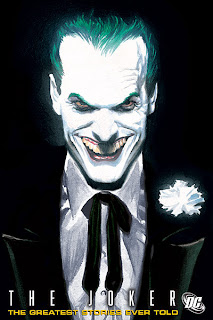
The Joker: The Greatest Stories Ever Told[Guest reviewer Zach King blogs about movies as The Cinema King]

Up to this point, the "Greatest Stories" series has profiled the best and brightest of the DC Universe. But when the series takes a turn toward the villainous, it's in many ways appropriate that DC's most iconic villain gets the "Greatest Stories" treatment in The Joker: The Greatest Stories Ever Told.

Perhaps even more so than with Batman, it's a bit difficult to assess what makes a Joker story "great" since I'm a staunch proponent of Grant Morrison's theory that The Joker is "super sane," reinventing his personality almost every day; as such, it's not hard to reconcile a Joker who builds sandcastles with a Joker who guns down Barbara Gordon.

But perhaps it's just that the relationship between The Joker and Batman is (literally) so black-and-white that it's difficult not to create an interesting match-up between the two. As for the contents of this volume, it's safe to say that each story in here is significant in one way or another; there are no real duds, and readers new and familiar will get a strong sense of who this character is -- just in time for Scott Snyder's big Joker story "Death of the Family" over in the New 52's Batman title.

The sum of the parts being more than the whole in this series, let's take a look at what's inside this volume.

"Batman Versus the Joker" (Batman #1, Spring 1940): It's no surprise that we begin with The Joker's first appearance, but what is surprising is just how fully formed the character is While The Joker's creation has been a point of contention for Batfans, writer Bill Finger and artist Bob Kane both craft a dynamite introduction to the character who has, aside from a goofy period in the Silver Age, remained mostly unchanged. The story's formula is familiar -- Joker vows to kill prominent Gothamites -- but its familiarity points to its influence on numerous adaptations (including The Dark Knight and an Steve Englehart remake reprinted later in this anthology). Kane's Joker is more morose and of somber countenance than readers might be prepared for, but he's never unrecognizable as Batman's greatest foe.

"The Joker's Comedy of Errors" (Batman #66, August/September 1951): Here might be the weakest story reprinted in this collection, because it doesn't seem to have been chosen for its importance to The Joker's character -- there's no "first" in this story, nor is his plot against Batman and Robin particularly compelling. No, it seems the editors chose this story because of its popularity on the Internet for its repeated use of the word "boner." Of course, the word meant something entirely different in 1951, but that doesn't stop the occasional snicker -- even from this reader, who usually considers himself above toilet humor. Finger's plot is overly involved, and Lew Schwartz's art stockier and cheekier (literally, The Joker's cheeks are huge here) than most, but the tale is ultimately not a terrible one. It's just that the editorial insight here seems sophomoric at best.

"Joker's Utility Belt" (Batman #73, October/November 1952): The story begins with a full-page teaser splash by Dick Sprang, in which Batman and Robin are menaced by perversely large Joker heads springing from an oversized utility belt. It's one of the most iconic Joker shots ever drawn by one of the definitive Joker artists, and the story by David V. Reed introduces a gimmick that, while abandoned in later stories, amps up the dark mirror in which The Joker reflects Batman. The story is cleverer than I was expecting, finding unique ways to utilize the bizarre gags that pack The Joker's utility belt. And while I've lamented the fact that this series doesn't reprint full covers, the inclusion of the hydra-like Joker's belt is "great" enough.

"Crime of the Month Club" (Batman #110, September 1957): Dave Wood and Dick Sprang take The Joker into new territory with this story, which casts the Clown Prince of Crime as a criminal consultant, auctioning off his master plans to the highest bidder. The premise is intriguing and given sufficient attention despite the brevity of the story, and it plays up one of my favorite Joker traits -- he always has a back-up plan. This is no "dog chasing cars," but rather the master strategist he always lies about being. Sprang's art again is classic and cements the angular grin which is The Joker's trademark.

"Joker's Last Laugh" (Detective Comics #332, October 1964): It's hard to believe that The Joker's signature laughing gas wasn't introduced until 1964, but here it sees first light -- this time as a powder which is (spoiler warning) easily defeated by a strong antihistamine prescription. While Sheldon Moldoff's pencils here are less compelling than Sprang's (indeed, Sprang is a tough act to follow), he's quite good with facial expressions, a key skill to have in a story where characters frequently erupt into spontaneous laughter. And the story also includes the rotating jail cell gag, which sums up The Joker's whole relationship with law enforcement but also raises serious questions about the security of Gotham's police station.

"The Laughing Fish" / "Sign of The Joker" (Detective Comics #475-476, February -- March 1978): If we're excluding The Killing Joke (if only for reasons of length) and Mad Love (on the grounds that it's more a Harley Quinn story), this might be my favorite Joker story of all time, so I'm elated to see it included here. It's easily the "Hey Jude" of Batman/Joker stories, because it's included on every top list and performed at every available opportunity. I gushed at length about this Steve Englehart and Marshall Rogers story in my review of Batman: Strange Apparitions, but it bears repeating that these are near-perfect stories, even thirty-some years later. Here is The Joker's dead-serious attempt to copyright fish, his trademark entrance in a stretched panel surrounded by laughter, and his spooky and dogged pursuit of the copyright officials. But it's also a great Batman story, giving us a snapshot of the Dark Knight's life at this time, as well as providing a look at the state of Gotham City as a whole. The story echoes The Joker's debut with a series of announced homicides, and its adaptation into an episode of Batman: The Animated Series only reverberates its iconic and greatest nature. It's a story that every Batfan needs to read.

"Have a Dreadful Birthday, Mr. Joker" (Batman #321, March 1980): After "The Laughing Fish," any story might feel like a comedown, and unfortunately for Len Wein and Walter Simonson such is this case with "Dreadful Birthday." It's not that it's a bad story; there's no shift in tone with the oversized (notice a trend?) birthday cake to which The Joker's hostages are tethered like candles, and the exploding boat finale is probably the most familiar version of the classic "We haven't seen the last of him" trope. It feels familiar, but it might just be a chicken-and-egg case of a spot-on distillation of this kind of story. What's more, Simonson's Joker is a wonderful interpretation, even more elongated than Rogers's, if it can be believed. While I may be sad that we didn't get anything from The Joker's solo series, the inclusion of Simonson in this story might atone for that.

"Laughter After Midnight" (Batman Adventures Annual #1, 1994): Throughout this series of reviews I've been clamoring for more representation from the DC Animated Universe, so it's wonderful to see that interpretation of The Joker represented here. I've long contended that the Dini/Timm approach to The Joker is the best and most accurate in any media adaptation -- even including Heath Ledger's wildly original Joker -- and it's telling that I still hear Mark Hamill's voice in my head when reading this and every other story in the collection. This story finds The Joker making his way home after yet another ignominious defeat at the hands of the Caped Crusader. John Byrne apes the style of the DCAU so cleanly that I had to double-check the artist wasn't Bruce Timm. It's a great story, one that I missed in my days reading the original series, but it's also a perfect peek into the odd blend of dark humor and deadly evil that made this interpretation of The Joker so beloved -- and so great.

"New Year's Eve" (Batman: The Long Halloween #4, March 1997): One of the earliest Joker stories in the post-Crisis canon (being that The Long Halloween is essentially "Year Two," only The Man Who Laughs is earlier for my money), this story combines many of my favorite characteristics of a Batman story: a dead serious Dark Knight, an eccentric Joker with a lethally insane plan, Jeph Loeb's writing, Tim Sale's art, and snow. While the whole issue isn't reprinted, the parts relevant to the collection unite seamlessly, such that you'll be hard-pressed to find the edits without a copy of the original on hand. Sale takes The Joker's facial elongation to its absurd nadir, such that The Joker's chin dangles near his navel by the end of Dark Victory, but it fits within the cartoonized world of the story; Batman is similarly exaggerated, muscular beyond plausibility but unmistakeably our hero. Considered by many a definitive Batman story, The Long Halloween does justice to The Joker and ought to encourage readers who had never read it before.

"Case Study" (Batman: Black and White, Volume 2, 2002): Ah, Alex Ross -- it's been a while since we saw you around these parts. Here Ross teams up with Paul Dini for a classic Joker origin story -- classic in that it's entirely plausible but probably not true. Riffing on Batman '89, Dini and Ross cast pre-chemicals Joker as a cunning and ambitious mobster whose last days as The Red Hood only made him more audacious. It's a nice nod to The Killing Joke, too long to be reprinted here but undeniably worthy of the "Greatest" appellation, but Dini puts a new "multiple choice" spin on Joker's possible origin, which is too clever to spoil. Ross's artwork is, as ever, stellar, even in black-and-white; his Joker reminds me of Jack Nicholson, which couldn't be less of a bad thing.

"The Joke" (Batman #614, June 2003): It's been said that Batman: Hush, of which this is the seventh chapter, is a retelling of all the iconic Batman moments in one epic story. If that's the case, "The Joke" represents the moral issue at the heart of the Batman/Joker conflict: Should Batman kill The Joker? Writer Jeph Loeb uses his internal narration style to its maximum potential here, stepping inside Batman's head as he beats The Joker near death; using Batman's memory to cycle back to some of The Joker's most notorious moments. It's a tidy package that interrogates what separates Batman from The Joker, but as an entry in this collection it also encompasses stories (i.e., The Killing Joke and A Death in the Family) that were too long to be included but still immensely significant. And the superstar artwork by Jim Lee doesn't hurt, either; Lee plays with shading and line thickness to emphasize the emotional shifts between memory and reality. As a part of one of my all-time favorite Batman stories, "The Joke" is also a wonderful summation of this complicated relationship.

"Slayride" (Detective Comics #826, February 2007): After fully exploring the Batman/Joker dynamic in "The Joke," Paul Dini returns to the writer's chair with "Slayride," another Christmas story in which The Joker abducts Robin Tim Drake and holds him captive during a series of brutal holiday crimes. Don Kramer's artwork in particular stands out for how well he makes The Joker look insane and evil without compromising his more clownish features. Dini is the master of the one-and-done Batman story, having honed his craft on The Animated Series, and this story is both thrilling and unforgettable; it's not difficult to picture this as an episode of the cartoon, although it's more violent than fans of the show will expect. It is, however, a great note on which the book can close, showing us what The Joker is like in the modern era -- still spooky and still uncomfortably funny.

Up to this point, Shazam! The Greatest Stories Ever Told was probably my favorite "Greatest Stories" collection, with Superman/Batman: The Greatest Stories Ever Told as a successful close second, with neither book wasting a story and instead presenting a highly canonical approach to the character's (or team's) history. But now I'm almost certain that The Joker: The Greatest Stories Ever Told is my new favorite, in part because the character is so strong but also because the editors have really done a bang-up job acknowledging every major interpretation of the character while providing each of his most significant moments without reprinting some of his longer appearances.

Indeed, I can't think of a story that's missing, no glaring omissions that got short shrift here; the only major story absent is the O'Neill/Adams tale "The Joker's Five-Way Revenge," but that's reprinted over in Batman: The Greatest Stories Ever Told, Volume One. I can't kvetch about the DCAU not being represented, since the editors rightfully recognize that The Joker, more than anyone, became a star at the hands of Dini and Timm; on that note, though, I might have liked a bit more Harley Quinn in this trade, since she only appears only peripherally in three small appearances here. And the Grant Morrison fan in me can't help but wonder why "The Clown at Midnight" didn't make the cut, although it's either too weird or too recent to merit inclusion.

All told, The Joker: The Greatest Stories Ever Told is as near to perfection as this series ever came, hitting all the important beats without wasting pages on unrewarding stories. It's a first-rate primer on the character -- exactly what I wanted from this series -- and it's excellent for all readers who want to know what The Joker is really all about. Just don't gaze too hard into the abyss, lest ... well, you know.

We've reached the last of the official "Greatest Stories" collections, but there's one more entry in this review series. No, it's not a post full of my complaints about missing stories. For the final entry in this series, I'll be reviewing The World's Greatest Superheroes, a collection of the oversized Paul Dini/Alex Ross OGNs which seems to fit nicely as a coda to the "Greatest Stories" line. Stay tuned!

More Greatest Stories reviews: Superman Vol. 1 and Vol. 2, Batman Vol. 1 and Vol. 2, Wonder Woman, Green Lantern, Flash, Justice League, Shazam, Batgirl, and Superman/Batman.
Superman/Batman: The Greatest Stories Ever Told[Guest reviewer Zach King blogs about movies as The Cinema King]

Say what you want about DC's Trinity or the Big 7, but for my money the superhero team-up tradition that started with the Justice Society of America reached its logical apex when Superman finally met Batman nearly fifteen years after they debuted on the scene. Though their relationship has changed significantly since the Silver Age, this partnership is enough to make your average comics fan say, "Avengers, schmavengers."

Published in the midst of the highly popular team-up series that began with Jeph Loeb and Ed McGuinness's "Public Enemies" arc, Superman/Batman: The Greatest Stories Ever Told seeks to gather the best of the Man of Steel and the Dark Knight. And perhaps fittingly for a book centered around the World's Finest, this trade is one of the best in the series, hitting all the important notes and serving as a strong primer for what this partnership has looked like over the last 60 years. While some of the stories haven't aged very well, each justifies its own inclusion beyond the one-page introduction, and none is a wasted reading experience.

The sum of the parts being more than the whole in this series, let's take a look at what's inside this volume.

"The Mightiest Team in the World" (Superman #76, May/June 1952): Where better to begin than at the beginning? It's hard to believe it took almost fifteen years for Superman and Batman to cross paths in a shared universe, but Edmond Hamilton's script doesn't worry about why they've never met before. Indeed, the story doesn't worry much about how they meet; the gimmick with an illuminated porthole revealing secret identities is a stretch, but it lets the story focus on the working relationship that forms quickly between the two. The story's iconic nature is aided by the always-capable pencils of Curt Swan, and the wonderful concept is executed so well that it's telling to see the story paid homage fifty years later at the end of this collection (more on that in a bit).

"Superman's and Batman's Greatest Foes" (World's Finest Comics #88, May/June 1957): After the World's Finest teamed up, it was only a matter of time until the World's Foulest -- Lex Luthor and The Joker -- did so as well. Hamilton's back on story duty, and this one is a bit more paint-by-numbers than its predecessor: Lex Luthor and The Joker wreak nefarious mischief by pooling their resources, confounding the World's Finest by seemingly going legitimate and inventing cybernetic Mechano-Men. Though the story doesn't break new ground like its predecessor, kudos to Hamilton for keeping me guessing on what the two were actually up to. Dick Sprang's artwork is more cartoony than Swan's, especially his Joker's elongated face and brutally high shoulders. Ultimately it's an important story, and a well-told one, at that.

"The Composite Superman" (World's Finest Comics #142, June 1964): Hamilton and Swan (the World's Finest in this collection?) reunite to create the foe who is most recognizably a Superman/Batman rogue, The Composite Superman -- half Superman, half Batman, and with all the powers of the entire Legion of Super-Heroes. Coming from a reader who was only aware of the Composite Superman as the large rocket built by Hiro Okamura in Superman/Batman: Public Enemies, finding out the "secret origin" (as it were) of this character was a real treat. The story isn't entirely successful, relying a bit too much on keeping the audience in the dark in a ham-fisted kind of way, and while the conclusion falls a bit flat, the introduction of the character is iconic in its own right and serves as required reading for any Superman/Batman aficionado.

"The Cape and Cowl Crooks" (World's Finest Comics #159, August 1966): I imagine one of the hardest challenges in a superhero team-up is finding a foe worthy of a combined effort; The Avengers had to go intergalactic with Loki and the Skrulls Chitauri, but in this story Hamilton and Swan go for the hat trick with the Anti-Batman and Anti-Superman collaborating to . . . well, it's not really clear what they're after. They deliver toys to the prisons of Metropolis and Gotham, and they lead the World's Finest on a merry chase, but they're not a major threat. The visual gimmick of wearing modified costumes of their opponents probably locked them into this collection, but the ending is, like most Silver Age stories, extremely predictable and more than slightly gimmicky. This is really the only story that doesn't work on at least some level, and one wonders if there's more potential in these two characters than is employed in this one-off.

"The Superman-Batman Split" (World's Finest Comics #176, June 1968): I've no doubt that this story is in the collection because it's illustrated by Neal Adams, arguably the artistic master of the post-Silver Age DC Universe. It's unfortunate, then, that the editors chose not to reprint the original artwork but opted instead for Adams's more recent altered versions, which are inked more heavily and with less grace than the originals (there are, interestingly enough, entire sites dedicated to scanning unaltered Adams artwork). The story by Cary Bates, in which multiple aliens split the allegiances of Superman and Batman, isn't entirely engaging; its major twist is a touch predictable, but it's great to see Batgirl and Supergirl joining the World's Finest with Robin and Jimmy Olsen for a regular Justice League of Awesome. The story is infectiously fun and multiplies the action -- a trend I've noticed throughout this volume -- but I can't help but feel that the original inks by Dick Giordano have been distractingly overwritten to the detriment of the reader.

"A Matter of Light and Death" (World's Finest Comics #207, November 1971): This story posits an interesting question -- can Batman stop Clark Kent from taking out a hit on Superman? It's a head-scratching premise by Len Wein, who pitches an incredibly original concept in this story, and even though the execution is a bit too protracted to be truly exciting, the central mystery will likely keep readers engaged. (Pay very close attention, though; the answer of why Clark Kent wants Superman dead is delivered in one quick panel in the midst of a long monologue.) Dick Dillin's artwork is effective but didn't distinguish itself to my eye the way that Adams or Swan did earlier (or Byrne and Sale, later). While the master villain is difficult to take seriously in a post-mindwipe world, the threat posed to Superman is tangible enough that Batman's involvement feels invaluable.

"One Night in Gotham City" (Man of Steel #3, November 1986): Now this is what I'm talking about. When I started reading comics, this was my first Batman/Superman team-up, and its inclusion here is practically a given. As an older reader, I realize now just how hard John Byrne is working to distance the post-Crisis World's Finest from the Silver Age's "super best friends" approach (including a cute wink at being friends "in a different reality"), but Byrne's efforts pay off in this creation of a new and starkly original take on the world's greatest partnership. Superman is, if it can be believed, more earnest than ever, and Batman is shady and suspicious without being the distrustful caricature that appeared in most post-No Man's Land tales. The art, too, is elegant, bespeaking just how influential Byrne's Superman reboot was to the pre-Flashpoint DC Universe. Heads up, Warner: if there's to be a Superman/Batman film after Man of Steel, "One Night in Gotham City" is the perfect place to start.

"A Better World" (Batman & Superman: World's Finest #7, October 1999): This story, written by Karl Kesel and illustrated by Peter Doherty, was part of a maxiseries (I still remember the in-house ads from monthlies at the time) which placed the post-Crisis World's Finest at important moments in DC continuity; here we check in just after Superman returns from Exile and while Batman mourns the death of Jason Todd. It's a time of quiet and reflective transition for both heroes, with each pondering the nature of their "no killing" rule, and Kesel nails the tense dynamic between two men who are too strong to admit how wounded they are but who know they can rely on each other for support without asking. The art by Doherty is a little weird; Bruce and Clark's faces look too similar out of costume, and a panel with The Joker looks like a bizarre comical anticipation of Lee Bermejo's Joker. But Kesel's script is the draw, finding compelling dialogue between the two with nary a super-crisis in sight. After reading this story, I'm sorry to see it's so hard to find; hopefully it's in the reprint rotation over at DC, especially after the Dave Gibbons miniseries of the same name was recently reprinted.

"When Clark Met Bruce" (Superman/Batman Secret Files 2003): It'd be blasphemy not to include anything from Jeph Loeb's run, and this one-off two-pager introduces Loeb's narration style over a story about how young Clark Kent almost met young Bruce Wayne. It's a storyline comics have always flirted with -- Jor-El met Thomas Wayne in a later issue of Superman/Batman, while Clark met Bruce after winning some kind of 1920s contest in Generations -- but this story, illustrated by Tim Sale in top Superman for All Seasons mode, demonstrates just how far apart these two men began life; it's sold by some great coloring by Mark Chiarello. While it might be a bit of a surprise pick, considering how important much of Loeb's Superman/Batman work was to continuity, it's a small treat which puts a different spin on the World's Finest.

"Stop Me If You've Heard This One . . ." (Superman/Batman Annual #1, December 2006): The book closes with a retelling of "The Mightiest Team," recasting Superman and Batman's first meeting aboard that cruise ship as a high-stakes multiversal assassination scheme, with the Crime Syndicate, Deathstroke, and . . . Deadpool? Joe Kelly and a jam session of artists spend so much time winking at continuity and company crossovers that it's difficult not to have a little bit of fun, and having just read the story on which this is riffing the reader gets even more out of the experience. While the story is almost assuredly out of continuity, the tone Kelly sets never lets that be troubling; in fact, the revelation of just how this story "happened" is a real crowd-pleaser. In short, it's a fun way to end the book and show us just how far these two have come since their "first meeting."

If there's one thing true about comics fans, it's that we can always find something to complain about. With that in mind, there are a few stories that might have been included here -- or which could comprise a second volume. Segments from The Dark Knight Returns or Kingdom Come could prove interesting in relation to Byrne's "One Night in Gotham City." I'm partial to the team-up from The Batman Adventures #25, in which the "Super Friends" take down Maxie Zeus and ginger clone Lex Luthor, and the precedent set by the Shazam! collection makes it not unfeasible. And even though I knocked the Trinity in my introduction, there's probably room for a Trinity story in here showing how Wonder Woman's presence affects the dynamic between the two.

But if my biggest complaint about the volume is that there's more good stuff out there, the editors have done a rather fine job, particularly because it makes me want to read more rather than just complain about what I don't have; indeed, I'll be first on the pre-order list if DC decides to release a second volume. Unlike many of the collections in this series, Superman/Batman: The Greatest Stories Ever Told benefits from a strong historical focus and hits all the major iconic moments. It's a great read for fans old and new, especially in light of the success of that other superhero team-up from last summer.

Next time around, justice takes a holiday as the Clown Prince of Crime steals the stage in The Joker: The Greatest Stories Ever Told. Stay tuned!

More Greatest Stories reviews: Superman Vol. 1 and Vol. 2, Batman Vol. 1 and Vol. 2, Wonder Woman, Green Lantern, Flash, Justice League, Shazam, and Batgirl.
[Guest reviewer Zach King blogs about movies as The Cinema King]

After Superman got his sequel, Batman's back with Batman: The Greatest Stories Ever Told, Volume 2. You'll recall the first volume was something of a success for me, with a strong Bruce-or-Batman theme holding the book together, and in some ways a second Batman book is more unsurprising than the second Superman volume.

Unfortunately, Volume 2 doesn't have a strong unifying hook like the question of his identity in Volume 1. What the book does have, however, are a few odd editorial choices (a recurring problem with this series) but many very good stories that, while not first choices for "greatest," still prove entertaining reads for the discerning Bat-fan.

The sum of the parts being more than the whole in this series, let's take a look at what's inside this volume.

"Secret Origins Starring the Golden Age Batman" (Secret Origins #6, September 1986): Rather than simply dive in like the second Superman trade did, and rather than reprint the first origin story -- and recognizing, perhaps, that Year One is unexcerptable -- the editors choose this offbeat tale which delivers the origin of the pre-Crisis Batman of Earth-Two. Roy Thomas selectively retells the first Batman stories, playing up Bruce Wayne's theatrical training and his love affair with Julie Madison; the update works, retaining some of the original lines (especially my favorite, "A fitting end for his kind") with Marshall Rogers lending decidedly more modern artwork to this strong retroactive origin story. Smartly distinguishing itself from Year One, "Secret Origins" is a surprise but ultimately wise choice to open the book.

"Professor Hugo Strange and the Monsters" (Batman #1, Spring 1940): The stalwart of Arkham City, Hugo Strange, makes his first appearance in this story, which is a good representative sample of Batman's Golden Age -- evil scientists, horroresque beasts, Batman's own inventive gadgets, and the Dark Knight's cavalier attitude toward killing his foes ("He's probably better off this way"). Bill Finger's story is still entertaining but doesn't quite live up to the Matt Wagner remake Batman and the Monster Men, in part because Bob Kane's artwork, while stubby and unrefined in a nostalgic way, is crammed into panel structure that is both puzzling and frustrating. Additionally, the story isn't quite fulfilling because it ends on a cliffhanger, but as a first encounter with one of Batman's greatest foes the story almost makes up for its faults.

"The Career of Batman Jones" (Batman #108, June 1957): This is one of my favorite Silver Age stories, and whenever a friend balks at my idea to name my firstborn son "Batman" this is the story I cite. Recently reintroduced to pre-New 52 continuity in Battle for the Cowl, Batman Jones decides to take up his namesake's crusade against crime and actually gets in a bit of training with the Caped Crusader and Boy Wonder. While Finger's story wraps a bit too quickly for my tastes, Sheldon Moldoff's artwork is quintessential Silver Age, with wide eyes, dimpled cheeks, and strong shoulders. It's almost a shame that this character was only used this once, since the story is so enjoyable.

"Prisoners of Three Worlds" (Batman #153, February 1963): If only because it wasn't included in The Black Casebook, I'm grateful to see this reprinted, and it's a good counterpoint for "Robin Dies at Dawn," which was included in the first Batman volume, in that both are (ostensibly) Batman's most famous encounters with the Silver Age's extraterrestrial population. While the science behind this story is tricky at best (I had a difficult time tracking which space-rays did what to whom), the concept by Bill Finger is intriguing and literalizes the mind/body dynamic examined in the first trade. What this story is most remembered for is likely the emotional moment between a dying Batman and Batwoman; though it's brushed away by a rather sexist final panel, Grant Morrison wasn't wrong in picking up that there was certainly something deeper with Kathy Kane. A hokey story, but saved in its earnest execution.

"How Many Ways Can a Robin Die?" (Batman #246, December 1972): Unfortunately, this Frank Robbins tale is rather forgettable, such that I forgot, in writing this review, that it wasn't "Robin Dies at Dawn." The inclusion of this story in this volume seems to be a kind of wink/nod at the perennial peril in which the Boy Wonder has been placed over the years. Here Batman is tricked into chasing wax dummies of Robin into death-traps, but the villain is never quite compelling, nor is his plot ultimately intelligible. A better choice might have been "Daughter of the Demon," a similar Robin-in-danger story which introduced a certain Demon's Head to the canon.

"The Batman's Last Christmas" (The Brave and the Bold #184, March 1982): I mused in the last review that Batman seems oddly at home in Christmas stories, and here the editors test that theory again but layer on a multiversal wrinkle by teaming Batman with the Huntress of Earth-Two, his own daughter/niece (however you want to reconcile their relationship). While it's an interesting idea to team these two, the case they investigate is overly complex but with a surprisingly simple answer; the real problem is that this doesn't quite feel like our Batman. He doesn't mind being called "Uncle Bruce" while taking down a mugger (shouldn't this be a superhero faux pas?), and he quits the heroing game without investigating claims of his father's corruption. While the Jim Aparo artwork is strong, Mike Barr's story never quite catches on, but then I was never a fan of Year Two either.

"All My Enemies Against Me!" (Detective Comics #526, May 1983): If the Batman "Greatest Stories" trades have seemed a little light on the famous Rogues Gallery, this oversized story more than atones for that sin of omission (as does the fact that The Joker gets his own Greatest Stories volume). Orchestrated by The Joker (and writer Gerry Conway), all your favorite rogues team up to take down Batman once and for all. Really, other than Ra's al Ghul and any character created post-1983, they're all here. At first, it seemed that would be incentive enough to include this as a "Greatest Story," but the story quickly becomes more important once you realize that the young boy helping the Bat-family is Jason Todd ...  and his parents are the ones spying on Killer Croc. Don Newton's artwork is gritty but a real treat to see what he does with each of the villains. "All My Enemies" is a surprise inclusion, one that probably wouldn't have made my personal list, but it's one I'm more than happy to have in my collection now.

"Of Mice and Men" (The Batman Chronicles #5, Summer 1996): I'm a fan of Alan Grant's work and Scott McDaniel's art, but there's something about this story that never quite feels right. Here we have Alfred bonding with a young Bruce Wayne over -- what else -- comic books and what it means to be a hero. But there are problems; Alfred is too glib about his calling, and Bruce's pivot from last angry boy to champion of the oppressed never feels natural. While it's not a bad idea to include stories where Bruce Wayne is the ostensible star (last volume did it quite well with "24/7"), there must be better stories out there than this one, which closes on a groan-worthy forced reference to the inevitable fate of the Waynes.

"Cave Dwellers" (Batgirl: Year One #4, May 2003): Here's a choice that's curious on several levels. For one, it's a Batgirl origin story, which leads me to wonder why it wasn't included in Batgirl: The Greatest Stories Ever Told. For another, Batman's a peripheral figure at best; there's even more Boy Wonder than Caped Crusader. But on one more level, the story serves as an interesting counterpoint to "Batman Jones," in that here we see how Batman has evolved from the Silver Age's avuncular father figure with a man-cave full of cool gadgets to today's highly distrustful guardian of his city who has a lethal-response training room in his basement. That said, it's asking a lot for the reader to intuit why this story and not some more apparent choice. I'm a huge fan of Batgirl: Year One, but I can't help feeling this trade would have benefited from a more Batman-centric choice.

"Citizen Wayne" (The Batman Chronicles #21, Summer 2000): Who knew Brian Michael Bendis ever wrote a Batman story? Or ever worked for DC, for that matter? Best known as the guy who reinvented Spider-Man in Ultimate fashion for the House of Ideas, Bendis remodels Batman as a Citizen Kane homage, with Wayne as Kane, and familiar faces like Jim Gordon, Dick Grayson, Selina Kyle, and The Joker filling in roles from Orson Welles's masterpiece. At six pages, the story is economically tight, and the levels of allusion demonstrate one of my favorite elements of the Batman mythos -- just how malleable the subject matter truly is, how the "idea' of Batman always works regardless of the setting.

Are these the greatest Batman stories ever told? In short, no, but then the honest-to-goodness greatest stories -- Year One, The Killing Joke, The Dark Knight Returns, and any of the long story arcs from the "triangle era" -- wouldn't fit in a single trade with other stories beside. In fact, I'm not sure that this volume is better than its predecessor; some of the stories are less memorable, and some aren't quite Batman stories. But as a "runner-up" volume, it's not all bad. There's plenty to like, although there are still a few stories I'm sorry to see didn't make the cut.

For one, I'm flabbergasted that "The Man Who Falls" is missing from these trades, since it meets all the apparent requirements -- brief, iconic, and not widely reprinted (you'll have to go to either the Batman Begins trade or Secrets of the Batcave). And after seeing the DC Animated Universe represented in other "Greatest Stories" collections, I'm sad to see no love for that era in the Batman trades, particularly since I know I can't be alone in thinking that those comics contributed to what was for me one of the definitive portrayals of the Dark Knight. It was recently pointed out to me that Jeph Loeb and Jim Lee's Hush is essentially "Batman: The Greatest Stories Ever Rewritten" with every classic Batman moment included (the fight with Superman, the death of a Robin, the moral dilemma of killing the Joker), so it's a bit surprising not to see it represented, either.

But all told, I'm a sucker for Batman stories, and so I'm inclined to give Batman: The Greatest Stories Ever Told, Vol. 2 a thumbs-up as I did with the first volume. Certainly the lack of a thematic link allows a few oddball choices to slip through, choices which might have made more sense if we'd been given an introduction to answer the question, "Why these stories at this time?" But none of these stories ever dips below the level of forgettable; there's nothing offensively bad (i.e., Lovers and Madmen) or ridiculously out-of-character (The Dark Knight Strikes Again), and even casual Bat-fans will find something to enjoy in this trade -- and I'm betting it's "All My Enemies," the surprise hit of the collection.

Next time, we get our second team-up of the series when we take a closer look at the Worlds' Finest partnership in Superman/Batman: The Greatest Stories Ever Told. Stay tuned!

More Greatest Stories reviews: Superman, Batman, Wonder Woman, Green Lantern, Flash, Justice League, Shazam, and Batgirl.
[Guest reviewer Zach King blogs about movies as The Cinema King]

The "Greatest Stories" series doubles down (or maybe goes double or nothing) with a return to Metropolis for Superman: The Greatest Stories Ever Told, Volume 2. While the first volume contained good Superman stories, you'll recall that not all were great in my estimation; none, however, were so atrocious as to leave a bad taste in my mouth.

But while a second Superman "Greatest Stories" volume is in some ways inevitable, is it any good? As before, none of the stories are flops; the editors have done a good job assembling nine entertaining reads without padding this trade with unnecessary fluff. This collection, however, contains several very puzzling editorial choices, made no clearer by Robert Greenberger's rapid-fire introduction which attempts to sum up 60 years of publication history in two pages.

The sum of the parts being more than the whole in this series, let's take a look at what's inside this volume.

"The Mysterious Mr. Mxyzptlk" (Superman #30, September/October 1944): We begin not with our hero's origin, but with the debut of his littlest foe, that bowler-wearing fifth-dimension imp whose name has been the plague of spell checkers for nearly seventy years. This is a puzzling choice, since the focus is unmistakeably on Mr. Mxyzptlk and not Supes, but the story seems to be included to make sense of the book's final story in which Mxy returns. But while it likely wouldn't be a first choice for "greatest," the story is still entertaining, representing Jerry Siegel's gift for supernatural slapstick, and it may be worth noting that much of this character hasn't changed with each retcon; Mxyzptlk's behavior, appearance, and abilities have remained consistent, and the McGurk statue gag was even used in the character's animated debut (and Gilbert Gottfried's voice rings in my head for this story, too).

"Superman's Other Life" (Superman #132, October 1959): Representing Superman's sci-fi phase, this story by Otto Binder finds Superman, at the suggestion of Batman, using his super-computer to see what would have happened if Krypton had never exploded. It's a classic imaginary tale, but it's not very thrilling since Superman continually interjects to remind us that the story is not "in continuity." While Wayne Boring's use of video screens as panels is initially inventive, it quickly becomes a distracting gimmick that never lets the reader fully enjoy the story. Indeed, the best part of this tale is not the glimpse of Krypton but the constant interjections from Batman to point out how much happier Superman's life could have been. While these moments make Batman out to be a jerk in hilariously unintentional ways, the story overall suffers from too much telling and not enough showing (a common complaint, I suppose, of the Silver Age).

"Superman's Return to Krypton" (Superman #141, November 1960): In some ways, this is a more successful version of "Superman's Other Life," making the previous story seem less successful by comparison. Siegel and Boring team up to take Superman back to Krypton's past after he accidentally flies too quickly through the sound barrier. If the inciting action seems hokey, Siegel quickly does justice to the premise by writing a story that carries emotional weight even as it reaches its inevitable climaxes. We know that Krypton is doomed and that Superman will find a way home (although the sudden resolution is unsatisfying), but Siegel fills the middle with memorable scenes that play fast and loose with the rules of time travel but ultimately give us a better sense about what Superman's past means to him.

"The Team of Luthor and Brainiac" (Superman #167, February 1964): The first team-up of Lex Luthor and Brainiac is unquestionably an important moment in Superman continuity, and Edmond Hamilton's story is engaging since he's mastered the voices of the two villains. It's a great story, but its inclusion in this volume raises two questions. First, where's Superman? The focus is understandably on the dastardly duo, but in a "Greatest Superman Stories" trade it's a bit disappointing that the Man of Steel spends much of his time powerless, unconscious, and in a Kandorian hospital. Second, the inclusion of this story (for me, at least) raises the question, where's "Whatever Happened to the Man of Tomorrow?" (Short answer: it's in DC Universe by Alan Moore.) Since Mr. Mxyzptlk gets a twofer in this volume, it's a bit of an oversight that one of the indisputable best Superman stories is missing, especially considering it's also the "last" Luthor/Brainiac team-up. Again, a solid tale, but one which may or may not be a "Greatest" Superman story.

"Superman Breaks Loose!" (Superman #233, January 1971): Everyone knows this is the one in which Denny O'Neil tried to update Superman, and most of us know it didn't stick for very long. Also collected in Kryptonite Nevermore, this story introduces Superman's new status quo, including his immunity to Kryptonite and his work as a TV reporter. Here is the kind of story I was expecting to fill these collections back when I assumed that "Greatest Stories" meant "primer on the history of the characters and what makes them tick." What can I say about this story? It's a classic, with spot-on characterization of Superman and wonderful art by Curt Swan. If I have a complaint, it's that the focus is more on changing Superman's surroundings than on how he reacts to those changes, but then I suppose as the first part of a longer arc I'll have to go to Kryptonite Nevermore for the rest of the story.

"The Legend from Earth Prime" (Superman #400, October 1984): A four-page headscratcher by Elliot S! Maggin and Frank Miller, "The Legend of Earth Prime" finds a future Metropolis discovering footage of the George Reeves Superman television show from our world (Earth-Prime) and learn the secret identity of Superman. While the premise and metafictional capacity of the story are intriguing on the surface, Maggin can't do much with them because of the space constraints. It's a more successful version of "Exile at the Edge of Eternity" from the same issue in the last volume, but it's unclear what Maggin is trying to say with this story other than elicit a chuckle from its cutesy premise and the seemingly significant wink in the last panel. Is Noah Mandell really Superman? (No Man-El?) Or am I reading too much into a story that is good but not great?

"The Secret Revealed" (Superman #2, February 1987): Scientist no more, Lex Luthor is now the industrial tycoon of the Byrne Age, but we see that his hubris remains fully intact. "The Secret Revealed" is the one where a computer deduces Clark Kent's identity only for Luthor to refuse to believe it on the grounds that no powerful being could be selfless enough to masquerade as a "mere human." The focus is more on Lex Luthor than on Superman (it would have fit better, perhaps, in the Superman vs. Lex Luthor collection), but the moments when Superman learns that Lana and the Kents may be in peril are stellar, gripping for their sentimental verisimilitude and for the effective communication of Superman's fury. A+ for John Byrne, who pens and scripts.

"Life After Death" (Adventures of Superman #500, June 1993): I think I read this single issue fifty times when I first bought it, and "Life After Death" -- in which Pa Kent suffers a heart attack but refuses to die without saving his adopted son from the funereal specters -- is still an exciting read, even excerpted from its longer narrative. Indeed, Superman titles from the "Triangle era" almost read like soap operas with expansive casts, extended story arcs, and long-form payoffs. But as a "greatest" Superman story? "Life After Death" doesn't quite make the cut. For one, Superman's dead for the whole story, and knowing what we know about his "resurrection," it's conceivable that the Superman we meet here might just be Pa Kent's imagination. What's more, the cliffhanger which leads into "Reign of the Supermen" feels out of place as the penultimate tale in this trade. This might fit in a "Pa Kent: The Greatest Stories Ever Told," but its sole virtue here is that it's a great story, Superman notwithstanding.

"Narrative Interruptus Tertiarius" (Adventures of Superman #638, May 2005): We close with a Greg Rucka story (something about which I'd seldom complain) in which Mr. Mxyzptlk weighs in on the "Man of Steel, Woman of Tissue" question by introducing Lois and Clark to their daughter from a "possible future." While the story isn't as strong as we might expect from Rucka, the art by Matthew Clark redeems the whole affair, especially when he riffs on the styles of Sin City (rendered as a spot-on satire of all Frank Miller's excesses), Calvin and Hobbes (here, a loving tribute to the style and tone of Bill Watterson), and the Dini/Timmverse (meant to convey the unselfconscious and high-flying mood of the animated series). While Superman isn't the focus of this story -- the spotlight is instead on his daughter Lara and on Mxyzptlk -- it does explore his relationship with Lois Lane in a way that no other story in these two volumes has. Especially in light of the absence of a Lois-and-Clark in the New 52, stories like this are made even sweeter by appreciation of the marriage we didn't know we'd miss.

As with much of the preceding trades, Superman: The Greatest Stories Ever Told, Volume 2 has left me uncertain about a final evaluation. On the one hand, the stories here are all entertaining and have factors which redeem their collection in a permanent form like the collected edition. As a grab-bag, this volume is successful and makes me wonder about the viability of trades that simply collect ten stories that haven't been collected elsewhere. [I like this suggestion -- kind of like what they did with those DC Comics Presents books. -- ed]

On the other hand, I would only label two of the nine stories in Superman: The Greatest Stories Ever Told, Volume 2 ("The Team of Luthor and Brainiac" and "Superman Breaks Loose" -- maybe "The Secret Revealed" as a third) as among the greatest Superman stories ever told. The rest are all either great stories with Superman in a negligible role or merely good stories with Superman. For a diehard fan like myself, the trickery of the book's title is permissible on the strength of the material therein, but for newcomers looking for more of a statement on the character, there are better places to look.  

All-Star Superman, especially issue #10 (which needs to be in Volume 3, if such a book comes to pass), is for my money the greatest Superman story ever told, but what this book -- and the series in general -- needs more than my personal favorite is a sense of purpose, a theme to link together a statement about the character of Superman.

After a mixed reaction on Superman's second anthology, next time we revisit Gotham City for the third (but not final) time in this series with Batman: The Greatest Stories Ever Told, Volume 2. Stay tuned!

More Greatest Stories reviews: Superman, Batman, Wonder Woman, Green Lantern, Flash, Justice League, Shazam, and Batgirl.
[Guest reviewer Zach King blogs about movies as The Cinema King]

After looking at some of the heavy-hitters of the DC Universe, we return to my comics hometown of Gotham City, the place where I feel most comfortable, the place where I was "born" into comics at age 3. This time, though, we're looking at a different member of the Bat-family -- Batgirl: The Greatest Stories Ever Told.

As with the Green Lantern trade, though, the title is something of a misnomer; what this volume really collects are the "greatest" Barbara Gordon Batgirl stories. A "best of" Batgirl trade ought to acknowledge that Babs isn't the only woman to don the cowl, so the omission of Cassandra Cain and Stephanie Brown is a glaring one.

What's more, the volume is slim -- only seven complete stories and 160 pages -- noticeably so in hand and on the shelf next to the other "Greatest Stories" trades. I'll kibitz more about what's not in the trade at the end of this review, but as for what we do have? It's actually a very good profile of Babs's stint as Batgirl.

The sum of the parts being more than the whole in this series, let's take a look at what's inside this volume.

"The Million Dollar Debut of Batgirl" (Detective Comics #359, January 1967): While we all know that this story was a backdoor opportunity for the campy 60s TV show to introduce Batgirl, Gardner Fox and Carmine Infantino turn in a story that still works, especially the bit about Babs as an accidental hero in what is essentially a Halloween costume (a detail nearly every other version of the character has used). Killer Moth is admittedly an odd choice for a first foe, but his pushover status lets Batgirl shine while allowing Batman and; Robin to step aside bemusedly and let her take center stage. An unsurprising inclusion, "Million Dollar Debut" still works.

"The Orchid-Crusher" / "The Hollow Man" (Detective Comics #396-397, February-March 1970): This is the only story that really falls flat in this collection. There's nothing truly "great" about this, although its uncomplicated plot allows us to see Batgirl in action without the Damoclean Sword of Continuity hanging over her every decision. What doesn't work, however, is the thinness of the procedural plot, in which Batgirl joins a dating service to track down a serial killer with a proclivity for redheads. Under Frank Robbins's script, Babs is surprisingly condescending, and the clues/red herrings are so flimsy that I had to read the story twice to figure out how the story's conclusion fit with what I'd just read.

"The Unmasking of Batgirl" / "Candidate for Danger" / "Batgirl's Last Case" (Detective Comics #422-424, April-June 1972): At first, there's nothing remarkable about this story, until Babs decides she's going to run for Congress -- and then we, the readers, realize she's going to win. Robbins begins to redeem himself here; while the story isn't particularly well-written (much of the politicking here is cliched and one-dimensional), it's much better than the previous entry, and you get the sense that this story matters. More importantly, the story gives a good sense of who Babs is, since she spends a lot of time out of costume; it might be no surprise that this storyline was published almost immediately after the O'Neill/Adams Green Lantern/Green Arrow realism road trip. And it's a mercy when Jim Gordon admits he knew his daughter's identity all along, although "Kick off, baby!" is a little too hip for my Commish.

"The Invader from Hell" (Batman Family #1, September/October 1975): Elliot S! Maggin and Mike Grell introduce the Batgirl/Robin team with an off-the-wall adventure in which Batgirl and Robin fight the revivified Benedict Arnold and his accomplice, Satan (who, Chris Sims has noted, looks suspiciously like Stan Lee). While the premise is wonky and the conclusion jingoistic at best, there's a real sense of chemistry created between the two youngsters, and the moment when they kiss is explosive. This kiss, and the story overall, really works thanks to some inventive work by Grell, who plays with panel structure and sequencing to create a dynamic reading experience. The action may be bizarre, but the longevity of the Dick/Babs relationship speaks to the emotional backbone of the story.

"Startling Secret of the Devilish Daughters" (Batman Family #9, January/February 1977): Here we're introduced to Duela Dent, and for that alone this is a significant entry in DC continuity. It's not, however, a Barbara Gordon story, although she does team up with Dick Grayson to take down Duela. The true star here is Robin, who deduces Duela's true identity with such aplomb that even the narrator can't explain it (honestly, this is more of a storytelling cheat than it sounds). Babs tangles with Duela and gets honored for her work as a Congresswoman, although her devotion to the job has already been established within this anthology, making this tale somewhat superfluous. That said, it's a fun and compelling read, even if the "startling secret" is a bit easy to predict.

"Photo Finish" (Batman Chronicles #9, Summer 1997): With "Photo Finish" we jump to a post-Crisis world for a different look at the debut of the Batgirl and Robin team. Written by Devin Grayson (surprisingly and/or disappointingly, the only woman contributing to this trade), we find Batgirl and Robin taking down museum robbers in what quickly starts to feel like a "first date." Again, the chemistry between the two is palpable, and it's not difficult at all to fall in love with either one of these crimefighters. Duncan Fegredo's art is solid here, too; while he's best known for his work on Hellboy, Fegredo does great work with facial expressions, giving vivid emotion and character to our protagonists.

"Folie a Deux" (Legends of the DC Universe #10-11, November-December 1998): We close with this Kelley Puckett and Terry Dodson story that is full of surprises. Not in the story it's telling, but in the manner in which it's told: after a long and silent opening scene, we find out how the parallel narratives are connected in a shocking visceral moment, and the story is populated with many moments of elegant emotional simplicity that hit the reader in a place they didn't know they could be touched. Indeed, "touching" is a word I'd use to describe the whole story; the difficulty Jim and Babs have in communicating with each other is telegraphed loud-and-clear to us, allowing Dodson to speak volumes for them with an arched eyebrow or a sideways smirk. "Folie a Deux" is an unqualified success, easily the "greatest" collected here.

All told, I'm of two minds on this trade. On the one hand, calling the book Batgirl: The Greatest Stories Ever Told leads me to expect some treatment of the character's legacy, which could have easily been accomplished, for example, by including the No Man's Land chapter where Helena Bertinelli passes the torch to Cassandra Cain, or by including any of the Stephanie Brown appearances (she'd been Batgirl for more than a year before this trade was published). Heck, even Misfit wouldn't have been out of place in this trade.

On the other hand, if this is a strictly Barbara Gordon book, there's a gaping hole-in-things with nary a mention of her tenure as Oracle; of course, The Killing Joke wouldn't fit in here for a number of reasons, but there are so many ways to work in her decades-long run as the DCU's resident computer genius -- her identity confession to her father in Gail Simone's Birds of Prey or anything from Scott Snyder's Batman run (which, admittedly, would have been too late for inclusion).

Either way, Batgirl: The Greatest Stories Ever Told is brief enough to accommodate at least three more stories, and with so much good material out there (especially the issue of Batman Adventures where Babs attends a costume party but ends up debuting as Batgirl to fight Poison Ivy and Harley Quinn) the treatment here is almost criminal. As I said in my introduction, what we have here is very good, but this is a collection that begs for expansion and republication.

Next time, we return and begin again with a second journey to Metropolis for Superman: The Greatest Stories Ever Told, Volume 2. See you then!

More Greatest Stories reviews: Superman, Batman, Wonder Woman, Green Lantern, Flash, Justice League, and Shazam.
[Guest reviewer Zach King blogs about movies as The Cinema King]

Speak his name and we can become the strongest and mightiest in the world -- Shazam! Is one magic word all it takes to be the greatest "Greatest Stories" trade? Read on, loyal reader!

I was first introduced to Captain Marvel in the Mark Waid/Alex Ross Kingdom Come, which colored my reading of the character from then on, so I entered this volume eager to see what the character was "supposed" to be. Since KC, I've come to appreciate the treatment of Captain Marvel as a child in a man's body, but I see from Jeff Smith's introduction to Shazam! The Greatest Stories Ever Told that such was not always the case. I'm hoping the volume covers a wide range of interpretations, although I'm dismayed to see that there's nothing from Smith's amazing Shazam! and the Monster Society of Evil. I'm impressed, however, at the size of the volume -- thirteen stories and 222 content pages, the longest in the series.

The sum of the parts being more than the whole in this series, let's take a look at what's inside this volume.

"Introducing Captain Marvel" (Whiz Comics #2, February 1940): We begin with the standard origin story, in which orphaned newsboy Billy Batson meets the mysterious wizard Shazam and is granted all the powers of Captain Marvel by speaking the wizard's name. The story by Bill Parker is timeless, but what really steals the show in this entry is C. C. Beck's artwork, which takes full advantage of shadow and smoke to create an atmosphere of sinister foreboding in the underground caverns. The second half of the story, in which Captain Marvel confronts his nemesis Dr. Sivana for the first time, is more charming and conventional superheroism, although Beck continues to impress with the dynamic motion with which he imbues the Big Red Cheese.

"[Untitled]" (Captain Marvel Adventures #1, 1941): It's difficult to resist a story as exuberantly insane as this one: Captain Marvel journeys "a billion miles away" to save the enslaved citizens of Saturn from a race of marauding dragon men. And it's no wonder, with titans Joe Simon and Jack Kirby at the helm, that this story is so wildly entertaining, covering all kinds of story beats with the endearingly stubby artwork of the Golden Age. But the dragon people are still menacing, despite the fact that you'll initially want to laugh at their appearance; they prove worthy adversaries for Captain Marvel while giving him an opportunity to show off his fantastic abilities. The only thing missing here is a title.

"The Trio of Terror" (The Marvel Family #21, March 1948): Beck returns as artist for this Otto Binder-penned "Shazam at the Circus" tale, in which the dastardly Dingling Brothers conjure up terrible beasties to headline their new tent show. While Beck's artwork is just as action-packed, especially with the Marvel family triumvirate (Cap, Mary, and Junior) clobbering the creatures, Binder's script isn't especially strong, and we never get the sense that there's much peril afoot. The Dingling Brothers are too absurd to be a serious threat, and the monsters are little more than personified punching bags. Mighty pretty pictures, but only a so-so story.

"King Kull and the Seven Sins" (Captain Marvel Adventures #137, October 1952): Binder steps up his game for this story, which goes back to Cap's origins and pits the wizard's champion against the revivified Seven Deadly Sins, led by the viking-like King Kull. The effects of the Sins' presence on earth is acutely felt, and Beck's illustrations capture perfectly the mood changes incited by the "Sin Bombs." The resolution, though, is extremely hasty, not quite living up to the preceding pages of fantastic build-up. It's a jarring conclusion that'll leave you searching for Part Two before you realize that's really the end, but the rest of the story is golden.

"Captain Marvel Battles the World" (Captain Marvel Adventures #148, September 1953): The late Golden Age sensibility is all too apparent in this story which finds Captain Marvel battling the embittered planet Earth itself. The story is quirky, narrated by Earth as he rages against Captain Marvel simply because he calls down the thunder too frequently. While the Moon's conversation with "Brother Earth" is witty and makes one want a spin-off for the moon (preferably authored by Grant Morrison), Captain Marvel is absent for much of the story (meaning a lot of the apparent plot happens off-panel), and Earth's personality is largely undetermined, oscillating wildly between dejected surrender and (self-)righteous indignation. It's the first story in this volume that isn't really about the title character, and so it loses "Greatest" points for that reason.

"The Primate Plot" (The Marvel Family #85, July 1953): I've never understood comics' fascination with monkeys, although my father was always a fan of our simian cousins. Here we get the Marvel family fighting King Zonga and his plot to turn the world into monkeys using the unfortunately-named "Homo Hormone." This story just didn't hit it for me; Otto Binder is still writing (it's his last credit but not his last appearance in this volume), but the story is a bit overlong and not entirely compelling. Worse, the switch from C. C. Beck to Kurt Schaffenberger on art duties results in darker imagery than we're used to, with heavy inks overdetailing the monkeys and darkening the backgrounds. Thankfully, the story ends with several sworn promises that "Zonga, the ape king, will never show up again!"

"In the Beginning ... / The World's Wickedest Plan" (Shazam! #1, February 1973): With Beck back on art and Denny O'Neil writing, we're back to the Cap of which I'm fond -- full-figured, with that Fred MacMurry squint. O'Neil retells the Big Red Cheese's origin, replete with on-panel cameo from Otto Binder, and then delves into an explanation of why Captain Marvel wasn't being printed for twenty years. No, it's not a cloud of legal woes but a bubble of Suspendium, engineered by Doctor Sivana and his grotesque progeny. While the story is a bit hammy and clarifies something that, in the logic of comics, doesn't need explaining, it's a welcome return to the Cap of old and an important moment in his history.

"Make Way for Captain Thunder!" (Superman #276, June 1974): Superman's "first" meeting with Captain Marvel, Elliot S! Maggin and Curt Swan bring us this story in which Superman meets alternate-dimension analogue Captain Thunder, who's apparently been brainwashed by the Universal Studios Monsters into being evil; slugfest ensues. I'm a little disappointed in this story, if only because the artifice behind which Captain Marvel appears is extremely transparent and ultimately pointless (unless some DC exec wanted to make sure that Captain Marvel and Superman could still live on the same earth). I'm again disappointed, this time that such an important event was handled so poorly. Important Shazam! story? Certainly. Greatest? Not hardly.

"The Evil Return of the Monster Society" (Shazam! #14, September/October 1974): You have to go elsewhere for the original Monster Society Saga (or to Jeff Smith's brilliant more recent reimagining), but Denny O'Neil's pseudo-sequel goes full retro such that it probably fits right in with the original (which I confess I haven't read). There's some really cool stuff happening with the Marvel Family, but the presence of Uncle Dudley insists upon itself so much that it stops being cute and starts being a little too accommodating. It's a bit like those episodes of Superman: The Animated Series where Superman had to get Bizarro out of the way without actually hurting him; Uncle Dudley is mere interference, and unappealing interference at that, like a narcoleptic Bibbo Bibbowski with a penchant for undressing in public. An otherwise good story is marred by an overreliance on a joke that is just plain unfunny.

"With One Magic Word" (DC Comics Presents Annual #3, 1984): In a story so titanic it took forty pages, four A-list writers -- Roy Thomas, Julius Schwartz, Gil Kane, and Joey Cavalieri -- and two Supermen, Captain Marvel fights his biggest battle yet when the nefarious Doctor Sivana bewitches the wizard Shazam, plunders his powers, and becomes Captain Sivana! While it isn't the first meeting proper between Cap and Supes (that came two years after the aforementioned "Make Way..."), it's definitely big and exciting, bounding quickly between set pieces and action sequences. While the Superman (of Earths One and Two) steal the show later in the story, the writers wisely let Captain Marvel get the biggest punches and the grandest rebound at the end, reinforcing both Captain Marvel's place in the DC Universe and the source of his true powers -- his faith in himself.

"Where Dreams End" (L.E.G.I.O.N. '91 #31, September 1991): Talk about an unlikely pairing! I'd love to have been a fly on the wall in the meeting when an editor said, "Hey, why doesn't Captain Marvel meet Lobo?" (Then again, wasn't that every DC editorial meeting in the earlier nineties?) Barry Kitson does double duty with writing and art here, and it helps the pacing of the story clip along without getting bogged down in what is essentially a one-note joke. While some might find the "clash of personalities" plot tedious and old-hat, I always liked Captain Marvel stories which emphasize his precocious childishness, and this personality trait is played out in a fun slugfest. Collection-wise, the end is extremely disjointed (possibly a casualty of its in-name-only tie-in status with the War of the Gods crossover), with Cap disappearing in midair, leaving Lobo -- and the reader -- confused.

"Yeah -- This is a Face Only a Mother Could Love..." (The Power of Shazam #33, December 1997): I'm sorry that so little of Jerry Ordway's work with Captain Marvel has been collected outside of a few "DC Comics Presents" editions, because between this and his Power of Shazam origin story graphic novel, I'm a big fan. The plot, in which Captain Marvel tries to help a burn victim, might seem simplistic and naive, but recall my fondness for such treatment of Cap; this story evokes the best of Geoff Johns's "Norman Rockwell" stories in JSA. Cap's devotion is a powerful one, and his persistence is Superman-esque. Pete Krause's pencils are heartbreaking, but it's the sense of a shared world which evokes the most pathos. Here's hoping we get further peeks into this endearing world, because this story is among the sweetest.

"Out of the Dark Cloud" (Adventures in the DC Universe #15, June 1998): This trade closes with a blast from my personal past, one of the first comics series I collected in monthlies. I'd forgotten about this series almost entirely, but it's a welcome addition and a fun reminder of what the character's really about -- a child's capacity to be a hero. Imitative of the Dini/Timmverse style of animation, Steve Vance and John Delaney bring this simple (but not simplistic) tale of Captain Marvel's powers gone wonky after Zeus (the Z in Shazam!) revokes his endorsement. This story is fast and fun, short and sweet, a real delight whose moral only becomes heavyhanded once Cap monologues it.

Coming as a surprise to me, of the seven "Greatest Stories" trades I've reviewed thus far, Shazam! is the greatest yet. There are only a few minor missteps but no major mars that destroy the integrity of the collection. This collection gives a fair and appealing portrait of Captain Marvel, serves as a good introduction to the character, and the only thing missing from this collection is Black Adam (actually a major omission now that I'm thinking about it). While my sense of the character isn't sufficient for me to decide whether this collects iconic stories, it's the first "Greatest Stories" trades since Batman: The Greatest Stories Ever Told that hasn't left me with a major cloud over my head.

More Greatest Stories reviews: Superman, Batman, Wonder Woman, Green Lantern, Flash, and Justice League.

In Zach's next "Greatest Stories" review, he'll return to Gotham City for a look at Batgirl: The Greatest Stories Ever Told. But coming up later this week, it's the Collected Editions review of Gail Simone's DC New 52 Batgirl: The Darkest Reflection. Don't miss it!