Any ardent Pogo fan can tell you Walt Kelly’s familiar character did not spring forth from his creator’s forehead fully formed. Rather he was developed over time. As you can see in this, the first appearance of both Albert Alligator and Pogo Possum in Animal Comics #1 (1942), they were hardly recognizable as to what they would someday become. No matter. The Kelly humor is here, and while the Pogo characters went through an evolution, Kelly was as talented in his beginnings as he was at the end of his career, which came with his death in 1973.

I’m also showing another Kelly strip from the same issue of Animal Comics. “Muzzy and Ginger,” is a more typical funny animal strip.


A story about George Tuska has gone around for a long time. (It is also in semi-fictional form in The Dreamer by Will Eisner.) A woman — memory tells me it was Toni Blum — who wrote scripts for the artists in the comic shop bullpen was the subject of talk by the guys. Tuska liked her. Bob Powell apparently said something sexually insulting about her and Tuska got up from his board and punched Powell to the floor. In another report I read, Tuska, who was a big guy — and Powell was not — stood over Powell and said in the voice of Lennie (Lon Chaney Jr in Of Mice and Men), “You shouldn’t ought to have done that, Bob.” True, or exaggerated? I dunno. Good story no matter the truth? Hell, yeah!

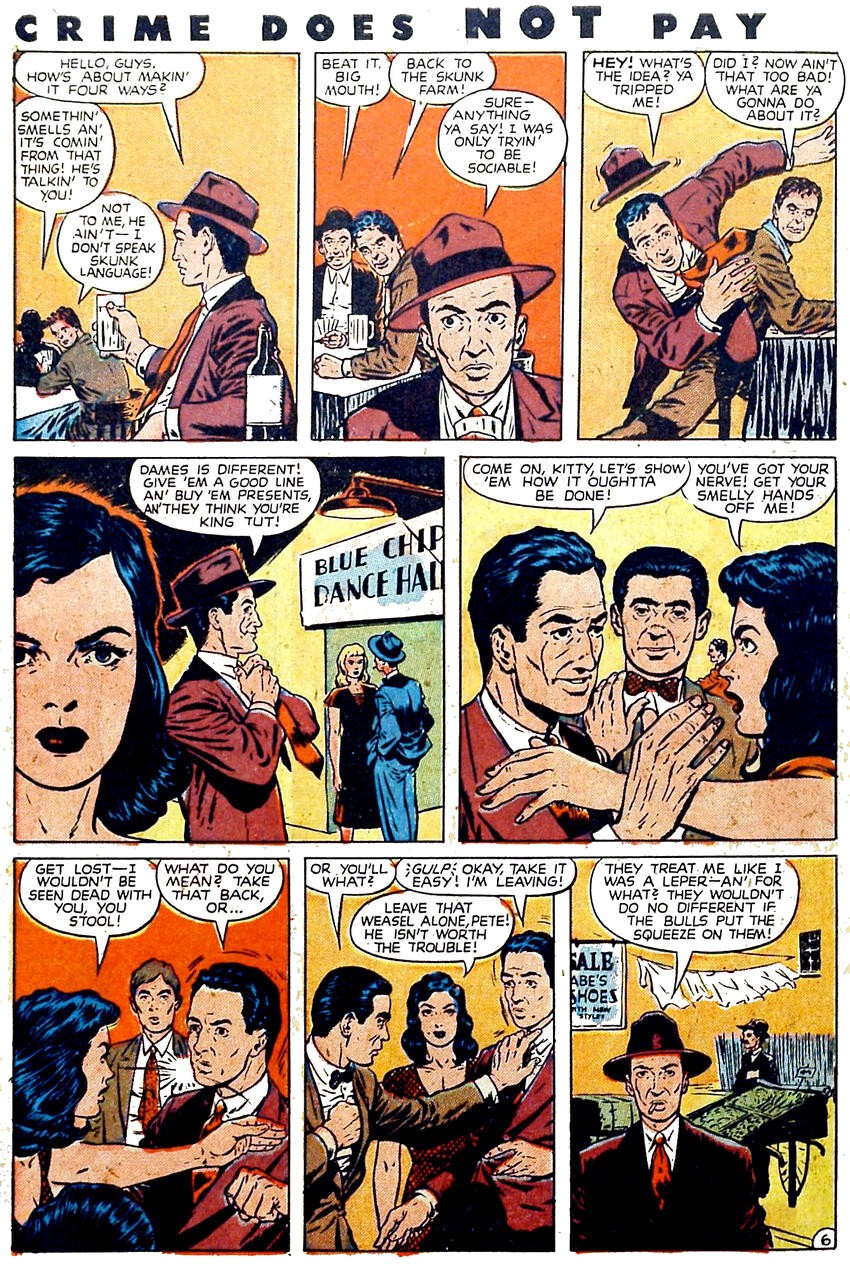
Tuska did the artwork on this lead story from Crime Does Not Pay #56 (1947). Cover by Biro.

Tuska, in my opinion, was at the absolute top of his illustrative skills when he did stories for Charlie Biro at Crime Does Not Pay. Biro was a demanding editor who made the artists draw everything, and that was even though the stories were burdened with text, captions and overloaded speech balloons. Still, Tuska managed to get all of the characters and violence into the panels. And speaking of violence, the sensitive among you need to be warned of some of the panels: a knife slices a cheek, a woman is shot.

Violence like that was part of what inflamed adults about crime comics being sold to children. Something a bit more subtle in this story is the message about being a squealer. Guys who tell on criminals meet a bad end. Remember that, kids.


 More classic Tuska: Butt Riley! Click on the picture.


**********
Your eyes will pop!

Another thing to cause concern amongst crime comic critics of the era is this ad from the same issue of Crime Does Not Pay: additional reading material from a third-party publisher. Five books, four of them concerned with crime. I don’t know for sure about the kids in 1947, but I sure would like to read them, and get the “hidden secrets, helpful information, inside ‘dope’.” That could be interpreted as ways to commit crimes. But there is one book, How Detectives Catch Crooks, that would be especially helpful. We still have that today: television programs about crime-busting through forensics, showing police methods, have helped some criminals.

It’s human nature to want to know about “Big-shot Gangsters, their crimes, careers and deaths!” and I’m no different. But I don’t plan to emulate them. I don’t commit crimes because I’m not a criminal, no matter how many books I read or TV shows I watch about crime. I suspect that’s true about most people, or despite all the crime-saturated entertainment the crime rate would be a lot higher than it is.


For someone who's unfamiliar with the expanded Star Wars universe, Dark Horse's Star Wars: Lost Tribe of the Sith -- Spiral comes as something of a shock. This is a story quite removed from the Star Wars movies -- taking place more than 2,000 years(!) before Episode I. As such, some of who fought whom and which group betrayed the other will be hard for a new reader to grasp at first -- there is an impressive amount of mythology here. At the same time, by the end of the first chapter, once a Wookie appears and the lightsabers come out, Spiral begins to feel enough like "traditional" Star Wars that any early misgivings ought dissipate.

Author John Jackson Miller offers a quite interesting look mainly at the Sith on their own, without any Jedi about. More than some of the villain-centered episodes of Star Wars: The Clone Wars, where the Sith plotted against one another or planned their next attack on the Jedi, here Miller imagines a real society -- if the Sith were marooned on a planet, how would they actually live day to day? Miller mixes all the treachery one would expect from the Sith with an intriguing dose of the mundane -- for instance, how Sith elect an official, or how they manage succession from one leader to the next.

In this way, Spiral suggests the sheer depth of the expanded Star Wars mythos -- someone's even thought through ancient Sith governmental proceedings -- even as it also offers a rousing adventure story. The setting allows Miller to imbue the story with a greater fantasy element than a Star Wars story might normally have, and this serves Spiral well almost (though not quite) to its end.

[Review contains spoilers]

Miller's main characters here are Takara Hilts, daughter of the Grand Lord of the Sith, and Parlan Spinner, a rebellious Sith slave. The cover of the book depicts Hilts with her lightsaber, and indeed Hilts is the character who's easier to follow -- she resembles a Force-user in the traditional sense, and also offers the "young person longing for new horizons" aesthetic a la Luke Skywalker.

Spinner is tougher for the reader to get ahold of, in that he starts the story captured by Hilts and seemingly functioning as Hilts's sidekick (a Han Solo to her Luke Skywalker, to an extent), but by the end he essentially takes over the story and seems to gain the greater reward. I don't fault Miller for defying my preconceived notions; rather it demonstrates good growth of the characters over the book's five chapters that they act in unexpected ways.

Spiral's best chapters are its first two, which have Hilts and Spinner getting out of some scrapes, offers details about how the "Lost Sith" -- marooned for centuries on an alien planet -- have built a society around and on top of the alien natives, and then provides an equally detailed look at a a group of Jedi and Sith marooned even earlier than Hilts's people, and how those Jedi have built themselves a utopian society. Hilts and Spinner seem to "go rogue" at every opportunity, and it's entertaining to see how they try to one-up each other or take advantage of their various captors (often with lightsabers flashing).

The end of the book offers both a starship battle (with a ship that looks awfully, and perhaps not coincidentally, like the Millenium Falcon) and a group of rampaging Leviathan monsters (like prehistoric rancors). With the latter, plus a group of Jedi dragon-riders, Miller delves into greater "swords and sorcery" territory than I was used to seeing in a Star Wars story (even despite the mystic power of the Force). Long-term this probably isn't how I'd like my Star Wars, but Miller makes it work and it helps especially that there's still that starships buzzing around the skies.

The one hitch in the book is the depiction of resurrected Sith lord Remulus Dreypa. Dreypa has a flamboyancy to him, more Ming the Merciless than Darth Vader, which generally works with the less serious, more swashbuckling tone of this story (we're more in Return of the Jedi mode here than Empire Strikes Back). But Dreypa looks neither scary nor imposing, but downright ridiculous, in a cape with his underwear on the outside like a superhero villain, when others wear armor and the like. It's a lone discordant note, but when the story turns on the threat of Dreypa's return, I'd have preferred to see him be more threatening.

It's fun to have artist Andrea Mutti here, having just seen his work in less fantastical form in Denise Mina's Girl with the Dragon Tattoo books. Mutti excels especially at the one-on-one conversations, such that Hilts and Spinner's banter comes through well, as do the more factual studies of Sith government; the only sore spot remains whomever designed poor Remulus Dreypa's costume.

Star Wars: Lost Tribe of the Sith -- Spiral is not the most straightforward entry into the expanded Star Wars universe for a new reader -- but at the same time, it contains enough detail and depth that a new reader certainly gains an appreciation for how truly expansive the extended Star Wars universe is. Hilts and Spinner are fun characters more or less in the classic Star Wars mold, and a new reader holding fast to them should be able to navigate this book relatively unscathed.
[Review by Doug Glassman, who Tumblrs at Hell Yeah '80s Marvel!]

Multiple Spider-Man titles are by no means a new thing, but in the aftermath of the “One More Day” reboot, the various books were all converted into extra issues of Amazing Spider-Man. However, the allure of multiple ongoing books was too strong, resulting in the launch of Avenging Spider-Man last year.

Despite the name, Avenging is not a Spidey book in the vein of Sensational or Friendly Neighborhood. It’s actually the newest version of Marvel Team-Up, which has traditionally featured Spidey teaming up with a various Marvel hero. The title makes sense when you consider that Avengers and Amazing Spider-Man are two of Marvel’s most recognizable titles, so combining them is a good marketing strategy.

That’s not to say that the book always teams up Spidey with an Avenger; the last story in the collection Avenging Spider-Man: The Good, The Green and The Ugly features Deadpool. But Spidey is the equivalent of Nightwing in that he knows and is (mostly) friendly with the majority of Marvel’s heroes. The first story sees him teamed up with another Marvel social butterfly, She-Hulk. They memorably shared the spotlight in an issue of She-Hulk’s much-missed title in which she helped Spidey sue J. Jonah Jameson for defamation. It’s always fun to see them together, partly because they have similar experiences as both Avengers and replacement members of the Fantastic Four. They’re also two of the Marvel Universe’s premiere quippers.

Kathryn Immonen injects Spidey and Shulkie into a standard museum exhibit opening with the added twist of Egyptian cultists. In the process, gods are summoned, Shulkie gets a tail, and Spider-Man gets to make allusions to Sebek, my favorite Egyptian god and the subject of a comic book pitch I’ve been working on. Illustrating this fun single-issue story is Stuart Immonen; it’s been a while since the Immonens have gotten to work together, and Stuart’s slightly cartoony and very kinetic art definitely helps the story.

The trade skips the next issue (which was part of the “Ends of the Earth” storyline of Amazing Spider-Man) and instead goes to a two-parter featuring Captain Marvel. As the included issue introductions allude to, this was a not-so-subtle ad for the new Captain Marvel series; it’s even written by Kelly Sue DeConnick. Spidey and Carol Danvers developed a strong chemistry during Brian Michael Bendis’ various Avengers runs. While I’m not entirely sold on the idea of a romantic relationship between them, it would potentially be the most stable pairing for both of them. It’s one of the promising storylines derailed by the new Superior Spider-Man concept.

DeConnick’s story is a bit muddled, involving the Occupy movement, privately-funded counter-protesters and a mysterious super-powered vigilante. The newness of the Captain Marvel identity plays a part, as few people seem to know that Ms. Marvel has changed her name. There’s a lengthy mid-air sequence since the Captain Marvel title uses flight as a key theme. Terry Dodson keeps the story moving briskly; he’s a personal favorite, and since his wife Rachel inks his work as always, that makes two married couples on this book’s creative team. (It would have been great to have Walt and Louise Simonson do a story for the trifecta.)

The aforementioned Deadpool two-parter both reads and looks different from the rest of The Good, The Green and The Ugly. As always, I dislike changing artists in the middle of a trade, but since Avenging is an anthology/team-up series, I don’t mind giving them leeway. I also think that this was a story not originally intended for this title. Instead, it feels like it was supposed to be in the defunct Deadpool Team-Up book, and this was as good a place as any to put it. Aaron Kuder’s artwork is darker and more heavily inked, closer to Scott Kolins than either Immonen or Dodson. There’s quite a bit of stylizing going on with the characters, which fits both the characters and the story being told.

Most of the first part of that story takes place in Peter Parker’s mind (clearly the man needs some anti-mind-control lessons from the X-Men), which Deadpool has entered with the help of a mysterious benefactor. Inception is name-checked, along with a half-dozen other films thanks to Deadpool’s madcap dialogue. Kuder does some great work in creating Peter’s inner demons from high school, such as a disembodied shop class teacher and ridiculous renderings of Spidey’s classic supporting cast as the members of The Breakfast Club. When this story took place, Deadpool had a second internal voice in white caption boxes as well as a desire to end his life, two elements which have been eliminated (in my opinion, for the better) in the new book.

Issue #13 transitions the story into the real world and the revelation of the true villain: the Hypno-Hustler, an infamously lame villain who hasn’t been seen for a while. As it turns out, the “inner demons” Peter beat up were actually the Hustler’s prison guards. Hustler uses the same illusion powers to turn the low-rent supervillains in the prison into better ones, including turning the equally lame and weird Painter of 1,000 Perils into J. Michael Straczynski’s Morlun. The ending involves a few jokes about the supposed influence of Spider-Man on Deadpool’s outfit and some comeuppance for the Merc With a Mouth.

Avenging Spider-Man: The Good, The Green and The Ugly is by no means an essential read. If you’re a fan of She-Hulk, Captain Marvel, Deadpool or a lighter take on Spider-Man -- and I happen to be all four -- then it’s worth a look. It’s the comic book equivalent of a beach read: fun and brief, with three great creative teams to boot.

Just about a week ago I showed a 1946 atomic destruction story by Joe Simon. You can see it in Pappy's #1382.

Now, for today’s radioactive post:

Looking at this 1952 story of futuristic (1972) soldiers fighting an atomic war, lobbing H-bombs around, reminds me yet again of growing up in this era, when I was certain we were going to have the Big One dropped on us.

In this action-packed atomic tale, drawn by an unidentified artist for Atomic Attack! #5 (actually #1, continued from Attack! numbers 1-4), young Tommy reads a letter from his older brother, Pete, fighting for the good ol’ U.S.A. against the dirty Reds. Pete describes his squad in battle. I’m glad I didn’t see this story when it came out because I’m sure it would have just ratcheted up my paranoia.


[Guest reviewer Zach King blogs about movies as The Cinema King]

I'm halfway through the six Criminal collections, and the series has been so delightful that I'm considering purchasing the deluxe edition hardcovers even though I've been borrowing the shorter trades from my local public library. At $50 each, though, they're quite expensive, so a part of me has been continuing to read the series to see if the quality drops enough to warrant not buying the deluxe editions.

With the fourth collection, Criminal: Bad Night, I haven't found that qualitative drop-off the cynic in me has come to expect. Instead, Ed Brubaker and Sean Phillips ... well, what can I say about how good this series is that I haven't already said about the first three volumes?

In Bad Night, we get the scoop on Jacob Kurtz, the cartoonist behind the inscrutable Frank Kafka, PI, strips. Presumed guilty after his wife disappeared, Jacob has become an insomniac and a slave to his work; though his innocence was proven when his wife's car crash was ruled an accident, Jacob is dogged by a cop who hates him, to say nothing of the ghostly presence of Frank Kafka himself. As a former counterfeiter, Jacob is kidnapped by one-night-stand Iris and her thug boyfriend Danny, finding himself at the epicenter of a mounting stack of bodies as his tenuous grasp on sanity begins to slip.

Maybe I'm the only one who missed it, but the fact that Tracy Lawless's counterfeiter buddy from Lawless is also the artist behind Frank Kafka came as a great surprise to me, one of those great epiphany moments that I have come to cherish with Criminal. Brubaker continues to fill in gaps by proving just how interconnected all the parts are, and his notes on Center City must look something like Batman's map of Leviathan (from Batman Incorporated [vol. 2] #3). It's like Sin City done realistically; each successive volume expands the web, making Criminal ideal fodder for a TV show now that neo-noir seems to be making a comeback.

Brubaker's use of Frank Kafka is of particular interest because the comic-within-a-comic doesn't fit into the larger story the way you'd expect. Since Watchmen and Tales of the Black Freighter, we've been trained to expect some sort of meta-commentary within the story. In Bad Night, however, it's a breath of fresh air when Jacob admits that the "total artistic freedom" that comes from his contract with Sebastian Hyde (yep, the same Sebastian Hyde we've seen throughout Criminal) has led to a strip that doesn't make much sense. Instead of going the easy route, Brubaker makes Frank a second psyche for Jacob, spending time with him like an invisible friend.

Likewise, instead of rendering Frank realistically to give the book an ambiguous is-he-or-isn't-he angle, Phillips's artwork makes Frank as cartoonish as possible, his permanent scowl and oversized fedora like something straight out of Dick Tracy. Phillips adjusts his style to make Frank an exaggerated caricature in grayscale, cluing us in that Jacob's sanity should always be in question. For Brubaker and Phillips, Frank is the Tyler Durden of Bad Night, and letting us know in advance that he's not real allows the reader to enjoy the book more effectively. It also builds to a fantastic payoff when Frank appears to shoot someone, where any narrative slight-of-hand is betrayed by the artwork, which clues in the reader if they're not taken in by the surreal narrative.

That's not to say that Phillips is slouching on the realism of the comic. Rather, he continues to do great work with facial expressions and body language, particularly in the case of sad sack insomniac Jacob. Phillips also does a great job with Iris, ostensibly the first true femme fatale of the series (after The Dead and the Dying did a phenomenal job humanizing Danica Briggs). Now, I'm not the world's biggest fan of cheesecake art -- Guillem March is about all I can take in my book -- but take a look at that cover. Phillips paints a gorgeous nude Iris, cloaked only in a pink sheet that accents her red hair. This image is a perfect one, since it tells us what kind of a character Iris will be -- especially when we see the gun in her hand.

As with all the other trades in this series thus far, this fourth volume was a one-sitting read -- not that the book was incredibly short or breezy, but because I quite literally could not bring myself to set it aside. And an evening spent reading Criminal Vol. 4: Bad Night is anything but.
Even if we accept for fictional purposes that a full-grown man can shrink himself into doll size and change instantly into a superhero, the idea that such a superhero would be held in a prison cell meant for normal beings causes incredulity. There’s more than the usual suspension of disbelief in this tale from Doll Man Quarterly #4 (1942). Superheroes exist in a universe where they are extraordinary beings, but beyond the reader accepting their powers we aren’t usually supposed to believe that anyone would be as extraordinarily dumb as the jail warder in this story.

The Grand Comics Database lists Max Elkan ? (question mark means they aren’t sure) as the artist.