The Wikipedia entry for Gotham Central notes that Greg Rucka at one point considered a post-Central series called Streets of Gotham. What eventually became the stories collected in Paul Dini's Batman: Streets of Gotham: Hush Money is not that original series, but Wikipedia does describe it as a cross between Gotham Central and the series Batman: Gotham Knights.

I enjoyed Hush Money, though I didn't find it overly moving. In part, it's somewhat difficult to know what this book is supposed to be about. Hush Money collects a Batman and Detective Comics issue post-Batman RIP, and then the first four issues of the series, which focus on Batman Dick Grayson and Robin Damian Wayne fighting Firefly, one issue on Hush disguised as Bruce Wayne, and one issue on Paul Dini's new creation, villain-real-estate maven the Broker. Is this another Batman and Robin series? A book starring Hush? A villain profile series, and if so, how to differentiate this from Dini's other villain profile series, Gotham City Sirens, except that one's about the girl-villains and this one's about the boy-villains? It's hard to know.

I hate to nit-pick on Hush Money, which will fill in a bunch of important background gaps for readers of Red Robin, especially, but this is a book that requires some patience. Dini introduces a heroic behemoth named Abuse who apparently knows the Batman Bruce Wayne, but gives the reader few clues besides Abuse's brief appearance; Dini has Black Mask beg Firefly for his life in a way that seems entirely off character from the Black Mask that Tony Daniel writes in Batman: Life After Death. For a book called Hush Money, this volume is a poor sequel to Batman: Heart of Hush, with few of the literary allusions or real character nuance that came from that earlier Bruce Wayne/Tommy Elliot battle.

I would venture at least part of the problem (though a good problem to have) is that DC includes the two-part "Faces of Evil" story post-Batman RIP at the beginning of this book, allowing only four issues of Streets of Gotham. While I'm glad to see the "Faces of Evil" story collected, and the Hush/Catwoman tale certainly leads in to Hush Money, it allows for only four issues of Streets of Gotham, and the book seems to end before it starts. Glancing ahead, I see the next two issues were a fill in by Red Robin's Christopher Yost, but maybe this book would have benefited from skipping around a bit and including a couple more Paul Dini/Hush issues to come.

The Batman universe is kind of a fractured place right now. Grant Morrison runs the main story, of course, but then there was also Judd Winick's Batman: Long Shadows, which stood all on its own, and Tony Daniel's Life After Death that tied in to Battle for the Cowl but not Morrison's work. Add to this that Paul Dini has set up his own small corner of the Bat-verse here, trading characters and plots between Streets of Gotham and Gotham City Sirens; as I mentioned before, aspects of this story also feed right in to the end of Red Robin: Collision. I like Hush Money for that reason; coming to it as I have a little late, this story is a linchpin that makes events in a number of other places in the "Batman Reborn" story make sense, but I was neither compelled by the slight police drama nor by the villain profiles to recommend this book in any kind of greater way.

One item of note that I would mention is the relationship Paul Dini creates here between Hush and Damian Wayne. Dini has Damian playing chess with an imprisoned Hush between the glass of Hush's Wayne Tower cell, as meek and alluring as a kind of Hannibal Lechter -- and with a good bit of insight, Dini notes that Damian is drawn to Hush because Hush wears the face of the father Damian hardly knew. I wish Dini had been able to play up this relationship more -- Hush escapes soon after -- and hopefully it'll come into play with Hush's later appearances. I also liked how Hush is able to escape by playing on his childhood relationship with Alfred; indeed, Dini has done a nice job making Hush a different kind of Batman villain, one with an ability to manipulate the Bat-family far differently that any of Gotham's regular rogues.

[Contains full covers and a pin-up. Printed on glossy paper]

It's little moments like these that make me likely to pick up the next volume of Paul Dini's Hush stories. I don't doubt Dini's abilities as a writer -- which he's demonstrated time and again in his Bat-stories -- and when he gets going in a Hush story, the work is likely bar none. So far, however, both Streets of Gotham: Hush Money and Dini's first outing on Gotham City Sirens both feel slight, like little stories around the periphery of the Batman universe instead of where the action is. Artist Dustin Nguyen draws attractive, angular work here, but doesn't quite achieve the close-up, gritty work of Michael Lark on Gotham Central for instance; I never quite found myself emotionally invested in the book.

[Talk, talk! You've read the review, now join the after-party! Get the latest Collected Editions conversations by following the Collected Editions comment feed in your Google Reader or other RSS applications.]
Can you say "omnibus?"

DC Comics sure can. Looking toward their 2011 winter trade paperbacks and collections already, the name of DC's game seems to be omnibuses.

* The Hawkman Omnibus Vol. 1

* DC/Marvel Crossover Omnibus Vol. 1

* League of Extraordinary Gentlemen Omnibus

* Kamandi Omnibus Vol. 1 The Last Boy on Earth

This is in addition to the recently announced Teen Titans by Geoff Johns Omnibus series, the New Teen Titans Omnibus series, and the earlier Flash by Geoff Johns Omnibus series.

What is an omnibus? In DC parlance, it seems to be a hardcover volume (initially) that collects the amount of material you'd usually find in at least two trades. The first Flash omnibus contains the Wonderland and Blood Will Run trades; the first New Teen Titans omnibus contains issues #1-16 from the first two New Teen Titans Archives.

Where did this Omnibus format come from? By my estimation, it started with the Starman Omnibus editions and with the Jack Kirby Fourth World Omnibus editions. There have been other books of similar ilk not specifically called omnibuses, like the JLA Deluxe books and the Gotham Central and Seven Soldiers hardcovers that collected two or more of the previous trade paperbacks. These were it in terms of omnibuses for a little while; in a short amount of time, however, we've seen an increasing number of omnibuses, including the classic Green Lantern omnibuses, and now these.

Why Omnibuses? They are not cheap, to be sure; the Hawkman volume is $50 before discounts, but the New Titans and Flash books are both $75. They do however in large part collect out-of-print material, consolidating DC's expansive collections line into fewer volumes.

Also -- furthering my theory that trade paperbacks are the new single issues -- I believe there's a growing sense when we see two volumes of Superman: The Black Ring or Superman: Grounded that a trade paperback is no longer the "whole story" like it once was, and the omnibuses offer additional completion for someone willing to forgo the immediate trades for the later omnibuses (or, I imagine DC hopes, someone willing to buy both).

New in the DC Universe
* Batman Incorporated Vol. 1 Deluxe

The next biggest news here, though not perhaps much of a surprise, is that Batman Inc. will be collected first in the deluxe oversized format. As Grant Morrison's recent other Batman books -- Batman RIP and the Batman and Robin volumes -- were also deluxe, this only stands to reason, though I wish all the books might've had a common trade dress.

* Superman: Reign of Doomsday

It's also not a great surprise that the ongoing Reign of the Doomsday crossover is getting a collection, but it will be interesting to see how this fits in trade-continuity-wise, given that it includes issues from Superboy, Supergirl, Outsiders, and Justice League.

* Flash Vol. 2: The Road to Flashpoint

Flashpoint, did you say? The crossover that will inevitably overwhelm DC's trade program not too long from now gets the titular role in the next (and last, if DC's hype machine is to be believed) Flash collection.

* Green Lantern: War of the Green Lanterns

Also, just in time for movie-time, a book with the word "Green Lantern" in the title not once, but twice.

* Doom Patrol: Fire Away

If you turn your head and squint just a little bit, it's possible this could collect issues #14-22 of Keith Giffen's Doom Patrol, bringing the entirety of this cancelled series to trade. Dare we hope?

* New Teen Titans: Games

The long-awaited and much delayed New Teen Titans graphic novel -- which I believe Marv Wolfman recently said would be back on the schedule soon -- is now re-solicited for September 2011.

* Booster Gold: The Life and Times of Michael Jon Carter

I believe this is just the next Keith Giffen Booster Gold volume, tying in to Justice League: Generation Lost, and not yet the Booster Gold/Flashpoint tie in -- but I mention it just because I like the title a lot.

Collected Reprints (sans Omnibus)
* Flex Mentallo: Man of Muscle Mystery Deluxe

Sure to be a hit, the legally-tenuous, long-rumored Flex Mentallo collection from Grant Morrison finally gets a solicitation.

* Batman: A Death in the Family

An interesting item here at 272 pages; I wonder if this is a paperback of the recent DC Comics Library hardcover, which collected both Robin Jason Todd's demise in A Death in the Family and Tim Drake's arrival in A Lonely Place of Dying. That "DC Comics Library" imprint seems to have died a quick death, however, and I think we'll know for sure if the paperback doesn't carry that label.

* Batman No Man's Land Vol. 1

The six-book No Man's Land is a favorite among Batman fans, and some of the volumes out of print. At $30 and 544 pages, my guess is that this paperback contains one or two of the No Man's Land books -- what'd be even better is if this series collects some of the No Man's Land stories that never saw collections (like stories that introduced the DC Universe Harley Quinn). I'd have preferred this in hardcover (Omnibus much?) but something is better than nothing.

* Suicide Squad Vol. 2 The Nightshade Odyssey

Pleased to see another volume reprinting the 1980s Suicide Squad series, bringing us one step closer to a trade of the first appearance of Barbara Gordon as Oracle.

* Legends of the Dark Knight: Marshall Rogers

Another artist-focused Batman collection, like similar books featuring the artwork of Gene Colan and Tim Sale. Curious that this one is called Legends of the Dark Knight and not Tales of the Batman like those are.

* The Legion of Super-Heroes: The Curse - Deluxe Edition

The new deluxe Great Darkness Saga was such a good-looking volume when it appeared on store shelves and then sold out during the holidays, that I finally picked one up for myself just a few weeks ago. I was quite excited to see DC solicit a sequel some time ago, and I re-mention it here only to note that this is indeed a collection of the early Paul Levitz stories that came after Great Darkness (as confirmed by recent DC solicitations) and not a part of the new series (though there's that, too -- see below). I hope DC continues to produce these -- deluxe oversized "omnibus-length" editions of DC's relevant classic material is OK with me!

* Night Force

Speaking of Marv Wolfman and Gene Colan, here's a collection of their 1982 supernatural series. DC just published a DC Comics Presents edition of issues #1-4; I'd hope at $40, this hardcover collects the entire series.

The Best of the Rest (also not Omnibus)
* Batman: Noel

Here's Lee Bermejo's new original graphic novel, becoming a DC Comics holiday tradition after Joker and Luthor. The next Superman Earth One isn't solicited yet, nor J. Michael Straczynski's Samaritan X, but DC publisher Dan DiDio has suggested the end of the year is when we'll see a spate of DC graphic novels.

* Batman: The Black Mirror

Collecting the Scott Snyder/Jock storyline that's getting considerable acclaim right now. Here's hoping this is just one volume, not two (per Superman's Black Ring and Grounded).

* Brightest Day Vol. 3

* Brightest Day Vol. 1 (paperback)

Brightest Day concludes in 2011, and even starts again in paperback the same year -- you can all check my math, but I think this is a "getting better" release schedule on DC's part. It does seem like we won't see Flashpoint collections until 2012, however.

* Superman: The Black Ring Vol. 2

* Superman Grounded Vol. 2

At about twelve issues each, and especially with all of Grounded's bad publicity, I really would've liked to see DC publish both of these as respective individual volumes, instead of unnecessarily stretching them out into two short hardcovers. We know DC can do twelve-issue hardcovers, i.e. Brightest Day -- not doing so just seems like profiteering to me.

* Supergirl: Good Looking Corpse

Even if this is the title of the new Nick Spencer/James Peaty storyline, it has weird "dead women" connotations of the kind I thought DC was trying to make a concerted effort to avoid these days. Will anyone ever want to say "my favorite Supergirl trade is Good Looking Corpse"? I think this one needs a re-do.

* Batman: Arkham City

* Birds of Prey Vol. 2: Death of Oracle


* Green Lantern Corps: The Weaponer

* Justice League: Generation Lost Vol. 2

* Justice League of America: Omega

* Justice Society of America: Supertown

* Superboy Vol. 1: Smallville Attacks

* Teen Titans: Team Building

No surprises here necessarily, either, but the next releases of your favorite ongoing series. Both the Superboy and Justice League trades ought be roundabout the Reign of Doomsday crossover.

EDIT:

* All Star Superman

With the Absolute edition and such, this didn't especially jump out at me, but it would seem a bunch of readers have been waiting to read All Star Superman in single-volume paperback form (and indeed I approve DC bringing these issues together in one volume, not two). I'd have thought this would be better released when the movie came out, but maybe DC was trying to push the Absolute at that time.

* Batgirl: The Lesson

Also can't believe I left off the next Bryan Miller Batgirl collection. I really liked the first volume and I'm looking forward to the second, and I'm thrilled at all the acclaim Miller has received for the most unlikely of books, one starring the erstwhile Spoiler Stephanie Brown.

There is more to say, especially on certain Omnibus editions, and look for that coming in a few days. I'll pause here, though, and ask: Omnibuses, love 'em or hate em? What else is on your to-buy list?


Number 917


Technology wipes out crime!


This short strip from Gang Busters #51, 1956, "The Detective of Tomorrow!" is prescient about advances in fighting crime, or even speeding motorists. Using a humanoid robot as a Photocop is cute for 1956, but in the Twenty-First Century the real Photocop is a camera designed to nab you in the act of speeding or going illegally through a red light.

The story, drawn by Ralph Mayo, is extrapolating based on technology known 55 years go, and is way too optimistic that crime will be eradicated by technology. What we have found is that technology can breed its own kind of criminal. We've also found that much technology is going through a period where society has to decide if its intrusiveness goes over the line from a right to privacy to protecting the public welfare. Like, I hate Photocop. If I'm nailed for speeding, let it be the old fashioned way, by a human cop.


An issue later, in Gang Busters #52, a public service announcement itself extrapolates the future. In this case 1976. Allergy sees himself hawking tickets on rocket ship rides. Tourism in space is still quite a ways off, although people like Sir Richard Branson are working on it. There is something special going on in the panel with the girl: a young woman has made a medical breakthrough, rare to show in the days of stay-at-home moms and few working professional women. She's communicating through what looks like a flat panel computer monitor. Now that's prescient. But then we get to the panel with Tom, who might "invent something for those big electronic machines." Uh, yeah, Tom, they're computers. If you want to work on them you should learn what they're called. He's also being congratulated by a Richard Nixon lookalike.

As the conclusion to the sweeping, eighty-plus part, over two-years long Superman: New Krypton saga, War of the Supermen does a passable job -- not satisfactory, by any means, but better than other readers had lead me to expect. Over the course of at least four different series and a number of different writers, New Krypton transformed from the story as which it started out into a different one; writers Sterling Gates and James Robinson offer a good ending, but not the one I was looking for.

[Contains spoilers]

The New Krypton series as a whole had a number of good stories and well-established characters, and Gates and Robinson treat them all well here. They didn't forget Greg Rucka's Nightwing and Flamebird, thankfully, and the characters' exits, if brief, are at least built on threads of the New Krypton story, as when Flamebird defeats the Kryptonian god Rao one more time. Superman gets another moment with his adopted son Chris before the latter disappears into the Phantom Zone; Robinson's Mon-El, perhaps the best part of all of New Krypton, makes a cameo; and the writers tease future stories with those characters and with the new Guardian and Billi Harper. New Krypton was an ensemble story, and the real disappointment would have been if the ensemble hadn't been able to take their bows; in that, Gates and Robinson deliver hands down.

I also thought the writers presented the book's tragedy well. That New Krypton would be destroyed has been a given since the beginning, but I didn't expect the twist in that the bomb would be Reactron, and the trigger would be Supergirl's mother Alura's overzealous torture of her enemy. The destruction of the planet, as depicted by Jamal Igle (I think) is visually astounding (if lacking sufficient similarity to depictions of Krypton's original destruction). The pages of Superman and Supergirl's grief, especially the silent pages, were very affecting, their tears bubbling in the zero gravity. I hadn't expected Lex Luthor's role in the destruction of New Krypton, and that surprised me as did how this book leads in to Paul Cornell's forthcoming Lex Luthor story Superman: The Black Ring.

Unfortunately, I think War of the Supermen missed the mark in a number of different ways.

First of all, I think to posit as War of the Supermen does that the New Krypton story is about Superman trying to broker peace between Earth and the Kryptonians is to miss the point of Geoff Johns's fantastic set up for this story. New Krypton is about Clark Kent in mourning over the death of his human father, and how this makes him too-readily accept the New Kryptonians who are not the surrogate family he presumed they would be. New Krypton is full reflective instances of fathers and sons -- Lois and General Lane, Nightwing and how he sacrifices himself for Superman -- and at the end of the book we even learn Mon-El is going to be a father. The writers even go so far as to have Lois think to herself about something Pa Kent told her, but there's never that scene with Superman that ties the story back to where it started, with Pa Kent's death. I liked the modern age incarnation of Superman where he parents were alive, I think it worked well in a number of stories, and that Johns killed off Pa Kent as the launchpad for New Krypton, only to have that death mean nothing in the end, is a disappointment to me.

Second, I felt the central conflict of War of the Supermen -- Superman versus General Zod and a horde of Kryptonians attacking Earth -- much too closely mirrored that of Superman: Last Son, and it's hard to top a work by Geoff Johns and Adam Kubert. Robinson and Greg Rucka's work in the third volume of Superman: New Krypton went a long way toward establishing Zod not as a one-note villain, but as a war hero dedicated to helping his people at all costs; War of the Supermen would have us believe that all of Zod and Superman's growing relationship was a sham, and that Zod really is just revenge-obsessed and "evil." More's the shame. Not to mention that I must have missed in the eighty-plus issues where the Phantom Zone destroyed projector regenerated itself; Superboy's retrieving it was a terrible deus ex machina, and a rather dull conclusion to the story -- Zod always gets re-imprisoned in the Phantom Zone, and sure enough, here he was again.

Third, and maybe this dovetails with the lack of acknowledgment for Pa Kent in the book, I disagree with focusing War of the Supermen's epilogue on Lois and Clark's relationship. Yes, the two had to separate for Superman to live on New Krypton, but it was always with the understanding that Superman was keeping an eye on Zod, and any number of times we saw Clark come back to Earth to visit Lois. The writers even have Lois ask Clark never to leave her again, and then follow it, essentially, with "just kidding." As far as I'm concerned, Lois Lane -- the DC Universe's most capable civilian -- ought be the first person who understands the responsibilities of her spouse and the last person to ask him to shy away from what he has to do. The Death of Superman -- shortly after Lois and Clark's engagement, with Clark in mortal danger -- was a story about Lois and Clark's relationship, and that story's romance-laden end was especially fitting; here, ending New Krypton with "I can't stop kissing you" and "I love you Lois," rather than, say, "Let's get Swamp Thing to build a memorial to the innocent Kryptonians that Reactron killed." It seems again a conclusion to a different New Krypton saga than the one I started out reading.

What to say then about Superman: New Krypton? Like "Batman Reborn," it was an ambitious story with a telegraphed ending, and the suspense was in how the writers would get there -- "Batman Reborn" is about how the world reacts to Batman's death, knowing as we did that Batman would be back; similarly we knew the planet of New Krypton couldn't last, but the question was how it might be destroyed. The Batman story, interestingly, is a comedy (a story with a happy ending), and the Superman story the tragedy. New Krypton was most certainly written by talented writers who like the same Superman eras as I do -- it had Bibbo, Natasha Irons, the Guardian, Dubblex, and even Agent Liberty in it, for gosh sakes; it fell flat, in the end, but there were so many highs getting to this point that I certainly can't discount the story entirely.

I liked New Krypton's ambitiousness, I liked the ways in which it reminded me of the "Triangle Era" of Superman comics. Part of me wants to say, "Try again! For Rao's sake, try again!" Superman deserves storytelling of the kind this could have been -- maybe a second attempt could be the charm.

[Contains full and variant covers. Printed on glossy paper.]

Thanks for reading!

Number 916


Two characters on a rainy day, in one act


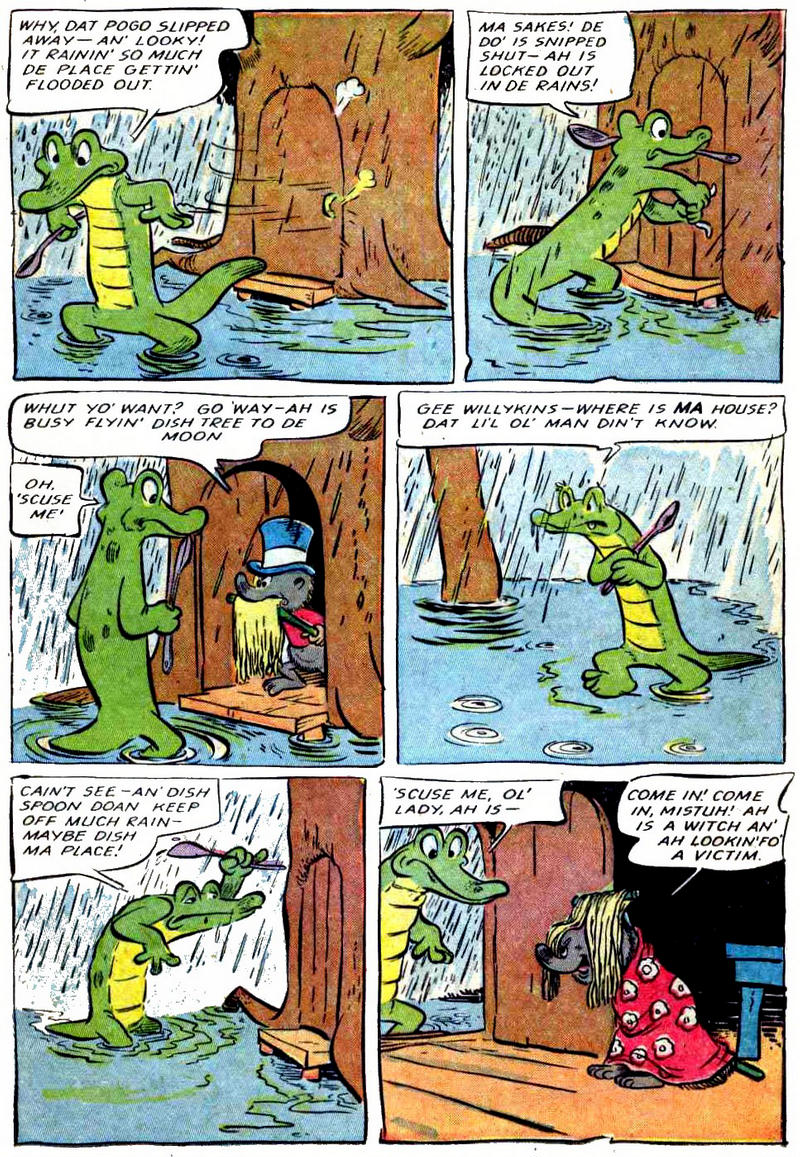
I try not to be overly hyperbolic in my praise, but dadgum it, damn the hyperbole, full speed ahead: this Walt Kelly story is perfect. He took two characters, put them inside on a rainy day making fudge (with coal, of all things), and made a story of it. That was Kelly, though. A true comic art genius. I can even imagine it being played on stage with actors.

But back to the play-on-paper, the Off Broadway comic book version: the story is early enough in the Pogo-Albert the Alligator partnership that Albert got top billing. The comic book Pogo of this era doesn't have the rounder, more commercially cute look of the bobbed-nose mature Pogo of the comic strip. In any case, Albert is always just Albert. While he got slicker as Kelly's artwork grew more refined, even in his early appearances he is instantly recognizable.

From Albert the Alligator and Pogo Possum, Dell Four Color Comics #148, 1947.


Number 915


Doom in the Airtomb!


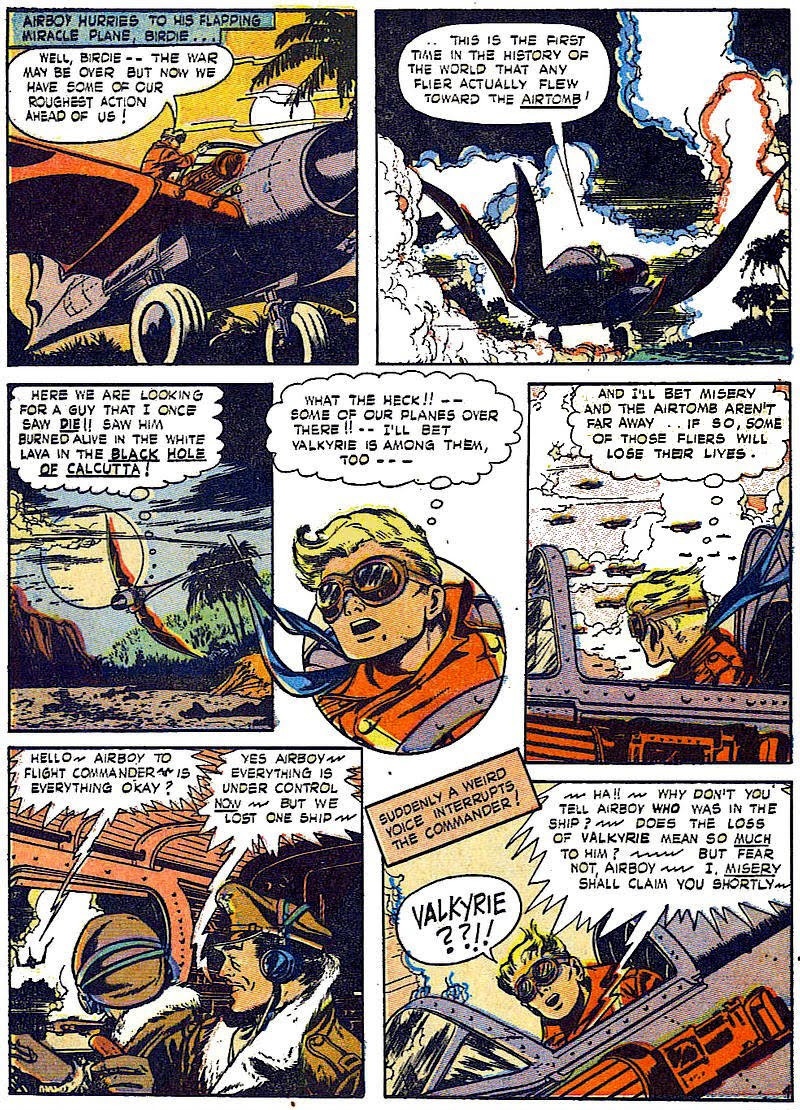
Airboy stories could go from adventure in exotic lands, a la Terry and the Pirates, to science fiction or supernatural. Misery is a supernatural character who showed up in his Airtomb to plague Airboy from time to time. Misery is still with us. I think I took a flight in the Airtomb once between Pittsburgh and Chicago.

This story, also featuring the sexy ex-Nazi flier, Valkyrie, is from the second issue of Airboy Comics, Volume 2 Number 3, after the title was changed from the World War II-era Air Fighters Comics. It's drawn well by Fred Kida, and the macabre panels of Misery and the Airtomb are out of a nightmare.


It was an interesting week in the world of digital comics.

For the first time, I believe, since DC Comics began selling their comics digitally through Comixology's digial comics website and application, there were no new releases on Wednesday.

On Thursday, DC launched a $0.99 sale on Comixology for over 200 "green"-themed comics, tied to St. Patrick's Day. It's possible that DC purposely held their Wednesday digital new releases until Thursday for the sale, but I think this is unlikely -- a basic rule of business is that if you can get customers hooked on expected a product at a certain time and on a certain day, i.e. new comics releases on Wednesday, that's not something you should monkey with, at least without giving the customers notice.

Despite that DC advertised a number of new releases to be included in that $0.99 St. Patrick's Day sale, those new releases -- which included Mike Grell's 1987 Green Arrow: The Longbow Hunters miniseries, Judd Winick's Green Arrow, some Brightest Day tie-in Green Lantern and Corps, and Dennis O'Neil's Green Lantern/Green Arrow -- remained unavailable until late Thursday night.

By way of explanation, Comixology mentioned a couple times on their Twitter feed Wednesday and Thursday that DC's comics were delayed by Apple approval, and that the specific comic caught in the approval process was the Green Arrow: The Longbow Hunters miniseries.

Let the unsubstantiated speculation begin.

Grell's Longbow Hunters, of course, launched a new Green Arrow title that would end up with one of DC's "Mature Readers" labels, prior to the creation of their Vertigo imprint and well before, just recently, DC's bucking of the Comics Code Authority entirely toward their own rating system. With that "Mature Readers" label, the Green Arrow title included perhaps more blood than you might've otherwise seen in a comic at the time (though not much greater than today's standards), and a greater amount of implied frontal nudity.

Longbow Hunters itself is rather bloody, with arrows through hands and chests, though again I think by today's standards Longbow matches Magog or Justice League: Cry for Justice in terms of gore (not in terms of story -- Longbow is a classic, and if you haven't read it, you should). In addition to some gore, Longbow also includes a depiction of Black Canary having been tortured, with some suggestion of sexual violence.

I wonder if some part of the above factored into the longer-than-normal Apple approval process.

We know Apple has had trouble in the past with overzealous censorship, including banning the Eucalyptus e-reader because it could access the Kama Sutra on Project Gutenberg. Was an almost two-day delay in the release of new digital comics the result of Apple's uncertainty about the content of a Green Arrow comic book? Do DC and Comixology now have to worry that if they want to make a "mature" comic available, they'll receive time-based penalization from Apple?

Given that the DC/Comixology digital store already contains a number of mature reader Vertigo titles, as well as DC Universe titles with strong content like Identity Crisis, I hope that if any of this is true, it's just a one-time blip. The concerns I express, however, go to recurrent issues facing the comic book industry and fans -- a general public misunderstanding that comics aren't just "kid stuff" and might contain strong content, and a new digital landscape for comics that involves bringing in third parties like Apple that may not understand comics culture, the important of Wednesday delivery, and so on.

I think that the reason more hasn't been made of all of this these past two days is because the only vendor DC's digital delay affected was Comixology, and because the digital comics in question are just reprints. Imagine, however, if this had applied to physical comics, and no comic book stores had received their DC titles until essentially Friday -- that'd be a big deal. I'll be curious to see if this happens again, and if more attention mounts as digital comics become more pervasive.

[You might also like Collected Editions' List of Digital Comics Unavailable in Trade Paperback]